
Air Canada Baggage Allowance: Carry-On and Checked Bag Rules
Air Canada baggage policy allows most passengers to bring one standard carry-on bag and one personal item, while checked baggage fees depend on the route, fare type, ticket purchase date, and travel benefits. Economy Basic passengers face additional carry-on restrictions on selected routes, and checked baggage charges can vary significantly between domestic and international journeys.
Packing for a flight involves more than choosing what to bring. Travelers also need to understand baggage dimensions, weight restrictions, airline fees, and the difference between cabin baggage and checked luggage.
Air Canada, Canada’s largest airline, operates domestic and international flights through major hubs such as Toronto, Vancouver, and Montréal. Its baggage rules apply across eligible Air Canada, Air Canada Rouge, and Air Canada Express services, although partner-operated flights may follow different conditions.
Recent policy changes have also made it important to check when a ticket was purchased. For example, some Economy Basic fares no longer include a standard carry-on bag, while updated checked baggage fees apply to eligible tickets purchased after specific dates.
This guide explains Air Canada’s carry-on allowance, checked baggage fees, overweight and oversized luggage rules, special items, and practical ways to avoid unnecessary baggage expenses.
What Are Air Canada Baggage Rules at a Glance?
Air Canada generally permits one personal item and one standard carry-on bag for eligible fares, with checked baggage allowances determined by the itinerary and ticket conditions.
The following table summarizes the main baggage rules.
| Baggage category | Air Canada allowance |
|---|---|
| Personal item | 1 permitted |
| Standard carry-on | 1 permitted on eligible fares |
| Carry-on dimensions | 55 × 40 × 23 cm (21.5 × 15.5 × 9 in) |
| Personal item dimensions | 43 × 33 × 16 cm (17 × 13 × 6 in) |
| Carry-on weight | No fixed weight limit; passenger must lift it unaided |
| Standard checked bag | 23 kg (50 lb) |
| Checked bag dimensions | 158 cm (62 linear inches) |
| Economy Basic carry-on | Restricted on selected routes |
| First checked bag fee | Depends on route and fare |
| Second checked bag fee | Depends on route and fare |
| Overweight or oversized luggage | Additional charges may apply |
| Extra baggage | Subject to fees and acceptance limits |
The baggage allowance displayed on the passenger’s booking confirmation takes priority over general examples.
What Is Air Canada’s Carry-On Baggage Allowance?
Air Canada’s standard carry-on policy permits one cabin bag and one personal item per passenger on eligible fares.
The standard carry-on bag must fit in the overhead compartment, while the personal item should fit underneath the seat in front.
What Are Air Canada’s Carry-On Baggage Size Limits?
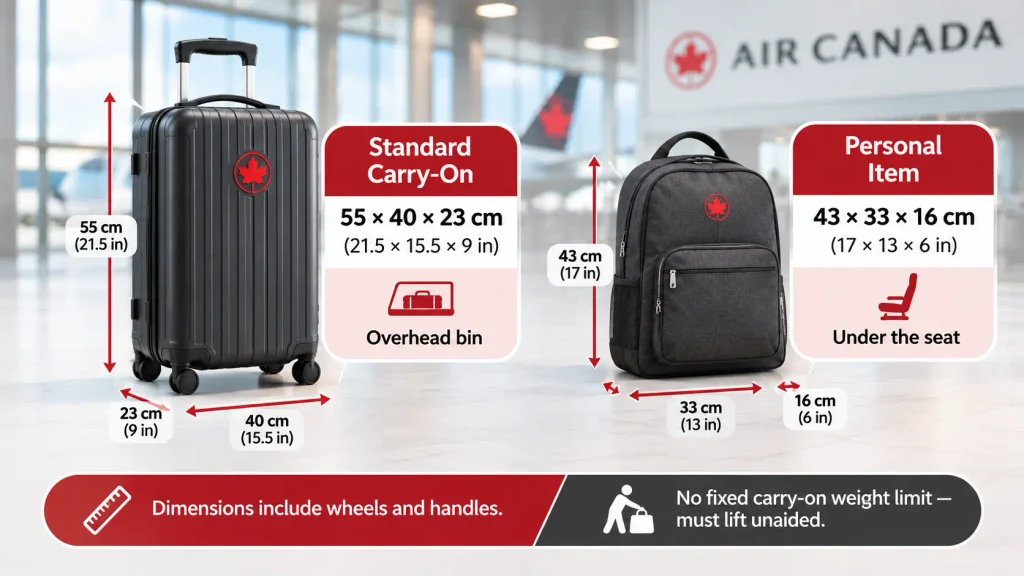
| Item | Maximum dimensions | Typical examples |
|---|---|---|
| Standard carry-on | 55 × 40 × 23 cm | Small suitcase, cabin trolley |
| Personal item | 43 × 33 × 16 cm | Laptop bag, small backpack |
| Additional small purse | 30 × 25 × 14 cm | Compact handbag |
Measurements include wheels and handles.
The additional small purse allowance is separate from the standard personal item allowance only when it satisfies Air Canada’s specific additional-item rules.
Is There a Weight Limit for Air Canada Carry-On Bags?
Air Canada does not publish a fixed weight limit for standard carry-on baggage.
However, passengers must be able to place their bags in the overhead compartment without assistance.
A bag that meets the size requirements but is too heavy for the passenger to lift safely may need to be checked.
Does Air Canada Check Carry-On Bag Dimensions?
Yes. Air Canada enforces carry-on dimensions and may use baggage sizing equipment before security or boarding.
Passengers whose bags exceed the permitted dimensions may need to check them.
Additional charges can apply depending on the fare and where the bag is checked.
Does Air Canada Economy Basic Include a Carry-On Bag?
Air Canada Economy Basic does not include a standard carry-on bag on selected routes for tickets purchased on or after January 3, 2025.
Affected passengers can bring one personal item but must check additional bags.
Which Economy Basic Routes Have Carry-On Restrictions?
The restriction applies to qualifying Economy Basic itineraries involving:
- Flights within Canada.
- Flights between Canada and the United States, including Hawaii and Puerto Rico.
- Flights to or from Mexico.
- Flights to or from Central America.
- Flights to or from the Caribbean.
What Happens When an Economy Basic Passenger Has a Connecting International Flight?
Passengers connecting onward to an eligible international destination can bring one standard carry-on bag and one personal item under Air Canada’s stated exception.
Travelers should check their complete itinerary because the rules depend on the destination and ticket conditions.
How Much Does Air Canada Charge for an Economy Basic Carry-On Bag?
A standard carry-on bag that is not included in the Economy Basic allowance must generally be checked and charged according to the applicable baggage rules.
Air Canada also applies higher handling charges when an ineligible bag reaches the gate.
For affected Economy Basic itineraries, the airline lists gate-handling charges of approximately CA/US$65–$78 including applicable taxes.
Travelers can usually reduce avoidable charges by checking ineligible bags before reaching security or the boarding gate.
Check Out Our Blog: Air Canada Review: Cabins, Baggage, Seats, Amenities & Services
How Much Are Air Canada’s Checked Baggage Fees?
Air Canada’s checked baggage fees depend on the fare type, destination, and ticket purchase date.
For eligible tickets purchased on or after April 13, 2026, the airline introduced updated fees for travel within Canada and between Canada or the United States and Mexico, Central America, or the Caribbean.
What Are Air Canada’s Checked Baggage Fees for Domestic and Regional Flights?
| Economy fare | First checked bag | Second checked bag |
|---|---|---|
| Economy Basic | CA/US$45 | CA/US$60 |
| Economy Standard | CA/US$45 | CA/US$60 |
| Economy Flex | Free | CA/US$60 |
These amounts apply to eligible tickets purchased on or after April 13, 2026, on the specified routes. Taxes may apply.
The same general fee structure covers eligible flights within Canada and qualifying services to or from the United States, Mexico, Central America, and the Caribbean.
What Are Air Canada’s Checked Baggage Fees for Long-Haul International Flights?
For eligible tickets purchased on or after May 14, 2026, Air Canada applies the following checked baggage fees to specified routes between Canada or the United States and Africa, Asia, the South Pacific, Europe, the Middle East, or South America.
| Economy fare | First checked bag | Second checked bag |
|---|---|---|
| Economy Basic | CA/US$90 | CA/US$120 |
| Economy Standard | Free | CA/US$120 |
| Economy Flex | Free | CA/US$120 |
Taxes may apply, and these examples do not replace the baggage allowance shown on an individual ticket.
Are Air Canada Baggage Fees Charged Per Flight or Per Direction?
Air Canada generally assesses checked baggage charges per direction of travel rather than separately for every connecting flight.
However, stopovers, partner airlines, and other itinerary conditions can affect how baggage charges are assessed.
Passengers should review the complete itinerary before assuming a single fee covers every flight segment.
What Are Air Canada’s Checked Baggage Weight and Size Limits?
Air Canada’s standard checked baggage allowance is generally 23 kg (50 lb) per bag, with maximum combined dimensions of 158 cm (62 inches).
The combined dimensions include the bag’s length, width, and height, including handles and wheels.
What Happens When Checked Baggage Exceeds the Weight Limit?
Passengers whose checked bags exceed the permitted weight may need to pay an overweight baggage fee.
| Baggage category | Weight | General treatment |
|---|---|---|
| Standard economy checked bag | Up to 23 kg (50 lb) | Standard allowance or applicable fee |
| Overweight checked bag | Over 23 kg to 32 kg (70 lb) | Additional fee may apply |
| Above standard acceptance limit | Over 32 kg (70 lb) | Must be handled through an appropriate cargo service |
Some premium cabin fares and elite status benefits provide a higher weight allowance.
Passengers should check their booking confirmation before paying an overweight charge.
What Is Air Canada’s Oversized Baggage Policy?
A standard checked bag must not exceed 158 cm (62 linear inches).
Bags exceeding this limit may incur oversized baggage fees.
Air Canada directs passengers to cargo arrangements when baggage exceeds certain maximum acceptance limits, including 292 cm (115 linear inches) in combined dimensions.
How Much Does Air Canada Charge for Overweight or Oversized Bags?
Air Canada’s overweight and oversized baggage fees vary by itinerary and the applicable baggage conditions.
There is no single fee that applies universally to every route.
Can a Bag Be Both Overweight and Oversized?
Yes. A bag can exceed both the permitted weight and dimensional limits.
Under Air Canada’s stated baggage rules, when a bag is both overweight and oversized, only one applicable overweight/oversized charge is assessed rather than charging both separately.
However, additional-bag fees and other conditions may still affect the total amount.
How Early Should Passengers Arrive With Excess Baggage?
Air Canada recommends arriving at least 120 minutes before departure when checking extra, overweight, or oversized baggage.
Passengers should allow additional time for special handling and documentation.
What Is Air Canada’s Baggage Allowance for Business Class?
Air Canada Business Class passengers generally receive a more generous checked baggage allowance than travelers purchasing restricted economy fares.
The exact allowance depends on the itinerary and ticket conditions.
How Do Economy and Business Class Baggage Allowances Compare?
| Feature | Economy Class | Business Class |
|---|---|---|
| Standard carry-on | Generally 1, subject to Basic restrictions | Generally 1 |
| Personal item | 1 | 1 |
| Checked baggage | Fare- and route-dependent | Generally 2 included |
| Standard checked bag weight | Usually 23 kg | Generally up to 32 kg |
| Additional bags | Fees may apply | Fees may apply |
Passengers should confirm the baggage allowance for their particular fare rather than assuming all premium tickets have identical benefits.
What Is Air Canada’s Baggage Policy for Infants and Children?
Air Canada provides specific baggage and equipment allowances for passengers traveling with infants and children.
The allowance depends on the child’s age, whether a separate seat has been purchased, and the applicable fare.
Can Parents Bring a Diaper Bag on Air Canada?
Yes. Passengers traveling with an infant on their lap may bring one additional standard article containing the child’s belongings, such as a diaper bag.
Other infant-care items may also be permitted under the airline’s applicable conditions.
Are Strollers and Car Seats Allowed?
Air Canada permits eligible child travel equipment, including strollers and car seats, subject to size, handling, and safety requirements.
Passengers traveling with children may generally bring qualifying child equipment in addition to their standard baggage allowance.
Larger equipment may need to be checked at the baggage counter rather than accepted at the boarding gate.
Can Air Canada Passengers Carry Musical Instruments?
Yes. Air Canada permits musical instruments in the cabin or checked baggage when they meet the applicable size, weight, and safety requirements.
Smaller instruments may qualify as standard carry-on baggage.
Can Travelers Bring a Guitar on Air Canada?
A guitar may be accepted in the cabin when it meets the airline’s applicable conditions and suitable storage space is available.
Larger instruments may need to be checked or transported using an approved additional-seat arrangement.
Travelers should confirm the requirements before departure because cabin storage is limited.
What Should Passengers Know About Checked Musical Instruments?
Musical instruments transported as checked baggage should be packed in protective cases suitable for handling.
Passengers should also review the airline’s liability conditions and consider appropriate insurance for valuable instruments.
What Is Air Canada’s Sports Equipment Baggage Policy?
Air Canada accepts various sporting items, including skis, snowboards, golf equipment, bicycles, and other eligible gear.
However, equipment-specific packaging rules, handling fees, and advance registration requirements may apply.
Which Sports Items Can Travelers Check?
| Sports equipment | General consideration |
|---|---|
| Skis and snowboards | Special packing and equipment rules |
| Golf clubs | Protective travel bag recommended |
| Bicycles | Packaging requirements and possible handling fees |
| Surfboards | Size restrictions and possible charges |
| Fishing equipment | Appropriate protective packaging |
| Hockey equipment | Equipment-specific baggage conditions |
Not every sporting item receives the same treatment as an ordinary checked suitcase.
Travelers should check the relevant equipment policy before booking or arriving at the airport.
Does Air Canada Allow Extra Checked Bags?
Yes. Air Canada accepts additional checked bags when the itinerary, aircraft capacity, and baggage rules permit.
Additional bags are generally subject to fees.
How Can Passengers Add Extra Baggage?
Passengers can review their baggage allowance through Air Canada’s booking management and check-in services.
Applicable baggage fees can be paid through supported online, mobile, airport kiosk, or check-in counter channels.
The airline’s baggage calculator provides itinerary-specific estimates.
How Can Travelers Avoid Air Canada Baggage Fees?
Travelers can reduce Air Canada baggage expenses by choosing an appropriate fare, packing within the published limits, and using eligible loyalty or credit card benefits.
Which Strategies Can Help Save Money?
| Strategy | Potential benefit |
|---|---|
| Compare Basic, Standard, and Flex fares | A higher fare may include checked baggage |
| Follow carry-on dimensions | Avoids unexpected checking charges |
| Weigh luggage before departure | Helps prevent overweight fees |
| Check bags before reaching the gate | Avoids higher gate-handling charges |
| Review Aeroplan benefits | Eligible members may receive additional allowances |
| Check credit card privileges | Certain eligible cards provide baggage benefits |
| Travel with fewer bags | Reduces additional-bag charges |
| Review connecting airline rules | Helps prevent unexpected fees |
For example, travelers considering Economy Basic should compare its total price, including baggage fees, with the cost of Economy Flex.
The lowest base fare may not be the least expensive overall.
Does Aeroplan Elite Status Provide Free Checked Baggage?
Yes. Eligible Aeroplan Elite Status members may receive additional checked baggage benefits according to their status tier and itinerary.
These benefits can reduce or eliminate certain baggage charges.
What Should Aeroplan Members Check?
Members should verify their status level, applicable baggage allowance, and whether the itinerary includes partner-operated flights.
The reservation should also contain the correct Aeroplan membership details.
Benefits may differ across airlines and travel routes.
Can Credit Cardholders Get Free Checked Bags on Air Canada?
Yes. Certain eligible Aeroplan co-branded credit cards provide complimentary checked baggage benefits.
However, the allowance depends on the card product, eligibility requirements, and itinerary.
Some benefits may also extend to qualifying companions traveling on the same reservation.
Travelers should review the card’s current terms before relying on a complimentary baggage allowance.
What Is Air Canada’s Baggage Policy for Military Personnel?
Eligible active, retired, and reserve members of the Canadian and U.S. military can receive an enhanced baggage allowance on qualifying Air Canada-operated flights.
The allowance includes up to three checked bags, each weighing up to 32 kg (70 lb), without additional baggage charges.
Passengers must present valid military identification.
This benefit does not automatically extend to accompanying family members or itineraries involving other operating airlines.
What Happens When an Air Canada Flight Includes Another Airline?
Baggage rules may differ when an itinerary includes flights operated by another airline.
For journeys beginning or ending in Canada or the United States, the operating carrier of the first flight generally determines the baggage rules for the itinerary under the applicable framework.
For other international journeys, the carrier operating the first flight between defined travel zones may determine the applicable baggage policy.
Travelers should review their booking confirmation because codeshare and interline arrangements can create additional considerations.
What Items Are Restricted in Air Canada Baggage?
Air Canada restricts certain items because of aviation security and dangerous goods regulations.
Restrictions vary depending on whether the item is packed in carry-on or checked baggage.
Which Items Should Passengers Keep in Carry-On Baggage?
Passengers should generally keep essential medications, travel documents, valuable electronics, keys, and spare lithium batteries in their cabin baggage.
What Are the Liquid Restrictions?
Liquids, aerosols, and gels carried through applicable airport security checkpoints generally must be in containers holding no more than 100 mL (3.4 oz), subject to the applicable screening rules and exemptions.
Are Power Banks Allowed in Checked Baggage?
Spare lithium batteries and power banks should be transported in carry-on baggage rather than checked luggage, subject to battery capacity and airline restrictions.
Passengers should verify the specifications of their devices before traveling.
What Happens If Air Canada Delays, Damages, or Loses Baggage?
Passengers whose baggage is delayed, damaged, or lost should report the problem promptly and retain their baggage identification tags.
Air Canada provides procedures for baggage tracing, claims, and reimbursement of eligible expenses.
What Should Travelers Do When Their Bag Does Not Arrive?
- Report the missing bag to Air Canada before leaving the airport when possible.
- Obtain a baggage incident or tracing reference.
- Keep the boarding pass and baggage claim tag.
- Provide accurate delivery and contact information.
- Retain receipts for reasonable essential purchases.
- Follow the airline’s baggage tracing instructions.
- Submit any required claims within the applicable deadlines.
Compensation and reimbursement depend on the circumstances, applicable international conventions, and legal liability limits.
Take a Look at Our Blog: Canada Travel Seasons: When Is the Best Time to Go?
Conclusion
Air Canada’s baggage policy varies according to the passenger’s fare, destination, ticket purchase date, and travel benefits.
Most eligible passengers can bring one standard carry-on bag and one personal item, while Economy Basic fares have additional restrictions on selected routes. Checked baggage charges also differ between domestic, regional, and long-haul international journeys.
Understanding the airline’s standard size and weight limits can help passengers avoid overweight, oversized, and gate-handling charges. Aeroplan status, eligible credit card benefits, and certain premium fares may provide additional baggage allowances.
Before departure, travelers should check the baggage details displayed on their booking confirmation and use Air Canada’s baggage calculator to verify applicable charges.
Careful planning can make packing easier, reduce unnecessary expenses, and help passengers enjoy a smoother journey.
Frequently Asked Questions
For eligible Economy Basic and Standard tickets purchased on or after April 13, 2026, the first checked bag costs CA/US$45 on specified domestic and regional routes, excluding applicable taxes.
The second checked bag costs CA/US$60 on eligible domestic and regional Economy Basic, Standard, and Flex fares under the updated policy. Long-haul international charges can differ.
Yes, most eligible fares include one standard carry-on and one personal item. However, Economy Basic tickets on selected routes may permit only a personal item.
Air Canada’s standard carry-on size limit is 55 × 40 × 23 cm (21.5 × 15.5 × 9 inches), including handles and wheels.
Air Canada does not specify a fixed carry-on weight limit. Passengers must be able to lift their bags into the overhead compartment without assistance.
A standard Economy Class checked bag generally cannot exceed 23 kg (50 lb). Certain premium fares and eligible status benefits permit heavier baggage.
Refund eligibility depends on the circumstances, the service purchased, and applicable conditions. Passengers should review the baggage fee terms or contact Air Canada when a paid service is not provided.
Yes. Applicable baggage fees can be paid through supported online and mobile check-in options, as well as airport kiosks and check-in counters.