
Looking for the Best Airline Credit Card? Here Are the Top Picks
The best airline credit cards in October 2026 include the Delta SkyMiles Gold American Express Card, United Explorer Card, Southwest Rapid Rewards Priority Credit Card, Alaska Airlines Visa Signature Credit Card, and JetBlue Plus Card, depending on the airline a traveler uses most often. Premium alternatives, such as the Delta SkyMiles Reserve and United Club cards, may offer greater value to frequent flyers who regularly use airport lounges and other airline benefits.
There is no single airline credit card that works best for everyone. A traveler taking two domestic trips a year may benefit more from a modest annual fee and complimentary checked baggage than from expensive lounge privileges. Someone flying twice a month, meanwhile, may justify a premium card through lounge visits, priority services, and other benefits they would otherwise purchase.
The most useful comparison is not simply which card earns the most miles. It is which card provides benefits that match a traveler’s actual flights, spending habits, and loyalty preferences.
This guide focuses on U.S.-issued airline credit cards and explains how to compare their rewards, annual fees, baggage benefits, companion perks, and redemption flexibility. Eligibility and card terms may differ for applicants outside the United States.
Which Airline Credit Cards Are Worth Comparing in October 2026?
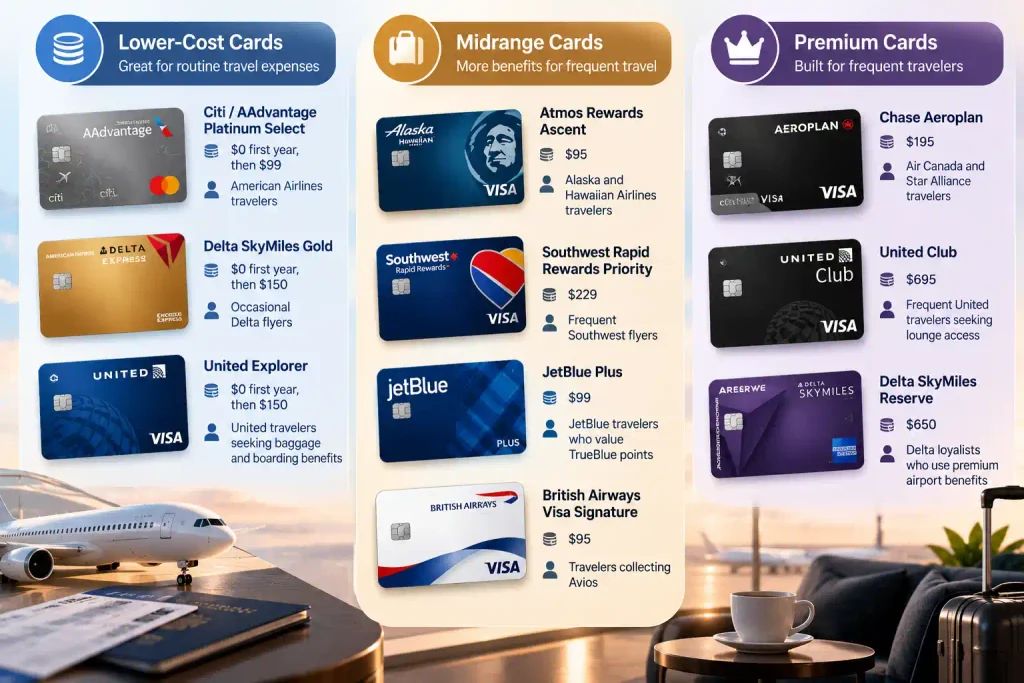
The strongest candidates generally fall into three groups: lower-cost cards that help reduce routine travel expenses, midrange cards offering additional airline benefits, and premium cards built around lounge access and frequent travel.
The following comparison uses published annual fees rather than temporary welcome bonuses, which can change frequently.
| Airline credit card | Annual fee | Best suited for |
| Citi / AAdvantage Platinum Select World Elite Mastercard | $0 first year, then $99 | Regular American Airlines travelers |
| Delta SkyMiles Gold American Express Card | $0 first year, then $150 | Occasional Delta flyers |
| United Explorer Card | $0 first year, then $150 | United travelers seeking baggage and boarding benefits |
| Atmos Rewards Ascent Visa Signature | $95 | Alaska and Hawaiian Airlines travelers |
| Southwest Rapid Rewards Priority Credit Card | $229 | Frequent Southwest flyers |
| JetBlue Plus Card | $99 | JetBlue travelers who value earning TrueBlue points |
| British Airways Visa Signature Card | $95 | Travelers collecting Avios |
| Chase Aeroplan Credit Card | $195 | Air Canada and Star Alliance travelers |
| United Club Card | $695 | Frequent United travelers seeking lounge access |
| Delta SkyMiles Reserve American Express Card | $650 | Delta loyalists who use premium airport benefits |
Annual fees are in U.S. dollars. Terms, benefits, and promotional offers can change. The comparison draws on issuer information and the October 15 reference update; applicants should verify the current card agreement before applying.
Which Airline Credit Cards Are Best for Different Types of Travelers?
1. Citi / AAdvantage Platinum Select: Best for Regular American Airlines Flyers
The Citi / AAdvantage Platinum Select World Elite Mastercard is a practical option for travelers who regularly book American Airlines flights and want useful benefits without paying a premium annual fee.
The card offers a complimentary first checked bag on qualifying domestic American Airlines itineraries for the cardholder and up to four companions on the same reservation. It also provides preferred boarding and opportunities to earn AAdvantage miles through eligible everyday spending.
Its annual fee is $0 for the first year and $99 afterward.
The strongest reason to choose this card is the value of recurring flight benefits. A traveler who checks baggage several times a year may recover the annual fee through baggage savings alone.
However, travelers who rarely fly American Airlines may struggle to use the benefits frequently enough to justify maintaining the card.
2. Delta SkyMiles Gold American Express: Best for Occasional Delta Flyers
The Delta SkyMiles Gold American Express Card is particularly suitable for travelers who fly Delta several times a year but do not need airport lounge access.
It earns two SkyMiles per dollar on eligible Delta purchases, U.S. supermarket purchases, and restaurant spending, including qualifying takeout and delivery.
Its travel benefits include complimentary checked baggage under the applicable conditions, priority boarding, and a TakeOff 15 discount on eligible Delta-operated award flights booked with miles.
The annual fee is $0 for the first year and $150 afterward.
A traveler who frequently flies with family members may find baggage benefits more valuable than earning a small number of additional miles on everyday purchases.
However, the card does not include Delta Sky Club access, so it is not designed for travelers whose main priority is airport lounge entry.
3. United Explorer Card: Best for United Travelers Seeking Everyday Flight Benefits
The United Explorer Card combines several practical travel benefits without the annual cost associated with a premium lounge membership.
Its features include a complimentary first checked bag on qualifying itineraries, priority boarding, and two United Club one-time passes each year, subject to the applicable access rules.
The card has a $0 introductory annual fee for the first year, followed by $150.
For example, someone who travels with United for occasional business trips may benefit from checked-baggage savings while using the lounge passes during longer airport waits.
Travelers should note that complimentary baggage benefits have specific booking and payment requirements. Merely holding the card does not guarantee that every checked bag will be free.
4. Atmos Rewards Ascent Visa Signature: Best for Alaska and Hawaiian Airlines Flyers
The Atmos Rewards Ascent Visa Signature Card is a particularly interesting option for travelers who regularly use Alaska Airlines or Hawaiian Airlines.
It carries a $95 annual fee and earns three Atmos Rewards points per dollar on eligible Alaska and Hawaiian purchases. Eligible gas, EV charging, transit, streaming, and selected other categories earn two points per dollar.
The card also provides a complimentary checked bag and preferred boarding for the cardholder and up to six companions on the same qualifying reservation when the required payment conditions are met.
Its annual Companion Fare benefit can be useful for couples or families, but the anniversary benefit requires at least $6,000 in purchases during the preceding account anniversary year. The companion ticket starts at $99 plus applicable taxes and fees.
Travelers should assess whether they can meet that spending requirement through normal expenses rather than making unnecessary purchases to obtain the fare.
5. Southwest Rapid Rewards Priority: Best for Frequent Southwest Flyers
The Southwest Rapid Rewards Priority Credit Card is designed for passengers who regularly choose Southwest and can use its airline-specific benefits.
The card has a $229 annual fee and earns four Rapid Rewards points per dollar on eligible Southwest purchases, two points at gas stations and restaurants, and one point on other eligible purchases.
It also offers 7,500 anniversary points and a complimentary first checked bag under the applicable conditions.
For frequent Southwest customers, the combination of anniversary rewards, baggage benefits, and cardholder travel privileges may help offset the fee.
However, the value depends on how often the cardholder flies Southwest. Someone who takes only one Southwest trip every few years may be better served by a lower-cost option.
6. JetBlue Plus Card: Best for Travelers Collecting TrueBlue Points
The JetBlue Plus Card offers a straightforward way to earn additional TrueBlue points on JetBlue purchases and selected everyday expenses.
It carries a $99 annual fee and earns six points per dollar on eligible JetBlue purchases, two points at restaurants and eligible grocery stores, and one point on other purchases.
Its benefits include a complimentary first checked bag under qualifying conditions, anniversary bonus points, and a points rebate on eligible award redemptions.
For travelers who regularly fly JetBlue, these benefits can provide meaningful value. However, the card is less flexible than a general travel rewards card because its earning and redemption opportunities are concentrated around JetBlue’s loyalty program.
Passengers should compare JetBlue’s route network with their usual destinations before deciding.
7. British Airways Visa Signature: Best for Travelers Who Want to Earn Avios
The British Airways Visa Signature Card is an option for U.S.-based travelers who frequently use British Airways or participate in the Avios rewards ecosystem.
The card earns three Avios per dollar on eligible purchases with British Airways, Aer Lingus, Iberia, and LEVEL, two Avios per dollar on eligible hotel accommodations booked directly, and one Avios on other purchases.
Its annual fee is $95.
Avios can be useful for flights across participating airline programs, although award availability, pricing, carrier charges, and redemption conditions vary.
This card is particularly worth considering for travelers who understand how Avios bookings work and have realistic opportunities to redeem their points.
8. Chase Aeroplan Credit Card: Best for Air Canada and Star Alliance Travelers
The Chase Aeroplan Credit Card is designed for U.S. applicants who want to earn Aeroplan points and use Air Canada’s loyalty program.
Its $195 annual fee is higher than several entry-level airline cards, but it includes benefits such as automatic Aeroplan 25K status, eligible checked-baggage privileges, and opportunities to earn additional rewards on Air Canada and everyday purchases.
Aeroplan points can also provide access to award travel with participating Star Alliance and other airline partners.
The card may appeal to travelers who fly internationally and understand how partner award availability affects redemption opportunities.
However, airline status does not automatically make every upgrade, lounge visit, or premium seat complimentary. Benefits remain subject to program rules.
9. United Club Card: Best for Frequent United Travelers Who Want Lounge Access
The United Club Card is a premium option for travelers who regularly use United Airlines and spend enough time in airports to benefit from lounge access.
With a $695 annual fee, it includes United Club access, complimentary first and second checked bags on qualifying itineraries, and Premier Access services.
The card also offers airline-specific rewards and selected partner credits, although many credits have separate eligibility requirements.
For someone flying United every week, lounge access and baggage privileges may justify the annual cost. A traveler who flies only a few times a year is less likely to recover comparable value.
The important calculation is how much the traveler would realistically spend on the included benefits without the card—not the maximum advertised value of every available credit.
10. Delta SkyMiles Reserve American Express: Best for Premium Delta Benefits
The Delta SkyMiles Reserve American Express Card is designed for frequent Delta travelers seeking lounge access, status-related benefits, and an annual companion certificate.
Its $650 annual fee includes 15 Delta Sky Club visits per Medallion Year on eligible travel. Unlimited visits can be unlocked after meeting the specified $75,000 annual purchase threshold.
The card also offers MQD Headstart and MQD Boost benefits toward Delta Medallion status, plus an annual companion certificate after renewal, subject to route, fare, availability, and tax restrictions.
This is a card for travelers who already use Delta’s premium services. It is difficult to justify solely through everyday spending rewards, particularly because most non-Delta purchases earn only one mile per dollar.
Which Airline Credit Cards Have No Annual Fee?
No-annual-fee airline credit cards can be useful for occasional travelers who want to earn airline miles without committing to an annual charge.
Examples include the American Airlines AAdvantage MileUp Card and the United Gateway Card.
The MileUp Card earns AAdvantage miles on eligible American Airlines and grocery purchases, while the United Gateway Card offers United MileagePlus earning opportunities without an annual fee.
However, no-annual-fee airline cards generally offer fewer airport benefits than their fee-based counterparts.
For example, a card that earns miles but does not include complimentary checked baggage may provide less practical value to someone who frequently checks luggage.
The better choice depends on whether the traveler wants to accumulate rewards gradually or save money on recurring airline charges.
How Do Airline Credit Cards Compare With General Travel Credit Cards?
Airline credit cards reward loyalty to a particular airline, while general travel credit cards typically offer more flexibility across different carriers, hotels, and other travel purchases.
The distinction matters most for travelers who regularly choose flights based on price rather than airline preference.
| Feature | Airline credit card | General travel credit card |
| Rewards | Usually airline miles or points | Flexible points, miles, or travel credits |
| Checked baggage | Often included on qualifying airline flights | Less commonly included |
| Priority boarding | Available on selected airline cards | Usually not included |
| Airport lounges | Available on certain premium cards | Available on some premium travel cards |
| Redemption flexibility | Concentrated around one loyalty program and partners | May support multiple travel programs |
| Best suited for | Travelers loyal to an airline | Travelers using multiple airlines |
When Is an Airline Credit Card Better?
An airline card is often more useful when the traveler consistently flies with the same carrier and regularly pays for services that the card includes.
For example, a passenger who flies Delta six times a year and checks a bag on every trip may receive measurable savings from a Delta-branded card.
The benefit is particularly meaningful when the passenger would otherwise pay for those bags.
When Is a General Travel Credit Card Better?
A general travel card may be more useful when a traveler books whichever airline offers the best combination of price, schedule, and route.
Someone who flies JetBlue for one trip, British Airways for another, and a different carrier for the next journey may prefer flexible rewards over benefits tied to one airline.
However, general travel cards can also charge substantial annual fees, so flexibility alone does not guarantee better value.
How Can You Calculate Whether an Airline Credit Card Is Worth Its Annual Fee?
The most practical method is to estimate the annual value of benefits the cardholder will actually use and subtract the annual fee.
A simple calculation is:
Netannualvalue=Usefulbenefits+Rewardsvalue-Annualfee
For example, consider a hypothetical airline credit card with a $150 annual fee.
| Annual benefit | Estimated personal value |
| Checked baggage savings | $140 |
| Priority boarding | $30 |
| Rewards redeemed for flights | $90 |
| Total estimated value | $260 |
| Annual fee | −$150 |
| Estimated net value | $110 |
This example is illustrative, not a valuation of a specific card. The traveler should count only benefits they would genuinely use or purchase.
A lounge visit has little financial value to someone who would otherwise wait comfortably at the gate. Likewise, a hotel credit is not worth its full advertised amount if using it requires a more expensive booking.
Should You Include the Welcome Bonus?
Yes, but separate it from the card’s long-term value.
A welcome bonus can make the first year particularly rewarding, provided the applicant meets the spending requirement through normal purchases.
However, the bonus usually cannot be earned again every year. A card should ideally remain worthwhile after the introductory offer disappears.
What Should You Check Before Applying for an Airline Credit Card?
Travelers should evaluate the card’s actual costs, benefits, and restrictions rather than focusing only on the headline mileage offer.
The following factors deserve particular attention.
How Important Is the Annual Fee?
The annual fee is a recurring expense that must be justified through benefits and rewards.
A card with a $95 fee may provide better value than a $650 premium card when the traveler rarely uses airport lounges.
Do Airline Credit Cards Charge Foreign Transaction Fees?
Some do, while others waive them.
For international travelers, foreign transaction fees can reduce the value of rewards earned on purchases abroad.
For example, a 3% foreign transaction fee on $2,000 in eligible overseas spending would add $60 in charges.
The card’s current pricing terms should always be checked before international use.
Does the Card Include Travel Insurance?
Some airline credit cards provide travel-related insurance benefits, but coverage is not universal.
Benefits may include trip delay insurance, baggage protection, rental car coverage, or trip cancellation and interruption insurance.
Each benefit has separate conditions, exclusions, and claim requirements. Cardholders should review the benefits guide and confirm whether the trip must be purchased using the card.
Will the Card Help You Earn Airline Elite Status?
Certain cards help travelers progress toward elite status through qualifying spending, status credits, or other program-specific benefits.
However, ordinary redeemable miles and elite-qualifying credits are not always the same.
Travelers should confirm which purchases count toward status and whether the benefits are available automatically or require additional spending.
What Mistakes Should Travelers Avoid When Choosing an Airline Credit Card?
The most expensive mistakes usually involve overestimating benefits or misunderstanding how rewards work.
- Choosing a card only for its welcome bonus: The annual fee continues after the introductory rewards are spent.
- Assuming every airline purchase earns the highest rate: Bonus categories often have eligibility restrictions.
- Overvaluing lounge access: Entry may depend on the airline, ticket type, guest policy, and annual visit limits.
- Ignoring baggage conditions: Some cards require the ticket to be purchased with the eligible card or the loyalty number to be attached.
- Treating airline miles like cash: Redemption value varies with route, availability, and program pricing.
- Carrying a credit card balance to earn rewards: Interest charges can exceed the value of points earned.
The last point is especially important. The U.S. Consumer Financial Protection Bureau explains that cardholders can generally avoid purchase interest when their card provides a grace period and they pay the statement balance in full by the due date.
Related: Looking for the Best Travel Credit Card? Unlock Premium Travel Rewards
Conclusion: Which Airline Credit Card Should You Choose?
The best airline credit card is the one that reduces the cost of flights a traveler already plans to take. For occasional flyers, that may mean a modest annual fee, complimentary baggage, and straightforward rewards. For frequent travelers, lounge access, companion certificates, and elite-status benefits can provide additional value.
The Citi / AAdvantage Platinum Select, Delta SkyMiles Gold, and United Explorer cards are practical candidates for travelers who regularly use their respective airlines. The Atmos Rewards Ascent and Southwest Rapid Rewards Priority cards offer different advantages for passengers loyal to those carriers, while premium options such as the United Club and Delta SkyMiles Reserve cards are better suited to frequent travelers who can consistently use their benefits.
Before applying, travelers should compare the annual fee with realistic savings, confirm the latest issuer terms, and check how easily the rewards can be redeemed for their preferred routes. A large welcome bonus may attract attention, but the card’s value after the first year is what determines whether it deserves a permanent place in a traveler’s wallet.
Related FAQs!
A lower-fee airline card is often a reasonable starting point for someone who already flies regularly with one carrier. The United Explorer and Delta SkyMiles Gold cards are examples, although the best choice depends on the traveler’s routes and expected benefits.
Yes. Travelers may hold multiple airline credit cards if approved by the relevant issuers. However, several annual fees can outweigh the benefits if the cards are rarely used.
Expiration rules vary by loyalty program. Some programs allow points to remain valid while an account stays open and in good standing, while others apply activity requirements.
Often, yes. Many airline loyalty programs allow redemption on participating partner airlines, subject to award availability, program rules, taxes, and fees.
No. Some cards provide upgrade priority or status-related benefits, but complimentary upgrades are not guaranteed and depend on eligibility, availability, and airline rules.
Certain cards offer companion certificates or discounted companion fares. These benefits may require annual spending, card renewal, taxes, fees, or eligible routes and fare classes.
They can be, particularly when the airline or its partners serve the traveler’s preferred destinations. However, international award availability, surcharges, baggage rules, and foreign transaction fees should be considered.
Yes. Airline credit cards generally award miles or points on eligible everyday purchases, allowing travelers to accumulate rewards without purchasing flights.
Applying may result in a hard credit inquiry, and opening a new account can affect credit history and utilization. The overall impact depends on the applicant’s credit profile and subsequent account management.
Airline miles can be more rewarding for travelers who understand how to redeem them effectively. Cash back may be preferable for people who want predictable value without navigating award availability or loyalty program restrictions.