
How Can You Travel Between Terminals at MCO Airport?
Passengers can walk between Terminals A and B at Orlando International Airport (MCO) through the connected main terminal complex. Transfers to Terminal C generally require the Terminal Link automated people mover (APM) or another airport-approved ground transportation option. The best route depends on the departure and arrival gates, whether the passenger has checked baggage, and whether another security screening is required.
Orlando International Airport is a major gateway to Central Florida, serving travelers visiting Walt Disney World, Universal Orlando Resort, and other destinations. Its terminal layout can seem confusing at first because the airport uses both terminal letters and numbered airside gate areas.
For example, a passenger arriving at Terminal A may not need a shuttle to reach Terminal B. However, a connection involving Terminal C requires a different approach.
This guide explains MCO’s terminal layout, transportation options, security considerations, and practical steps for making connections without unnecessary backtracking.
Related: Atlanta to Orlando Flights: Best Airlines & Deals 2026
How Is Orlando International Airport Organized?
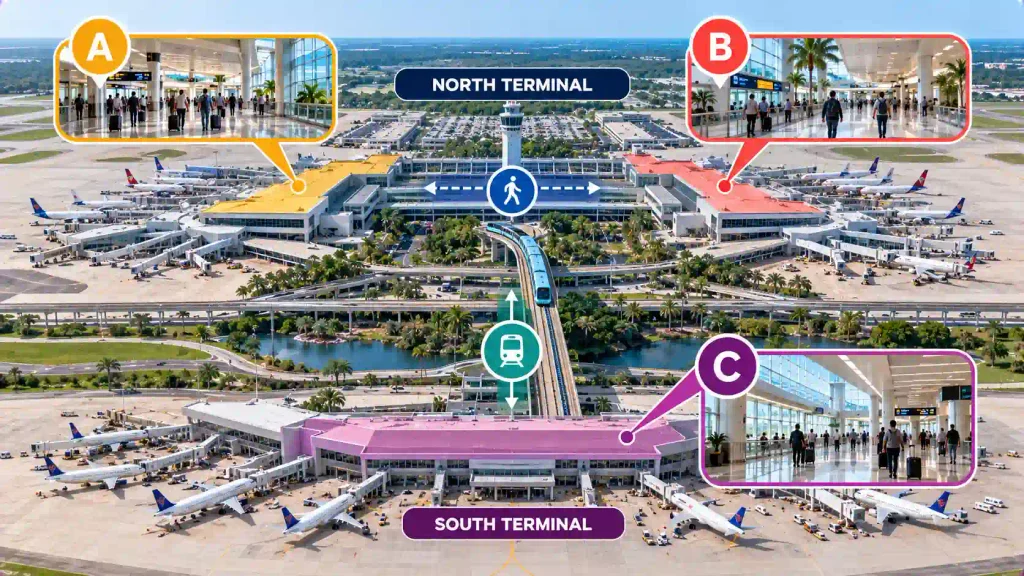
Orlando International Airport has three terminal designations: A, B, and C. Terminals A and B are on opposite sides of the main North Terminal complex. Terminal C is a separate South Terminal facility.
Understanding the difference between a terminal and an airside concourse is particularly important at MCO.
| Terminal | General layout | Gate areas | Main connection method |
| Terminal A | North Terminal, A-side | Airsides 1 and 2, Gates 1–29 and 100–129 | Walk between A and B; APM to the airside gates |
| Terminal B | North Terminal, B-side | Airside 3 and 4, Gates 30–59 and 70–99 | Walk between A and B; APM to the airside gates |
| Terminal C | Separate South Terminal | Primarily Gates C230 and above | Terminal Link to the North Terminal complex |
Gate allocations and airline locations can change. Always follow the gate and terminal shown on the latest boarding pass and airport departure displays.
Why Does MCO Have Both Terminal Letters and Airside Numbers?
Terminal letters identify the main landside facilities, while airside numbers identify the secured gate concourses connected to Terminals A and B.
For example, a passenger departing from Gate 105 uses Terminal A’s landside facilities but must reach the appropriate airside concourse via the automated people mover.
This distinction matters because moving between terminal check-in areas is different from moving between secured boarding gates.
How Can Passengers Travel Between Terminals A and B at MCO?
Passengers can walk between the A and B sides of MCO’s North Terminal without taking a shuttle or train. Both sides are part of the same main terminal building, with check-in, baggage claim, and ground transportation facilities arranged around the central complex.
However, a passenger transferring between departure gates may need to use an automated people mover, and some gate changes require another security screening.
Can Passengers Walk Between Terminals A and B?
Yes. The A and B check-in areas are connected within the main terminal building.
For example, a traveler dropped off at Terminal A who discovers that their airline uses Terminal B can follow the interior signs to the correct side.
The walk does not require leaving the airport building or boarding a shuttle.
How Do Passengers Travel Between Different Gate Areas?
Passengers use MCO’s Gate Link automated people movers to reach the four airside concourses.
According to the airport, Gate Link trains operate around the clock and typically run every two minutes.
The important distinction is whether the arriving and departing gates share a security checkpoint.
How Can Travelers Get Between Terminals A or B and Terminal C?
Passengers can use the Terminal Link automated people mover or the free terminal shuttle bus to travel between the North Terminal complex and Terminal C. Both options operate outside the secure gate areas, so connecting passengers must plan for security screening at their next departure terminal.
A rail connection between the North Terminal complex and the MCO Train Station near Terminal C. Passengers continue on foot between the station and Terminal C.
A ground-level connection between Terminal B and Terminal C, useful for travelers who prefer not to walk through the train station and parking garage.
How Does the Terminal Link Train Work?
The Terminal Link connects the North Terminal complex with the MCO Train Station, which is linked to Terminal C by a pedestrian route.
Passengers traveling from Terminal A or B should follow signs toward the Terminal Link station on the Terminal B side, then:
- Board the Terminal Link train toward the MCO Train Station.
- Exit at the train station.
- Follow the signs through the pedestrian connection toward Terminal C.
- Proceed to the Terminal C check-in and security area, if departing from that terminal.
The reverse route works for passengers traveling from Terminal C to A or B.
The airport’s parking guidance estimates approximately five minutes by APM between Garage C and the North Terminal complex. The overall transfer takes longer because of walking, waiting, and security procedures.
Where Can Passengers Catch the Free Terminal Shuttle Bus?
The free terminal shuttle connects Terminal B and Terminal C.
| Shuttle location | Pickup point |
| Terminal B | Level 1, space B16 |
| Terminal C | Level 1, space C272 |
The shuttle is listed as operating 24 hours a day. Travelers should check signs and current pickup instructions at the airport, as boarding locations may change.
UpgradedPoints.com
Is the Terminal Link the Same as Brightline?
No. The Terminal Link is an airport people mover used for terminal transfers, while Brightline is an intercity passenger rail service.
Both connect with the MCO Train Station area, but passengers changing terminals should follow Terminal Link signs rather than signs directing them to an intercity train departure.
Can Passengers Walk From Terminal C to Terminals A or B?
Walking is not the recommended terminal-transfer method between Terminal C and the North Terminal complex.
Although pedestrian routes connect Terminal C to its parking garage and the MCO Train Station, the North Terminal complex is farther away. The Terminal Link and shuttle bus provide the designated connections.
Passengers should not attempt to walk along airport access roads between the terminal complexes.
Can Passengers Transfer Between MCO Gates Without Going Through Security Again?
Yes, some connections within the North Terminal complex can be completed without another security screening. However, this depends on which gate areas are involved.
MCO’s official guidance confirms that some connections between Terminals A and B can use the Gate Link system while remaining airside. Other gate combinations require passengers to exit and re-enter security.
| Connecting gate areas | Typical security requirement |
| Gates 1–29 and 30–59 | May remain airside using Gate Link |
| Gates 70–99 and 100–129 | May remain airside using Gate Link |
| Gates 1–59 to Gates 70–129 | Generally requires another security screening |
| Gates within Terminal C | Can normally walk between gates airside |
| Terminal C to Terminal A or B | Requires exiting security and screening again |
These arrangements assume normal domestic connections and no need to reclaim baggage. International arrivals and operational restrictions can change the route.
How Can Passengers Transfer Between Gates 1–29 and 30–59?
Passengers can normally use the relevant Gate Link trains to move between these gate areas without leaving the shared secure checkpoint zone.
For example, a traveler arriving at Gate 22 and departing from Gate 45 can follow the signs back toward the main terminal’s secure transfer area, then take the appropriate Gate Link to the onward concourse.
What Happens When Connecting Between Opposite Security Zones?
Passengers generally need to exit the secure area and pass through the security checkpoint serving their next gate group.
For example, a connection from Gate 15 to Gate 110 requires a different process from a connection between Gates 15 and 45.
Travelers should allow time to return to the main terminal, walk to the other checkpoint, clear security, and board the next Gate Link.
Can Passengers Stay Airside When Connecting Within Terminal C?
Yes. Terminal C passengers can normally walk between its departure gates without leaving the secure area.
MCO confirms that connections within Terminal C remain airside, provided no baggage collection, customs processing, or other procedure requires the passenger to exit.
How Long Does It Take to Transfer Between MCO Terminals?
The time required depends on the distance between gate areas, the transportation method, and whether passengers must go through security again.
The airport confirms that the Terminal Link runs approximately every four minutes, while Gate Link trains normally run every two minutes. These are service intervals, not complete transfer times.
| Transfer | Planning consideration |
| Terminal A to Terminal B, before security | A walk within the same building |
| Gates 1–29 to Gates 30–59 | Two Gate Link rides, without normally re-clearing security |
| Gates 70–99 to Gates 100–129 | Two Gate Link rides, without normally re-clearing security |
| Gates 1–59 to Gates 70–129 | Gate Link, walking, and another security checkpoint |
| Terminal A or B to Terminal C | Terminal Link or shuttle, walking, and security |
| Between Terminal C gates | Walking within the secure departure area |
Passengers should allow extra time for airport congestion, baggage handling, boarding deadlines, and mobility assistance.
Is a 45-Minute Layover Enough at Orlando International Airport?
A 45-minute layover may be enough for a straightforward domestic connection within the same secure gate area. Still, it can be risky for connections that cross security zones or involve Terminal C.
Boarding may close before the scheduled departure time, leaving less usable transfer time than the itinerary suggests.
For separate-ticket journeys, passengers should plan to collect luggage and check in again.
How Much Connection Time Should Passengers Allow Between Terminal C and A or B?
Passengers should favor a generous connection rather than relying on the short train ride alone.
A transfer between Terminal C and the North Terminal involves leaving the secure area, traveling between terminal complexes, walking to the next checkpoint, and completing security screening.
As a conservative planning approach, allow around two hours or more for a domestic connection involving a terminal change, with extra time for international arrivals or separate tickets. This is a planning suggestion, not an official MCO minimum connection time.
What Should International Passengers Know About Terminal Transfers?
Depending on their arrival and itinerary, international passengers may need to complete U.S. immigration and customs procedures before continuing to another flight.
For passengers entering the United States at MCO, the process may include passport control, baggage collection (where required), customs, and another security screening.
Travelers arriving from a U.S. preclearance airport may have a different arrival process.
What Happens When an International Passenger Arrives at Terminal C?
Passengers arriving on an international flight at Terminal C should follow the airport’s arrival and border-processing instructions before attempting to transfer.
After completing the required procedures, they can use the Terminal Link or shuttle to reach the North Terminal complex if their onward flight departs from A or B.
They should confirm whether they need to collect and recheck their checked baggage.
Can Checked Baggage Be Transferred Automatically?
Sometimes. Baggage handling depends on the airlines involved, whether the flights are on a single ticket, the journey’s origin, and applicable customs requirements.
A passenger connecting between two flights on one ticket may have baggage tagged through to the final destination. However, certain international arrivals still require baggage collection and customs processing.
Travelers should verify the baggage tag and ask the airline at their original check-in counter.
How Can Passengers With Reduced Mobility Move Between MCO Terminals?
Passengers needing mobility assistance can request wheelchair or other accessibility services through their airline, ideally before they travel.
MCO has elevators, escalators, accessible routes, and automated transportation systems. Still, the distance between Terminal C and the MCO Train Station can be challenging for travelers who cannot comfortably walk long distances.
For a connecting itinerary, travelers should tell their airline they need assistance between flights and confirm how the airline will coordinate that assistance across terminals.
Is the Terminal Link Accessible?
The Terminal Link and the associated station facilities are designed to support accessible travel. Passengers should follow designated elevator routes and request assistance when necessary.
For travelers who cannot manage the pedestrian connection between Terminal C and the train station independently, airline-arranged assistance may be especially important.
Read this guide: How To Get Between Terminals at Los Angeles Airport
What Mistakes Should Passengers Avoid When Changing Terminals at MCO?
Common mistakes include confusing terminal letters with gate numbers, assuming every connection stays airside, and overlooking the distance between Terminal C and the North Terminal.
- Going to the wrong security checkpoint: Gates 1–59 and 70–129 are served by different checkpoint zones.
- Assuming Terminal A and B require a shuttle: The landside areas are connected within the same building.
- Confusing Gate Link with Terminal Link: Gate Link serves the North Terminal gate concourses; Terminal Link connects the North Terminal with the train station near Terminal C.
- Ignoring checked baggage: Collecting luggage can require leaving the secure area.
- Relying on an old gate assignment: Airline gates can change, particularly during operational disruptions.
- Underestimating an international connection: Immigration, customs, and security can significantly affect transfer time.
The best precaution is to confirm the next flight’s gate before leaving the arrival concourse.
Conclusive Words!
The easiest way to navigate MCO is to find your next flight’s gate first, then choose the right walking route, Gate Link train, Terminal Link, or shuttle.
For most passengers, moving between the A and B sides is straightforward because they share one building. Connections involving Terminal C require more planning, especially if you need to collect baggage or go through additional security screening.
Before traveling, passengers should verify their terminal assignment, confirm whether checked baggage will transfer automatically, and review the latest airport directions. Those small checks can make a significant difference when connecting through Orlando.
Frequently Asked Questions
Yes. The airport’s Terminal Link automated people mover and interterminal shuttle bus are free for passengers traveling between the terminal complexes.
Yes. MCO lists the Terminal Link as operating 24 hours a day, with trains normally arriving approximately every four minutes.
The Terminal Link is located outside the secured departure gate areas, unlike the Gate Link trains. It is used for travel between the North Terminal complex and the train station near Terminal C.
A train is not needed to move between the A and B check-in areas. Passengers can walk across Level 3 of the connected North Terminal building.
Passengers can move between certain North Terminal gate areas without leaving security. However, a transfer between Terminal C and Terminals A or B requires exiting the secure area.
MCO may provide alternative transportation during maintenance or operational disruptions. The airport currently identifies upgrade work affecting the Gate Link serving Gates 70–129, with possible overnight shuttle arrangements. Travelers should follow posted airport instructions.
Passengers can approach MCO customer service ambassadors or airline representatives for assistance. The airport also provides terminal maps and transfer guidance through its official website.