
Travel Insurance: Do You Actually Need It?
Travel insurance isn’t necessary for every trip, but it can be worth buying when unexpected medical expenses, cancellations, or travel disruptions could cause significant financial losses. A short domestic getaway with refundable bookings may need little additional protection, while an expensive international vacation or a trip involving multiple connections may justify broader coverage.
The decision is not simply about how much the trip costs. A traveler could lose a relatively small amount on a canceled hotel reservation but face a much larger expense if emergency medical treatment or transportation becomes necessary abroad.
Travel insurance protects against specified risks, not every inconvenience that can occur during a journey. Understanding what a policy covers, what it excludes, and how it compares with existing benefits helps travelers decide whether purchasing coverage is worthwhile.
This guide examines the different types of travel insurance, typical costs, key exclusions, and when a policy may provide meaningful financial protection.
Related: Travel Insurance Guide: Coverage, Policies & Exclusions
What Is Travel Insurance, and How Does It Work?
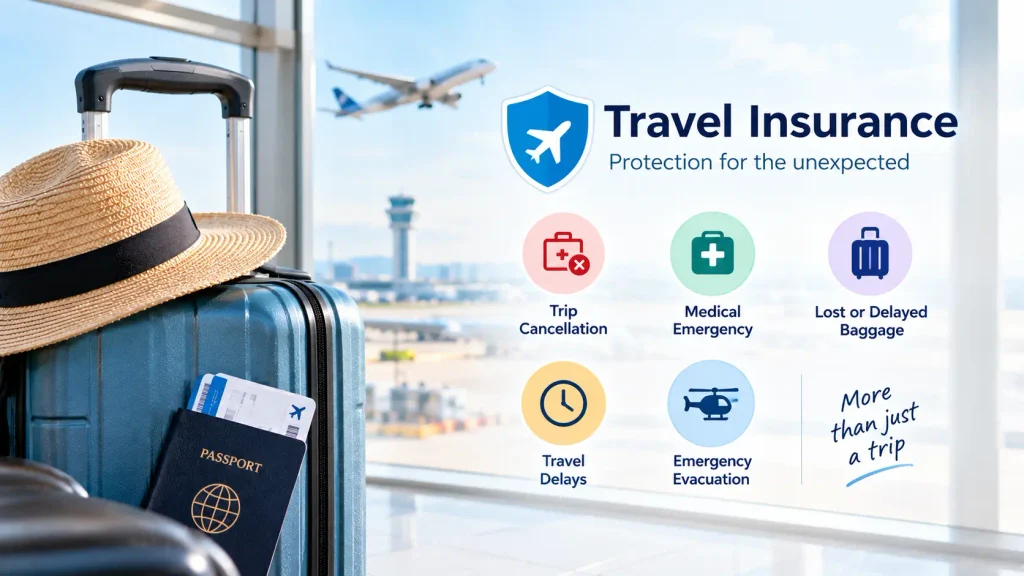
Travel insurance is a financial protection product that covers certain unexpected events before or during a trip. Depending on the policy, these may include trip cancellation, emergency medical treatment, baggage loss, travel delays, or emergency evacuation.
Most policies reimburse eligible expenses after the traveler submits a claim and supporting documents. Some insurers also provide emergency assistance or, when the policy allows, arrange direct payment to medical facilities.
The policy wording governs coverage, including covered reasons, exclusions, benefit limits, deductibles, and claim procedures.
For example, a standard traveler who cancels a prepaid vacation because of a covered illness may qualify for reimbursement of nonrefundable costs. However, canceling because the traveler simply changes their mind generally won’t qualify under ordinary policies.
Travel insurance becomes more valuable when a disruption’s potential financial consequences exceed what a traveler can comfortably absorb.
Coverage needs depend on several factors, including destination, health insurance arrangements, prepaid expenses, trip complexity, and personal financial circumstances.
| Travel situation | Insurance value | Main reason |
| Short domestic trip with refundable bookings | Often lower | Limited nonrefundable exposure |
| Expensive international vacation | Often higher | Significant prepaid expenses |
| International trip without medical coverage abroad | High | Potential medical costs |
| Cruise or organized tour | Often higher | Large nonrefundable payments |
| Trip involving multiple separately booked flights | Potentially higher | Missed connections and disruption exposure |
| Adventure activities or remote destinations | Potentially higher | Specialized medical and evacuation risks |
| Business trip covered by an employer | Depends on existing coverage | Possible duplicate protection |
| Travel booked with a premium credit card | Depends on card benefits | Some risks may already be covered |
These are general assessments, not guarantees, that an insurance policy will pay a claim. The exact benefits and exclusions remain decisive.
What Does Travel Insurance Actually Cover?
Travel insurance can protect several parts of a journey, but coverage depends on the benefits included in the selected policy. A comprehensive plan may combine trip protection, emergency medical expenses, and baggage benefits, while a basic policy may cover only a few specific risks.
| Coverage type | What it generally covers | Common limitations |
| Trip cancellation | Eligible prepaid, nonrefundable costs when a covered event prevents departure | Change of mind is usually excluded |
| Trip interruption | Covered unused expenses and sometimes additional transportation after a trip begins | Covered reasons and benefit limits apply |
| Emergency medical | Eligible treatment for unexpected illness or injury | Pre-existing conditions and exclusions |
| Medical evacuation | Medically necessary transport to an appropriate facility | Insurer authorization and medical necessity |
| Travel delay | Eligible meals, accommodation, and other expenses after a qualifying delay | Minimum delay periods and reimbursement limits |
| Baggage loss or theft | Covered belongings lost, stolen, or damaged during travel | Per-item limits and exclusions |
| Baggage delay | Essential purchases while checked baggage is delayed | Waiting periods and spending limits |
| Accidental death and dismemberment | Specified benefits for qualifying serious accidents | Strict definitions and exclusions |
The U.S. Centers for Disease Control and Prevention (CDC) distinguishes between travel disruption insurance, travel health insurance, and medical evacuation insurance because these products protect against different financial risks.
Does Travel Insurance Cover Flight Cancellations?
Travel insurance may reimburse eligible nonrefundable expenses when a trip is canceled for a reason specifically covered by the policy. Common covered reasons can include an unexpected serious illness, injury, or certain family emergencies.
However, an airline canceling a flight does not automatically mean the traveler can claim the entire trip cost from an insurer. The airline may already owe a refund or alternative transportation under its conditions of carriage or applicable passenger protection laws.
For example, if an airline cancels a flight and refunds the ticket, the traveler generally cannot also recover the same refunded amount through travel insurance. A policy might still cover other eligible losses, such as a nonrefundable hotel reservation, depending on its terms.
Read This Too: The Best Flight Cancellation Insurance: What It Covers and When It’s Worth It
Does Travel Insurance Pay for Emergency Medical Expenses?
Travel medical insurance can cover health-related expenses during an international trip, including emergency consultations, hospital treatment, and certain prescribed medications.
This coverage matters because domestic health insurance often doesn’t provide adequate protection overseas. Some policies exclude international treatment entirely, while others reimburse only certain services.
The U.S. The Department of State recommends travel medical insurance for international travelers and advises checking whether an existing health plan covers treatment abroad.
What Is Emergency Medical Evacuation Coverage?
Medical evacuation coverage pays for or arranges medically necessary transportation when a traveler cannot get appropriate treatment where they are.
This can involve transporting a patient to another hospital, another city, or occasionally another country.
It is not the same as paying for an ordinary flight home. Evacuation generally requires medical justification and may need insurer authorization.
The CDC reports that medical evacuation costs can range from approximately $25,000 within North America to more than $250,000 for some distant or remote locations. These figures reflect potential expenses, not standard insurance benefits.
What Does Travel Insurance Usually Not Cover?
Travel insurance is not an unlimited guarantee against financial loss. Every policy includes exclusions that define when the insurer will not pay.
Common exclusions or restrictions may include:
- Canceling a trip simply because plans have changed.
- Medical conditions that do not qualify for coverage or an applicable waiver.
- Participation in excluded adventure sports or hazardous activities.
- Losses caused by events already known when the policy was purchased.
- Traveling against certain official restrictions or advisories, depending on policy wording.
- Claims arising from excluded alcohol- or drug-related incidents.
- Expenses that exceed policy limits or lack required documentation.
- Costs already reimbursed by an airline, hotel, or another provider.
The exact exclusions vary. Travelers should read the policy certificate rather than relying only on a promotional summary.
Are Pre-Existing Medical Conditions Covered?
Pre-existing medical conditions may be excluded from ordinary travel medical insurance unless the policy provides coverage or a qualifying waiver.
Some insurers offer pre-existing condition waivers that require specific purchase timing, eligibility, and coverage of applicable trip costs.
A traveler managing an existing medical condition should carefully review the insurer’s definition of a pre-existing condition. It may depend on recent treatment, medication changes, or symptoms during a specified look-back period.
The CDC identifies pre-existing conditions as an important source of denied international medical insurance claims.
Does Travel Insurance Cover Adventure Activities?
Not every travel insurance policy covers injuries from skiing, scuba diving, mountain climbing, or other higher-risk activities.
A standard plan may exclude particular sports or cover them only under defined conditions. Some insurers offer specialized adventure sports coverage or optional riders.
Travelers planning these activities should confirm both medical treatment and evacuation coverage before departure.
How Much Does Travel Insurance Cost?
Travel insurance commonly costs around 5% to 10% of the total trip price for policies that include trip protection, according to the National Association of Insurance Commissioners (NAIC). Actual premiums depend on the destination, travel dates, age of insured travelers, and selected benefits.
A policy covering emergency medical expenses alone may have a different pricing structure from comprehensive insurance that also protects nonrefundable trip payments.
How Much Might Insurance Cost for Different Trips?
The following figures illustrate a 5%–10% premium range. These are calculations for comparison, not insurer quotations; for example, a traveler spending $3,000 on nonrefundable flights, accommodation, and activities might consider paying 150–$ 300 for a comprehensive policy. However, the decision should depend on the benefits and potential losses rather than the percentage aAAn
A traveler’s more expensive plan protection is less useful than a policy with inadequate medical coverage.
Is Travel Insurance Necessary for International Trips?
Travel insurance isn’t universally required for international travel, but it can be especially valuable when visiting a country where the traveler’s existing health insurance offers limited coverage.
International journeys can involve unfamiliar healthcare systems, different payment requirements, longer flight connections, and substantial costs if a traveler must return home unexpectedly.
The U.S. The Department of State recommends purchasing travel medical insurance before traveling abroad and strongly recommends evacuation insurance for destinations with higher risks or limited medical care.
Is Travel Insurance Required for a Visa?
Others recommend insurance without making it a general entry requirement.
For example, applicants for a Schengen short-stay visa generally must provide travel medical insurance that meets specified requirements, including at least €30,000 in coverage and protection for emergency medical treatment and repatriation throughout the Schengen area.
However, visa-exempt visitors should not assume that identical documentation rules apply to them.
Travelers should verify the policy against the destination’s immigration website, which often has lower requirements when the traveler already has adequate medical coverage, and most bookings are refundable.
Consider a two-day domestic trip involving a refundable hotel and a low-cost flight. If cancellation would create only a manageable financial loss, purchasing comprehensive insurance may offer limited additional value.
A different calculation applies to an expensive domestic tour with prepaid activities, nonrefundable accommodation, and multiple transportation arrangements.
For domestic journeys, trip cancellation, interruption, and delay benefits may matter more than international medical evacuation coverage.
Do Travelers Need Insurance When Their Credit Card Already Provides Coverage?
Not necessarily. Some travelers’ cards include benefits such as trip cancellation precautions, baggage delay reimbursement, rental-car coverage, or trip delay insurance.
However, these benefits may be subject to strict conditions. A card may require travelers to pay for the trip with that card, and coverage may be limited to specific people, expenses, or events.
Credit card protection also should not automatically be treated as a substitute for emergency medical or evacuation insurance. The CDC specifically cautions travelers to examine credit card benefits separately from dedicated travel health and medical evacuation policies.
How Does Credit Card Protection Compare With Travel Insurance?
Credit card protection and travel insurance offer different levels of financial security during a trip. While credit cards may cover certain travel disruptions, standalone insurance often provides more comprehensive benefits, including emergency medical expenses, evacuation, and customizable coverage options.
| Feature | Credit card travel benefits | Standalone travel insurance |
| Trip cancellation | Available on some cards | Available with qualifying policies |
| Trip delay | Available on some cards | Often available in comprehensive plans |
| Baggage protection | May be included | Available with selected plans |
| Emergency medical expenses | Often limited or absent | Available with travel medical coverage |
| Medical evacuation | Varies considerably | Available in dedicated or comprehensive plans |
| Customizable coverage | Usually limited | Greater choice of benefits and limits |
| Eligibility | Card and payment conditions | Policy-specific eligibility |
Travelers should compare their credit card’s actual guide to benefits with the proposed insurance policy. Buying duplicate protection may not increase the amount recoverable for the same expense.
What Is Cancel for Any Reason Travel Insurance?
Cancel for Any Reason (CFAR) coverage is an optional benefit that provides greater flexibility than standard trip cancellation insurance.
Ordinary cancellation insurance requires the traveler to cancel for a covered reason. CFAR can provide partial reimbursement if the reason costs more than those standard conditions, provided the traveler satisfies the conditions.
According to the NAIC, CFAR commonly reimburses 55% of prepaid, nonrefundable costs. It generally costs more than standard coverage and usually must be purchased within a specified period after you book the initial trip.
Is Cancel for Any due Storage Worth the Extra Cost?
CFAR may be useful for travel-added plans that are uncertain for reasons that ordinary policies would not cover.
For example, a traveler who books an expensive vacation but may need to cancel because of a personal scheduling decision could benefit from the additional flexibility.
However, CFAR is not a full refund guarantee.
If a hypothetical policy reimburses 75% of a $4,000 eligible nonrefundable trip, the maximum CFAR reimbursement would be $3,000, subject to the policy’s requirements.
Travelers should compare that potential recovery with the higher premium and any refunds already available from travel providers.
When Should Travel Insurance Be Purchased?
Travel insurance is generally best considered soon after making the first significant nonrefundable trip payment.
Buying early can help travelers qualify for certain time-sensitive benefits, such as pre-existing condition waivers or CFAR coverage, where offered.
Waiting until shortly before departure may reduce available protection. For example, a traveler purchasing insurance after a severe storm has already become a known threat should not assume the policy will cover losses caused by that storm.
The NAIC advises purchasing coverage before foreseeable problems arise because travel insurance is primarily designed for unexpected events.
Can Travel Insurance Be Purchased After Booking a Flight?
Yes. Many insurers let travelers buy coverage after booking flights or accommodation.
However, some benefits may only be available when the policy is purchased within a defined period after the initial trip deposit. Coverage also cannot generally be used retroactively for losses that occurred before the policy became effective.
Travelers should confirm the effective date, coverage start time, and any purchase deadlines before paying.
How Can Travelers Choose the Right Travel Insurance Policy?
Choosing travel insurance requires more than comparing premium prices. Travelers should identify the risks they want to protect against and determine whether the policy offers adequate benefits for those circumstances.
A practical comparison should include the following:
- Check existing protection. Review health insurance, credit card benefits, and refundable booking conditions.
- Calculate nonrefundable expenses. Include flights, accommodation, tours, and other prepaid arrangements that cannot be recovered.
- Assess medical needs. Determine whether emergency treatment and medical evacuation are covered at the destination.
- Compare benefit limits. Look at the maximum reimbursement for each covered event, not just the total policy limit.
- Review exclusions. Pay particular attention to pre-existing conditions, adventure activities, and known events.
- Check deductibles and waiting periods. These can affect the amount payable on a claim.
- Understand the claims process. Confirm required documents, notification deadlines, and whether emergency assistance is available around the clock.
The U.S. The Department of State recommends checking the policy’s geographic validity, duration, medical benefits, evacuation arrangements, and activity restrictions before departure.
How Can Travelers File a Travel Insurance Claim?
Travel insurance claims generally require your insurer to establish that the loss occurred and that the claim is valid.
The process varies by insurer, but most claims follow a similar sequence.
- Notify the insurer. Contact your insurer as soon as possible, especially if medical treatment or evacuation requires authorization.
- Collect supporting documents. Keep booking confirmations, receipts, medical reports, airline notices, and proof of cancellation.
- Request available refunds first. Contact the airline, hotel, or tour operator to establish which expenses are refundable.
- Submit the claim. Provide the requested documents through the insurer’s approved claims channel.
- Respond to additional requests. The insurer may require clarification or additional evidence before deciding.
- Review the outcome. If a claim is denied, examine the stated reason and the policy’s appeal or complaint procedure.
For medical claims, travelers may need to pay a hospital directly and seek reimbursement afterward. The CDC advises keeping detailed medical records and payment receipts because documentation is essential to the claim process.
Also Worth Reading: How to Get Paid for Airline Delays: A Traveler’s Guide
Conclusive Thoughts!
Travel insurance is most useful when a trip exposes the traveler to financial risks that existing benefits cannot adequately cover. International medical expenses, emergency evacuation, and substantial nonrefundable bookings are particularly important considerations.
A traveler with flexible reservations and comprehensive existing coverage may not need an additional policy. However, someone planning an expensive international journey may benefit considerably from carefully selected protection.
A practical approach is to compare the amount at risk, existing coverage, and the policy’s exclusions before buying insurance. The right decision is not necessarily to buy the most comprehensive plan, but to obtain protection for losses that would otherwise be difficult to manage.
Frequently Asked Questions!
No. Airlines generally don’t require passengers to buy travel insurance just to board a flight. However, certain destinations, visa categories, organized tours, or travel programs may require insurance.
It may. Missed connection coverage depends on the cause of the disruption, minimum delay requirements, ticket arrangements, and the policy’s covered reasons. Separately booked flights may require particular attention.
Some policies assist with or reimburse eligible expenses related to lost or stolen travel documents. Coverage may include replacement-document costs or additional travel expenses, subject to limits and exclusions.
Coverage varies. Some policies cover unexpected pregnancy-related medical complications but exclude routine maternity care, childbirth, or travel after a specified stage of pregnancy. Travelers should verify the exact wording before departure.
Some insurers offer a review or free-look period during which eligible policyholders can cancel and receive a premium refund. The availability and length of that period depend on the insurer, policy, and jurisdiction.
It may cover eligible expenses when a weather-related delay meets the policy’s requirements. Travelers should check the minimum delay duration, covered expenses, and documentation needed.
Annual or multi-trip insurance may offer better value for frequent travelers, while single-trip coverage may suit occasional vacations. Annual plans often limit each trip to a maximum duration.
Yes. Standalone travel medical policies are available and may suit travelers with refundable bookings who still need protection against emergency healthcare expenses abroad.