
Air China Domestic Economy: Seats, Meals, and Booking
Air China’s domestic economy service offers an organized boarding process, helpful cabin crew, reasonable legroom, and access to Star Alliance booking partners. However, meal availability varies by flight, the aircraft reviewed lacks personal seatback entertainment screens, and airport check-in may take longer for some international travelers.
The airline serves major Chinese destinations, including Chengdu, Lhasa, and Beijing. Its domestic economy experience combines several practical strengths with limitations that passengers should consider before booking, particularly when arranging special meals, managing partner-award reservations, or planning airport arrival times.
| Feature | Details |
| Airline | Air China |
| Airline code | CA |
| Service reviewed | Domestic economy |
| Aircraft types covered | Airbus A321-200 and A330-200 |
| Routes covered | Chengdu–Lhasa, Lhasa–Chengdu, and Chengdu–Beijing |
| Seat pitch | 31 inches on the A321-200; 32 inches on the A330-200 |
| Boarding | Organized groups and clear directional guidance |
| Cabin crew | Generally helpful, with English communication reported |
| Meals | Inconsistent across the flights reviewed |
| Entertainment | Personal seatback screens unavailable; device-based entertainment offered |
| Alliance | Star Alliance |
Boarding and Airport Procedures
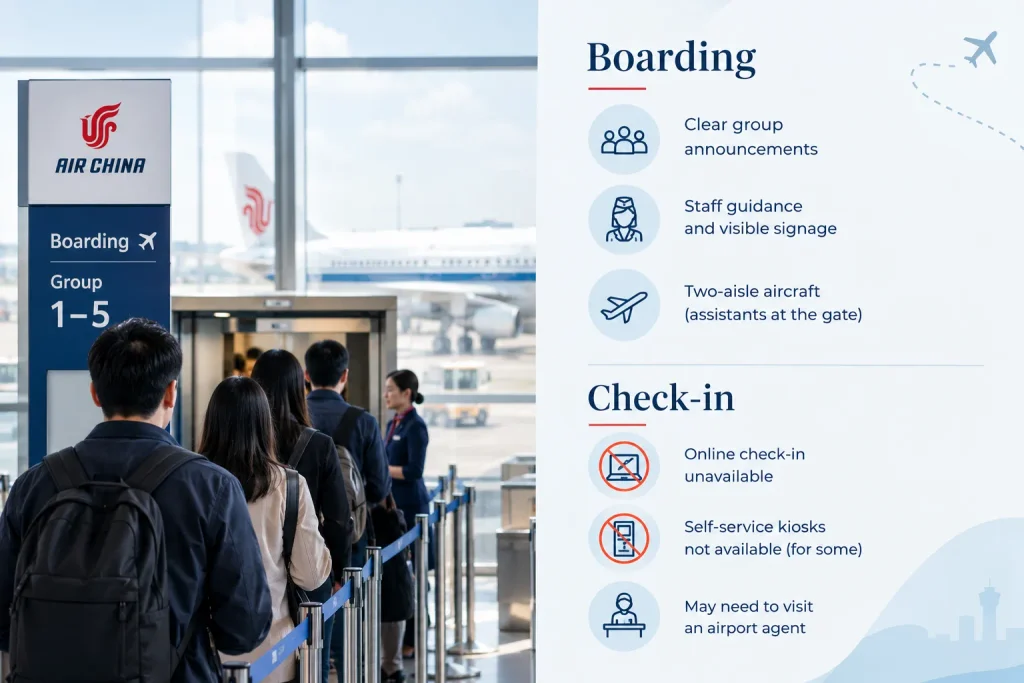
Air China’s domestic boarding process is generally organized, with clear group announcements and staff guidance. However, check-in may require extra time for international travelers, as online check-in and self-service kiosks were unavailable for some bookings reviewed.
Organized and Efficient Boarding
One of the strongest aspects of the domestic economy experience was the boarding process. Across the three flights covered in the source, boarding groups were announced clearly, and airport staff maintained the designated order. Signs helped passengers find the correct boarding lanes, making the process more structured.
Although one flight was delayed before boarding, the process remained orderly once it began. This distinction matters for travelers: an efficient boarding procedure doesn’t mean every flight will depart on time, but it can make the airport experience easier to navigate.
Aircraft layout also influenced the boarding experience. On two of the flights, the aircraft had two aisles. Flight attendants near the entrance helped passengers identify the correct aisle and direction to reach their seats.
These procedures are practical advantages, especially for passengers unfamiliar with an airport or aircraft layout. Clear announcements and visible crew assistance can reduce confusion when boarding a full cabin.
Check-In Can Require Additional Planning
Check-in was a more significant weakness in the reported experience. Online check-in was unavailable for the flights covered, while self-service kiosks did not work for the international travelers involved. Passengers without the required Chinese residency documentation or national identification had to visit an airport agent instead.
This added a step for travelers who expected to complete check-in independently. It also meant that arriving with no checked baggage did not necessarily eliminate the need to queue at a staffed counter.
Passengers traveling on Air China within China should therefore verify the check-in instructions applicable to their booking and travel documents. International visitors, in particular, may benefit from allowing extra time at the airport rather than assuming that online or kiosk check-in will be available.
Procedures may have changed since the June 2024 flights, so the airline’s current guidance should be checked before departure.
Air China Domestic Economy Seats and Legroom
The economy cabins reviewed offered reasonable legroom for domestic travel. The reported seat pitch was 31 inches on the Airbus A321-200 and 32 inches on the Airbus A330-200.
Seat pitch measures the distance between corresponding points on successive seats. It indicates available space, but it is not the same as seat width or a direct measurement of the space available for every passenger’s knees.
| Aircraft | Reported economy seat pitch |
| Airbus A321-200 | 31 inches |
| Airbus A330-200 | 32 inches |
The extra inch on the A330-200 provides a modest difference in seat spacing. Based on the aircraft configurations described in the source, both measurements suggest reasonable room for short- and medium-length domestic journeys.
Passengers should still check the aircraft assigned to their particular flight. Seat dimensions and cabin layouts can differ across aircraft and configurations, and a published aircraft type does not guarantee that every seat will feel identical.
Check Out This Blog: Shanghai Travel Guide: Top Attractions, Food & Things to Do
What to Expect From the Economy Cabin
The reported cabins were functional rather than entertainment-focused. On the flights reviewed, passengers had standard economy seating, overhead and cabin facilities, and access to onboard entertainment through personal devices.
The source does not establish that all Air China domestic aircraft use the same seat pitch or cabin configuration. Travelers who prioritize extra legroom, specific seat locations, or additional personal space should confirm the available seating information for their flight before choosing a seat.
Cabin Crew and Onboard Service
Air China’s domestic cabin crew provide helpful boarding assistance and clear onboard announcements, with English communication reported among most crew members encountered. The reviewed flights also featured clean, well-maintained lavatories, supporting a comfortable economy-class journey.
Helpful Flight Attendants
Cabin crew service was a notable positive in the reported flights. Flight attendants clearly communicated information about drinks, meals, and announcements. Most of the crew spoke good to fluent English, which made routine onboard communication easier for travelers who did not speak Chinese.
English-language communication can be particularly useful for international visitors flying domestic routes in China. Understanding safety instructions, service announcements, and catering choices can reduce uncertainty during a journey.
However, language ability should not be assumed to be the same on every crew or flight. The source describes the service on three segments rather than guaranteeing it across all Air China domestic services.
Cabin Cleanliness
The onboard lavatories were also reported as clean and orderly, even after a three-hour flight. Cleanliness is an important part of the overall economy experience, especially on flights where passengers share compact facilities.
Taken together, the reported crew service and cabin upkeep helped balance some of the limitations involving catering and entertainment. Passengers on a straightforward domestic flight may value these operational aspects more than premium onboard features.
Air China Domestic Meals and Catering
Air China’s domestic meal service varies by flight, ranging from light snack bags to full meals or complimentary drinks without food. Special meal availability may also differ, so passengers with dietary requirements should confirm arrangements before departure.
Meal Service Can Vary Between Flights
Catering was the clearest inconsistency in the reported experience. Flights with similar durations and the same aircraft type did not necessarily provide the same food service. One approximately two-hour flight from Chengdu to Lhasa offered a snack bag, while the return flight from Lhasa to Chengdu included a full meal.
The difference was notable because the flights were broadly comparable in duration. The meal service also differed on the longer Chengdu–Beijing journey, which lasted approximately three hours and 15 minutes. In the reported experience, that flight provided complimentary drinks but no meal or snack.
These examples show why passengers should avoid assuming that a longer domestic flight automatically includes a meal. Catering can depend on the flight and applicable service arrangements, and the source does not establish a universal Air China domestic meal policy.
What Was Included in the Reported Snack Bag?
The snack bag on the Chengdu–Lhasa flight contained:
- A chicken-and-cheese sandwich
- A cup of yogurt
- A piece of candy
This was a simple offering meant as a light snack, not a full meal.
What Was Included in the Full Meal?
The full meal served on the Lhasa–Chengdu flight included:
- A hot dish
- A cookie
- Cold noodles
- A salad
The meal was more substantial than the snack bag, demonstrating the differences in catering between the flights covered.
The source also noted that the meal box featured decorative panda designs. While presentation can add a distinctive touch to onboard catering, passengers are more concerned with whether the quantity and type of food meet their needs.
Special Meal Requests
Special meal arrangements were another limitation. A vegan meal request made in advance was reportedly unavailable on the Chengdu–Lhasa flight, where passengers were offered the same snack instead of a choice of meal types. On the Lhasa–Chengdu flight, special meal requests were possible.
This variation means that passengers with dietary requirements should not assume that a special meal request will automatically be fulfilled on every domestic sector. They should contact Air China before departure, confirm the required meal’s availability for each flight, and make alternative arrangements if the airline cannot confirm a suitable option.
The reported flights do not establish a current, route-wide policy for vegetarian, vegan, religious, allergy-related, or other special meals. Current requirements should be verified directly with the airline.
Inflight Entertainment and Connectivity
Air China’s domestic aircraft reviewed lacked individual seatback entertainment screens, but passengers could access selected movies, television programs, and destination guides through personal devices connected to the onboard network. Bringing a charged phone or tablet helps enhance the journey.
No Individual Seatback Screens
The Airbus A321-200 and A330-200 flights covered in the source did not have individual entertainment screens installed at each economy seat. Passengers therefore could not rely on a personal seatback display for movies or television programs.
Some shared screens were present on bulkheads or folded down from the ceiling. However, these were used primarily for the safety video rather than serving as a comprehensive individual entertainment system.
For travelers accustomed to seatback screens on longer international flights, this may be a drawback. This matters especially on journeys lasting several hours, when entertainment can make the flight feel more comfortable.
Device-Based Entertainment
The flights offered an alternative: passengers could connect a personal phone or tablet to the onboard network to browse entertainment options. The source described options that included destination guides, television programs, and movies.
This approach allows passengers to use their own screens, but it requires some preparation. Travelers may want to bring a charged device and suitable headphones rather than expecting individual screens at their seats.
The source does not establish that every domestic aircraft provides the same entertainment selection or connectivity experience. Passengers should also avoid assuming that access to an onboard entertainment network means unrestricted internet access.
Booking Air China Flights and Using Miles
Air China’s Star Alliance membership lets eligible travelers book awards through partner programs such as United MileagePlus and Air Canada Aeroplan. Availability, mileage costs, and reservation management options vary, so passengers should verify details before booking.
Star Alliance Membership
Air China is a member of Star Alliance, an international airline alliance that connects participating airlines through a shared network. This membership can create additional options for travelers who collect frequent-flyer miles or points with eligible partner programs.
The source reported that partner booking platforms, including those associated with United MileagePlus and Air Canada Aeroplan, listed Air China flights. This made it possible to find award-flight options through programs other than Air China’s own frequent-flyer scheme.
The availability of a flight through a partner program does not guarantee that every route, cabin, or date will have award seats. Redemption prices, taxes, fees, and booking conditions can also differ between programs.
Comparing Booking Options
Travelers considering an Air China domestic flight may want to compare both cash fares and eligible award options. Partner programs can help if a traveler already has miles or points, but the best option depends on availability and the program’s rules.
Before transferring points or committing to an award booking, passengers should confirm:
- Whether the required flight is available for redemption
- The total miles or points required
- Any applicable taxes and fees
- Whether the booking can be managed online
- How seat selection and special meal requests are handled
These checks matter most when booking through a partner airline rather than directly with Air China.
Managing Partner-Award Reservations
A major difficulty reported in the source involved managing a booking made using partner miles. Air China could not manage the reservation online, so passengers had to call to request seats and special meals.
This matters for passengers who value digital self-service. A ticket purchased with cash and a partner-award reservation may not offer the same online management options, and travelers should confirm which airline handles changes or special requests.
Before booking, it is sensible to identify the correct point of contact for the reservation. Passengers should also confirm seat assignments and any required meal arrangements well before departure, especially if those details are essential to the journey.
Main Advantages and Disadvantages
Air China domestic economy service offers several practical benefits, but the reported experience also highlights areas where expectations should be managed.
| Advantages | Disadvantages |
| Clearly organized boarding groups | Meal service varied across similar flights |
| Crew assistance during boarding | Special meals were not available on every reported flight |
| Helpful flight attendants | No individual seatback entertainment screens |
| English communication reported among most crew encountered | Partner-award bookings could be difficult to manage online |
| 31-inch pitch on the A321-200 | Online check-in was unavailable on the flights covered |
| 32-inch pitch on the A330-200 | Some international travelers had to check in with an airport agent |
| Award-booking options through Star Alliance partners | Additional airport time may be necessary |
Who May Find Air China Domestic Economy Suitable?
Air China may be worth considering for travelers who need domestic connections within China and value organized boarding, helpful crew, and reasonable seat pitch on the aircraft configurations described.
It may also suit passengers who are comfortable bringing their own entertainment and don’t rely on a guaranteed onboard meal. Travelers using miles through a partner program may appreciate the additional booking possibilities, provided they check redemption availability and understand how the reservation will be managed.
Passengers with strict dietary requirements, limited airport time, or a strong preference for individual entertainment screens should pay closer attention to their specific flight details before booking.
Read This Blog: Best Ways to Book Finnair Business Class With Points
Practical Tips Before Flying Air China Domestically
A little preparation can help passengers avoid the main inconveniences reported on these flights.
1. Allow extra time for check-in.
International travelers should confirm whether online or kiosk check-in is available for their documents and booking. If an airport agent is required, arriving early can reduce unnecessary pressure before departure.
2. Confirm catering arrangements.
Do not assume that every flight includes a full meal, even if it lasts several hours. Passengers who need a particular type of food should contact the airline in advance and confirm arrangements for each sector.
3. Prepare personal entertainment.
Because the aircraft reviewed lacked individual seatback screens, a charged phone or tablet can be useful. Downloading entertainment before departure can also provide a backup if onboard options are unavailable.
4. Verify partner-award conditions.
Travelers booking through United MileagePlus, Air Canada Aeroplan, or another eligible partner should check the reservation-management process before completing the booking. Confirm how to request seats, make special meal arrangements, and contact the responsible airline.
5. Check the aircraft and seat details.
The reported 31-inch and 32-inch seat-pitch measurements apply to the A321-200 and A330-200 configurations described. Travelers should check their flight’s aircraft and seating details instead of assuming every aircraft offers identical space.
6. Recheck current airline instructions.
The flights covered took place in June 2024. Check-in systems, catering, entertainment options, and booking procedures may change, so current airline information should take priority over older trip reports.
Final Verdict
Air China’s domestic economy service offers a practical combination of orderly boarding, helpful cabin crew, and reasonable legroom on the A321-200 and A330-200 aircraft covered in the source. Star Alliance membership also provides potential access to partner award-booking options.
The main weaknesses are inconsistent catering, no individual seatback entertainment screens, and potential difficulties with online booking management and airport check-in. These limitations are manageable for many travelers, but passengers with specific meal requirements or tight airport schedules should plan carefully.
For journeys within China, Air China can be a reasonable option when its routes and fares suit the itinerary. Before departure, confirm the aircraft, check-in procedure, catering arrangements, and booking conditions, rather than assuming every domestic flight will offer the same experience.
Frequently Asked Questions
The reported domestic economy experience had several strengths, including organized boarding, helpful flight attendants, and reasonable legroom on the aircraft reviewed. However, meal inconsistency, limited personal entertainment, and check-in challenges may affect some travelers. The overall suitability depends on the route, aircraft, and passenger requirements.
The source reported 31 inches of seat pitch on the Airbus A321-200 and 32 inches on the Airbus A330-200. These figures apply to the aircraft configurations covered and should not be treated as a guarantee for every Air China domestic flight.
Meal service varied across the flights reviewed. One flight offered a snack bag, another provided a full meal, and a longer flight offered complimentary drinks without a meal or snack. Passengers should confirm arrangements for their specific route rather than assume catering is guaranteed.
The aircraft reviewed did not have individual seatback entertainment screens. Shared cabin screens were used mainly for safety information. At the same time, passengers could access entertainment options such as movies, television programs, and destination guides through a personal device connected to the onboard network.
Air China is a Star Alliance member, and the source reported that partner programs such as United MileagePlus and Air Canada Aeroplan offer flights. Award availability and redemption conditions vary, so passengers should check the relevant loyalty program details before booking.
The source says passengers could not manage the partner-award reservation online through Air China and needed to call for seat and meal requests. This may not apply to every booking, so passengers should confirm the process with the airline or the program that issued the ticket.
Allowing extra time is a sensible precaution. The source reported that some international travelers could not use self-service kiosks and had to check in with an airport agent. Verify current check-in requirements in advance because procedures can change.
No. Air China and China Airlines are separate airlines. Air China is the flag carrier of the People’s Republic of China and a Star Alliance member. China Airlines is based in Taiwan and belongs to the SkyTeam alliance. Their similar names should not be taken to mean they are the same company.