
Frontier Cancel for Any Reason: What Travelers Should Know
Frontier Airlines now offers Cancel for Any Reason (CFAR) protection, allowing eligible customers who purchase the option during booking to cancel for any reason before its stated expiration time and receive either an 80% or 100% refund, depending on the coverage selected.
The new option is particularly notable because Frontier’s regular tickets are generally nonrefundable, with qualifying cancellations typically resulting in travel credit rather than money returned to the original payment method. The CFAR product is powered by HTS, the fintech and travel-technology division of Hopper, and is available through Frontier’s website and mobile app during the booking process.
For travelers considering a low-cost Frontier fare but worried that plans could change, CFAR creates a third option beyond simply accepting a restrictive ticket or purchasing conventional travel insurance. Here is how it works, what it costs, and when it may actually be worth paying for.
What Is Frontier’s Cancel for Any Reason Option?

Frontier’s Cancel for Any Reason option is a paid booking add-on that provides a refund if a traveler decides not to take the flight, without having to establish a covered reason. Unlike conventional trip insurance, the traveler does not generally need to demonstrate illness, severe weather, a family emergency, or another qualifying event. Frontier describes the product as allowing customers to cancel “for whatever reason” and receive the selected refund.
The option became available in September 2026 and is presented during the booking process on FlyFrontier.com and through the Frontier mobile app. It is supplied by HTS rather than functioning as a standard Frontier fare type.
The two refund choices
Travelers can select between:
| CFAR option | Potential refund |
| 80% option | 80% |
| 100% option | 100% |
The exact terms, expiration time and price are presented when the protection is purchased. Frontier says the service expiration date is provided at purchase and in the booking confirmation.
One important distinction is that the CFAR purchase itself is not simply another refundable part of the ticket. The cost of the protection is separate from the airfare and should be considered when calculating the total value of the option.
Related: Frontier Airlines Latest Review
How Does Frontier Cancel for Any Reason Work?
The process is relatively straightforward, but the timing matters. A traveler first books a qualifying Frontier itinerary and is presented with CFAR during the booking flow. The traveler then chooses the desired refund level and pays the additional charge.
If the trip later becomes unnecessary, the traveler can cancel before the service’s stated expiration deadline. The refund is then based on the CFAR option purchased.
For example, suppose a traveler buys a Frontier ticket for a family vacation but later decides not to travel. With CFAR attached, the traveler does not need to prove that the vacation was canceled because of illness or another covered event. The traveler can use the purchased cancellation protection according to its terms.
CFAR is different from Frontier canceling the flight
This distinction is important. If Frontier cancels a flight or makes a qualifying significant schedule change, the passenger’s normal refund rights may apply. CFAR is not necessary simply because Frontier disrupts the itinerary. Frontier’s refund policy separately addresses situations involving airline cancellations and significant delays or schedule changes. CFAR is primarily designed for situations where the traveler chooses not to fly.
Why Is This Significant for Frontier Passengers?
Frontier has traditionally operated with an unbundled, low-cost model in which the initial fare can be inexpensive but additional flexibility may cost extra.
As of September 25, 2026, Frontier’s published policy lists a $149 cancellation fee per passenger, per direction for Basic/Standard bookings, although qualifying Economy, Premium and Business bundles and Economy Fare have different cancellation rules. The remaining value from a standard eligible cancellation is generally retained as travel credit rather than refunded to the original payment method.
That makes CFAR particularly interesting for travelers who place a higher value on cash refunds than travel credits.
Consider a traveler booking a $500 itinerary. If the traveler later cancels under a normal fare, the result can involve a cancellation fee and travel credit. With CFAR, the traveler pays an additional upfront amount but gains access to the selected refund percentage if the cancellation is made within the applicable window. The trade-off is therefore simple: pay more now for greater flexibility later.
How Much Does Frontier Cancel for Any Reason Cost?
There is no single published CFAR price that applies to every Frontier reservation. The cost is presented during booking and can vary according to the itinerary and booking circumstances. Sample CFAR pricing ranges from about 10% to 18% of the total trip cost, with the 100% option costing more than the 80% option in the examples it tested.
Those sample figures should not be treated as a universal Frontier fee. Travelers should use the price shown for their own itinerary when deciding whether the protection makes financial sense.
Why the price matters
A $20 add-on on a cheap fare has a very different value proposition from a $100-plus add-on on a costly family itinerary.
A practical comparison is:
Potential loss without CFAR:
Ticket value − applicable cancellation fee − any other nonrefundable amounts
Potential protection with CFAR:
Refund under the selected 80% or 100% option − CFAR purchase cost
The calculation becomes more useful when the traveler knows how likely plans are to change.
Is Frontier CFAR the Same as Travel Insurance?
No. Frontier’s Cancel for Any Reason product is not a replacement for travel insurance. CFAR is designed around the specific decision to cancel a Frontier booking. Travel insurance can potentially cover a broader range of situations, depending on the policy, including certain medical emergencies, trip interruptions, baggage problems and other covered events.
This distinction can work in the traveler’s favor. For example, a traveler may have a credit card with trip cancellation and interruption protection. Such coverage generally applies only to specified reasons under the card’s insurance terms. CFAR, by contrast, can provide flexibility when the traveler simply decides not to take the trip.
These types of protection can complement rather than duplicate each other because CFAR and conventional travel insurance address different risks. Travelers should therefore check existing credit-card benefits and insurance coverage before paying for another protection product.
What Frontier CFAR Does Not Cover
The biggest mistake would be to interpret “cancel for any reason” as meaning every travel problem is covered in every circumstance.
The product has its own terms and expiration deadline. Frontier states that the applicable service expiration date is supplied when the option is purchased and in the confirmation email.
Travelers should pay attention to:
- The refund percentage selected.
- The CFAR purchase price.
- The service expiration date.
- The terms associated with the specific reservation.
- Whether the protection applies to the booking being canceled.
- The fact that CFAR is separate from standard airline refund rights.
- The fact that the CFAR fee itself may not be refundable.
The coverage is also tied to the specific booking rather than functioning as a general travel protection plan for future Frontier trips.
What Happens If Frontier Changes or Cancels the Flight?
CFAR should not be used as the starting point when Frontier itself disrupts a trip. Frontier’s standard refund policy says passengers may qualify for a refund to the original form of payment when the airline cancels a flight or makes a qualifying significant schedule change or delay, subject to the applicable conditions. The airline currently identifies delays of more than three hours for domestic flights and more than six hours for international flights in its refund guidance.
In that situation, travelers should first review their ordinary airline rights rather than assuming they need to invoke CFAR.
This distinction can save money because CFAR is an optional paid product; passengers should not have to purchase it simply to obtain a refund they are already entitled to under Frontier’s standard rules.
How Frontier’s Normal Cancellation Policy Compares With CFAR
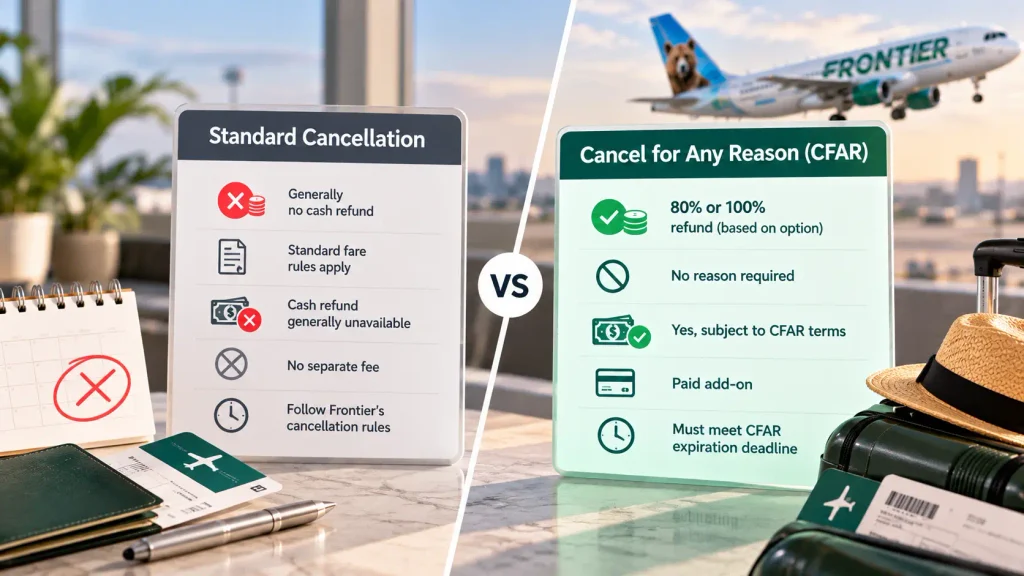
The difference becomes clearer when the options are placed side by side.
| Feature | Standard cancellation | Cancel for Any Reason |
| Refund for simply changing plans | Generally no cash refund | Yes, subject to CFAR terms |
| Reason required | Standard fare rules apply | No reason required |
| Cash refund | Generally unavailable for voluntary cancellations | 80% or 100%, based on option |
| Additional purchase | No separate CFAR fee | Paid add-on |
| Cancellation timing | Must follow Frontier’s rules | Must meet CFAR expiration deadline |
| Travel insurance | No | No |
| If Frontier cancels | Separate refund rules apply | Standard airline rights still apply |
Frontier’s current cancellation rules vary according to when the reservation was made and the fare or bundle purchased. For bookings made on or after September 25, 2026, Basic/Standard fares have a $149 cancellation fee, while qualifying Economy, Premium and Business bundles and Economy Fare have no cancellation fee.
That means travelers should not compare CFAR with a single universal Frontier cancellation policy. The underlying fare matters.
Who Should Consider Buying Frontier CFAR?
CFAR is most useful for travelers who have a meaningful possibility of canceling but cannot predict a specific qualifying reason.
It may be worth considering for:
Expensive bookings
The larger the nonrefundable amount at risk, the more valuable a potential refund can become.
Family or group trips
Plans involving several travelers can change more easily because one person’s circumstances may affect the entire itinerary.
Trips booked far in advance
A reservation made months ahead leaves more time for work, family or personal plans to change.
Travelers who value cash refunds
Someone who rarely uses airline travel credits may place substantially more value on a refund to the original payment method.
Who May Want to Skip It?
CFAR is not automatically a good purchase for every Frontier ticket. It may be less compelling when:
- The airfare is very inexpensive.
- The traveler is highly confident about taking the trip.
- The traveler already has suitable cancellation protection.
- A qualifying Frontier fare or bundle already provides favorable cancellation terms.
- The CFAR price is high relative to the amount that could be lost.
For example, adding a relatively expensive protection product to a very cheap one-way ticket may not make economic sense. The same protection could be more attractive for a costly round-trip reservation involving several passengers.
The decision should therefore be based on the actual CFAR price displayed at checkout, not a generic percentage.
Does CFAR Earn Frontier Miles?
The CFAR purchase should not be treated as an airfare component that automatically earns loyalty rewards.
The Upgraded Points analysis reports that the CFAR purchase does not earn Frontier Miles under Frontier’s loyalty terms.
Travelers who collect Frontier Miles should therefore distinguish between the base airfare and optional products added during checkout.
How to Buy Frontier Cancel for Any Reason
CFAR is offered as part of the Frontier booking process rather than as a general protection policy that travelers can add to any old reservation.
The basic process is:
- Search for a Frontier flight on FlyFrontier.com or the Frontier app.
- Select the itinerary and fare.
- Review the optional products presented during checkout.
- If CFAR is offered, review the available refund options.
- Compare the 80% and 100% choices.
- Review the expiration date and terms.
- Decide whether the additional cost is worthwhile.
- Complete the booking.
Frontier confirms that the product is offered through its website and mobile app and is purchased during booking.
Frontier CFAR vs. a Credit Card’s Trip Protection
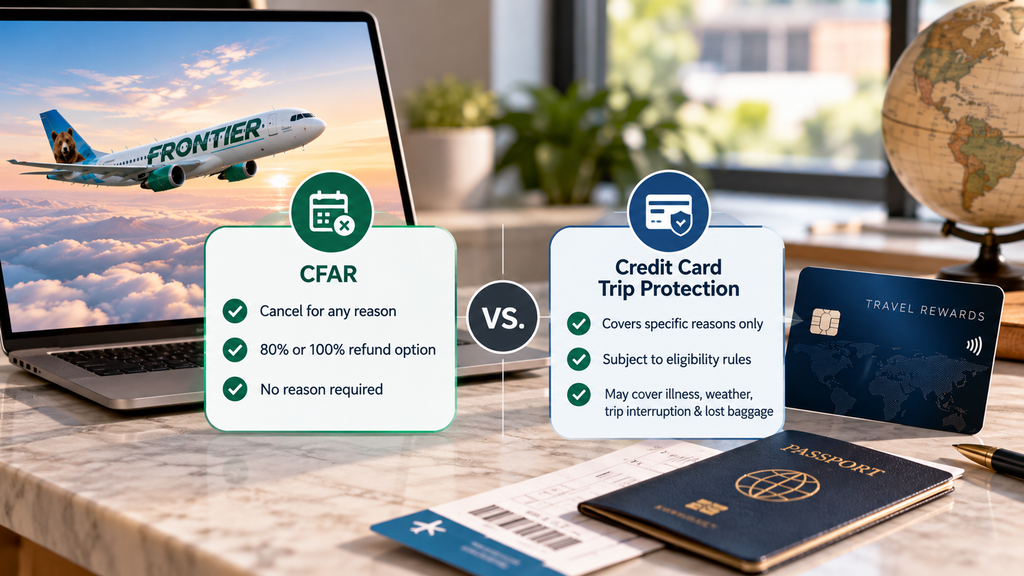
A travel credit card can sometimes provide another layer of protection, but it is important not to confuse the two.
A credit-card trip cancellation policy usually has covered reasons and specific eligibility requirements. CFAR is different because its principal appeal is the ability to cancel without having to establish one of those qualifying reasons.
For example:
| Situation | CFAR | Typical covered-trip insurance |
| Traveler simply changes their mind | Potentially covered | Usually not |
| Covered illness | Potentially cancelable under CFAR | Potentially covered |
| Certain severe weather events | Potentially cancelable under CFAR | Potentially covered, depending on policy |
| Lost baggage | Not its primary purpose | Potentially covered |
| Trip interruption | Not its primary purpose | Potentially covered |
| Frontier cancels qualifying flight | Standard airline rights apply | Policy-specific |
Actual credit-card and insurance benefits vary significantly, so travelers should read the applicable terms instead of assuming that a premium card automatically provides unrestricted cancellation protection.
Is Frontier’s Cancel for Any Reason Worth It?
It can be worthwhile when the probability or financial impact of canceling is high enough to justify the added cost.
The strongest case is generally a relatively expensive itinerary where plans are uncertain and a traveler would strongly prefer cash back over an airlines credit.
The case is weaker for a cheap fare that the traveler is highly likely to use.
A useful way to decide is to ask three questions before checkout:
- How much would be lost if the trip had to be canceled?
- How much does CFAR cost for this particular booking?
- Does existing insurance or credit-card coverage already protect the biggest risks?
If the answers show that the traveler could lose a substantial amount and value flexibility, the 100% option may be worth comparing against the cheaper 80% option.
If the reservation is inexpensive, however, paying a significant additional amount for flexibility may simply increase the overall cost without providing much practical benefit.
Frontier Cancel for Any Reason: Key Takeaways
Frontier’s new CFAR option changes the economics of booking a nonrefundable low-cost fare. Instead of relying solely on travel credit rules, eligible customers can purchase an additional product that allows cancellation for any reason under the applicable terms and choose an 80% or 100% refund option.
The most important point is that CFAR is optional, paid protection—not a blanket replacement for Frontier’s refund policy or travel insurance. Its price varies, the service has an expiration deadline, and the cost of the protection itself needs to be included when assessing its value.
Before purchasing, travelers should compare the CFAR price with the ticket’s cancellation rules, any included fare benefits, and existing credit-card or travel-insurance coverage. That comparison is more useful than automatically selecting the highest refund option.
Final Takeaway
Frontier’s Cancel for Any Reason product gives travelers something the airline’s traditional nonrefundable fares generally do not: the ability to change their minds and potentially recover most or all of the fare without providing a specific cancellation reason.
The smartest approach is to price the protection at checkout, compare it with the fare’s existing cancellation rules, and check any credit-card or travel-insurance benefits first. For expensive or uncertain trips, the added flexibility may be valuable; for inexpensive fares, paying extra for protection may not be necessary.
Frequently Asked Questions
Yes. Frontier offers a paid Cancel for Any Reason product through its website and mobile app. Customers can cancel according to the product’s applicable deadline and receive the refund percentage selected at purchase.
There is no single fixed price. The CFAR cost is shown during booking and varies by itinerary and booking circumstances. The 100% refund option is generally priced higher than the 80% option.
Frontier describes CFAR as an additional paid item offered during the booking process. Travelers should therefore check the option before completing a new reservation rather than assuming it can be added later.
No. CFAR is a separate optional cancellation product powered by HTS. It does not function as comprehensive travel insurance for medical problems, baggage issues, or trip interruptions.
A Frontier cancellation can trigger separate refund or rebooking rights under the airline’s standard policies. CFAR is not required to claim a refund when the passenger is already entitled to one because of an airline cancellation or qualifying schedule disruption.
Generally, Frontier tickets are nonrefundable, although important exceptions apply. These include qualifying cancellations within 24 hours of booking when the flight is at least seven days away, certain airline-initiated disruptions, and particular fare or loyalty benefits.
Travelers should not assume that the cost of CFAR itself is refundable. The product fee is separate from the airfare and should be considered a cost of obtaining the cancellation protection.