
Alaska and Hawaiian Plan Deeper Oneworld Partnerships
Alaska Airlines and Hawaiian Airlines could gain deeper connections with major Oneworld carriers as Alaska Air Group moves toward participation in existing joint businesses across the Atlantic and Pacific. The plan could eventually allow closer coordination on international routes, schedules, fares, and connections, but regulatory approval is still required before the proposed arrangements can take effect.
Alaska Airlines and American Airlines announced the plans on September 29, 2026. Under the proposal, Alaska would join American’s existing Atlantic and Pacific joint businesses. The Atlantic partnership includes American Airlines, British Airways, Iberia, Finnair, Aer Lingus, and LEVEL, while the Pacific partnership currently involves American Airlines and Japan Airlines.
The development comes as Alaska Air Group continues integrating Hawaiian Airlines and expanding its international presence.
Read This Blog: Alaska Airlines: 5 New Korean Air Codeshare Routes
Alaska and Hawaiian Joint Venture Plans at a Glance
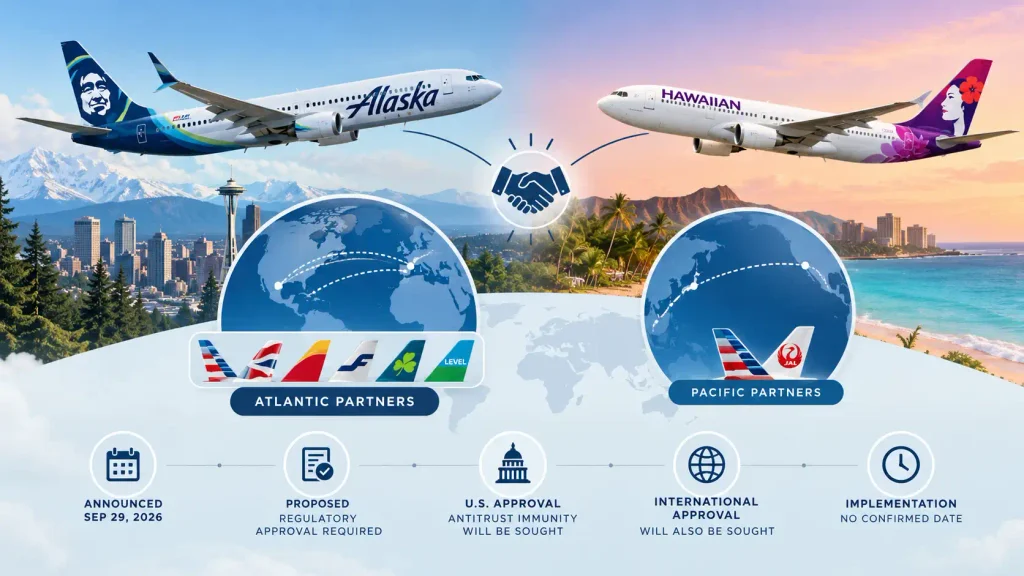
| Detail | Current Information |
| Announcement date | September 29, 2026 |
| Current status | Proposed; regulatory approval required |
| Atlantic Joint Business | American, British Airways, Iberia, Finnair, Aer Lingus, and LEVEL |
| Pacific Joint Business | American and Japan Airlines |
| Alaska Airlines | Plans to join both joint businesses |
| Hawaiian Airlines | Part of Alaska Air Group and Oneworld |
| U.S. approval | Antitrust immunity will be sought from the DOT |
| International approval | Other relevant regulatory approvals will also be sought |
| Implementation date | No confirmed date |
| Oneworld membership | Alaska and Hawaiian are already members |
Alaska and American expect to file for approval and antitrust immunity with the U.S. Department of Transportation and pursue required international regulatory approvals.
What Are Alaska and Hawaiian Planning?
Alaska Air Group is seeking closer cooperation with several Oneworld airlines through two existing joint businesses.
The proposed arrangement covers major international markets in two directions:
- Across the Atlantic: Alaska would join the joint business involving American Airlines, British Airways, Iberia, Finnair, Aer Lingus, and LEVEL.
- Across the Pacific: Alaska would join the partnership between American Airlines and Japan Airlines.
These partnerships are more extensive than standard airline alliance membership.
If regulatory authorities approve the proposal, the participating airlines could coordinate more closely on eligible international services.
What Is an Airline Joint Venture?
An airline joint venture is a commercial partnership that allows participating carriers to coordinate certain aspects of their operations more closely than airlines generally can through alliance membership alone.
Depending on the approved arrangement, participating airlines can coordinate areas such as:
- Flight schedules
- Fares
- Connections
- Sales
- Network planning
- Certain commercial activities
Such cooperation can require antitrust immunity because competing airlines would otherwise face restrictions on coordinating areas such as pricing and schedules.
The proposed Alaska partnerships therefore require government approval before the airlines can implement this deeper level of cooperation.
Joint Venture vs. Oneworld Membership
Airline alliances and joint ventures are related concepts, but they are not the same.
| Oneworld Alliance Membership | Joint Business/Joint Venture |
| Provides a broad airline partnership network | Involves a smaller group of airlines |
| Supports loyalty reciprocity | Can permit deeper commercial cooperation |
| Can provide elite-status recognition | Can include coordinated schedules |
| Can provide lounge and priority benefits | Can include coordinated fares |
| Covers many member airlines | Usually covers defined geographic markets |
| Does not automatically permit joint pricing | Requires appropriate regulatory authorization for deeper coordination |
Alaska Airlines has been a Oneworld member since 2021. Hawaiian Airlines officially joined the alliance in April 2026, becoming Oneworld’s third U.S.-based member airline.
Joining the proposed joint business would therefore represent another stage of international cooperation rather than Hawaiian or Alaska joining Oneworld for the first time.
Which Airlines Are in the Atlantic Joint Business?
The Atlantic Joint Business was established in 2010 and currently includes:
- American Airlines
- British Airways
- Iberia
- Finnair
- Aer Lingus
- LEVEL
Alaska Airlines intends to become another participant if the necessary approvals are granted.
The partnership covers cooperation in the transatlantic market.
For Alaska Air Group, participation could become particularly relevant as the company develops additional long-haul flying and international connections from its West Coast hubs.
Which Airlines Are in the Pacific Joint Business?
The Pacific Joint Business currently consists of:
- American Airlines
- Japan Airlines
The partnership has operated for approximately 15 years.
Alaska’s proposed entry would deepen its commercial connection with these carriers across the Pacific market.
The Pacific side is particularly relevant to Alaska Air Group because Hawaiian Airlines already has an established network across Hawai‘i, Japan, Australia, New Zealand, Tahiti, and other Pacific destinations. Oneworld describes Alaska Air Group as serving more than 140 destinations across North America, Latin America, Asia, and the Pacific.
Where Does Hawaiian Airlines Fit Into the Plan?
Hawaiian Airlines is now part of Alaska Air Group following Alaska’s acquisition of Hawaiian Holdings in September 2024. The airlines subsequently reached a major integration milestone in October 2025 when Alaska received a single operating certificate from the FAA. The two brands continue to be maintained.
Hawaiian then became a full Oneworld member in April 2026.
Its addition brought destinations such as Hilo, Rarotonga, Pago Pago, and Papeete into Oneworld’s broader network while establishing Honolulu as another important alliance hub.
Alaska Air Group’s proposed participation in the Atlantic and Pacific joint businesses would build on that integration and international expansion.
Hawaiian Airlines Is Already a Oneworld Member
The proposed joint ventures should not be confused with Hawaiian’s Oneworld membership.
Hawaiian Airlines officially became a Oneworld member on April 22, 2026, with the alliance publicly welcoming the airline on April 23.
Hawaiian’s membership provides access to benefits associated with the broader alliance.
Atmos Rewards members can earn and redeem points across Oneworld airlines and receive eligible status benefits. Members of other Oneworld airline loyalty programs can likewise earn and redeem on Hawaiian and receive applicable elite recognition.
The proposed joint businesses would go further by permitting closer commercial cooperation among participating airlines if approved.
Check This Out: Hawaiian Airlines Baggage Fees: A Quick Guide
Could Flight Schedules Become Better Coordinated?
Closer schedule coordination is one potential result of airline joint ventures.
Airlines participating in an approved joint business can coordinate schedules on covered routes. This can make it possible to structure connecting flights around each other’s operations more effectively.
For example, an arriving domestic flight could potentially be scheduled to connect more conveniently with a partner’s international departure.
The reference identifies more coordinated connections as one of the potential passenger benefits of the proposal.
However, specific schedule changes have not yet been announced.
Could Airfares Be Coordinated?
Joint ventures can permit participating airlines to coordinate fares on eligible routes under the terms of their regulatory approvals.
This is one of the major differences between a standard alliance relationship and an antitrust-immunized joint business.
The proposed Alaska arrangements could therefore permit closer fare coordination within the covered markets if regulators authorize the partnerships.
No specific fare changes have been announced.
Could International Connections Improve?
Improved connectivity is one of the principal benefits Alaska Air Group associates with the proposal.
Alaska says joining the joint businesses would expand international reach and improve connectivity throughout the West Coast.
The potential network could combine Alaska and Hawaiian’s West Coast and Hawai‘i presence with established international operations from partner airlines.
Possible connection flows could involve:
- Alaska’s U.S. network feeding international partner flights
- Hawaiian’s Pacific network connecting with Oneworld services
- International arrivals connecting to Alaska’s West Coast destinations
- More coordinated transatlantic connections
- More coordinated transpacific connections
Specific new itineraries resulting directly from the proposed joint businesses have not yet been announced.
Why Are the Atlantic Partnerships Important for Alaska?

Alaska Airlines has traditionally maintained a strong presence on the U.S. West Coast and in Alaska, but its network is becoming more international.
The company currently lists major hubs including:
- Seattle
- Honolulu
- Portland
- Anchorage
- Los Angeles
- San Diego
- San Francisco
Alaska Air Group says its airlines fly to more than 140 destinations throughout North America, Latin America, Asia, the Pacific, and Europe.
Joining the Atlantic Joint Business would connect Alaska more closely with established European airlines including British Airways, Iberia, Finnair, Aer Lingus, and LEVEL.
Why Is the Pacific Partnership Important?
The Pacific partnership aligns particularly closely with Alaska Air Group’s expanded network after acquiring Hawaiian Airlines.
Hawaiian has long operated international flights across the Pacific, while Honolulu has become an important hub for the combined airline group.
When Alaska completed the Hawaiian acquisition in 2024, the company said Honolulu would become its second-largest hub and highlighted the potential for greater connections between the U.S. mainland, Hawai‘i, Asia, Australia, and the South Pacific.
Joining the Pacific Joint Business with American and Japan Airlines could deepen cooperation within this strategically important region.
How Does Atmos Rewards Fit Into the Partnership?
Alaska and Hawaiian already share Atmos Rewards, the loyalty program used across the combined airline group.
Oneworld states that Atmos Rewards members can earn status points when flying Alaska, Hawaiian, and eligible airline partners.
Hawaiian’s Oneworld membership also allows eligible members to:
- Earn points with Oneworld airlines
- Redeem points across participating partners
- Receive applicable elite recognition
- Access qualifying priority services
- Use eligible alliance lounge benefits
These benefits already exist independently of the proposed joint businesses.
Any additional loyalty-program changes connected specifically to the joint ventures would depend on future implementation details.
Are Alaska and Hawaiian Already Fully Integrated?
Alaska Airlines completed its acquisition of Hawaiian Airlines in September 2024.
In October 2025, the airlines reached another important milestone when Alaska received a single operating certificate from the FAA. The certificate allows the operation to function under one regulatory framework while maintaining the Alaska and Hawaiian brands.
Integration has also included a shared loyalty program and Hawaiian’s entry into Oneworld.
However, maintaining distinct consumer-facing brands remains part of Alaska Air Group’s strategy.
What Regulatory Approval Is Required?
The proposed joint businesses cannot move forward solely through agreements between the airlines.
Alaska and American state that they expect to seek:
- Approval from the U.S. Department of Transportation
- Antitrust immunity
- Other relevant international regulatory approvals
The carriers said these filings would occur in the coming months.
Antitrust immunity is particularly important because joint businesses can involve coordination that independent competing airlines normally could not undertake.
Have the Joint Ventures Already Been Approved?
No. Alaska’s participation in the Atlantic and Pacific joint businesses has been announced as a plan and has not yet received the required approvals.
The airlines announced their intent on September 29, 2026.
The official announcement specifically states that approval and antitrust immunity will be sought from the U.S. Department of Transportation, along with other relevant international approvals.
Therefore, potential benefits involving coordinated schedules, fares, and network planning should be treated as possible future outcomes rather than current passenger benefits.
When Could Alaska Join the Joint Businesses?
No confirmed implementation date has been announced.
The airlines expect to submit regulatory filings in the coming months, but the length and outcome of the approval process remain uncertain.
Several steps may therefore occur before Alaska formally participates:
- Regulatory applications must be submitted.
- U.S. authorities must evaluate the proposed arrangements.
- Relevant international regulators may also need to provide approval.
- Antitrust immunity must be granted where required.
- The participating airlines would then need to implement approved commercial coordination.
Until those stages are completed, existing airline arrangements remain in place.
What Could Change for Travelers if the Plans Are Approved?
The proposal could affect international travel in several ways.
More Coordinated Connections
Flight schedules could be structured more closely around partner services, potentially improving certain international connections.
Broader Network Coordination
Participating carriers could coordinate eligible routes across their respective networks.
Coordinated Fares
Joint businesses can permit closer fare coordination within their approved scope.
More Integrated International Travel
A deeper partnership could make some itineraries involving multiple participating carriers function more like a coordinated network.
Stronger West Coast International Connectivity
Alaska specifically identifies improved West Coast connectivity and broader international access as objectives of joining the joint businesses.
These remain potential outcomes because regulatory approval has not yet been granted.
What Will Not Change Immediately?
The September announcement does not mean that passengers should expect immediate changes to:
- Existing reservations
- Current flight schedules
- Current fares
- Oneworld benefits
- Atmos Rewards benefits
- Alaska or Hawaiian branding
- Existing partner access
The proposal remains subject to regulatory review.
Hawaiian and Alaska already participate in Oneworld and already share Atmos Rewards, so those existing benefits do not depend on approval of the new joint businesses.
Oneworld Membership vs. Proposed Joint Businesses

The distinction can be summarized as follows:
Already active:
- Alaska is a Oneworld member.
- Hawaiian is a Oneworld member.
- Alaska and Hawaiian belong to Alaska Air Group.
- Alaska and Hawaiian use Atmos Rewards.
- Eligible alliance-wide earning, redemption, status, and priority benefits are available.
Still proposed:
- Alaska joining the Atlantic Joint Business.
- Alaska joining the Pacific Joint Business.
- Deeper commercial coordination permitted by those partnerships.
- New coordinated schedules or fares resulting specifically from the joint businesses.
Key Points About Alaska and Hawaiian’s Joint Venture Plans
The most important details include:
- Alaska and American announced the proposal on September 29, 2026.
- Alaska intends to join two existing international joint businesses.
- The Atlantic Joint Business includes American, British Airways, Iberia, Finnair, Aer Lingus, and LEVEL.
- The Pacific Joint Business includes American and Japan Airlines.
- Joint businesses allow deeper cooperation than ordinary airline alliance membership.
- Alaska and Hawaiian are already Oneworld members.
- Hawaiian officially joined Oneworld in April 2026.
- Alaska Air Group already operates Alaska and Hawaiian under a single operating certificate while maintaining separate brands.
- Regulatory approval and antitrust immunity are still required.
- No confirmed implementation date has been announced.
- No specific new fares or schedules resulting from the proposal have been announced.
Final Thoughts
Alaska Air Group’s planned participation in Oneworld-related Atlantic and Pacific joint businesses could create deeper international coordination, but the proposal remains subject to regulatory approval.
The Atlantic arrangement would connect Alaska more closely with American Airlines, British Airways, Iberia, Finnair, Aer Lingus, and LEVEL. Across the Pacific, Alaska would join the existing partnership between American and Japan Airlines.
The proposal follows several major changes at Alaska Air Group, including the acquisition of Hawaiian Airlines, a single FAA operating certificate, a shared Atmos Rewards loyalty program, and Hawaiian’s April 2026 entry into Oneworld.
For the moment, the existing Oneworld and Atmos Rewards benefits remain the relevant active arrangements. Deeper coordination through the Atlantic and Pacific joint businesses would depend on regulatory approval and subsequent implementation.
Frequently Asked Questions
Alaska Air Group has announced plans for Alaska to participate in existing Atlantic and Pacific joint businesses involving several Oneworld airlines. The proposal still requires regulatory approval.
The Atlantic Joint Business currently includes American Airlines, British Airways, Iberia, Finnair, Aer Lingus, and LEVEL. Alaska intends to join the partnership.
The Pacific Joint Business currently involves American Airlines and Japan Airlines. Alaska plans to join if the proposal receives the necessary approvals.
Yes. Hawaiian Airlines officially joined Oneworld in April 2026 and became the alliance’s third U.S.-based member.
Yes. Alaska Airlines has been part of Oneworld since 2021. The proposed joint businesses represent deeper partnerships beyond standard alliance membership.
No. Alaska and American expect to seek U.S. Department of Transportation approval, antitrust immunity, and other relevant international regulatory approvals.
No confirmed implementation date has been announced. Regulatory filings are expected in the coming months.
If approved, participating airlines could coordinate schedules more closely on eligible routes, potentially improving some international connections. No specific schedule changes have been announced.
Joint ventures can allow participating airlines to coordinate fares within the scope permitted by regulators. No specific fare changes have been announced for Alaska’s proposed participation.
Yes. Alaska and Hawaiian use Atmos Rewards, which provides earning and redemption opportunities across the airlines and eligible partners.
Alaska Air Group has continued to maintain both Alaska Airlines and Hawaiian Airlines as distinct brands while integrating operations under a single operating certificate.
No. Alaska and Hawaiian already participate in Oneworld, and the newly announced joint-business plans remain subject to regulatory approval. Existing alliance benefits therefore remain separate from the proposed deeper commercial arrangements.