
Copa Airlines Economy Review: Comfort & Onboard Service
Copa Airlines Economy Class offers a straightforward, no-frills travel experience on regional and medium-distance routes, with Boeing 737-8 aircraft featuring a 3-3 economy layout, USB-A and USB-C charging, personal-device entertainment, complimentary refreshments, and hot meals on longer flights.
The overall product focuses on practical transportation rather than premium comfort or extensive onboard amenities. Economy passengers receive basic conveniences such as overhead-bin space, charging ports, and access to an entertainment portal. Still, the cabin does not feature seatback screens or Wi-Fi on the flights covered in the source.
The review covers Copa Airlines economy service between Guatemala City, Panama City, and Lima, with both flight segments operated by Boeing 737-8 aircraft. It provides a useful look at the airline’s economy cabin, airport procedures, seating, entertainment, meals, service, and fare differences.
Copa Airlines Economy Class at a Glance
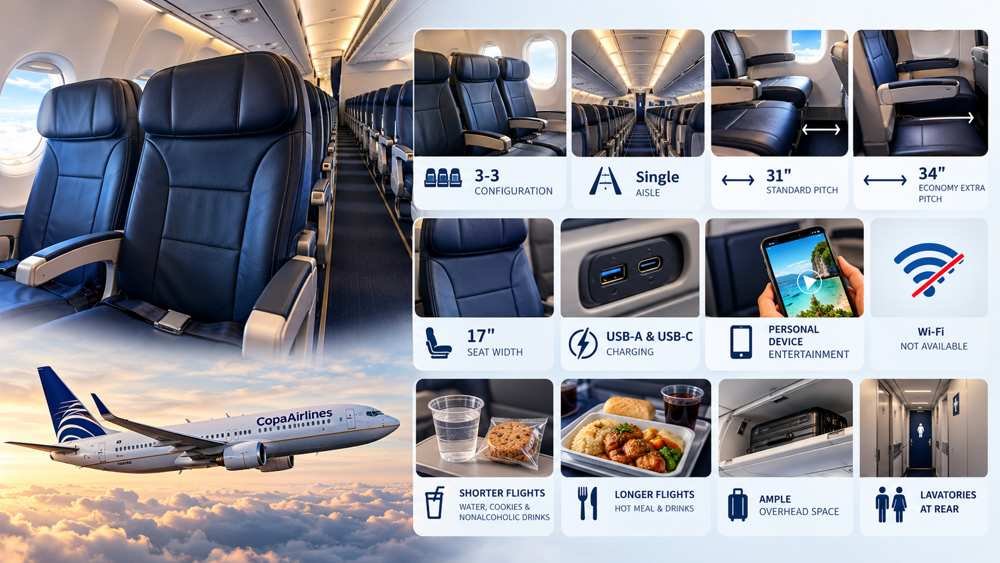
Copa Airlines Economy Class provides practical seating, onboard entertainment, and baggage options that vary by fare and route. Its Boeing 737 fleet includes Main Cabin and Economy Extra seating, while select aircraft offer wireless entertainment through Copa Showpass. Overall, it suits travelers seeking a straightforward option across Copa’s Americas network.
| Feature | Copa Airlines Economy |
| Aircraft reviewed | Boeing 737-8 |
| Economy configuration | 3-3 |
| Cabin aisle | Single aisle |
| Standard seat pitch | About 31 inches |
| Standard seat width | About 17 inches |
| Economy Extra pitch | 34 inches |
| Seat material | Dark blue leather |
| Charging | USB-A and USB-C |
| Seatback screens | No |
| Personal-device entertainment | Yes |
| Wi-Fi | Not available on the flights reviewed |
| Shorter-flight service | Water, cookies, and nonalcoholic drinks |
| Longer-flight service | Hot meal and drinks |
| Economy special meals | Generally unavailable |
| Overhead bins | Ample space |
| Lavatories | Rear of cabin |
| Overall style | Traditional, no-frills |
Booking and Fare Options
The source describes a Copa Airlines itinerary connecting Guatemala City (GUA) with Panama City (PTY), followed by a flight to Lima (LIM). The total cash fare for the itinerary was $240, while an award option required 22,500 United MileagePlus miles plus $48.80 in taxes and fees.
Based on the valuation used in the source, the cash fare represented the better value for that particular itinerary. Redeeming 22,500 miles reduced the effective cash portion by $191.20 after accounting for taxes and fees, producing a redemption value of approximately 0.85 cents per mile.
This illustrates an important point for passengers considering Copa flights through a mileage program: the value of an award ticket depends on the cash fare, taxes, fees, and the value assigned to the miles being redeemed.
Copa Airlines is part of Star Alliance, which allows eligible travelers to interact with partner loyalty programs when booking or earning on qualifying flights.
For economy travelers, the fare type also affects what is included. The source’s fare comparison identifies Basic, Classic, and Full economy options, with differences centered primarily on checked baggage, seat selection, and flexibility.
Copa Basic Economy
The Basic fare provides a personal item and carry-on allowance, but it does not include a free checked bag. Checked baggage therefore requires an additional fee.
Seat selection is also not included in the same way as with Classic, making Basic more suitable for travelers focused primarily on the lowest initial fare.
Copa Classic Economy
Classic includes a free checked bag and free seat selection. It also includes one free change waiver when the change is made at least 8 days in advance of a trip.
Meals and baggage remain the same as the other economy fare options described in the source.
Copa Full Economy
Full includes two free checked bags, making it more suitable for travelers carrying more luggage.
The source states that checked bags can weigh up to approximately 50 pounds each.
Because baggage and seat benefits can significantly affect the final cost of a trip, travelers comparing Copa fares should consider the total cost rather than only the base fare.
Check-In Experience
The airport check-in process described in the source was the least efficient part of the overall journey.
At Guatemala City, the check-in line moved slowly despite multiple agents being available. The queue had fewer than 30 people ahead of the passenger, yet the wait to drop off a checked suitcase exceeded an hour.
The passenger had already completed online check-in and had a boarding pass, but the extra time was spent completing the digital check-in process and airport baggage formalities. Online check-in can save time during preparation, but passengers with checked baggage may still encounter queues at the airport.
For travelers using Copa from Guatemala City, the source suggests allowing additional baggage is advisable based on the conditions described.
The source does not indicate that the same delay occurred at every Copa airport, so the Guatemala City experience should not be taken as representative of all experiences.
Boarding Process
Copa Airlines uses assigned boarding groups, and the groups are actively enforced.
At the gates described in the source, boarding-group signs were easy to identify, and staff made repeated announcements to keep passengers informed.
Passengers were expected to board according to their assigned groups rather than entering the aircraft whenever they reached the gate.
This structured approach can make the boarding process more orderly by reducing confusion about who should board at each stage.
The source also describes an issue with boarding beginning before the cabin crew was ready to receive passengers. This resulted in passengers waiting on the jet bridge before being able to enter the aircraft.
While boarding-group enforcement was a positive operational feature, starting the process before the aircraft was ready created an unnecessary waiting period.
Boeing 737-8 Economy Cabin
Both flight segments in the source were operated by Boeing 737-8 aircraft, resulting in a consistent cabin experience across the itinerary.
The economy cabin uses a conventional 3-3 configuration with a single aisle.
The aircraft provided ample overhead-bin space, allowing passengers to store carry-on luggage above the seats; the seats were upholstered in blue leather. The source describes the seats as clean, although the aesthetic is relatively simple.
The cabin therefore follows a traditional short- and medium-haul economy design rather than a premium or highly customized configuration.
Copa Economy Seat Comfort
The standard Boeing 737-8 economy seat provides approximately 31 inches of pitch and about 17 inches of width, according to the source’s FAQ information.
These dimensions are broadly within the conventional economy-seat range. The standard seats are therefore designed around basic comfort rather than unusually generous personal space. On shorter regional flights, the available space can be adequate, while longer flights can feel more restrictive.
Copa also offers Economy Extra seating.
Economy Extra seats are positioned in the first few rows of the economy cabin and provide 34 inches of pitch. They also have dedicated overhead-bin space above the applicable seats.
The additional pitch provides a noticeable improvement for travelers who prioritize legroom.
Economy Extra
Economy Extra is the stronger seating option for passengers who want additional personal space within the economy cabin.
The first few rows provide 34 inches of pitch, compared with approximately 31 inches in standard economy.
The source also describes strong knee and foot clearance from the Economy Extra seating area. The front-row arrangement places passengers immediately behind the divider separating economy from business class.
For travelers on longer regional flights, the additional pitch can make Economy Extra more attractive than standard economy, particularly when the fare difference is reasonable.
Seat Storage and Tray Tables
The seatback pocket provides enough space for common travel materials. The source specifically notes that it could accommodate a laptop along with the safety information card and inflight magazine.
Tray-table designs vary according to the row.
In the front row, the tray table is stored in the armrest. It folds out from the armrest and becomes a full-size surface when deployed.
Most other economy rows use conventional tray tables that fold down from the seat in front.
The source reports an issue with cleanliness on one front-row tray table, while the tray table on the second flight was clean. This indicates that the condition of individual surfaces can vary between flights.
Charging and Power because
Colports are located in 737-8 economy seats and include both USB-A and USB-C charging ports.
The charging points were especially underneath the seats and were available on both flights described in the study. The ports are USB-A and USB-C, which are most useful for travelers carrying different generations of smartphones, tablets, headphones, and other personal electronics.
However, the location underneath the seats means passengers should identify the charging port before settling in, particularly if the device will need to remain connected throughout the flight.
The presence of charging ports is one of the more useful practical features of the economy cabin, especially because the flights did not offer Wi-Fi.
Inflight Entertainment
Copa’s economy cabin on the aircraft covered in the source does not have individual seatback entertainment screens.
Instead, passengers can use their own smartphones, tablets, or laptops to access an onboard entertainment portal.
The entertainment network includes television programs, movies, games, and a flight tracker.
This approach keeps the aircraft free of traditional seatback screens while still providing digital entertainment for passengers who bring a compatible device.
Travelers should therefore have a charged personal device available if they plan to use the entertainment system.
The USB-A and USB-C charging ports help support that use, although passengers should not assume that the entertainment portal will replace internet connectivity.
Wi-Fi Availability
The flights covered in the source did not have Wi-Fi.
Copa was only beginning its Wi-Fi rollout in the summer of 2026, with Starlink identified as the internet provider.
The source also notes that Copa was the first carrier to charge for Starlink service.
Because the review flights took place before Wi-Fi was available on those aircraft, passengers should distinguish between Copa’s developing Wi-Fi program and the onboard connectivity actually available on the reviewed flights.
For travelers who need reliable internet access during a flight, the lack of Wi-Fi on the aircraft described in the source is an important consideration.
Food and Beverage Service
Copa provides complimentary economy food and beverage service, with the type of sIncluding on flight duration.
For flights shorter than approximately 3.5 hours, economy passengers receive a snack and nonalcoholic drinks.
On longer flights, the service includes a hot meal and drinks.
The longer flight described in the source was more than 3.5 hours and included a choice of two hot meals: chicken with mashed potatoes or beef with rice.
The inclusion of a hot meal on a regional flight of this length provides a more substantial service than the snack-only offering on shorter sectors.
Meals and snacks are included regardless of the economy fare type described in the source, so passengers choosing Basic, Classic, or Full economy do not lose the standard onboard food service.
Special Meal Restrictions
One limitation highlighted in the source is Copa’s policy concerning special meals in economy.
Economy passengers cannot request special meals on most flights, and the airline has several restrictions surrounding special meal requests.
The source contrasts this with business class, where special meal requests were available on the Panama City-to-Lima flight discussed.
For passengers following vegan, vegetarian, religious, medical, or other specialized diets, the lack of a suitable special-meal option can therefore be a significant consideration.
Travelers with dietary requirements may need to plan ahead and carry appropriate food rather than relying entirely on the onboard meal service.
Economy Cabin Service
The cabin service described in the source is practical and task-focused.
On the shorter flight, flight attendants distributed water and cookies to economy passengers.
On the longer flight, the crew provided a hot meal and a choice of drinks.
The service is therefore centered on completing the scheduled onboard duties rather than providing a highly personalized or elaborate interaction.
At the end of the flight, flight attendants were positioned near the aircraft door to say goodbye to passengers and thank them for flying with Copa.
The overall service style is best characterized as functional and straightforward.
Cabin Cleanliness
Cabin cleanliness was generally positive in the source.
Apart from the condition of one tray table, the cabin was described as clean.
The lavatories remained clean on both flights.
The rear-of-cabin lavatories are compact and conventional, reflecting the limited space normally available on a narrow-body Boeing 737.
The combination of clean cabin areas and maintained lavatories contributes to a satisfactory basic economy experience, even though the aircraft does not offer premium facilities.
Baggage Allowance
The source’s FAQ identifies the baggage allowance associated with Copa economy fares.
Every economy ticket includes one personal item and one carry-on weighing up to 22 pounds at no additional charge.
Checked baggage varies by fare.
| Economy Fare | Free Checked Bags | Seat Selection |
| Basic | None | Not included |
| Classic | 1 | Included |
| Full | 2 | Included |
Checked bags can weigh approximately 50 pounds each.
The baggage differences are therefore one of the most important distinctions between Copa’s economy fare families.
Travelers who need to check luggage may find that Classic or Full provides better overall value than Basic after baggage fees are considered.
Copa Economy: Strengths
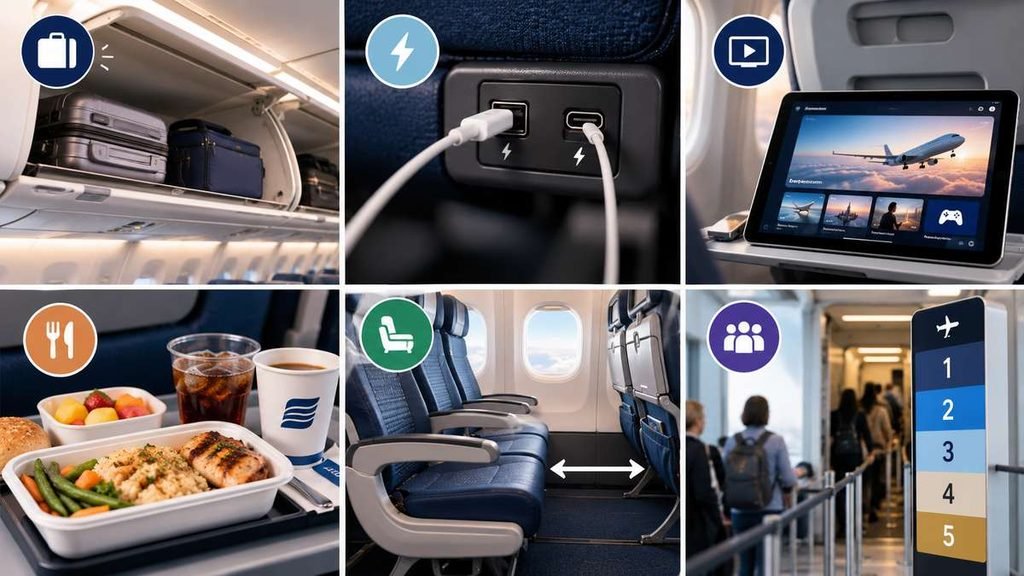
Copa’s economy product has several practical advantages.
Generous Overhead-Bin Space
The Boeing 737-8 aircraft described in the source provided ample overhead-bin space.
USB-A and USB-C Charging
Both charging standards are available underneath the seats, making it easier to keep personal electronics powered.
Personal-Device Entertainment
Passengers can access television programs, movies, games, and a flight tracker through an onboard entertainment portal.
Complimentary Food and Drinks
Economy passengers receive snacks and nonalcoholic drinks on shorter flights, while longer flights receive a hot meal and drinks.
Economy Extra
Passengers who want additional space can select Economy Extra seats offering 34 inches of pitch.
Structured Boarding
Boarding groups are clearly designated and actively enforced.
Copa Economy: Limitations
The product also has several limitations that travelers should consider.
No Seatback Entertainment Screens
Passengers must use their own devices for entertainment.
Limited Wi-Fi Availability
The flights covered in the source did not offer Wi-Fi, although Copa had begun introducing Starlink-equipped aircraft in 2026.
Special Meals Are Restricted
Economy passengers generally cannot request special meals on most flights.
Standard Economy Space
Standard seats offer approximately 31 inches of pitch and 17 inches of width, providing conventional rather than generous economy space.
Check-In Delays
The Guatemala City baggage-drop experience described in the source involved a wait of more than an hour.
Functional Rather Than Personalized Service
The cabin service is focused on completing scheduled tasks rather than extensive passenger interaction.
Is Copa Airlines Economy Comfortable?
Copa Airlines economy offers standard narrow-body economy comfort on the Boeing 737-8, with approximately 31 inches of pitch and 17 inches of seat width.
The standard cabin is adequate for shorter regional journeys but provides less space than Economy Extra.
Passengers seeking additional legroom can consider Economy Extra, which offers 34 inches of pitch in the first few economy rows.
The seating environment is therefore functional rather than spacious. Travelers on longer flights may find Economy Extra more appealing, particularly when additional legroom is a priority.
Is Copa Airlines Economy Good for Longer Flights?
Copa’s economy product can be practical for medium-distance flights, but the experience remains firmly in the no-frills category.
Longer flights receive a hot meal and drinks, which adds value compared with a snack-only service. The entertainment portal also provides movies, television programs, games, and flight tracking.
However, the absence of seatback screens and Wi-Fi on the reviewed flights means passengers should bring a charged personal device and should not depend on onboard internet access.
For flights extending beyond approximately 4 hours, the standard economy seat can also feel relatively tight according to the source’s description of the seating dimensions.
Economy Extra can therefore be worth considering for travelers who prioritize additional legroom.
Copa Basic vs. Classic vs. Full Economy
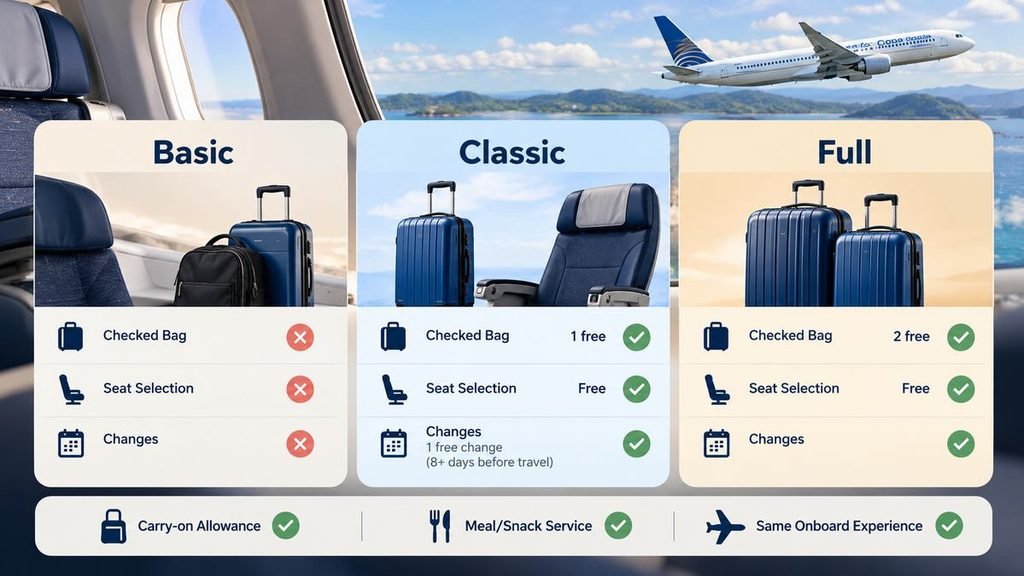
The three economy fare types are primarily differentiated by baggage, seat selection, and flexibility.
Basic is the lowest-level option and does not include a free checked bag or the same seat-selection benefits provided by Classic.
Classic adds a free checked bag, free seat selection, and one free change waiver when made at least 8 days before travel.
Full provides two free checked bags.
The core onboard economy experience remains similar, including the carry-on allowance and meal or snack service. For passengers traveling with only a personal item and carry-on, Basic can provide a lower initial fare. Travelers checking luggage may find Classic or Full more practical because the baggage allowance is included.
Overall Copa Airlines Economy Review
Copa Airlines economy provides a conventional regional-airline experience centered on reliable transportation and basic onboard necessities rather than luxury.
The Boeing 737-8 cabin uses a 3-3 configuration with dark blue leather seats, ample overhead-bin space, and standard economy dimensions. Economy Extra provides 34 inches of pitch and dedicated overhead-bin space, making it the preferred option for travelers who want additional legroom.
The entertainment offering is entirely device-based. There are no seatback screens on the aircraft described, but passengers can connect their personal devices to an onboard portal offering television shows, movies, games, and a flight tracker.
USB-A and USB-C charging ports are a useful addition, particularly because the reviewed flights did not offer Wi-Fi.
Food service is more substantial on longer flights. Shorter flights receive water, cookies, and nonalcoholic drinks, while flights longer than approximately 3.5 hours receive a hot meal and drinks. The reviewed longer flight offered chicken with mashed potatoes or beef with rice.
The major limitation for passengers with dietary requirements is the restricted availability of special meals in economy.
The airport experience can vary. The Guatemala City check-in process described in the source involved a lengthy baggage-drop queue, while boarding itself was structured and strictly organized by assigned groups.
Overall, Copa Airlines economy is best viewed as a functional, traditional, no-frills product. It provides the essential elements needed for regional and medium-distance travel, with some useful extras such as charging ports, personal-device entertainment, Economy Extra seating, and complimentary food service.
Final Verdict
Copa Airlines Economy Class delivers a straightforward travel experience with enough practical features to make regional and medium-distance flights manageable.
Its strongest points are the 3-3 Boeing 737-8 cabin, ample overhead-bin space, USB-A and USB-C charging, personal-device entertainment, complimentary refreshments, hot meals on longer flights, and the availability of Economy Extra seating with 34 inches of pitch.
The biggest compromises are the lack of seatback entertainment screens, limited Wi-Fi availability on the aircraft covered by the source, standard economy legroom, restrictions on special meals, and the lengthy check-in queue described at Guatemala City.
The fare structure is another important consideration. Basic, Classic, and Full differ mainly in baggage and flexibility, with Classic including one checked bag and Full including two. Travelers should therefore compare the complete cost of each fare rather than choosing solely on the initial ticket price.
For passengers seeking a polished or highly interactive premium-style economy experience, Copa may feel basic. For travelers who primarily want a practical way to travel through Latin America, the product offers the core features expected from a conventional economy cabin.
Frequently Asked Questions
Copa Airlines Economy is a straightforward, no-frills product with standard seating, complimentary food or snacks, charging ports, and personal-device entertainment. It can be practical for regional and medium-distance travel, particularly when the fare is competitive.
Standard economy on the Boeing 737-8 provides approximately 31 inches of pitch and 17 inches of seat width. Economy Extra provides 34 inches of pitch and additional legroom.
Economy Extra is a seating option located in the first few rows of the economy cabin. The seats provide 34 inches of pitch and have dedicated overhead-bin space.
No. The Boeing 737-8 aircraft described in the source did not have seatback entertainment screens. Passengers could instead connect their own devices to an onboard entertainment portal.
The flights described in the source did not have Wi-Fi. Copa had begun introducing Starlink-equipped aircraft in the summer of 2026 as it developed its onboard internet service.
Yes. Flights shorter than approximately 3.5 hours receive a snack and nonalcoholic drinks. Longer flights receive a hot meal and drinks. The longer flight described in the source offered chicken with mashed potatoes or beef with rice.
Special meal availability is restricted for economy passengers, and the source states that economy passengers generally cannot request special meals on most flights.
Every economy ticket includes one personal item and one carry-on weighing up to 22 pounds. Basic includes no free checked bag, Classic includes one, and Full includes two. Checked bags can weigh approximately 50 pounds each.
Classic includes a free checked bag, free seat selection, and one free change waiver when made at least 8 days ahead. Basic does not include those benefits, while the meal and carry-on allowance remain the same.
Yes. The Boeing 737-8 economy seats described in the source have both USB-A and USB-C charging ports located underneath the seats.