
Why Nuuk Deserves a Place on Your 2027 Travel Itinerary
Nuuk is worth considering for a 2027 trip because Greenland’s capital combines Arctic wilderness, Inuit culture, museums, contemporary dining, hiking, whale watching, and enormous fjord landscapes within easy reach of a small urban center. Getting there has also become easier following the opening of Nuuk’s expanded international airport.
Nuuk is Greenland’s largest city, yet it has fewer than 20,000 residents. Within minutes of the city center, travelers can reach the coastline of the Nuuk Fjord or head toward mountains and backcountry landscapes. At the same time, the capital has restaurants, cafés, shops, cultural institutions, museums, and contemporary architecture.
That combination makes Nuuk quite different from destinations where Arctic nature requires a separate expedition from the city.
If Greenland is on your travel list, here are 10 reasons to consider visiting Nuuk in 2027, followed by practical advice on seasons, transportation, trip length, and planning.
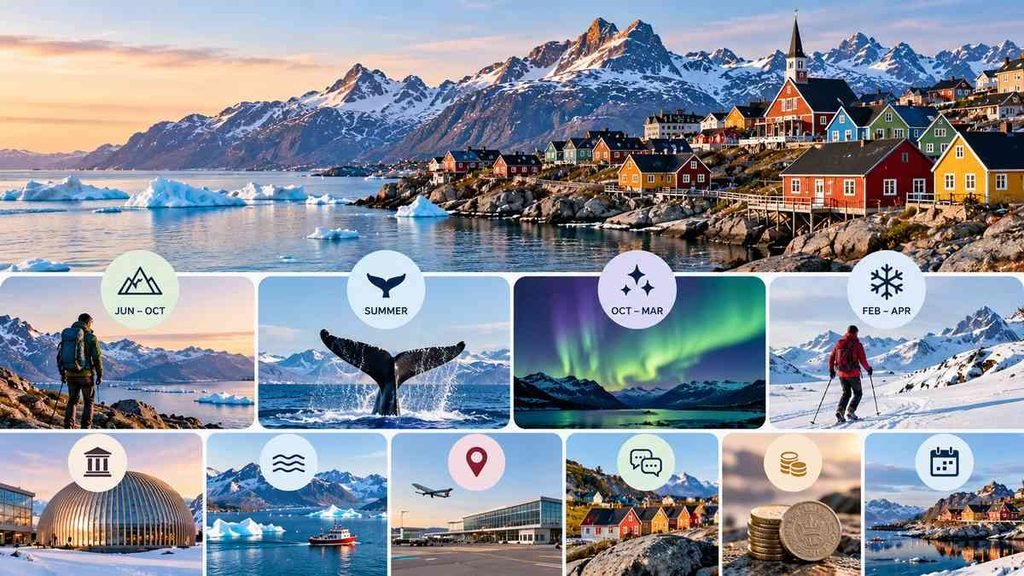
Nuuk, Greenland at a Glance
| Travel Detail | Information |
| Destination | Nuuk |
| Country | Greenland |
| Airport | Nuuk Airport (GOH) |
| Best for hiking | June-October |
| Whale-watching season | Primarily summer |
| Northern lights | October-March |
| Winter activities | February-April is particularly suitable for skiing and snowshoeing |
| Major cultural attractions | Greenland National Museum, Nuuk Art Museum, Katuaq |
| Major natural attraction | Nuuk Fjord |
| Languages visitors may encounter | Greenlandic and Danish; English is also used within tourism |
| Currency | Danish krone (DKK) |
| Ideal stay | Around 3-5 days for many first-time visitors |
The best season depends heavily on what you want to do. Visit Greenland from February through April for skiing and snowshoeing, June through October for hiking, whale watching, boat tours and fishing, and October through March for northern lights.
1. Getting to Nuuk Is Easier Than It Used To Be
Accessibility is one of the biggest reasons Nuuk is attracting more attention.
Nuuk’s expanded international airport opened in late 2024, allowing larger aircraft to fly directly to the capital rather than requiring many international travelers to transfer through another Greenlandic airport.
Nuuk now functions as Air Greenland’s main international hub, connecting international passengers with destinations elsewhere in the country.
Air Greenland currently operates direct service between Nuuk and Copenhagen and also serves international connections involving Iceland. Direct flights connect Copenhagen and Reykjavík, while domestic Air Greenland flights link Nuuk with several communities across Greenland.
What Changes in 2027?
Greenland’s aviation network continues evolving.
A new international airport at Ilulissat opened in late 2026, meaning travelers heading specifically for Disko Bay may no longer need to connect through Nuuk as frequently. Nuuk nevertheless remains Air Greenland’s principal hub.
Air Greenland has also announced plans for its new Airbus A320neo, named Unaaq, to enter service in spring 2027. The airline said the aircraft would also be deployed between Nuuk and Copenhagen, although the final schedule had not yet been announced when the plan was published.
For 2027 travelers, the practical takeaway is straightforward: check current schedules rather than relying on an older Greenland itinerary that automatically routes every trip through Kangerlussuaq.
2. The City and Arctic Wilderness Sit Side by Side
One of Nuuk’s most unusual qualities is how quickly the urban environment gives way to wilderness.
Travelers can walk only a few minutes from the modern city center to the shore of Nuuk Fjord, while mountains and backcountry terrain are a short drive away.
That allows visitors to spend the morning in a museum or café and the afternoon on a boat, hiking trail, or outdoor excursion.
Mountains dominate the landscape around Nuuk. Two particularly recognizable areas are:
- Quassussuaq (Lille Malene)
- Ukkusissaq (Store Malene)
Experienced hikers can tackle more demanding routes, while shorter outings provide opportunities to experience the surrounding terrain without committing to a multiday expedition.
The result is a destination that can work both as a city break and as a starting point for an Arctic adventure.
3. Nuuk Fjord Is an Adventure on Its Own
The Nuuk Fjord system is one of the biggest reasons to spend more than a day in the capital.
Boat tours operate throughout the year, although available routes and conditions vary seasonally.
Excursions can range from a few hours on the water to full-day trips deeper into the fjord system. Some visit settlements, while others focus on scenery, fishing, wildlife, or the icefjord. Private boat charters can provide additional flexibility.
Depending on the season and operator, activities around the fjord may include:
- Boat sightseeing
- Fishing
- Whale watching
- Stand-up paddleboarding
- Kayaking
- Settlement visits
- Icefjord excursions
- Photography
Summer travelers can also combine fishing with dining at Qooqqut Nuan, a restaurant situated in the Nuuk Fjord. It is the type of excursion that illustrates why travelers should not judge Nuuk only by what appears on a city map.
4. Summer Brings Whale-Watching Opportunities
Wildlife provides another reason to visit during the warmer months.
Humpback, fin, and minke whales are among the species commonly associated with Greenland’s summer waters. A group of humpback whales repeatedly returns to Nuuk Fjord during summer.
Sightings can never be guaranteed, but travelers visiting during the appropriate season can join boat excursions that combine fjord scenery with the possibility of seeing whales.
June through October is generally a good period for whale watching and boat trips around Nuuk.
Whale watching also demonstrates why trip timing matters so much in Greenland. Someone visiting primarily for whales will plan a very different Nuuk vacation from a traveler hoping to see the northern lights.
5. Winter Can Bring Northern Lights Over the Capital
Nuuk is also a year-round destination.
From roughly October through March, dark nights create opportunities to see the aurora borealis.
It is sometimes possible to see the northern lights from Nuuk itself, but heading away from city lighting can improve viewing conditions. Both road- and boat-based northern-lights excursions are available.
Aurora visibility still depends on factors including:
- Cloud cover
- Solar activity
- Darkness
- Weather
- Location
Travelers should therefore avoid planning a short winter trip around the assumption that the lights will appear on a particular evening.
A longer stay gives you more opportunities if weather interferes.
6. Nuuk Is One of Greenland’s Best Places To Understand Its History
Greenland is much more than its glaciers and Arctic landscapes, and Nuuk provides an important introduction to the country’s history.
The Greenland National Museum and Archives covers approximately 4,500 years of Greenlandic history, ranging from early Arctic Stone Age cultures through Norse settlement, Thule culture, Inuit life, and more recent periods.
Among its collections are:
- Qilakitsoq mummies and clothing
- Traditional skin boats
- Dog sledges
- Historic clothing
- Ethnographic objects
- Art and photography
The museum is located in the old Colonial Harbour, making it easy to combine with a walk around the historic waterfront.
Visitors can also stop at Nuuk Local Museum, which focuses more specifically on Nuuk’s development, particularly from the 1950s onward as the city developed into Greenland’s capital.
Visiting both can provide a broader perspective than treating Nuuk merely as a jumping-off point for outdoor tours.
7. Contemporary Greenlandic Culture Is Easy To Experience
Nuuk is not a preserved historical settlement. It is Greenland’s contemporary cultural center.
One of its most recognizable buildings is the Katuaq Cultural Centre, whose architecture draws inspiration from the movement of the northern lights. Katuaq hosts concerts, exhibitions, films, conferences, performances, and other cultural events.
The building also houses Cafetuaq and sits within walking distance of central shops, hotels, and the Colonial Harbour.
Another worthwhile stop is Nuuk Art Museum.
The museum holds more than 1,200 works and objects, including historic and contemporary art associated with Greenland. Its collection encompasses paintings, carvings, and works by Greenlandic Inuit artists as well as European artists who depicted Greenland.
Travelers can also follow the Nuuk Art Walk, a self-guided route highlighting public artworks around the city.
These experiences help visitors see how modern Greenlandic artists and institutions interpret identity, history, landscape, and Inuit culture today.
8. Nuuk Has a More Interesting Food Scene Than Some Visitors Expect
Travelers arriving in Nuuk expecting only basic Arctic provisions may be surprised by the capital’s food scene.
Nuuk blends local Greenlandic ingredients with international culinary influences, from fine dining to more casual fare.
Greenlandic ingredients can include:
- Reindeer
- Musk ox
- Fish
- Shellfish
- Seal
- Whale
- Local berries and herbs
One traditional dish travelers may encounter is suaasat, a Greenlandic soup traditionally made with seal meat. Another culturally significant food is mattak, consisting of whale skin and blubber.
Visitors do not need to seek out traditional ingredients at every meal. Nuuk also has contemporary restaurants, cafés, international dishes, bakeries, and familiar everyday food.
That mixture reflects Nuuk itself: unmistakably Greenlandic but also a modern capital.
9. Hiking Can Start Surprisingly Close to Town
You do not need to travel deep into Greenland to find hiking opportunities.
The mountains surrounding Nuuk provide routes ranging from approachable outings to demanding day hikes.
Quassussuaq (Lille Malene) is accessible throughout the year with appropriate seasonal equipment, while the hike up Ukkusissaq (Store Malene) can reward experienced summer hikers with panoramic views across Nuuk and the fjord.
Travelers considering independent hikes should take Arctic conditions seriously.
Weather can change quickly, and factors such as:
- Temperature
- Wind
- Visibility
- Snow
- Trail conditions
- Daylight
- Personal fitness
can turn an apparently straightforward route into something more difficult.
Bring appropriate equipment, check local conditions, and consider a guide for routes beyond your experience level.
For travelers who want scenery without a strenuous hike, boat tours and scenic flights offer alternatives.
10. Nuuk Works in More Than One Season
Perhaps the most useful reason to consider Nuuk is that there is no single correct month to visit.
Your ideal travel dates depend on the experience you want.
| Season/Period | Good For |
| February-April | Skiing and snowshoeing |
| June-October | Hiking, fishing, boat tours and whale watching |
| July-September | Arctic char fishing opportunities |
| October-March | Northern lights |
| Summer | Long daylight, fjord excursions and hiking |
| Winter | Snow landscapes, skiing and aurora opportunities |
Seasonal recommendations are based on current destination guidance.
This variety means Nuuk can feel almost like 2 different destinations.
A summer visit emphasizes water, hiking, long days, fishing, and whales. A winter trip centers more on snow, darkness, northern lights, skiing, and indoor cultural experiences.
When Is the Best Time To Visit Nuuk?
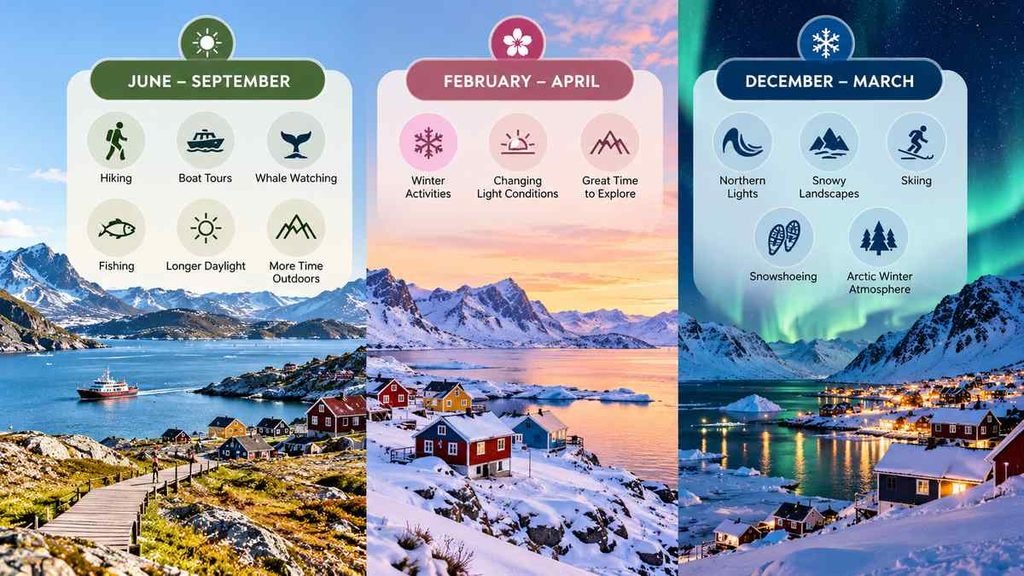
For many first-time visitors interested in outdoor sightseeing, June through September provides a useful combination of hiking, boat excursions, fishing, whale-watching possibilities, and long daylight hours.
But summer is not automatically the best season for everyone.
Choose your dates according to your priorities:
Visit in Summer If You Want:
- Hiking
- Fjord boat tours
- Whale watching
- Fishing
- Longer daylight
- More time outdoors
Visit in Winter If You Want:
- Northern lights
- Snow-covered landscapes
- Skiing
- Snowshoeing
- A distinctly Arctic winter atmosphere
Consider Spring If You Want:
February through April is particularly suited to winter outdoor activities while seasonal light conditions continue changing rapidly.
How Do You Get to Nuuk in 2027?
Travelers can reach Nuuk Airport (GOH) directly from selected international gateways, while Air Greenland also connects Nuuk with communities around Greenland.
Current tourism information identifies Copenhagen and Reykjavík among the important direct international gateways to Nuuk.
Air Greenland’s network continues to evolve following the opening of new international airports in Greenland, so travelers planning for 2027 should check schedules for their exact dates rather than rely on older route maps.
This is particularly important because the opening of Ilulissat’s international airport in late 2026 changes some domestic and international connecting patterns. Nuuk nevertheless remains Air Greenland’s main hub.
Travelers should also build some flexibility into Greenland itineraries. Arctic weather can affect aviation and marine transportation, and a tightly timed connection may leave little room for disruption.
How Many Days Should You Spend in Nuuk?
Around 3 to 5 days can work well for a first visit, although there is no universal ideal length.
A possible 4-day itinerary could look like this:
Day 1: Explore central Nuuk, Colonial Harbour and the Greenland National Museum.
Day 2: Take a Nuuk Fjord boat excursion.
Day 3: Visit Katuaq and Nuuk Art Museum, then explore the city’s restaurants and shops.
Day 4: Go hiking, whale watching, fishing, skiing, or on a seasonal outdoor excursion.
Staying longer gives you more flexibility if weather delays a boat tour or prevents an outdoor activity.
It also allows Nuuk to serve as an actual destination rather than merely an overnight stop.
Is Nuuk Walkable?
Central Nuuk is relatively compact, and many museums, restaurants, shops, cultural venues, and waterfront areas can be reached on foot.
The waterfront of Nuuk Fjord lies only a short walk from the modern city center.
However, not every attraction or trailhead is necessarily within a convenient walking distance. Buses, taxis, tour transfers, or other transportation may be useful depending on where you are staying and what you plan to do.
Winter conditions also change the equation. Snow, ice, wind, and low temperatures can make a distance that looks short on a map considerably less comfortable on foot.
Is Nuuk Expensive To Visit?
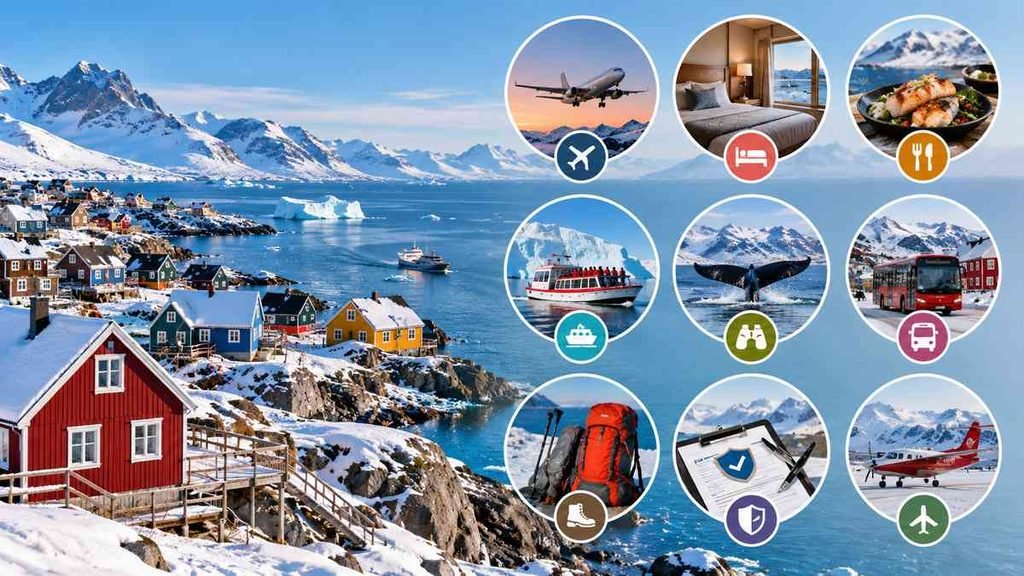
Travelers should generally expect Greenland to require more budgeting than many conventional city breaks.
Many goods must travel long distances, while excursions involving boats, guides, specialist equipment, or aircraft can add substantially to the cost of a trip.
Your budget should account for:
- International flights
- Accommodation
- Meals
- Fjord tours
- Wildlife excursions
- Local transportation
- Outdoor equipment
- Travel insurance
- Domestic Greenland flights, if applicable
Rather than judging the trip only by the cost of a hotel room, calculate the complete itinerary.
A traveler planning several boat excursions will have a very different budget from someone primarily visiting museums, walking around Nuuk, and hiking independently.
Practical Tips for Visiting Nuuk in 2027
Book Accommodation Early
Nuuk’s hotel capacity has been under pressure as air access and visitor numbers have grown. Air Greenland specifically noted limited hotel capacity in Nuuk when discussing recent tourism growth.
If your dates are fixed, particularly during busy summer periods, reserving accommodation early is sensible.
Pack Waterproof Layers
Even during summer, Greenlandic weather can be cool and changeable.
Bring layers rather than relying on one heavy garment.
Leave Some Flexibility
Do not schedule every hour of the trip. Wind, visibility, sea conditions, and other weather factors can affect outdoor excursions.
Check Tour Requirements
Fishing, hunting, hiking, kayaking, and other activities can have licensing, equipment, safety, or guide requirements.
Respect Local Culture
Nuuk is a living capital, not an Arctic theme park. Learn about Greenlandic culture, follow local guidance, ask before photographing people closely, and treat traditional foods and practices respectfully.
Verify 2027 Flights Before Booking
Greenland’s aviation network is changing quickly. Routes, frequencies, aircraft, and seasonal schedules can change between planning and departure.
Final Thoughts
Nuuk stands out because travelers do not have to choose between a city trip and an Arctic adventure.
Within the same stay, you can learn about thousands of years of Greenlandic history at the National Museum, see contemporary Inuit and Greenlandic art, eat in modern restaurants, sail through an enormous fjord system, hike above the city, watch for humpback whales, or—during the darker months—look for the northern lights.
Improved international airport infrastructure has also made Nuuk more accessible, while Greenland’s broader aviation network continues developing for 2027.
The key is to choose the season according to what you actually want to experience. Summer and winter offer dramatically different versions of Greenland’s capital, and either can justify putting Nuuk on a 2027 travel itinerary.
Frequently Asked Questions
Nuuk can be particularly worthwhile for travelers interested in Arctic landscapes, Greenlandic culture, hiking, museums, fjord excursions, whale watching, or northern lights. Its combination of a functioning capital city and easily accessible wilderness distinguishes it from many Arctic destinations.
Yes, northern lights can be visible from Nuuk when conditions are suitable. October through March is the main aurora period, and you’ll want to get away from city lights for better viewing.
Yes. Humpback whales return to the Nuuk Fjord region during summer, and whale-watching opportunities are available. Sightings are wildlife-dependent and cannot be guaranteed.
Nuuk is Greenland’s capital and largest city. It is known for Greenlandic culture, museums, contemporary art, Nuuk Fjord, nearby mountains, outdoor activities, northern lights, and its unusual proximity between city life and Arctic wilderness.
Yes. Major options include the Greenland National Museum and Archives, Nuuk Art Museum, and Nuuk Local Museum. The National Museum covers roughly 4,500 years of Greenlandic history.
Yes. Mountains such as Quassussuaq and Ukkusissaq provide hiking opportunities near the city. Difficulty and accessibility vary by route and season, so hikers should check current conditions and use appropriate equipment.
Greenland uses the Danish krone (DKK). Travelers should check their card’s international fees and carry an appropriate backup payment method.
Greenlandic and Danish are important everyday languages, while English is commonly used in the tourism sector. For example, major visitor attractions such as the Greenland National Museum and Nuuk Art Museum list service in English as well as Greenlandic and Danish.
Yes. Nuuk is promoted as a year-round destination, but available experiences change significantly by season. Summer favors hiking, boats, fishing, and whale watching, while the darker months provide northern-lights opportunities and winter activities.