
Flying Business Class to Europe: Top Ways Compared
Flying Business Class to Europe can offer a significant upgrade over Economy, but the experience can vary widely between airlines, aircraft, and routes. A lie-flat seat, direct aisle access, quality dining, attentive service, and a comfortable lounge can make a long-haul flight considerably more enjoyable, while an older cabin may offer a far less impressive experience despite the higher fare.
The aircraft operating the flight is particularly important on transatlantic routes. Airlines can use different Business Class seats across their fleets, meaning the same carrier may offer everything from a modern suite-style seat to an older product with fewer features.
This guide compares some of the standout Business Class options for flights to Europe, covering the seat, privacy, service, dining, aircraft, and booking considerations. It also highlights what travelers should look for when comparing Business Class fares, so they can choose a flight based on the overall experience rather than the airline name alone.
What makes a business-class flight to Europe worth booking?

A strong transatlantic business-class experience usually combines four elements: a genuinely comfortable lie-flat seat, reliable access to the aisle, thoughtful service, and a ground experience that adds value before departure.
For overnight flights from North America to Europe, the seat is particularly important. A passenger leaving New York for Paris, for example, may spend most of the flight trying to sleep rather than taking advantage of a long list of dining or entertainment features. In that situation, privacy, bed design, bedding, and cabin quietness can matter more than an elaborate menu.
The reverse journey can feel different. A daytime flight from Europe to the U.S. gives travelers more opportunity to enjoy a meal, work, watch movies, or use the lounge. This is one reason the “best” business-class experience depends partly on the direction and length of the itinerary.
The six products at a glance
| Airline/product | Aircraft highlighted | Standout feature | Main consideration |
| Air France Business | Airbus A350-900 | Suite-style privacy and direct aisle access | Aircraft configuration matters |
| Virgin Atlantic Upper Class | Airbus A350-1000 | Private suites and social spaces | Product varies across fleet |
| Singapore Airlines Business | Boeing 777-300ER | Large seat and attentive service | Requires an indirect itinerary from the U.S. East Coast |
| British Airways Club World | Airbus A380 | Full-flat seat and Heathrow connectivity | Older configurations and potentially high award surcharges |
| Lufthansa Business | Older configurations vs. Allegris | New Allegris seats and suites | Finding the new aircraft is essential |
These aren’t universal rankings. They show the strengths and compromises behind different products, while recognizing that fares, aircraft assignments, schedules, and personal priorities can change the calculation.
1. Air France Business Class on the Airbus A350-900
Air France newer A350-900 Business Class is one of the most distinctive European business-class products to consider, combining a fully flat bed, direct aisle access, and a sliding privacy door.
The A350’s redesigned Business cabin has 48 seats, with each seat converting into a nearly two-meter-long bed. The airline describes the product around three principles: full-flat, full-access, and full-privacy.
That makes a meaningful difference on an overnight flight. A solo passenger can close the door to create a more private environment, while couples seated in the center can lower the divider between their seats.
The cabin also offers modern connectivity and entertainment, while Air France’s long-haul service includes meals and premium amenities.
Why the A350 version stands out
The important point is that “Air France Business Class” is not one single seat. Travelers should verify the aircraft and cabin configuration rather than assuming every Air France flight offers the newest suite.
For example, two itineraries both advertised as Air France A350 service can potentially display different configurations. Seat maps and aircraft information therefore deserve attention before booking, particularly for travelers who specifically want a closing door.
2. Virgin Atlantic Upper Class on the Airbus A350-1000
Virgin Atlantic’s Upper Class is built around a very different philosophy. Rather than making the cabin feel purely private, the airline combines individual suites with social spaces.
On the A350-1000, every Upper Class seat faces the window, offers direct aisle access, and converts into a fully flat bed. Virgin also provides storage, personal entertainment, charging options, and mood lighting.
One of the most recognizable features is The Loft, a social area where Upper Class passengers can sit, chat, have a drink, work, or simply change scenery during the flight. Virgin says The Loft is available on selected A350 and A330neo aircraft.
That combination makes Virgin particularly interesting for travelers who don’t want to spend the entire flight inside their own seat.
What to check before booking
Virgin Atlantic operates several long-haul aircraft types, and the Upper Class experience isn’t identical across the fleet. Look for the A350-1000 when the newer Upper Class suite is the priority.
Virgin is also continuing to update its fleet and premium cabin offering, so travelers should confirm the aircraft shown for their specific flight rather than relying only on the route name.
3. Singapore Airlines Business Class on the Boeing 777-300ER
Singapore Airlines is an unusual choice for a U.S.-Europe business-class trip because the most interesting option isn’t a conventional nonstop transatlantic flight.
The airline operates a fifth-freedom-style itinerary connecting New York with Frankfurt through Singapore, with the Singapore-Frankfurt segment operated by a Boeing 777-300ER offering Business Class. Singapore Airlines currently lists New York–Frankfurt itineraries connecting through Singapore and confirms that the 777-300ER operates the Singapore-Frankfurt sector.
That routing is obviously much longer than a nonstop flight from New York to Frankfurt. For a traveler whose only objective is reaching Europe quickly, it makes little sense. But for someone deliberately seeking the Singapore Airlines experience, the itinerary can be attractive.
The 777-300ER Business Class cabin is known for a particularly wide seat, substantial personal space, attentive service, and a refined dining experience. The airline also provides personal entertainment and meals on the relevant sectors.
The catch: geography
This is an important distinction between a great flight experience and a practical Europe itinerary.
A New York traveler can reach Frankfurt nonstop in roughly a transatlantic flight, while the Singapore routing requires traveling eastward across Asia before heading back toward Europe. The extra flying time can overwhelm the benefits for travelers with limited vacation time.
It is therefore best viewed as an aviation enthusiast’s or premium-cabin enthusiast’s routing rather than a straightforward shortcut to Europe.
The business-class products that may not be worth prioritizing
A business-class ticket guarantees a premium cabin, but it does not necessarily guarantee the newest seat or the same level of privacy as a competitor.
The following three examples illustrate why travelers should research the aircraft rather than simply selecting the airline with the most familiar name.
5. British Airways Club World on older configurations
British Airways has made major improvements to its long-haul business class with Club Suite. The newer product provides direct aisle access, a door for privacy, a fully flat bed up to 198 cm (6 feet 6 inches), additional storage, and a larger entertainment screen.
That is a substantial improvement over the airline’s older Club World arrangement.
The distinction matters because British Airways still operates different business-class seat designs depending on the aircraft and route. The airline itself says Club World includes two distinct seat designs, with Club Suite appearing on newer or refurbished aircraft.
When British Airways can still make sense
British Airways has a major advantage for travelers whose destination is London: its Heathrow network can make connections across Europe convenient.
The question becomes one of price and product. If a traveler can book a newer Club Suite at a competitive cash fare or award rate, the proposition differs greatly from paying a large premium for an older Club World seat.
Award travelers should also compare taxes and fees. The cost of an award isn’t simply the number of Avios or other miles required; cash surcharges can materially affect the overall value.
6. Lufthansa Business Class on older aircraft
Lufthansa Airlines provides perhaps the clearest example of why the aircraft should be part of every business-class search.
The airline’s new Allegris Business Class is a major redesign. Lufthansa offers five different Business Class seat types, including a Business Class Suite with a door, and says every seat provides direct aisle access in the Allegris configuration.
It also offers an unusual amount of choice. Travelers can select seats designed for privacy, additional space, or traveling together. The Business Class suites can even be configured for two passengers on certain seats.
The problem is availability. Allegris remains available on selected long-haul routes from Frankfurt and Munich. Its current destination list shows that specific routes can change as the airline deploys the new aircraft.
That means booking “Lufthansa Business Class” isn’t enough. Travelers who specifically want Allegris should verify the aircraft, route, and seat map.
How to identify the product
Before booking, check:
- The aircraft type listed for the flight.
- The seat map when available.
- Whether the route is specifically listed among Lufthansa’s Allegris destinations.
- Whether a later aircraft swap could affect the experience.
For someone who values a modern enclosed suite, these checks can be more important than the airline’s overall reputation.
What should travelers compare before booking business class to Europe?
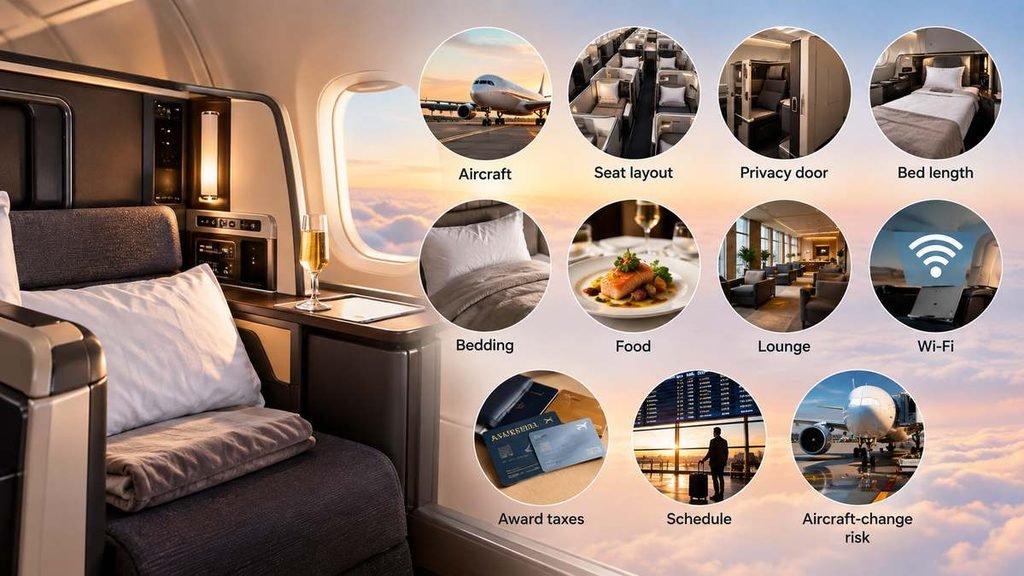
A premium cabin is easier to evaluate when the comparison is broken into individual features.
| Factor | Why it matters |
| Aircraft | Determines which business-class seat may actually be installed |
| Seat layout | 1-2-1 generally gives direct aisle access to every passenger |
| Privacy door | Particularly useful for overnight solo travel |
| Bed length | Important for taller travelers and overnight flights |
| Bedding | Can influence actual sleep quality |
| Food | More relevant on longer daytime sectors |
| Lounge | Adds value before departure and during connections |
| Wi-Fi | Important for working travelers |
| Award taxes | Can change the value of a points booking |
| Schedule | A slightly less luxurious flight may be more practical if it saves hours |
| Aircraft-change risk | A schedule or equipment swap can change the cabin |
The most expensive seat isn’t automatically the most useful one. A traveler who plans to sleep for six hours may prioritize a door and bed over an elaborate meal. Someone taking a daytime flight may put more weight on dining, Wi-Fi, entertainment, and lounge access.
Business class to Europe: nonstop versus connecting
One of the biggest decisions is whether to fly nonstop or connect.
Nonstop flights
A nonstop itinerary generally offers:
- Less total travel time
- Fewer opportunities for missed connections
- No need to change aircraft
- More predictable sleeping time
- Easier arrival planning
For example, an overnight New York-to-Paris flight in a good business-class seat can be considerably more practical than a theoretically superior cabin requiring a long detour.
Connecting itineraries
Connections can make sense when they unlock a substantially better product or a much lower award price.
Paris can be useful for Air France, London for Virgin Atlantic or British Airways, Frankfurt and Munich for Lufthansa, and Amsterdam for KLM. A connection can also open up more award availability.
But travelers should calculate the total journey, not just the quality of the long-haul seat.
A five-hour connection followed by a premium cabin may not be preferable to a nonstop flight simply because the seat is newer.
How to book business class to Europe with points
Business class to Europe can be expensive in cash, which is why transferable points and airline miles are often part of the equation.
Programs such as Air France-KLM Flying Blue, Air Canada Aeroplan, and other airline loyalty programs can provide access to partner or alliance awards, although the mileage requirement, taxes, fees, and availability vary.
Flying Blue, for example, can offer business-class awards between the U.S. and Europe from around 60,000 miles one way at certain saver-level prices, but its award pricing is dynamic, and taxes and carrier-imposed charges can add substantially to the cash component.
You can also book Lufthansa Allegris through partner programs when award inventory is available. The key is to search for the exact flight rather than transferring points first and hoping the seat appears later.
A practical award-booking workflow
- Choose the destination and dates.
- Search several nearby departure airport.
- Identify which airlines operate the route.
- Check the aircraft and business-class configuration.
- Compare cash fares with award prices.
- Add taxes and fees to the mileage cost.
- Confirm the award seat before transferring transferable points.
- Recheck the aircraft closer to departure.
That final step matters because aircraft assignments can change.
Should travelers choose business class for the outbound or return flight?
This is one of the most useful questions for travelers with a limited points balance.
For many U.S.-Europe itineraries, the eastbound flight to Europe is overnight. That makes a lie-flat bed extremely useful, especially for travelers who want to arrive ready to start their trip.
However, the return flight can offer better value in some cases. A daytime westbound flight can provide more time to enjoy the premium cabin, and some travelers may prefer spending points on a longer daytime experience.
The answer depends on the schedule.
A traveler flying New York to London at night might value the bed above almost everything else. A traveler returning from London to New York during the day might place greater value on dining, Wi-Fi, entertainment, and lounge access.
How the three standout products differ?
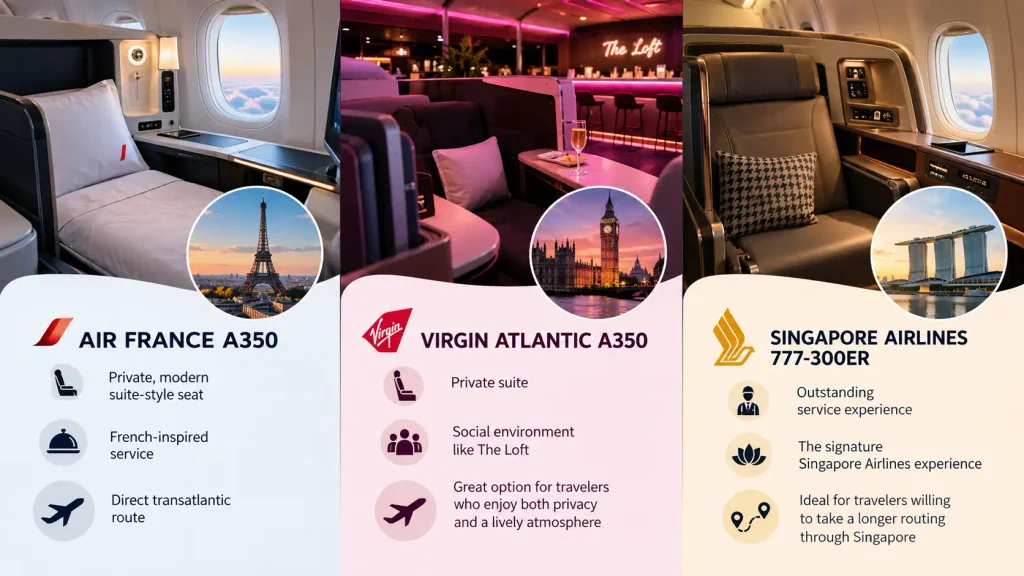
The three experiences highlighted in the reference article have very different strengths.
Air France A350: best suited to travelers who prioritize privacy, a modern suite-style seat, French-inspired service, and a direct transatlantic route.
Virgin Atlantic A350: particularly interesting for travelers who want a private suite but also appreciate a social environment such as The Loft.
Singapore Airlines 777-300ER: appealing for travelers who prioritize service and the Singapore Airlines experience and are willing to accept a much longer routing through Singapore.
These differences demonstrate why a simple airline ranking can be misleading. The right product depends heavily on the itinerary.
What about Delta One?
Delta is worth considering even though it wasn’t among the six flights highlighted in the source article.
Delta One offers lie-flat seating, premium bedding, amenity kits, and suite-style privacy on many aircraft. Delta says its Delta One suites have full-height doors and privacy dividers on most Airbus A350 and A330-900 flights.
The airline is also expanding its suite offering to additional aircraft, including refreshed A330-200/300 aircraft and its new A350-1000.
For travelers departing from cities served by Delta’s extensive transatlantic network, this can make Delta One a practical alternative to European carriers. Delta says its summer 2026 schedule includes more than 650 weekly flights to nearly 30 European destinations.
The same rule applies: check the aircraft rather than relying only on the Delta One label.
How to choose the right business-class flight to Europe
Instead of asking which airline has the absolute best business class, travelers can use a more practical checklist:
For overnight sleep
Prioritize:
- Fully flat bed
- Privacy
- Direct aisle access
- Quality bedding
- Quiet cabin
- Convenient departure time
For daytime flights
Prioritize:
- Dining
- Wi-Fi
- Entertainment
- Lounge access
- Workspace
- Comfortable seating
For couples
Look for:
- Center seats
- Adjustable privacy dividers
- Double suites where available
- Seats that allow conversation without sacrificing aisle access
Lufthansa Allegris, for example, was specifically designed with different traveler needs in mind and includes configurations intended for couples as well as solo passengers.
For points travelers
Focus on:
- Transferable-point access
- Award availability
- Mileage requirement
- Taxes and fees
- Cancellation rules
- Partner-booking restrictions
A 60,000-point business-class award isn’t necessarily better value than a 70,000-point option if the first requires several hundred dollars more in taxes and fees.
Final thoughts
The most important lesson from comparing business-class flights to Europe is that the aircraft can matter as much as the airline. Air France’s newer A350 suite, Virgin Atlantic’s A350 Upper Class, Lufthansa Allegris, British Airways Club Suite and newer Flagship Suite all show how quickly premium cabins are evolving.
Before booking, travelers should compare the exact aircraft, seat configuration, route, schedule, lounge access, cash price, and award cost. A slightly less glamorous business-class product on a convenient nonstop flight can sometimes make more sense than a superior seat that requires a lengthy connection.
FAQs About Business Class to Europe
No single option is best for every traveler. Air France’s newer A350 product emphasizes privacy, Virgin Atlantic combines private suites with social spaces, and Singapore Airlines offers a distinctive premium experience on its New York–Frankfurt routing via Singapore.
It can be especially valuable on overnight flights because a lie-flat seat can provide meaningful sleep. The value depends on the fare difference, flight duration, schedule, and how much the traveler values arriving rested.
No. Lufthansa describes Allegris as a product available on selected long-haul routes, so travelers should verify the aircraft and route before booking specifically for the new Business Class.
Yes. British Airways Club World seats convert into fully flat beds, but the exact design depends on the aircraft and route. Newer Club Suite seats provide direct aisle access and a privacy door.
No. The Singapore Airlines New York–Frankfurt itinerary operates via Singapore; the Singapore–Frankfurt segment uses a Boeing 777-300ER.
The safest approach is to check the aircraft type, seat map, and the airline’s current product information before booking and again before departure. Aircraft swaps can occur, so even a carefully selected itinerary isn’t completely immune to changes.