
citizenM Hotels: What Makes This Hotel Concept Unique?
citizenM is a tech-forward hotel brand built around compact rooms, central locations, smart technology, lively shared spaces, and a deliberately simplified stay experience. Founded in 2008, the brand was acquired by Marriott International in 2025 and is now part of the Marriott Bonvoy portfolio, giving travelers access to a different kind of hotel experience within a major global loyalty ecosystem.
The concept is straightforward: put travelers in well-connected city locations, give them an exceptionally comfortable bed and the technology they actually use, and shift more of the social and working experience into thoughtfully designed common areas. Instead of large rooms, traditional concierge desks, extensive room service, and multiple room categories, citizenM concentrates on what it considers most useful for modern city travelers.
That approach can be particularly appealing for people who spend most of their trip outside the hotel, business travelers who need somewhere comfortable to work, and guests who value design and technology over extra square footage. It is less suitable for travelers who expect spacious suites, in-room dining, traditional concierge services, or extensive room categories.
What Makes citizenM Hotels Different?
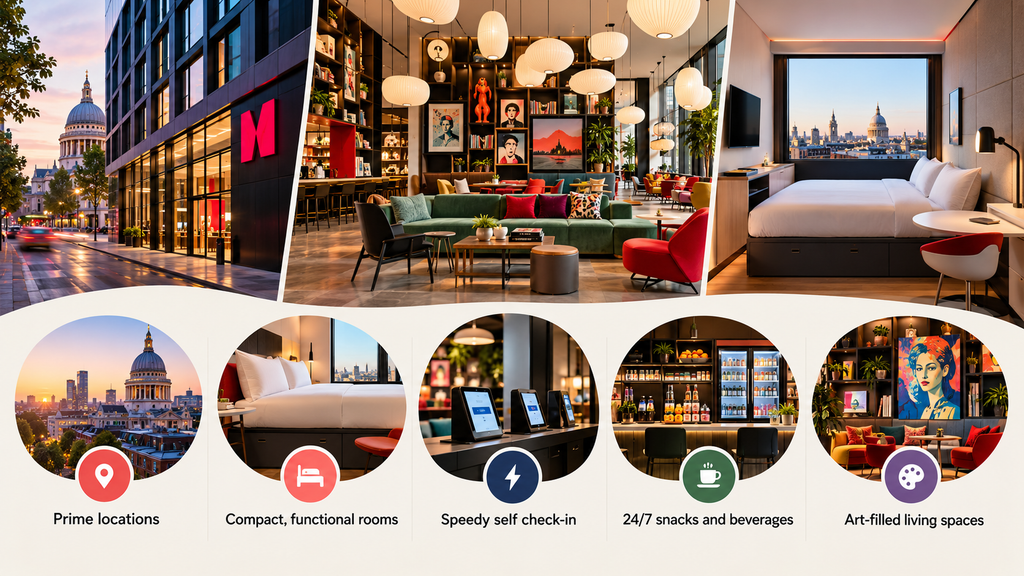
citizenM is best understood as a lifestyle hotel brand rather than a conventional full-service chain. Its hotels emphasize three things: location, efficient rooms, and substantial public spaces.
The rooms are intentionally compact, while the shared areas are designed to feel more like an attractive living room than a conventional hotel lobby. Guests can work, read, eat, watch television, meet other travelers, or simply relax without retreating to a small guest room.
Marriott currently describes citizenM as a brand offering compact rooms, speedy self-check-in, smart design, 24/7 snacks and beverages, and art-filled living spaces.
This makes the brand particularly interesting for city breaks. Someone visiting New York, London, Paris, Copenhagen, Amsterdam, or Rome may spend most daylight hours sightseeing, attending meetings, shopping, or dining. In that situation, paying for a large hotel room that remains empty for most of the day may make less sense than choosing a smaller but highly functional room in a central location.
A Brief History of citizenM
citizenM opened its first hotel at Amsterdam Airport Schiphol in 2008. The original concept focused on making high-quality hotel stays more accessible by removing some traditional features that add complexity and cost.
The brand subsequently expanded into major urban and airport markets across Europe, North America, and Asia.
A major change came in 2025, when Marriott International acquired citizenM. The acquisition brought the brand into Marriott’s portfolio and eventually into Marriott Bonvoy. Marriott’s current documentation confirms that citizenM properties are available through Marriott’s booking channels and participate in Marriott Bonvoy.
That transition is important for travelers comparing older citizenM reviews with the current experience. Information published before the Marriott integration may describe citizenM as a standalone hotel company with its own booking ecosystem. That no longer reflects the full picture.
Where Can Travelers Find citizenM Hotels?
citizenM focuses heavily on major cities and strategically located urban neighborhoods. Current properties include destinations such as:
- Amsterdam
- Austin
- Boston
- Chicago
- Copenhagen
- Dublin
- Geneva
- Glasgow
- Kuala Lumpur
- London
- Los Angeles
- Miami
- New York
- Paris
- Rome
- San Francisco
- Seattle
- Taipei
- Washington, D.C.
- Zurich
The brand’s current portfolio spans more than 30 hotels, with Marriott describing the properties as being positioned in the center of major destinations.
Location is one of the most important parts of the citizenM proposition. For example, citizenM New York Times Square places guests near Broadway, Rockefeller Center, and Central Park, while citizenM Copenhagen Rådhuspladsen sits in central Copenhagen near major attractions and public transportation.
That means the hotel can function as a practical base rather than simply a place to sleep.
What Are citizenM Hotel Rooms Like?
The room is where citizenM’s unconventional philosophy becomes most obvious.
citizenM generally offers one standard room concept rather than a large collection of room categories and suites. Marriott describes each room as designed around an XL king bed, a powerful shower, smart controls, and efficient use of space.
Typical room features include:
- XL king-size bed
- Blackout blinds
- Mood lighting
- Rainfall or powerful shower
- Free Wi-Fi
- Chromecast
- Smart tablet controls
- Television
- Efficient luggage storage
- Compact bathroom design
The tablet is particularly central to the experience. Depending on the property, guests can use it to control elements such as lighting, temperature, blinds and entertainment.
For example, instead of getting out of bed to adjust the room temperature or turn off the lights, a guest can make those changes from the in-room control system. Marriott’s current citizenM pages describe this tablet-controlled approach across the brand.
How Small Are citizenM Rooms?
The rooms are compact by conventional hotel standards, and this is one of the most important things to understand before booking.
The limited footprint is intentional. citizenM prioritizes a large bed, an efficient bathroom, technology, and storage over extra floor space.
That works well for a solo traveler who spends most of the day sightseeing or a couple visiting a city for a short break. It may be less comfortable for travelers carrying several large suitcases, families needing additional beds, or guests who enjoy spending long periods inside their room.
Marriott confirms that the standard citizenM room is designed for two adults.
The citizenM Living Room
Instead of maximizing guest-room size, citizenM invests heavily in its communal areas.
The citizenM living room is central to the concept. These spaces combine seating, books, art, work areas, and places to eat or relax. Marriott describes them as communal spaces where guests can work, watch television, eat, read or simply spend time.
This is especially useful for travelers who don’t want to work from their bed.
A guest staying in New York for a business trip, for example, might spend the morning answering emails in the living room, head to a client meeting, return for a drink, and then use the same space to plan the evening.
The design also makes the hotel feel more social without forcing guests to participate in organized activities.
Working From a citizenM Hotel
Remote workers are one of the audiences most naturally suited to citizenM.
The brand’s public areas provide comfortable places to work, while selected properties also offer societyM meeting rooms for more formal business needs. Marriott confirms that select properties offer meeting rooms.
The combination can be useful for:
- Remote employees
- Freelancers
- Consultants
- Startup teams
- Business travelers
- Small client meetings
- Travelers needing a workspace between flights or appointments
mycitizenM+ subscribers can also receive complimentary coworking access at participating properties, with Taipei excluded from that benefit according to Marriott’s current FAQ.
canteenM: Food and Drinks Without Traditional Room Service
citizenM does not try to replicate a conventional hotel restaurant and room-service model.
Instead, many properties feature canteenM, a 24/7 food-and-beverage concept. It covers everything from coffee and breakfast to snacks, meals, and drinks at different times of day.
This can be especially convenient after a late flight.
For example, someone arriving in Amsterdam at 11 p.m. doesn’t necessarily need to leave the hotel to find an open restaurant. The property’s canteen can provide food and drinks around the clock, depending on the individual hotel’s offerings.
Breakfast is not automatically included with every reservation. Marriott advises guests to check the rate or package selected when booking.
Do citizenM have Rooftop Bars?
Some citizenM hotels feature cloudM rooftop bars, but not every property offers them.
Where offered, these rooftop spaces can give travelers another reason to spend time at the hotel rather than using it as a sleeping base. Marriott highlights cloudM locations for their cocktails, snacks, and city views.
Examples include rooftop spaces associated with citizenM properties in cities such as New York and London.
The important point is that rooftop access is property-specific, so travelers should check the individual hotel’s amenities rather than assuming every citizenM has a rooftop.
Do citizenM have Swimming Pools?
Some citizenM properties have pools, but a pool is not a standard brand-wide amenity.
This is another area where the individual property matters more than the brand name. A traveler specifically looking for a pool should check the hotel’s current Marriott property page before booking.
The same principle applies to parking, rooftop access, fitness facilities, and meeting rooms.
How Does citizenM Check-In Work?
One of citizenM’s signature features is fast self-check-in.
Guests use touchscreen kiosks in the hotel’s check-in area rather than waiting for a conventional front-desk process. Marriott says the process can take approximately 60 seconds to check in and 30 seconds to check out, with Ambassadors available if assistance is needed.
This is useful after a long flight or train journey when the traveler simply wants to reach the room.
The technology does not mean staff disappears from the experience. citizenM uses the term Ambassadors for its hotel staff, who can assist guests with practical questions, check-in problems, and other needs.
What Services Does citizenM Deliberately Leave Out?
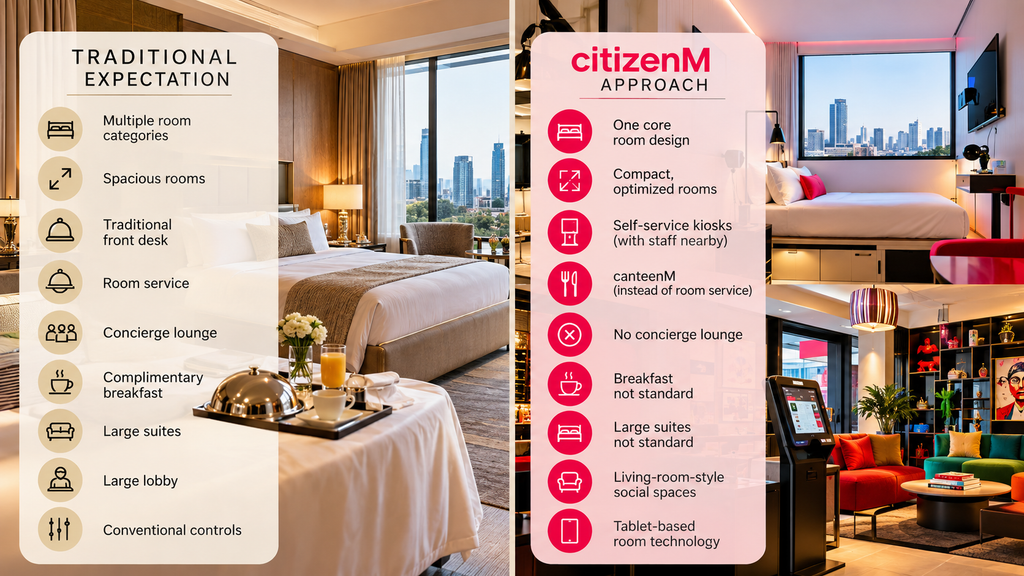
The brand’s simplicity is both a feature and a potential drawback.
Marriott explicitly notes that citizenM does not offer traditional room service, concierge lounges or complimentary breakfast as standard.
That means travelers accustomed to full-service hotels should adjust their expectations.
| Traditional expectation | citizenM approach |
|---|---|
| Large selection of room categories | One core room design |
| Large guest rooms | Compact, highly optimized rooms |
| Traditional front desk | Self-service kiosks with staff nearby |
| Room service | canteenM |
| Concierge lounge | Not provided |
| Free breakfast | Not standard |
| Large suites | Not the brand’s standard model |
| Large lobby | Living-room-style social spaces |
| Conventional controls | Tablet-based room technology |
This trade-off is deliberate. citizenM puts more emphasis on location, design, technology and common spaces than on maximizing in-room amenities.
citizenM and Marriott Bonvoy
The Marriott acquisition has substantially changed the loyalty proposition.
citizenM hotels now participate in Marriott Bonvoy, allowing eligible members to earn and redeem Marriott Bonvoy points at participating properties. Marriott currently states that members earn 10 Marriott Bonvoy points per U.S. dollar and one Elite Night Credit per qualifying night at citizenM.
This is a major difference from older citizenM articles that described the brand as operating outside a major hotel loyalty program.
Travelers can book eligible stays through Marriott.com and the Marriott Bonvoy app, which helps connect the reservation to their Bonvoy account.
What Do Marriott Bonvoy Elite Members Get?
Eligible Marriott Bonvoy elite members can receive applicable benefits at citizenM properties.
Marriott’s current information states that Gold Elite members and above can receive certain benefits such as late checkout and room upgrades when available, although the standardized room design means upgrade opportunities can be limited.
Platinum Elite members and above can receive an Elite Welcome Gift choice at participating citizenM hotels, including points or a food-and-beverage credit under Marriott’s current terms.
This makes citizenM more attractive to existing Marriott travelers than it was before the acquisition.
What Is mycitizenM+?
mycitizenM+ remains citizenM’s paid annual subscription program, but it now works alongside Marriott Bonvoy rather than functioning as a completely separate loyalty ecosystem.
The current membership fee is $170, €150 or £130 per year, according to Marriott’s current citizenM FAQ.
Current benefits include:
- 15% off direct retail room rates
- Up to 30% off during selected sales
- 15% off food and drinks, excluding breakfast
- 15% off meeting rooms
- Complimentary coworking at participating locations, except Taipei
- Marriott Bonvoy Gold Elite status after linking the accounts
Marriott’s loyalty terms confirm that mycitizenM+ does not have its own points system. Members instead earn and redeem through the Marriott loyalty program after linking the accounts.
The membership can therefore appeal most to travelers who stay at citizenM several times a year. Someone staying only once may not recover the annual fee from the room discount alone.
Is citizenM Good for Business Travel?
citizenM can be a strong fit for business travelers who prioritize location, connectivity and a reliable place to sleep over large rooms.
The combination of central properties, fast Wi-Fi, work-friendly common areas, meeting rooms at selected hotels and 24/7 food options is practical for short business trips.
A consultant attending meetings in central London, for example, could use the hotel as a base between appointments instead of spending time commuting back to a suburban property.
The compact room is less important when the guest mainly needs a comfortable bed, shower and workspace outside the room.
Is citizenM Good for Families?
This is where travelers need to pay particular attention.
The standard citizenM room is designed for two adults, and the brand does not follow the traditional model of offering connecting rooms and numerous family-oriented room categories across its portfolio.
Families should therefore check the specific hotel’s occupancy rules before booking.
For parents traveling with children, the compact layout may also feel restrictive compared with a conventional family room or suite.
Is citizenM Good for Couples?
For couples taking a city break, citizenM can make sense when the priority is spending time outside the hotel.
A couple visiting Copenhagen for three days, for example, may prefer a centrally located property with an XL bed and efficient room over a larger suburban hotel that requires longer daily transportation.
The main consideration is space. Couples who like spacious bathrooms, separate sitting areas or room service may find the citizenM concept less appealing.
Advantages and Disadvantages of citizenM
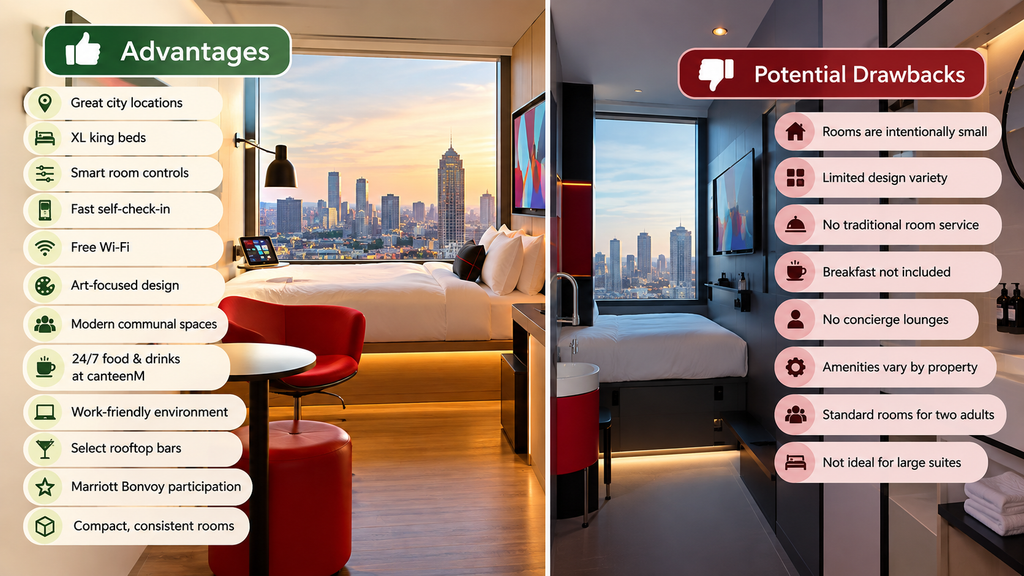
Advantages
- Strong locations in major cities
- Comfortable XL king beds
- Smart room controls
- Fast self-check-in
- Free Wi-Fi
- Art-focused design
- Attractive communal living spaces
- 24/7 food and beverage at canteenM
- Work-friendly environment
- Select rooftop bars
- Marriott Bonvoy participation
- Compact, consistent room concept
Potential Drawbacks
- Rooms are intentionally small
- Standard room design offers limited variety
- No traditional room service
- Breakfast is not automatically included
- Concierge lounges are not part of the concept
- Some amenities vary significantly by property
- Standard rooms are designed for two adults
- Travelers seeking large suites may need another hotel brand
The central question, then, is not simply whether citizenM is “good.” It is whether its particular trade-offs match the trip.
Who Should Consider Staying at citizenM?
citizenM is particularly suited to travelers who:
- Spend most of their day outside the hotel.
- Prefer central urban locations.
- Value design and technology.
- Want a comfortable bed without paying for excessive room space.
- Work remotely while traveling.
- Like social common areas.
- Want Marriott Bonvoy earning and redemption opportunities.
- Prefer quick self-service check-in.
- Travel alone or as a couple.
- Appreciate straightforward hotel concepts.
It may be less suitable for travelers who prioritize large rooms, suites, extensive concierge services, traditional room service or family-oriented accommodations.
How to Choose the Right citizenM Property
Because amenities vary, travelers should compare the individual property rather than relying solely on the brand.
Before booking, check:
Location: Check proximity to the nearest metro, train station, airport connection, and major attractions.
Room details: Confirm occupancy and understand the compact layout.
Amenities: Check whether the property has a gym, rooftop, pool, meeting rooms or other features that matter for the trip.
Breakfast: Determine whether it is included in the selected rate.
Bonvoy participation: For points and elite benefits, book through eligible Marriott channels and add the Marriott Bonvoy number where required.
Membership value: If considering mycitizenM+, calculate the expected savings against the current annual subscription cost.
For example, a traveler planning four citizenM stays could compare the membership’s annual fee with the expected 15% direct-booking savings across those reservations, while also accounting for the food, meeting-room and Gold Elite benefits.
Final Thoughts
citizenM’s appeal comes from doing fewer things, but doing the central parts of the hotel experience distinctively. Its compact rooms, XL beds, smart technology, central locations, communal living spaces, and canteenM concept are designed for travelers who treat the hotel as a comfortable base rather than a destination in itself.
The Marriott acquisition adds another dimension. citizenM is now part of Marriott Bonvoy, allowing eligible travelers to earn and redeem points, while qualifying elite members can receive applicable benefits.
For a city trip where location, sleep quality, technology,y and convenient public spaces matter more than a large suite, citizenM can be an appealing alternative to a conventional hotel. Before booking, however, travelers should compare the specific property’s room size, occupancy rules, amenities, breakfast terms, and Marriott Bonvoy conditions. The brand’s concept is deliberately different—and understanding that difference is the key to knowing whether it fits the trip.
Frequently Asked Questions About citizenM Hotel: Does Marriott own citizenM?
Yes. Marriott International acquired citizenM in 2025, and the brand is now integrated into Marriott Bonvoy.
Yes. Compact rooms are an intentional part of the brand’s business model. Instead of maximizing floor space, citizenM concentrates on an XL king bed, bathroom, smart technology and efficient storage.
No traditional room-service model is offered. citizenM instead uses canteenM for food and drinks, with availability designed around 24/7 service at participating properties.
Yes. Marriott currently states that members can earn 10 Bonvoy points per U.S. dollar and one Elite Night Credit per qualifying night at citizenM. One can also book eligible stays using Marriott Bonvoy points.
No. cloudM rooftop bars are available only at selected properties, so travelers should check the individual hotel’s amenities before booking.
Breakfast is not automatically included with every stay. Inclusion depends on the rate or package selected, and guests can check their reservation details for the applicable terms.
Yes. citizenM provides living-room-style spaces designed for working and relaxing, while selected properties have societyM meeting rooms. mycitizenM+ members can also receive coworking access at participating properties, except Taipei.
No. They are separate programs that now work together. mycitizenM+ is a paid annual subscription offering citizenM-specific discounts and perks, while Marriott Bonvoy is Marriott’s broader loyalty program. Linking the accounts gives eligible mycitizenM+ subscribers Marriott Bonvoy Gold Elite status.
It depends on personal preferences. The compact rooms can work for travelers who spend most of their time sightseeing or working elsewhere, but guests who want substantial in-room space may prefer a larger hotel room or apartment-style accommodation.