
What Are the Must-Have Carry-On Travel Essentials for Flight?
The most important carry-on travel essentials include travel documents, medications, headphones, a portable charger, a reusable water bottle, snacks, personal hygiene products, and comfort accessories. These items help passengers stay organized, comfortable, and prepared for unexpected situations during their journey.
A well-packed carry-on can make a noticeable difference between a comfortable flight and an exhausting travel experience. Whether a traveler is taking a short domestic flight or spending several hours on an international journey, having the right items within reach can reduce inconvenience.
However, packing everything that might be useful is not always practical. Airlines have different cabin baggage allowances, airport security restrictions apply to certain items, and limited storage space requires careful planning.
The most effective approach is to prioritize essential items based on flight duration, personal needs, and destination.
This guide covers the best carry-on essentials for short and long flights, packing tips for different travelers, airport security considerations, and common mistakes to avoid.
Don’t Miss: How Many Bags Can You Bring on Southwest? Carry-On, Checked & Liquids
What Are Carry-On Travel Essentials?
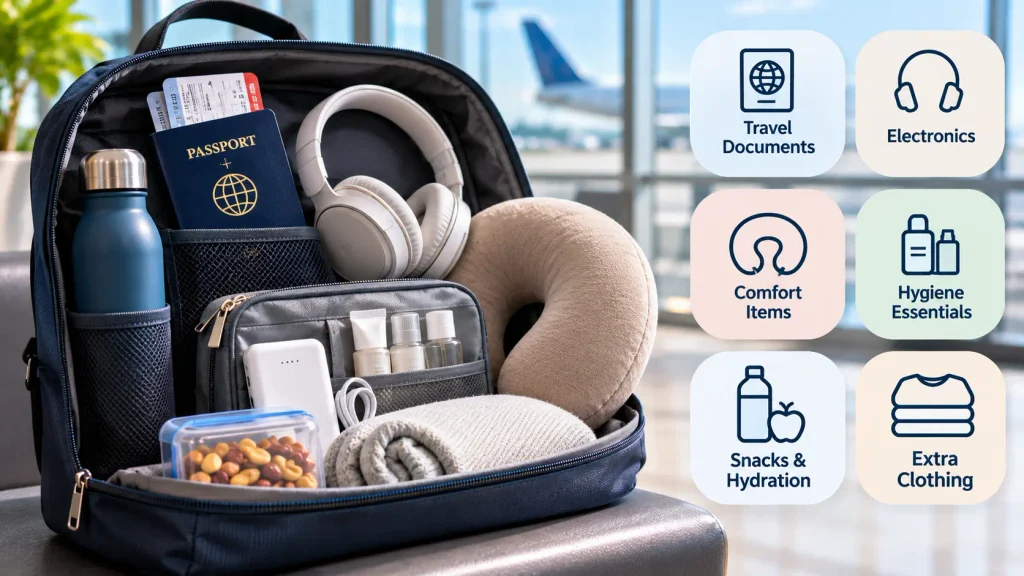
Carry-on travel essentials are items passengers keep in their cabin baggage or personal item to use during the flight or immediately after arrival.
Unlike checked luggage, carry-on bags remain accessible during most of the journey. This makes them useful for storing valuable belongings, important documents, medication, and items needed for personal comfort.
What Should Every Traveler Pack in a Carry-On Bag?
| Category | Essential items | Why they matter |
|---|---|---|
| Travel documents | Passport, identification, boarding pass | Airport verification and boarding |
| Electronics | Phone, charger, power bank | Communication and entertainment |
| Comfort | Neck pillow, eye mask, earplugs | Rest and relaxation |
| Health | Prescription medication, personal medical supplies | Essential health needs |
| Hydration | Empty reusable water bottle | Convenient access to drinking water |
| Food | Packaged snacks, protein bars | Managing hunger between meals |
| Hygiene | Hand sanitizer, tissues, toothbrush | Staying fresh during travel |
| Clothing | Light jacket, extra socks | Managing cabin temperatures |
| Organization | Travel wallet, packing pouches | Keeping belongings accessible |
| Entertainment | Book, e-reader, downloaded movies | Passing time during the flight |
Travelers should choose items based on their individual requirements rather than treating every packing recommendation as mandatory.
What Are the Best Carry-On Essentials for Short Flights?
The best carry-on essentials for short flights are compact items that passengers may need during a journey lasting approximately one to three hours.
Since short flights provide limited time for eating, sleeping, or entertainment, travelers can usually pack fewer comfort accessories.
Essential Tips: Carry-On Luggage Size Chart for 64 Major Airlines – Dimensions, Sizes, & More
Which Items Should Travelers Carry on Short Flights?
- Travel documents: A passport or acceptable identification and boarding pass should remain easily accessible.
- Smartphone: Useful for digital boarding passes, airline notifications, and communication.
- Headphones: Allow passengers to listen to music or downloaded entertainment.
- Reusable water bottle: An empty bottle can be filled after security screening where permitted.
- Small snacks: Packaged snacks can be useful when onboard food is unavailable.
- Hand sanitizer: Helps maintain hygiene during airport and cabin travel.
- Lip balm: Can provide comfort in dry cabin conditions.
- Light sweater: Useful when the aircraft cabin feels cold.
- Portable charger: Provides backup power during delays.
- Travel wallet: Keeps essential documents and payment cards organized.
For a short journey, a small backpack or personal item may be sufficient, provided it meets the airline’s baggage requirements.
What Are the Most Important Carry-On Essentials for Long-Haul Flights?
Long-haul flights require additional comfort, hygiene, and entertainment essentials because passengers may spend eight hours or more onboard.
A thoughtful selection of items can make sleeping, eating, and managing personal needs considerably easier.
What Should Travelers Pack for an Overnight Flight?
| Essential | Main benefit |
|---|---|
| Neck pillow | Supports the neck while resting |
| Sleep mask | Blocks cabin lighting |
| Noise-canceling headphones | Reduces background noise |
| Earplugs | Offers a compact alternative to headphones |
| Compression socks | May help reduce travel-related leg swelling |
| Toothbrush and toothpaste | Helps passengers freshen up |
| Moisturizer and lip balm | Improves comfort in dry cabin air |
| Reusable water bottle | Encourages regular hydration |
| Comfortable clothing | Supports easier movement and rest |
| Extra socks | Adds warmth and comfort |
| Downloaded entertainment | Provides offline activities |
| Medication | Keeps necessary treatments accessible |
Passengers should prioritize lightweight and multipurpose items rather than filling their bags with unnecessary accessories.
Which Travel Comfort Accessories Make Flying Easier?
Travel comfort accessories such as neck pillows, sleep masks, earplugs, and lightweight blankets can make flights more relaxing.
Their usefulness depends on flight duration, seating conditions, and personal preferences.
Is a Travel Neck Pillow Worth Carrying?
A travel neck pillow can help support the head and neck when passengers rest in an upright position.
Memory foam pillows often provide firmer support, while inflatable designs are easier to pack.
Travelers should choose a pillow that fits comfortably without forcing the neck into an awkward position.
Do Sleep Masks Help During Long Flights?
Sleep masks can reduce exposure to cabin lighting, making it easier for passengers to rest.
They are particularly useful on overnight flights when cabin lights, reading lamps, or entertainment screens may remain illuminated.
Adjustable masks with soft materials are generally more comfortable for extended use.
Are Noise-Canceling Headphones Useful on Airplanes?
Noise-canceling headphones can reduce the perception of steady cabin noise, including engine sounds.
They are useful for listening to music, watching movies, or creating a quieter environment.
However, passengers should remain attentive to crew announcements and safety instructions.
Should Travelers Pack Compression Socks?
Compression socks may help reduce leg swelling during prolonged periods of sitting.
They can be useful on long-haul flights, especially for travelers prone to swollen feet or ankles.
However, compression socks are not a substitute for moving regularly, and passengers with circulation-related medical conditions should seek appropriate professional guidance before using them.
What Electronics Should Travelers Keep in Their Carry-On Bags?
Travelers should keep essential electronics such as smartphones, charging cables, power banks, and entertainment devices in their carry-on bags.
These items provide convenience during travel and help passengers stay connected when delays occur.
Which Electronic Devices Are Most Useful During Flights?
| Device | Purpose | Packing consideration |
|---|---|---|
| Smartphone | Boarding passes, communication, entertainment | Keep charged |
| Power bank | Backup device charging | Carry in cabin baggage |
| Charging cable | Charging compatible devices | Use an organizer |
| Headphones | Music and entertainment | Download content beforehand |
| E-reader | Reading without bulky books | Charge before departure |
| Tablet | Movies, work, games | Protect with a case |
| Laptop | Work and personal tasks | Follow security screening instructions |
| Travel adapter | Charging at the destination | Match destination plug standards |
Travelers should check airline rules for electronic devices, particularly batteries and charging equipment.
Can Passengers Carry Power Banks on Airplanes?
Yes. Most airlines allow power banks in cabin baggage, subject to lithium battery safety restrictions.
Power banks generally must not be placed in checked luggage.
Under common aviation guidelines, power banks up to 100 watt-hours are usually permitted, while larger batteries may require airline approval or be prohibited.
Some airlines also restrict the use or charging of power banks during flights.
Passengers should verify the operating airline’s current requirements before traveling.
Should Travelers Download Entertainment Before Flying?
Yes. Downloading movies, music, podcasts, or books before departure helps passengers access entertainment without relying on onboard Wi-Fi.
Not every aircraft provides free internet access, and connection quality can vary.
Offline entertainment is particularly useful during long-haul flights and journeys involving multiple connections.
What Personal Hygiene Products Should Travelers Pack in a Carry-On?
Travelers should pack compact hygiene products such as hand sanitizer, facial wipes, a toothbrush, toothpaste, tissues, and lip balm to stay comfortable throughout the journey.
Long flights can make passengers feel tired or uncomfortable, particularly when they have limited opportunities to freshen up.
Which Toiletries Are Useful During Air Travel?
| Toiletry | Why it is useful |
|---|---|
| Hand sanitizer | Helps clean hands when soap and water are unavailable |
| Facial wipes | Removes sweat and refreshes the skin |
| Toothbrush | Maintains oral hygiene |
| Travel-size toothpaste | Convenient for overnight journeys |
| Lip balm | Helps prevent dry lips |
| Moisturizer | Reduces skin dryness |
| Deodorant | Helps passengers feel fresh |
| Tissues | Useful for everyday hygiene |
| Contact lens supplies | Essential for passengers wearing lenses |
| Menstrual products | Provides convenience during unexpected needs |
Travelers should select leak-resistant containers and store liquid products in an accessible toiletry pouch.
What Is the TSA 3-1-1 Rule for Carry-On Liquids?
The TSA 3-1-1 rule generally limits liquids, aerosols, gels, creams, and pastes in U.S. carry-on baggage to containers of 3.4 ounces (100 milliliters) or less.
These containers must fit inside one quart-sized, clear, resealable bag per passenger.
The rule applies to common products such as shampoo, toothpaste, lotion, and liquid makeup.
Certain medically necessary liquids and infant-feeding supplies may qualify for exceptions.
Security requirements can differ outside the United States, so international travelers should check the rules at their departure and connecting airports.
What Food and Drinks Should Travelers Carry on a Plane?
Travelers should pack lightweight, nonperishable snacks and a reusable water bottle to stay comfortable when onboard refreshments are limited or unavailable.
Although many airlines provide food and beverages, the options vary by route, cabin class, and ticket type.
Which Snacks Are Best for Air Travel?
Some practical carry-on snacks include:
- Protein or granola bars
- Crackers and biscuits
- Nuts and trail mix
- Dried fruit
- Pretzels
- Sandwiches
- Whole fruits, where permitted
- Dry cereal or other packaged snacks
Travelers should choose foods that are easy to eat, do not require refrigeration, and are unlikely to spill.
However, international destinations may restrict the import of fresh fruit, meat, dairy products, and other agricultural items.
Can Travelers Bring a Reusable Water Bottle Through Airport Security?
Yes. Passengers can generally carry an empty reusable water bottle through airport security and fill it afterward.
Some airports also permit additional arrangements for medically necessary liquids or infant supplies.
An insulated bottle can help keep drinks at a preferred temperature, although travelers should choose a size that fits comfortably in their personal item.
What Clothing Essentials Should Travelers Keep in Their Carry-On?
Travelers should keep a lightweight jacket, extra socks, and a change of clothes in their carry-on, especially when taking overnight or connecting flights.
Aircraft cabin temperatures can vary, and unexpected delays may extend the journey.
Must Read: Checked Luggage Dimensions & Weight Limits of Popular Airlines
Which Clothing Items Are Most Useful?
| Clothing item | Best use |
|---|---|
| Lightweight sweater | Cold aircraft cabins |
| Extra socks | Warmth and comfort |
| Scarf or shawl | Additional warmth |
| Spare T-shirt | Unexpected delays |
| Underwear | Overnight journeys or baggage delays |
| Comfortable trousers | Long-haul comfort |
| Compression socks | Selected long-duration journeys |
| Packable rain jacket | Arrival in unpredictable weather |
A spare outfit can be particularly helpful when checked baggage is delayed or an overnight connection becomes necessary.
What Should Women Pack in Their Carry-On Bags?
Women can pack travel essentials based on their individual comfort, hygiene, and personal care requirements.
Items such as menstrual products, skincare essentials, a compact hairbrush, and a lightweight scarf may be useful during long journeys.
Which Personal Care Items Are Worth Including?
A compact personal care pouch may contain lip balm, moisturizer, menstrual products, a hair tie, facial wipes, a small mirror, and travel-size deodorant.
Passengers who wear makeup may also carry a few products for touch-ups after landing.
However, liquid cosmetics must comply with the applicable airport security rules.
Keeping these items together makes them easier to access without searching through the entire bag.
What Should Men Pack in Their Carry-On Bags?
Men can prioritize compact grooming products, comfortable clothing, and electronic accessories based on their travel requirements.
A small toiletry pouch may include deodorant, lip balm, facial wipes, a toothbrush, and a travel-size grooming product.
For overnight flights, an extra T-shirt, socks, and basic hygiene supplies can provide additional comfort.
The most useful packing choices depend on personal needs rather than gender-specific recommendations.
What Carry-On Essentials Should Families Pack When Flying With Children?
Families should pack age-appropriate snacks, spare clothing, entertainment, wipes, and essential childcare supplies in their carry-on bags.
Children may need additional attention during long flights, particularly when meal schedules, sleep routines, or cabin conditions differ from those at home.
What Should Parents Keep Accessible?
| Essential | Purpose |
|---|---|
| Diapers and wipes | Infant hygiene |
| Spare clothing | Managing spills or accidents |
| Snacks | Reducing hunger between meals |
| Refillable water bottle | Hydration for older children |
| Small toys | Entertainment |
| Coloring books | Quiet activities |
| Downloaded videos | Offline entertainment |
| Child medication | Essential health needs |
| Baby food or formula | Infant feeding |
| Lightweight blanket | Warmth and comfort |
Parents should check airline-specific rules for strollers, child restraint systems, and infant baggage allowances.
Are Baby Formula and Breast Milk Allowed in Carry-On Bags?
Yes. In the United States, TSA permits reasonable quantities of breast milk, formula, toddler drinks, and baby food beyond the standard 3.4-ounce liquid limit.
These items may require separate screening.
Families traveling internationally should verify the security rules at every relevant airport.
How Do Carry-On Essentials Differ Between Domestic and International Flights?
Domestic and international flights often require similar comfort items, but international journeys may involve additional documentation, longer travel times, and different airport security procedures.
| Essential | Domestic flights | International flights |
|---|---|---|
| Identification | Acceptable domestic travel ID | Passport and other required documents |
| Visa or entry documents | Usually unnecessary | Depending on destination and nationality |
| Neck pillow | Optional | Particularly useful on long flights |
| Travel adapter | Usually unnecessary | May be necessary |
| Medication | Keep accessible | Check destination restrictions |
| Snacks | Useful | Useful, subject to customs rules |
| Spare clothing | Recommended | Strongly recommended |
| Offline entertainment | Useful | Particularly valuable |
| Power bank | Follow airline rules | Follow airline and transit rules |
| Travel insurance details | When applicable | When applicable or required |
International travelers should also keep important booking details and emergency contact information available offline.
What Are the Carry-On Baggage Rules for Major Airlines?
Carry-on baggage rules differ by airline, ticket type, cabin class, and route.
Some airlines include a standard cabin bag and personal item, while certain basic fares restrict what passengers can bring without an additional charge.
How Do Common Airline Carry-On Allowances Compare?
| Airline | Common cabin baggage allowance | Important consideration |
|---|---|---|
| American Airlines | One carry-on and one personal item | Size and fare conditions apply |
| Delta Air Lines | One carry-on and one personal item | Aircraft storage restrictions may apply |
| United Airlines | One carry-on and one personal item on eligible fares | Basic Economy restrictions may apply |
| Southwest Airlines | One carry-on and one personal item | Size restrictions apply |
| JetBlue | One carry-on and one personal item | Fare and operational conditions apply |
| Emirates | Cabin baggage allowance varies by cabin | Weight restrictions are important |
| Qatar Airways | Cabin baggage varies by cabin | Weight and size restrictions apply |
| Lufthansa | Allowance varies by fare and cabin | Some fares have reduced allowances |
Travelers should verify the baggage rules shown on their booking confirmation before departure.
A bag accepted on one airline may exceed the allowance of another, especially on itineraries involving multiple carriers.
How Can Travelers Organize Their Carry-On Bags Efficiently?
Travelers can organize their carry-on bags by separating important documents, electronics, toiletries, and comfort items into dedicated compartments.
This approach helps passengers retrieve frequently used belongings without unpacking everything.
Should Travelers Use Packing Cubes for Carry-On Bags?
Yes. Packing cubes can help separate clothing, accessories, and other belongings inside a carry-on suitcase.
Compression packing cubes may reduce the volume of soft clothing, but they do not reduce its weight.
Passengers should avoid overpacking because cabin baggage weight limits still apply.
What Should Travelers Never Pack in Checked Luggage?
Travelers should generally keep essential medication, travel documents, valuables, spare lithium batteries, and power banks out of checked luggage.
Some items are necessary during travel, while others are subject to aviation safety restrictions.
| Item | Why it belongs in cabin baggage |
|---|---|
| Passport and identification | Needed during the journey |
| Prescription medication | Must remain accessible |
| Power banks | Restricted from checked baggage |
| Spare lithium batteries | Generally required in cabin baggage |
| Cash and valuables | Reduces risk of loss |
| Important electronics | Protects valuable devices |
| Essential medical equipment | May be needed during travel |
| One change of clothes | Useful during baggage delays |
Airlines may have additional restrictions on lithium batteries, electronic devices, and medical equipment.
What Are the Most Common Carry-On Packing Mistakes?
Common carry-on packing mistakes include carrying too many unnecessary items, ignoring airline size limits, and placing essential belongings in difficult-to-access compartments.
Travelers should also avoid these errors:
- Packing oversized liquid containers: Airport security may require restricted liquids to be surrendered.
- Forgetting power bank restrictions: Spare lithium batteries and power banks generally belong in cabin baggage.
- Keeping all essentials in an overhead bag: Passengers may be unable to access it during certain parts of the flight.
- Not preparing offline entertainment: Onboard Wi-Fi may be unavailable or unreliable.
- Overpacking: Heavy or oversized bags may incur additional charges.
- Ignoring connecting airline rules: Baggage allowances can differ between carriers.
- Forgetting essential medication: Important medicines should remain accessible.
- Packing restricted destination items: Customs regulations may prohibit certain foods or products.
A carefully planned carry-on should provide convenience without creating unnecessary weight or clutter.
Essential Guide: Samsonite Omni PC Luggage: Features, Pros & Cons
Conclusion: What Should Travelers Remember When Packing Carry-On Essentials?
Packing the right carry-on travel essentials can make both short and long flights more comfortable, organized, and convenient. Important documents, medication, electronics, snacks, hygiene products, and practical comfort accessories should take priority over unnecessary items.
For short flights, a compact personal item may provide everything a traveler needs. Long-haul journeys generally require additional preparation, including sleep accessories, spare clothing, and entertainment.
Passengers should also check their airline’s baggage allowance, airport security restrictions, and destination regulations before departure.
A well-organized carry-on is not necessarily the fullest bag. It is the one that keeps the most useful belongings accessible throughout the journey.
Frequently Asked Questions About Carry-On Travel Essentials
The five most important carry-on essentials are travel documents, a smartphone, necessary medication, a charging cable or power bank, and personal hygiene supplies. Additional items depend on flight duration and individual needs.
Travelers should pack a neck pillow, sleep mask, headphones, snacks, water bottle, toiletries, spare clothing, and entertainment for a 10-hour flight. Essential medication and travel documents should remain easily accessible.
Yes. Most solid snacks are allowed in carry-on baggage. However, foods classified as liquids or gels may face security restrictions, and certain products may be prohibited by destination customs regulations.
Yes. Travel pillows are generally permitted on airplanes. However, some airlines may count large pillows toward the cabin baggage allowance, particularly when they are carried separately.
Yes. Skincare products are generally permitted in carry-on baggage when they comply with applicable liquid restrictions. Solid products may be easier to pack than large bottles of creams or lotions.
Yes. A spare outfit can be useful on long-haul flights, connecting itineraries, and journeys involving checked baggage. It provides additional convenience if luggage is delayed.
Yes. Portable chargers are generally permitted in cabin baggage within applicable lithium battery limits. They should not be packed in checked luggage, and some airlines restrict their use onboard.
Travelers should keep passports, wallets, phones, medications, headphones, and other frequently needed belongings in their personal item. This helps ensure access even when overhead baggage is temporarily unavailable.
Travelers can pack light by selecting multipurpose items, using small organizers, choosing travel-size toiletries, and avoiding duplicate accessories. Prioritizing essentials over optional products helps reduce baggage weight.
Yes. International travelers may need passports, visas, destination-specific documents, travel adapters, and additional comfort items. They should also review customs restrictions and airport security requirements.