
How Can Travelers Avoid Holiday Travel Stress and Delays?
Travelers can reduce holiday travel stress by booking flexible flights, allowing extra airport time, packing strategically, monitoring weather conditions, and preparing alternatives for unexpected disruptions. Careful planning is especially important during Thanksgiving, Christmas, and New Year’s celebrations, when busy airports and winter weather can complicate journeys.
Holiday travel is exciting, but crowded terminals, expensive tickets, delayed flights, and misplaced luggage can quickly turn a festive journey into a frustrating experience.
Whether passengers are flying home for Thanksgiving, visiting relatives for Christmas, or taking an international winter vacation, a few practical decisions can make their trip more comfortable.
Why Is Holiday Travel More Stressful Than Regular Travel?
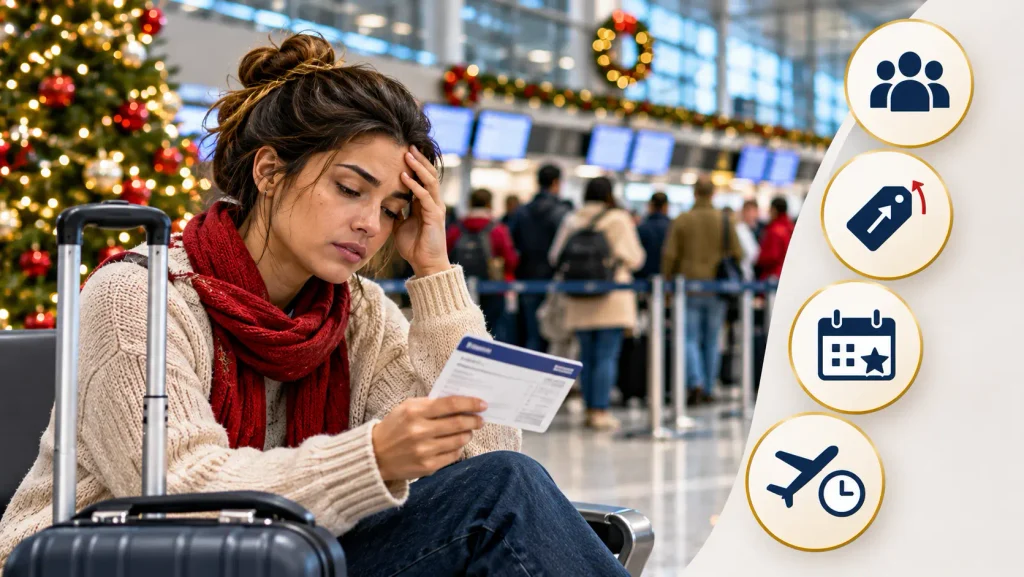
Holiday travel is often more stressful because large numbers of passengers travel within a short period, placing additional pressure on airlines, airports, security checkpoints, and ground transportation.
Several factors contribute to holiday travel disruptions:
- High passenger demand: Popular departure dates attract travelers heading to similar destinations.
- Winter weather: Snow, fog, ice, and strong winds can disrupt airport operations.
- Limited flight availability: Fully booked flights make last-minute rebooking more difficult.
- Long airport queues: Security screening, baggage drop, and boarding may take longer.
- Higher travel expenses: Airfare, accommodation, and rental car prices can increase during peak periods.
- Tight holiday schedules: Delays can interfere with family gatherings, hotel reservations, or connecting transportation.
The biggest challenge is often the lack of flexibility. Travelers may need to arrive before a particular celebration, leaving little room for unexpected changes.
When Are Airports Busiest During the Holiday Season?
International airports are generally busiest on major departure and return dates surrounding Thanksgiving, Christmas, and New Year’s Day.
However, the busiest days vary according to the calendar, airport, and travel patterns.
| Holiday period | Commonly busy travel dates | Practical recommendation |
| Thanksgiving | Wednesday before and Sunday after | Consider earlier departures or alternative return dates |
| Christmas | Several days before December 25 | Compare flights earlier in the week |
| Post-Christmas | December 26–30 | Allow additional time for return travel |
| New Year’s | Days surrounding December 31 and January 1 | Monitor flight availability and airport conditions |
| Winter school holidays | School vacation departure and return weekends | Book early when traveling with children |
Traveling on the holiday itself can sometimes mean fewer passengers or lower fares, but this is not guaranteed.
Is Flying on Christmas Day Less Crowded?
Christmas Day can be quieter than surrounding peak travel dates because many travelers prefer to reach their destinations before the celebration.
However, passenger numbers depend on the airport, destination, and flight schedule.
Some airport restaurants, shops, and transportation services may also operate reduced holiday hours.
Is Thanksgiving the Busiest Travel Holiday?
Thanksgiving is one of the busiest U.S. travel periods, particularly for domestic flights.
The Wednesday before Thanksgiving and the Sunday afterward frequently experience heavy passenger traffic.
Travelers with flexible schedules may find it easier to avoid the most crowded departure and return windows.
How Can Travelers Prepare Before Booking Holiday Flights?
Travelers should begin holiday planning by comparing flight dates, choosing suitable fare conditions, and evaluating the total journey rather than simply selecting the lowest advertised ticket price.
Booking decisions can influence how easily passengers handle unexpected changes later.
Should Holiday Flights Be Booked Early?
Booking holiday flights early can provide a wider choice of departure times, seating options, and available itineraries.
However, purchasing tickets months in advance does not guarantee the lowest fare.
Travelers should monitor prices, compare nearby dates, and book when they find a competitive fare that suits their plans.
Those traveling with families or requiring specific flights may benefit from reserving seats earlier.
Are Flexible Airline Tickets Worth the Extra Cost?
Flexible tickets can be valuable during the holiday season because they may allow passengers to change or cancel travel plans with fewer restrictions.
For example, a traveler whose family gathering changes dates may find it easier to adjust a flexible reservation than a restrictive basic economy ticket.
However, travelers should distinguish between:
| Fare feature | What it means |
| No change fee | A separate change penalty may be waived, but fare differences can apply |
| Refundable ticket | Eligible cancellation may return money to the original payment method |
| Nonrefundable ticket | Cancellation may provide a travel credit, depending on fare rules |
| Basic economy fare | Often includes more restrictions on changes, seating, and services |
| Travel credit | May have validity periods and usage conditions |
Travelers should review the actual ticket conditions before purchasing.
Is Booking Directly With an Airline Better?
Booking directly with an airline can simplify communication when flights are delayed, canceled, or rescheduled.
Passengers may find it easier to manage their reservation, request assistance, and review available rebooking options through the airline’s official channels.
Third-party booking platforms can still offer useful comparison features, but their servicing procedures may differ.
Travelers should understand who is responsible for handling changes before completing a reservation.
Should Travelers Choose Nonstop Flights During Winter?
Nonstop flights can reduce the number of potential disruption points because passengers do not need to make a connection.
A connecting itinerary introduces additional considerations, including:
- Delays on the first flight.
- Missed connections.
- Baggage transfer problems.
- Winter weather at connecting airports.
- Limited alternative flights.
When nonstop flights are unavailable, travelers should choose connections with sufficient transfer time.
A cheaper itinerary with an extremely short layover may create unnecessary risk during winter travel.
How Can Travelers Save Money on Holiday Trips?
Travelers can reduce holiday expenses by comparing flexible dates, monitoring airfare, evaluating nearby airports, and using travel rewards strategically.
The lowest advertised airfare is not always the most economical option after additional charges are included.
Can Flying on Different Dates Reduce Holiday Airfare?
Yes. Shifting departure or return dates by one or two days can sometimes produce significant savings.
For example, a traveler planning to depart immediately before Christmas may find a cheaper flight earlier in the week.
Flexible-date calendars can help passengers identify lower-priced travel periods.
However, savings vary by destination and availability.
Are Nearby Airports Worth Considering?
Alternative airports may offer cheaper flights or more convenient schedules.
For example, travelers visiting the New York metropolitan area can compare JFK Airport, Newark Liberty International Airport, and LaGuardia when suitable for their itinerary.
However, a lower ticket price may be offset by longer ground transportation, parking, or transfer expenses.
Travelers should calculate the complete journey cost.
Can Credit Card Points and Airline Miles Help?
Travel rewards can reduce out-of-pocket costs when suitable award flights are available.
Travelers may be able to redeem airline miles, transferable credit card points, or hotel loyalty rewards.
However, award availability can be limited during peak holidays, and taxes or carrier-imposed charges may still apply.
Passengers should consider the best credit cards for travel and compare the cash price with the value of the rewards required before redeeming points.
Should Travelers Wait for Black Friday Travel Deals?
Black Friday, Cyber Monday, and Travel Tuesday can feature airline and hotel promotions.
However, peak Thanksgiving and Christmas dates may be excluded from discounted offers.
Travelers should compare promotional prices with previously available fares rather than assuming every advertised deal represents a genuine saving.
Related- Black Friday, Cyber Monday, and Travel Tuesday Flight Sales Guide
What Should Travelers Do Before Leaving for the Airport?
Travelers should verify their reservations, organize travel documents, check weather conditions, and prepare essential belongings before departure.
A short pre-travel review can prevent avoidable problems at the airport.
Which Travel Documents Should Be Checked?
Passengers should verify that their identification and booking information meet the requirements of their journey.
For domestic U.S. flights, travelers aged 18 and older generally need a REAL ID-compliant license or another TSA-accepted form of identification.
International travelers should check passport validity, visa requirements, and destination-specific entry rules.
| Document or detail | What to verify |
| Passport | Validity and destination requirements |
| Government-issued ID | Accepted for the intended journey |
| Airline ticket | Correct passenger name and itinerary |
| Visa or travel authorization | Validity and eligibility |
| Hotel reservation | Dates, location, and confirmation |
| Travel insurance | Coverage, exclusions, and assistance contacts |
| Emergency contacts | Accessible even without internet service |
Travelers should keep digital copies of important documents in a secure location, while carrying the original documents required for travel.
Which Travel Apps Are Useful During the Holidays?
Airline apps and flight-tracking services can help travelers respond to schedule changes.
Useful options include:
- Airline apps for check-in, boarding passes, and flight notifications.
- FlightAware or similar services for monitoring flight operations.
- Google Maps for ground transportation and navigation.
- TripIt or comparable itinerary organizers.
- Translation apps for international travel.
- Weather apps for destination and airport forecasts.
Travelers should download important information before departure because airport or in-flight internet access may be unreliable.
Should Airport Parking Be Reserved in Advance?
Airport parking reservations can save time during busy holiday periods.
Popular airport parking facilities may fill quickly, and shuttle transportation can experience additional demand.
Travelers should check parking availability, terminal transfer times, and cancellation conditions before leaving home.
How Should Travelers Pack for Holiday Flights?
Holiday travelers should pack essential items in their carry-on baggage, check airline baggage allowances, and prepare for possible delays.
Packing carefully can reduce inconvenience if checked luggage is delayed or a connecting flight is missed.
Is Carry-On Baggage Better Than Checked Luggage?
Carry-on baggage can make holiday travel more convenient because passengers may avoid baggage-drop queues and waiting at baggage claim.
It also reduces the risk of essential belongings becoming inaccessible during a baggage delay.
However, carry-on allowances vary by airline and fare type. Some restrictive tickets charge for larger cabin bags.
Passengers should check the permitted dimensions, weight limits, and personal item rules before departure.
What Should Travelers Keep in Their Carry-On Bags?
| Essential item | Why it matters |
| Passport and identification | Required for check-in and travel |
| Medication | Accessible during unexpected delays |
| Phone charger and power bank | Keeps devices available for communication |
| Spare clothes | Useful during overnight disruptions |
| Snacks | Helpful when food outlets are crowded or closed |
| Headphones and entertainment | Makes long waits more comfortable |
| Baby supplies | Supports families during extended delays |
| Valuables | Reduces risk associated with checked baggage |
Power banks and spare lithium batteries generally belong in cabin baggage rather than checked luggage, subject to airline and aviation safety rules.
Can Holiday Gifts Be Carried on Airplanes?
Yes. Many holiday gifts are permitted in carry-on baggage, but their contents must comply with security restrictions.
For U.S. airport screening, TSA may need to inspect or unwrap presents. Therefore, carrying gifts unwrapped or using gift bags is often more convenient.
Items such as chocolates, books, clothing, and many electronic gifts are generally permitted.
Liquids, gels, and aerosols must meet applicable cabin baggage restrictions.
Can Snow Globes and Holiday Food Pass Through Security?
Small snow globes may be permitted in carry-on baggage if they comply with the TSA’s liquid limits.
Larger snow globes generally need to be packed in checked luggage.
Solid foods such as cookies and chocolates are usually allowed in carry-on bags, while spreadable or liquid foods may be subject to additional restrictions.
Travelers should also review destination customs rules before carrying food internationally.
Are Luggage Trackers Useful During Holiday Travel?
Luggage trackers can help passengers monitor the approximate location of checked bags.
Devices such as Apple AirTags may be useful when luggage is delayed or sent to another airport.
However, a tracker does not guarantee baggage recovery or replace the airline’s official baggage tracing process.
Passengers should retain their baggage claim receipts and report missing luggage promptly.
How Early Should Travelers Arrive at the Airport During Holidays?
Holiday travelers should allow additional airport time because security lines, check-in counters, baggage services, and transportation systems may be busier than usual.
For U.S. flights, a common starting recommendation is to arrive at least two hours before domestic departures and three hours before international departures.
During especially busy holiday periods, additional time may be appropriate.
How Much Extra Airport Time Is Recommended?
| Travel situation | Suggested planning allowance |
| Domestic flight | At least 2 hours before departure |
| International flight | At least 3 hours before departure |
| Major holiday departure | Add time according to airport conditions |
| Checked baggage | Allow time for baggage-drop deadlines |
| Traveling with children | Account for additional screening and boarding needs |
| Large international airport | Check terminal and security wait-time guidance |
These are general planning recommendations, not universal airline requirements.
Passengers should always check their airline’s check-in and boarding deadlines, which may close well before departure.
Can TSA PreCheck Reduce Holiday Airport Wait Times?
TSA PreCheck can make security screening more convenient for eligible travelers at participating U.S. airports.
Approved passengers generally receive access to dedicated screening procedures that may allow them to keep shoes and certain items in place.
However, TSA PreCheck does not guarantee a particular wait time, and screening procedures may change.
Is Global Entry Useful for International Holiday Travel?
Global Entry can simplify U.S. customs processing for approved travelers returning from international destinations.
Membership also includes TSA PreCheck eligibility for qualifying participants.
Children must have their own Global Entry membership, although certain minors may qualify for a waived application fee when applying with or after an eligible parent or legal guardian.
Does CLEAR+ Help at Busy Airports?
CLEAR+ can expedite the identity-verification portion of security screening at participating airports.
However, it does not replace TSA security screening.
Its usefulness depends on airport availability, operating conditions, membership eligibility, and the length of the relevant queues.
Can Airport Lounges Make Holiday Travel Easier?
Airport lounges may provide more comfortable seating, refreshments, charging facilities, and workspaces during long waits.
Travelers can access certain lounges through eligible credit cards, airline status, premium tickets, or paid memberships.
However, lounge access is not guaranteed during busy periods, and some locations impose capacity restrictions or guest fees.
What Should Travelers Do if Their Holiday Flight Is Delayed or Canceled?
Travelers should check their airline’s latest flight status, review available rebooking options, and contact the carrier promptly when a holiday flight is disrupted.
The most useful response depends on whether the passenger still wants to travel, needs an alternative route, or prefers a refund.
What Should Passengers Do First After a Cancellation?
Step 1: Confirm the disruption
Check the airline’s official app, airport displays, and flight notifications.
Step 2: Review alternative flights
Search for available flights through the same airline, including nearby airports or different connection points.
Step 3: Contact airline support
Use the airline app, telephone support, or airport service desk to discuss rebooking.
Step 4: Check refund and assistance rights
Determine whether a refund, meal voucher, hotel accommodation, or other assistance applies.
Step 5: Keep relevant records
Save cancellation notifications, receipts, revised booking confirmations, and correspondence.
Can Passengers Receive Refunds for Canceled Holiday Flights?
Yes. Under U.S. Department of Transportation rules, passengers are generally entitled to a refund when an airline cancels their flight and they do not accept the offered alternative transportation or other compensation.
Refund eligibility may also arise following a qualifying significant schedule change or delay.
However, passengers who accept and use an alternative flight generally cannot also claim a full refund for the transportation received.
Additional compensation and assistance depend on the applicable laws, airline policies, and circumstances.
Does Travel Insurance Cover Winter Weather Delays?
Travel insurance may cover certain expenses resulting from qualifying weather-related delays or cancellations.
Depending on the policy, covered expenses may include accommodation, meals, or nonrefundable trip costs.
However, coverage varies significantly.
Travelers should check minimum delay periods, covered reasons, exclusions, and documentation requirements before making a claim.
What Is the Best Backup Plan for Holiday Travel?
A practical backup plan identifies alternative flights, nearby airports, ground transportation, and possible overnight accommodation.
For example, a traveler flying to a family gathering might identify another airport within a reasonable distance of the destination.
However, passengers should avoid purchasing expensive replacement transportation without understanding their airline’s obligations and any insurance coverage.
How Can Families Travel More Comfortably During the Holidays?
Families can make holiday travel easier by selecting practical flight schedules, organizing essential supplies, and preparing children for airport procedures.
Traveling with young children often requires more time for security screening, meals, restroom breaks, and boarding.
Should Families Choose Morning Flights?
Morning flights can be a useful choice because delays may accumulate throughout the day.
An early departure may also leave more opportunities for same-day rebooking if a flight is canceled.
However, morning flights are not immune to weather disruptions, particularly when aircraft require deicing or airports experience overnight storms.
What Should Parents Pack for Children?
Parents should carry sufficient snacks, age-appropriate entertainment, spare clothes, and essential supplies for the scheduled journey plus reasonable delays.
Families traveling with infants may also need diapers, formula, bottles, and feeding supplies.
For U.S. security screening, medically necessary liquids and certain infant or toddler feeding items may be allowed in quantities exceeding the standard carry-on liquid limit, subject to screening procedures.
How Can Families Avoid Seating Problems?
Families should review the airline’s seating policy before booking.
Some airlines offer specific accommodations for children traveling with adults, while others may have restrictions depending on fare type and seat availability.
Passengers should request appropriate seating arrangements as early as possible.
How Can Travelers Stay Safe During Winter Holiday Trips?
Travelers can improve holiday safety by monitoring weather alerts, protecting personal belongings, keeping devices charged, and preparing for transportation disruptions.
Safety planning is particularly important when traveling through areas affected by snow, ice, or severe winter conditions.
What Should Travelers Check Before a Winter Road Trip?
Drivers should inspect their vehicle’s tires, battery, brakes, lights, and fluid levels before a long journey. They should also review weather forecasts and road conditions along the route. Useful emergency supplies include warm clothing, drinking water, snacks, a flashlight, a first-aid kit, and a phone charger.
Travelers should avoid driving through hazardous conditions simply to maintain their original schedule.
How Can International Travelers Prepare for Emergencies?
International travelers should review destination entry requirements, local emergency contact information, and applicable travel advisories.
U.S. citizens may also consider enrolling in the Smart Traveler Enrollment Program, which can help them receive relevant embassy or consulate information.
Travelers should share their itinerary with a trusted contact and keep emergency assistance details accessible.
What Should Be on a Holiday Travel Checklist?
A holiday travel checklist should cover reservations, identification, baggage, airport transportation, and emergency arrangements.
- Travelers can use the following interactive checklist to prepare before departure.
- Confirm flight and hotel reservations
- Check passport, ID, and entry requirements
- Review airline baggage and seating rules
- Download boarding passes and travel apps
- Check weather and flight status
- Pack medication, chargers, and essential supplies
- Review travel insurance and refund conditions
- Arrange airport transportation or parking
- Identify alternative flights or routes
- Share the itinerary with a trusted contact
Conclusion
Holiday travel becomes easier when passengers prepare for the busiest parts of the journey rather than focusing only on reaching their destination.
Booking flexible flights, monitoring travel updates, packing essentials, and arriving at the airport with plenty of time can reduce common travel difficulties. Understanding airline refund policies and preparing backup arrangements can also make unexpected disruptions easier to manage.
For families, international travelers, and passengers navigating winter weather, thoughtful planning matters most.
Although no strategy can eliminate every delay or cancellation, these holiday travel tips can help travelers make informed decisions, protect their plans, and enjoy a more comfortable journey during Thanksgiving, Christmas, and New Year’s celebrations.
Frequently Asked Questions
The best approach is to book suitable flights, allow extra travel time, monitor flight updates, and prepare alternative arrangements. Flexible planning can reduce the impact of unexpected disruptions.
The Wednesday before Thanksgiving, the Sunday after Thanksgiving, and popular departure dates immediately before Christmas are frequently among the busiest U.S. travel periods.
Travelers should generally allow at least two hours for domestic flights and three hours for international flights, with additional time during particularly busy periods or when recommended by the airline.
Early flights can reduce exposure to delays that accumulate later in the day. However, severe weather and operational disruptions can affect flights at any time.
Christmas Day flights can sometimes cost less than departures immediately before the holiday because passenger demand may be lower. Prices still depend on the route and availability.
Travel insurance can be useful for expensive or nonrefundable trips, especially when winter weather or missed connections create financial risks. Travelers should compare policy coverage and exclusions.
Traveling with carry-on baggage can simplify airport transfers and reduce the risk of checked baggage delays. However, travelers should follow airline size and weight limits.
Wrapped gifts are generally permitted if their contents comply with security rules, but screening officers may need to unwrap them. Gift bags or unwrapped presents are often more convenient.
Passengers should review alternative flight options and applicable refund rights. Under U.S. rules, a canceled flight generally qualifies for a refund when the passenger declines the airline’s offered alternative.