
What Should You Know About Airline Ticket Transfers and Name Changes?
Most airline tickets cannot be transferred to another person because they are issued in a specific passenger’s name, although certain airlines allow passenger substitutions for a fee. The rules depend on the airline, fare conditions, booking channel, and whether the request involves a genuine passenger replacement or simply correcting the original traveler’s name.
For example, a traveler who books a flight but later becomes unavailable may want a friend or family member to use the ticket instead. Some airlines allow this through a paid name-change process, while others require canceling the original reservation and purchasing a new ticket.
The distinction matters because a name correction, legal name update, passenger transfer, and transferable travel credit are four different situations.
This guide explains which airlines allow ticket transfers, how passenger name changes work, potential fees, and alternatives when a ticket is nontransferable.
Read this blog: Can You Correct a Wrong Name on a Southwest Ticket?
What Does It Mean to Transfer a Flight Ticket?
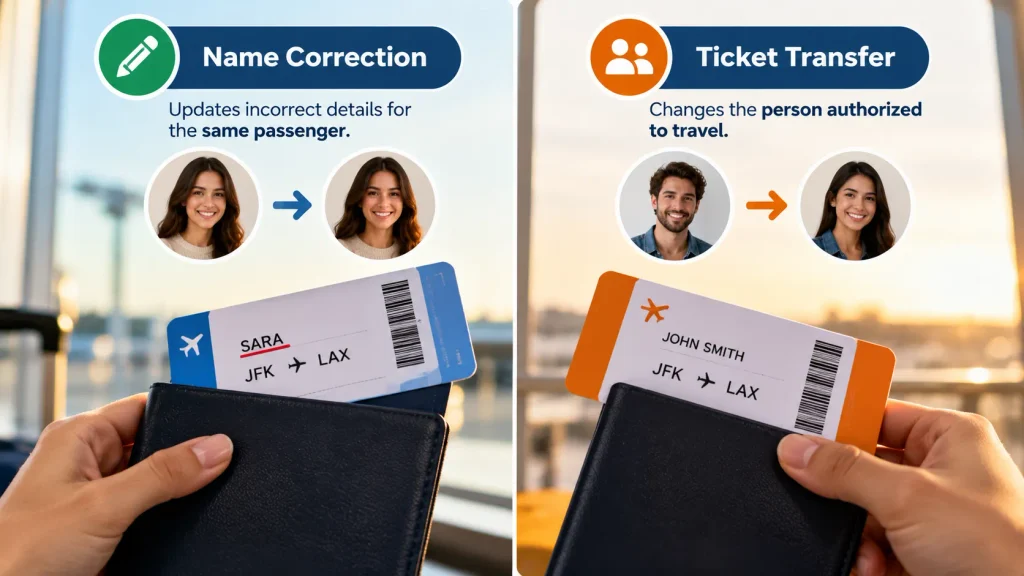
Transferring a flight ticket means replacing the original passenger with another person while retaining the existing reservation, subject to the airline’s rules.
For example, if a ticket was purchased for one traveler but another person wants to use it, changing the passenger identity would constitute a ticket transfer.
This differs from changing the departure date or correcting a spelling mistake. In those situations, the original passenger remains the same.
What Is the Difference Between a Name Correction and a Ticket Transfer?
A name correction updates inaccurate details for the same passenger, while a ticket transfer changes the person authorized to travel.
| Situation | Example | Is it a ticket transfer? |
| Minor spelling correction | Sara to Sarah | No |
| Reversed first and last names | John Smith to Smith John | No |
| Legal name update | Name changed after marriage | No |
| Passenger substitution | John Smith to Emily Brown | Yes |
| Flight date change | Same passenger travels next week | No |
| Travel credit transfer | Eligible credit is given to another person | No, the original ticket is not transferred |
This distinction matters because an airline may allow a spelling correction at little or no cost while prohibiting the ticket from being reassigned to another traveler.
Why Are Most Airline Tickets Nontransferable?
Most airlines issue tickets to named passengers and prohibit transfers to maintain booking controls, fare conditions, and accurate traveler identification.
Passenger names link reservations to security information and travel documents. Airlines also use nontransferability rules to control how tickets are resold or reassigned.
However, passenger identification requirements do not universally prohibit ticket transfers. Some airlines permit the original booking to be reissued in another person’s name after collecting the required fee.
Does a Nontransferable Ticket Mean It Cannot Be Changed?
No. A nontransferable ticket may still permit date changes, flight changes, or name corrections for the original passenger.
For example, an airline may allow a traveler to move a flight from Monday to Thursday without permitting another person to take the original traveler’s place.
The passenger identity restriction and the flight modification policy operate separately.
Which Airlines Allow Flight Tickets To Be Transferred to Another Person?
Some airlines permit a complete passenger name change, while others allow only corrections for the original traveler.
The following examples illustrate how airline policies differ.
| Airline | Transfer to another person | Important conditions |
| Ryanair | Permitted | Paid full name change, subject to deadlines |
| easyJet | Permitted | Name change fee per passenger, per flight |
| Wizz Air | Permitted | Fee per passenger, per flight; advance deadline applies |
| Southwest Airlines | Not permitted for the ticket | Certain flight credits may be transferable |
| Delta Air Lines | Generally not permitted | Corrections for the same traveler may be allowed |
Airline policies can change, and restrictions may differ for package bookings, group reservations, codeshare flights, and tickets issued by travel agencies.
Can Ryanair Tickets Be Transferred to Another Passenger?
Ryanair permits full passenger name changes for a fee, provided the request satisfies its booking conditions and deadlines.
The airline distinguishes complete name changes from minor corrections. Passengers should review the applicable charge and whether the change affects every flight on the reservation.
Continue Reading: Is It Possible to Change Passenger Names on British Airways Tickets?
Does easyJet Allow Ticket Transfers?
Yes. easyJet explicitly allows you to change a booking from one passenger to another after paying its name change fee.
Its published terms also prohibit ticket resale, meaning permission to replace a passenger does not authorize selling the ticket through an unauthorized marketplace.
Explore This Blog: Pros and Cons of Flying With easyJet: Is It Worth It?
Can Wizz Air Passengers Change the Ticket to Another Person?
Yes. Wizz Air allows a complete passenger name change for a fee, generally up to three hours before departure.
The airline calculates the charge during the booking modification process, and changing the name through its call center may incur an additional transaction fee.
Minor corrections, including certain spelling mistakes, are handled differently from full passenger substitutions.
Can Southwest Airlines Tickets Be Transferred?
Southwest Airlines tickets are generally nontransferable, meaning the original passenger cannot simply assign the reservation to another person.
However, eligible transferable flight credits may be transferred under the airline’s applicable rules.
Transferring an eligible flight credit allows another person to use that credit toward a new booking. It does not change the passenger named on the original ticket.
How Can Passengers Transfer a Flight Ticket When the Airline Allows It?
Passengers can transfer an eligible ticket by requesting a complete passenger name change through the airline’s reservation management system or authorized customer service channel.
The process varies by airline, but the general steps are similar.
- Check the airline’s transfer policy. Confirm that a complete passenger substitution is permitted, rather than only minor spelling corrections.
- Retrieve the booking. Open the reservation using the airline’s website, app, or original booking provider.
- Select the passenger change option. Look for a full name change or passenger replacement feature.
- Enter the replacement traveler’s details. Provide the correct name and any other required information exactly as shown on the travel documents.
- Review the charges. Check the name change fee, any additional fare or service charges, and the final amount.
- Confirm the modification. Complete payment and obtain the revised itinerary or ticket confirmation.
- Verify the updated booking. Ensure the new passenger’s name appears correctly before check-in.
For example, Wizz Air permits eligible passenger changes through the booking’s Make changes section, while easyJet offers name changes through its website or mobile app.
How Much Does It Cost to Transfer a Flight Ticket?
The cost of transferring a flight ticket depends on the airline’s name change fee, the number of affected flight segments, and any additional charges.
There is no universal ticket transfer fee across airlines.
What Factors Affect Passenger Transfer Fees?
Passenger transfer fees depend on the airline’s name change policy, fare type, booking channel, and number of flight segments. Additional service charges, departure deadlines, and ticket restrictions may also influence the total cost of transferring a flight ticket.
| Cost factor | How it affects the total |
| Airline policy | Determines whether transfers are allowed and the applicable fee |
| Number of flight segments | Some airlines charge per passenger, per flight |
| Booking channel | Call center or agency service charges may apply |
| Time before departure | Fees or eligibility may depend on the remaining time |
| Fare conditions | Certain ticket types may have additional restrictions |
| Replacement airfare | May matter when cancellation and rebooking are required |
For example, easyJet applies its name change charge per passenger, per flight. Therefore, replacing one passenger on a round-trip reservation can involve charges for both flight segments.
Is Transferring a Ticket Cheaper Than Booking a New Flight?
A ticket transfer may be cheaper than purchasing another ticket, but the comparison depends on the transfer fee and current airfare.
Consider this hypothetical example:
| Expense | Amount |
| Original ticket price | $150 |
| Passenger name change fee | $80 |
| Current price of a new ticket | $210 |
In this scenario, paying $80 to transfer the existing reservation may be more economical than purchasing a new $210 ticket.
However, if the transfer fee exceeds the price of a replacement ticket, cancellation and rebooking may be preferable, depending on the original ticket’s remaining value.
These amounts are illustrative, not published airline fees.
What Can Passengers Do if Their Airline Does Not Allow Ticket Transfers?
Passengers holding nontransferable tickets can consider cancellation, rebooking, refunds, or eligible travel credits instead of attempting to replace the original traveler.
The best option depends on the ticket’s refund conditions, remaining value, and departure date.
Can a Passenger Cancel a Ticket and Book It for Someone Else?
Yes. The original traveler may cancel an eligible reservation and purchase a separate ticket for another person.
However, cancellation does not guarantee a refund, and any resulting flight credit may remain restricted to the original passenger.
For example, if a traveler cancels a $300 nonrefundable ticket and receives a non-transferable $300 credit, that credit generally cannot be used to purchase a ticket for someone else.
The new passenger would need a separate booking and an eligible payment method.
Can Flight Credits Be Transferred Instead of Tickets?
Some airlines allow certain travel credits to be transferred, even when their tickets are nontransferable.
Southwest Airlines provides a clear example through its Transferable Flight Credit program.
Under Southwest’s published rules, eligible credits can be transferred once between Rapid Rewards members. The recipient can then apply the credit toward a new reservation, subject to expiration and other conditions.
This differs from changing the passenger on an existing ticket.
Can the 24-Hour Cancellation Rule Help?
Yes. The U.S. Department of Transportation requires airlines to offer either a 24-hour reservation hold or penalty-free cancellation for qualifying bookings made at least seven days before departure.
The rule applies to airlines, including foreign carriers, for covered flights to, from, or within the United States.
However, the federal requirement does not directly apply to tickets purchased through travel agencies or online travel agencies, which may have their own policies.
For example, if a passenger accidentally books a ticket under the wrong person’s name, canceling an eligible reservation within the permitted window and purchasing a new ticket may be more practical than requesting a passenger substitution.
The replacement ticket’s price is not guaranteed to remain unchanged.
Can Flight Tickets Be Transferred After Check-In?
Some airlines may permit passenger name changes after online check-in, but the traveler must still meet the airline’s modification deadline and complete any required check-in procedures again.
For example, Wizz Air states that a passenger whose name changes after check-in must check in again and obtain an updated boarding pass.
Other airlines may prohibit changes after a particular deadline or once travel has started.
Can a Ticket Be Transferred After the First Flight Has Been Used?
Generally, you can’t simply reassign a partially used ticket to another person for the remaining journey.
For example, a passenger who has already flown the outbound segment of a round-trip booking should not assume someone else can use the return segment.
Even airlines that permit full name changes may restrict them to unused reservations or require changes across all flights in the booking.
Can International Flight Tickets Be Transferred to Another Person?
International flight tickets may be transferable when the airline expressly permits passenger substitutions, but additional documentation and ticketing restrictions can apply.
Check passenger transfers on an international booking carefully, because the replacement traveler may have different entry, transit, and visa requirements.
Does a Ticket Transfer Include the New Passenger’s Visa?
No. A passenger name change does not transfer visas, travel authorizations, or immigration permissions.
For example, if one traveler has authorization to enter a destination country, replacing that person on the airline ticket does not give the new traveler the same authorization.
The replacement passenger must independently satisfy the destination’s travel requirements.
Can Codeshare Tickets Be Transferred?
Codeshare and multi-airline reservations can have more restrictive change procedures.
Even when one airline permits passenger substitutions, another carrier involved in the itinerary may prohibit them.
Travelers should obtain confirmation that the entire reservation can be modified before paying any name change fee.
Can Tickets Booked Through Travel Agencies Be Transferred?
Tickets purchased through travel agencies may be eligible for passenger changes when the airline permits them, but the original booking provider may need to process the request.
Agency-issued tickets can involve additional administrative procedures or service charges.
For example, easyJet advises passengers who booked through third parties to contact the booking provider for assistance with modifications.
Can an Online Travel Agency Override an Airline’s Transfer Policy?
No. An online travel agency generally cannot override an airline’s prohibition on transferring tickets to another passenger.
A third-party website may offer booking management assistance, but the underlying ticket remains subject to the issuing airline’s conditions.
Travelers should be cautious of agencies that promise guaranteed ticket transfers without confirming the airline’s actual rules.
What Happens if Someone Else Tries to Travel Using a Nontransferable Ticket?
A passenger attempting to travel using another person’s nontransferable ticket may be denied boarding.
Airlines generally require the ticketed passenger’s identity to correspond with the reservation and applicable identification documents.
For example, Delta Air Lines explicitly states that its tickets are valid only for the named passenger and cannot be transferred. Its contract of carriage also provides that presenting a ticket for use by another person renders it invalid.
Simply giving someone else a booking confirmation, boarding pass, or ticket number does not authorize them to travel.
What Should Travelers Check Before Requesting a Flight Ticket Transfer?
Travelers should verify the airline’s complete passenger name change policy before paying a fee or canceling a reservation.
The most important checks include:
- Whether a full passenger substitution is permitted.
- Whether the ticket is completely unused.
- The deadline for requesting the change.
- Fees for each passenger and flight segment.
- Whether the booking includes partner-operated flights.
- Whether baggage, seat selections, and other extras remain valid.
- Whether a travel agency issued the original reservation.
- Whether cancellation and rebooking would cost less.
- Whether the replacement passenger meets all travel document requirements.
These checks can help prevent travelers from paying a substantial name change fee when purchasing a new ticket would be more economical.
Wrapping Up!
Flight ticket transfers are possible with select airlines, but most major carriers do not allow passengers to transfer an existing ticket to another person.
Ryanair, easyJet, and Wizz Air provide examples of airlines that allow paid passenger name changes. By contrast, many other airlines permit only corrections or legal name updates for the original traveler.
Before requesting a transfer, passengers should compare the airline’s name change fee with the cost of canceling and booking a new ticket. They should also check whether any unused travel credit can legally be transferred.
The safest approach is to review the airline’s official ticket conditions and obtain a revised confirmation before the replacement passenger attempts to travel.
Frequently Asked Questions!
Only if the airline permits a full passenger substitution and officially updates the reservation; otherwise, the ticket remains valid for the original passenger.
Some airlines allow you to transfer tickets to family members through a paid name change. Others prohibit transfers regardless of the passengers’ relationship.
A nonrefundable ticket may be transferable if the airline permits passenger changes. Refundability and transferability are separate ticket conditions.
Free passenger substitutions are uncommon. Airlines that allow full name changes generally charge a fee, although minor spelling corrections may be free.
Yes, but only when the airline permits a full passenger name change. Airlines with nontransferable ticket policies generally do not make exceptions simply because the replacement traveler is a friend.
Some airlines permit passenger substitutions on unused round-trip bookings. However, the change may need to apply to both flights, and fees may be charged separately for each segment.
Some airlines allow passenger substitutions shortly after booking. For eligible U.S.-covered reservations, cancellation and rebooking may be an alternative under the applicable 24-hour protection.
Award ticket rules vary by loyalty program. Some programs allow members to redeem points for another traveler, but that does not necessarily mean an already issued award ticket can be reassigned.
Group bookings may have separate passenger name change deadlines and conditions. Travelers should review the group agreement rather than relying on ordinary individual ticket rules.
Generally, passengers should not assume they can reassign only the return portion of a ticket. Eligibility depends on the airline’s rules for partially used tickets and passenger changes.