
What Are Your Rights for Delayed or Damaged Bags on Delta?
Delta Air Lines allows passengers to report delayed, lost, or damaged checked baggage and submit eligible reimbursement claims, while personal belongings left on an aircraft or at an airport are handled through a separate lost-and-found process. The correct reporting procedure depends on what happened to the item, where it was last seen, and whether it was checked in or carried onboard.
A suitcase that never arrives at baggage claim is not handled the same way as a phone forgotten in a seat pocket. Similarly, a damaged suitcase requires different documentation from a bag that arrives several days late.
Understanding these differences can help travelers avoid missed reporting deadlines, unnecessary replacement expenses, and rejected claims.
This guide explains Delta’s lost-and-found procedures, baggage tracking, delayed baggage reimbursement, damage claims, compensation limits, and the steps passengers should take when their belongings do not arrive as expected.
What Is Delta Air Lines’ Lost, Delayed, and Damaged Baggage Policy?
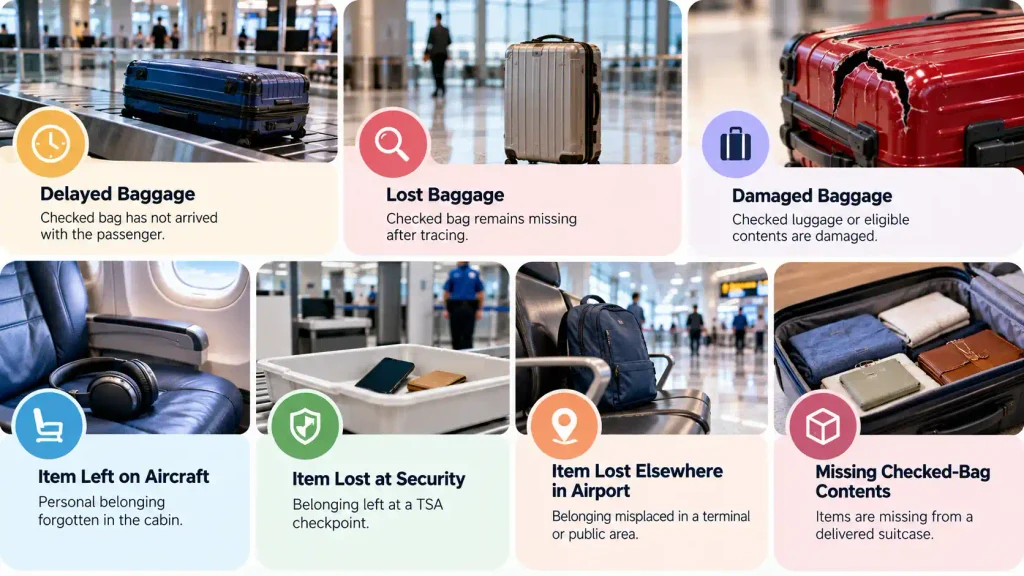
Delta Air Lines’ baggage policy provides separate procedures for checked bags that arrive late, bags that cannot be located, luggage damaged during transportation, and personal belongings left behind.
The airline generally asks passengers with checked baggage problems to contact its Baggage Service Office at the arrival airport and obtain a file reference number.
This reference helps the airline investigate the problem and allows passengers to follow the progress of their case.
However, passengers who leave personal belongings inside an aircraft or airport facility generally need to submit a lost-item report instead.
| Baggage problem | What it means | Recommended first action |
| Delayed baggage | Checked bag has not arrived with the passenger | Report it to Delta’s Baggage Service Office |
| Lost baggage | Checked bag remains missing after tracing | Maintain the baggage claim and submit required documentation |
| Damaged baggage | Checked luggage or eligible contents are damaged | Report the damage and preserve evidence |
| Item left on aircraft | Personal belonging forgotten in the cabin | Submit Delta’s lost-item report |
| Item lost at security | Belonging left at a TSA checkpoint | Contact TSA lost and found |
| Item lost elsewhere in airport | Belonging misplaced in a terminal or public area | Contact the appropriate airport lost-and-found department |
| Missing checked-bag contents | Items are missing from a delivered suitcase | Report the missing contents and provide supporting details |
The important distinction is between a checked baggage claim and a lost personal item report. Submitting the wrong type of report can delay the search.
How Can Passengers Report Delayed Baggage on Delta?
Passengers should report delayed checked baggage as soon as they discover that their suitcase has not arrived at the destination baggage carousel.
The most practical approach is to visit Delta’s Baggage Service Office before leaving the airport, provide the bag-tag details, and obtain a reference number.
Delta may also offer digital reporting options for eligible itineraries, depending on the airport and circumstances.
What Should Passengers Do When Their Checked Bag Does Not Arrive?
- Confirm that the correct baggage carousel has been checked, including any separate oversized-baggage collection area.
- Locate the baggage claim receipt issued when the suitcase was checked.
- Visit Delta’s Baggage Service Office or use an available official reporting channel.
- Provide the flight details, bag-tag number, and a description of the missing suitcase.
- Confirm the delivery address and contact information.
- Save the file reference number and any written instructions.
- Track the case and retain receipts for necessary replacement purchases.
For example, a passenger arriving in Atlanta whose suitcase fails to appear should report the issue before traveling to their hotel, rather than waiting until the following morning.
This allows Delta to begin tracing the bag promptly.
What Information Is Needed for a Delayed Baggage Report?
Delta may request the passenger’s name, flight number, travel date, baggage tag, delivery address, and contact details.
A detailed bag description can also help. Travelers should mention the suitcase’s color, brand, size, distinguishing marks, and any identifying accessories.
A photograph taken before departure can be useful when several bags look similar.
Check Out: International Air Lines Review: Seats, Baggage, Wi-Fi & Service
How Can Travelers Track a Delayed Delta Bag?
Delta passengers can check available baggage status information through the airline’s official baggage tracking tools.
The Fly Delta app and Delta’s baggage tracking system can provide information about scanned baggage movements, although the level of detail depends on the journey.
Travelers should distinguish between a baggage scan and a confirmed delivery arrangement. A scan may show that a suitcase reached an airport without establishing when it will reach the passenger.
Essential Tips: How Much Does Delta Air Lines Charge for Checked Bags?
Does Delta Provide Real-Time Baggage Tracking?
Delta provides baggage tracking updates based on available scanning information, but the system should not be interpreted as continuous GPS tracking.
Passengers may see updates when bags are accepted, transferred, loaded, or otherwise processed through the baggage system.
For a delayed bag, the baggage claim reference remains important because it connects the passenger to the tracing case.
Official resources: Delta Baggage Information and Delta Baggage Tracking.
When Does Delta Consider a Delayed Bag Lost?
Delta generally considers a checked bag likely lost if it has not been located within 21 days of the passenger’s arrival.
However, passengers should not wait 21 days to begin documenting the contents of a missing suitcase.
Delta instructs travelers whose bags have been delayed for six days or more to submit a potential property loss claim. This allows the airline to collect the information needed if the baggage cannot be recovered.
What Should Passengers Do After Six Days?
Passengers should use the reference number from their original baggage report to begin a property loss claim.
They may need to provide a detailed inventory of the missing contents, including descriptions, approximate purchase dates, and supporting receipts.
For example, a passenger whose suitcase contains clothing, shoes, and personal accessories should prepare an itemized list rather than submitting a single estimated amount for the entire bag.
Delta continues searching while the claim is under review. If the bag remains missing after 21 days, a representative may contact the passenger regarding settlement or reimbursement.
Does Delta Reimburse Passengers for Delayed Baggage?
Yes. Delta may reimburse passengers for reasonable and necessary expenses caused by delayed checked baggage.
Eligible expenses generally involve essential items needed while the passenger waits for the suitcase to arrive.
For example, someone traveling to New York for a three-day conference may need basic toiletries and a change of clothes if their checked suitcase does not arrive.
However, the airline reviews claims individually. Reimbursement is not an unrestricted allowance for shopping.
What Expenses May Qualify for Reimbursement?
| Expense | General treatment |
| Basic toiletries | May qualify when reasonably necessary |
| Essential clothing | May qualify based on the circumstances |
| Replacement underwear or socks | May qualify during the delay |
| Necessary personal-care products | May qualify when justified |
| Expensive designer replacements | May be reduced or denied if unreasonable |
| Nonessential shopping | Generally not eligible |
| Purchases without supporting receipts | More difficult to substantiate |
Delta evaluates factors such as necessity, purchase location, timing, length of the delay, and documentation. It asks passengers to provide itemized receipts showing the merchant, date, items, amount, and payment method.
Is There a Fixed Daily Compensation Amount?
Delta does not guarantee a fixed daily payment for every delayed baggage claim.
Reimbursement depends on reasonable actual expenses, supporting evidence, applicable liability limits, and the circumstances of the delay.
A passenger who spends $60 on essential clothing and toiletries may have a different eligible claim from someone who purchases $600 worth of nonessential merchandise.
The purpose of reimbursement is to address the inconvenience caused by missing baggage, not to provide a shopping allowance.
Can Passengers Get Their Delta Checked Baggage Fee Refunded?
Yes. Delta offers checked baggage fee refunds for qualifying delays, with eligibility depending on whether the journey is domestic or international and how long the bag remains undelivered.
The published thresholds are:
| Journey | Qualifying baggage delay |
| Domestic flight | Bag not delivered within 12 hours of arrival at the gate |
| International flight lasting 12 hours or less | Bag not delivered within 15 hours |
| International flight lasting more than 12 hours | Bag not delivered within 30 hours |
Exceptions apply. For example, the refund may not be available when the passenger fails to collect and recheck baggage at customs, voluntarily agrees to travel separately from the bag, or does not meet applicable minimum check-in requirements.
This refund is separate from reimbursement for necessary purchases.
A passenger may therefore have grounds to request reimbursement for essential items and a refund of an eligible checked baggage fee.
What Is Delta’s Damaged Baggage Policy?
Delta allows passengers to submit claims when checked baggage is damaged during transportation, subject to reporting deadlines, liability rules, and the nature of the damage.
Eligible cases may result in repair, replacement, or other appropriate compensation.
However, ordinary wear and tear is not necessarily compensable. Minor scratches, scuffs, and damage caused by overpacking or pre-existing defects may be treated differently from a broken suitcase wheel or damaged structural component.
How Soon Must Damaged Baggage Be Reported?
Delta’s reporting deadlines are particularly important because missing them can result in a denied claim.
For domestic tickets issued on or after October 8, 2025, Delta generally requires visible baggage damage to be reported in person at its Baggage Service Office within six hours of arrival.
For domestic tickets issued before that date, the published deadline is 24 hours.
Certain exceptions allow reporting within 24 hours, including damage not apparent from an exterior inspection, damage to a delayed bag after its return, and specified accessibility-related circumstances.
For international flights, Delta states that damaged baggage claims must be reported within seven days of arrival.
| Damage situation | Delta’s published reporting requirement |
| Visible damage on a domestic ticket issued on or after October 8, 2025 | Within 6 hours of arrival, generally in person |
| Visible damage on an earlier domestic ticket | Within 24 hours |
| Concealed damage or specified domestic exceptions | Within 24 hours |
| Damage discovered when a delayed bag is returned | Within 24 hours of receiving the bag |
| International baggage damage | Within 7 days |
Travelers should still report any damage immediately whenever possible, even if a longer deadline applies.
What Evidence Should Passengers Keep?
Photographs of the damaged suitcase are useful, particularly when they show the entire bag and a close-up of the affected area.
Passengers should also retain the baggage tag, boarding pass, purchase receipt if available, and any repair estimate requested by the airline.
A suitcase with a broken wheel, for example, should be photographed before repairs are attempted.
Passengers should not discard damaged baggage until Delta has provided instructions or completed the necessary inspection.
How Does Delta’s Lost and Found Service Work?
Delta’s lost-and-found service helps passengers report personal belongings left on a Delta aircraft, at a Delta gate or counter, or inside a Delta Sky Club.
Unlike delayed checked baggage, these items are not normally associated with a checked-bag tag.
Passengers must provide enough information for the airline to distinguish their belongings from similar objects.
For example, a traveler who leaves wireless headphones in a seat pocket should provide the flight number, travel date, seat number, brand, color, and any distinguishing details.
How Can Passengers Submit a Delta Lost-and-Found Report?
Passengers can begin through Delta’s official Lost and Found resources.
The process generally involves selecting the option for items left onboard, at the gate, or in a Delta Sky Club, then completing the requested form.
Useful details include the flight number, date, seat assignment, item description, and contact information.
Delta will attempt to locate the item, but recovery is not guaranteed.
Need to Know: Delta SkyMiles Reserve Business American Express Card
What If an Item Was Lost at Airport Security?
An item left at a TSA security checkpoint is generally handled by TSA’s lost-and-found department rather than Delta.
Likewise, an item lost in an airport restaurant, restroom, or other public terminal area may fall under the airport’s own lost-property procedures.
Passengers should identify the location where the item was last seen before submitting a report.
This distinction is particularly useful for travelers who realize something is missing only after boarding or arriving at their destination.
What Should Passengers Do If Items Are Missing From a Checked Bag?
Passengers who discover that belongings have disappeared from a delivered suitcase should submit a missing-contents or pilferage claim.
This situation differs from a suitcase that never arrived.
Delta instructs passengers to report missing checked-bag contents within 24 hours of arrival on domestic flights or seven days on international flights.
The airline provides a reference number that passengers can use to submit the appropriate claim with supporting documentation.
For example, if a passenger opens their suitcase at home and discovers that a pair of shoes is missing, they should document the contents, photograph any signs of tampering, and report the issue promptly.
Receipts or other proof of ownership may help substantiate the value of the missing items.
How Much Compensation Can Passengers Receive for Lost or Damaged Delta Baggage?
Compensation depends on the actual eligible loss, supporting documentation, applicable legal rules, and baggage liability limits.
The maximum liability amount is not an automatic payment.
For domestic U.S. transportation, the U.S. Department of Transportation states that airlines may limit baggage liability to $4,700 per passenger.
For most international itineraries governed by the Montreal Convention, the applicable baggage liability limit is 1,519 Special Drawing Rights (SDRs) per passenger. The equivalent amount in U.S. dollars varies with the exchange rate.
| Travel category | General baggage liability limit |
| Domestic U.S. flights | Up to $4,700 per passenger |
| International flights covered by the Montreal Convention | Up to 1,519 SDRs per passenger |
| Other international arrangements | Depends on the applicable treaty and conditions |
These limits generally cover eligible claims for baggage loss, damage, or delay rather than guaranteeing the maximum amount for each type of incident.
Does Delta Pay the Full Purchase Price of a Lost Suitcase?
Not necessarily. Airlines may consider the age, condition, depreciation, and documented value of lost property.
A suitcase purchased several years earlier may not be reimbursed at the original retail price.
For example, a passenger who paid $250 for luggage three years ago should not automatically expect a $250 settlement if the suitcase is permanently lost.
The same principle may apply to clothing and other personal belongings.
Are Expensive Electronics and Jewelry Covered?
High-value, fragile, or otherwise restricted items may be subject to additional limitations under the airline’s conditions of carriage.
Travelers should avoid placing passports, essential medication, expensive jewelry, cash, and important electronics in checked baggage whenever possible.
Delta’s conditions of carriage address limitations involving certain fragile and valuable articles.
Travel insurance or credit card baggage coverage may provide additional protection, but each policy has its own limits and exclusions.
What Are Delta’s Carry-On and Checked Baggage Rules?
Delta generally allows one carry-on bag and one personal item free of charge on Delta-operated flights, subject to aircraft and safety restrictions.
A standard carry-on bag must not exceed 22 × 14 × 9 inches, including handles and wheels.
The standard checked baggage size limit is 62 linear inches, calculated by adding length, width, and height.
For standard checked bags, the usual weight limit is 50 pounds in Delta Main, Delta Comfort, and Delta Premium Select, while Delta One and Delta First generally have a 70-pound limit.
| Baggage category | Standard allowance or limit |
| Carry-on baggage | 1 bag, up to 22 × 14 × 9 inches |
| Personal item | 1 item that fits under the seat |
| Standard checked bag dimensions | Up to 62 linear inches |
| Standard checked bag weight | Usually 50 lb (23 kg) |
| Delta One and Delta First standard weight | Usually 70 lb (32 kg) |
| Checked baggage fees | Depend on itinerary, fare, and eligible exemptions |
How Much Does Delta Charge for Checked Baggage?
Delta currently lists $45 for a first standard checked bag and $55 for a second standard checked bag on qualifying domestic U.S. itineraries in Delta Main and Delta Comfort without applicable exemptions.
These amounts are not universal. Charges may vary by ticketing date, destination, loyalty status, eligible credit card benefits, and operating airline.
Passengers should check the baggage estimate for their specific reservation rather than assuming domestic prices apply to international journeys.
Do Baggage Rules Change on Connecting Flights?
Yes. Connecting itineraries may involve different baggage handling requirements, particularly when multiple airlines operate the flights.
For example, a passenger entering the United States from another country may need to collect and recheck their suitcase after customs, depending on the airport and itinerary.
Failure to follow required rechecking procedures can complicate a baggage claim.
Delta advises passengers whose final flight was operated by another airline to file the baggage claim with the carrier operating the final segment.
How Can Passengers File a Delta Baggage Reimbursement Claim Online?
Passengers who already have a baggage file reference number can use Delta’s online claim system to request eligible reimbursement.
The form asks for information about the journey, affected baggage, missing or damaged items, and relevant receipts.
The claim type should match the actual problem.
For example, a passenger seeking reimbursement for toiletries purchased during a delay should use the appropriate delayed baggage claim rather than reporting the suitcase as permanently lost.
The official form is available through Delta’s Online Baggage Claim.
What Documents Should Passengers Prepare?
- Baggage file reference number
- Flight and travel details
- Checked baggage tag receipt
- Photographs of damaged luggage, when applicable
- Itemized receipts for necessary purchases
- Proof of ownership or value for lost items
- Contact and delivery information
Passengers should keep copies of their submissions until the claim has been resolved.
How Can Travelers Contact Delta About Baggage Problems?
Delta provides baggage assistance through its airport Baggage Service Offices, official online claim system, messaging support, and baggage service telephone numbers.
For passengers in the United States, Delta publishes 1-800-325-8224 as a baggage assistance number. Where the toll-free service is unavailable, it also lists 404-209-3034.
Passengers outside the United States should consult Delta’s Help Center for country-specific contact options.
| Contact method | Best use |
| Airport Baggage Service Office | Initial delayed or damaged baggage report |
| Online baggage claim form | Reimbursement and property loss claims |
| Baggage tracking tools | Checking available bag movement information |
| Delta lost-and-found form | Personal belongings left onboard or in Delta areas |
| Baggage assistance phone number | Questions about existing reports or claim corrections |
| Original operating airline | Baggage problems on certain connecting itineraries |
What Can Travelers Do to Reduce the Risk of Lost or Damaged Baggage?
Although baggage handling problems cannot always be prevented, a few preparations can make recovery and claims easier.
Travelers should attach durable identification tags, remove outdated airline labels, and photograph their checked bags before departure.
Keeping important medication, travel documents, valuables, and essential electronics in carry-on baggage also reduces the consequences of a delayed suitcase.
For passengers using compatible Apple devices, Delta supports sharing an AirTag or Find My accessory location through its baggage tracking process after a delayed bag has been reported. This can help with locating the suitcase, although it does not replace the official baggage claim.
A useful packing habit is to keep one change of clothes and basic necessities in carry-on baggage when traveling on a complicated itinerary with multiple connections.
Related: Delta One Seats Compared: Which Aircraft Has the Best Seat?
Conclusion: How Should Travelers Handle a Delta Baggage Problem?
The most effective response to a Delta Air Lines baggage problem is to identify the correct claim type and report the issue before the applicable deadline expires.
Delayed bags should be reported promptly, while damaged luggage requires particular attention to inspection and reporting requirements. Passengers whose belongings are permanently lost should prepare an accurate inventory with supporting documentation.
Travelers flying with Delta Air Lines should also review their baggage allowance and keep their bag-tag receipts accessible throughout the journey.
A complete report, accurate contact information, and well-organized evidence can make the claims process easier and improve the chances of a fair resolution.
Related FAQs!
Yes. Delta may arrange delivery of recovered delayed baggage to an appropriate address, such as a hotel or residence, depending on the circumstances and local delivery arrangements. Passengers should confirm the delivery address when reporting the delay.
A missing baggage tag can make tracing more difficult, but passengers should still contact Delta with their flight and reservation information. The airline may be able to locate relevant baggage records.
A broken wheel may qualify as baggage damage if the claim meets Delta’s conditions. The passenger should report it promptly and retain the suitcase for inspection.
Passengers should contact Delta for instructions. The airline may need to reconcile the previous settlement with the recovered baggage, depending on the circumstances and the terms of the claim.
Damage caused during a TSA inspection may need to be reported directly to TSA rather than Delta. Delta directs passengers to TSA when they believe a security inspection caused the damage.
Certain claims can be submitted or completed online after leaving the airport. However, strict reporting deadlines apply, particularly to visible domestic baggage damage. Travelers should make the initial report before leaving whenever possible.
Travel insurance may cover certain eligible baggage losses, delays, or replacement expenses, depending on the policy. Travelers should check coverage limits, exclusions, and whether airline reimbursement must be considered first.