
How Can You Make Your Way Through Istanbul Airport Easily?
Istanbul Airport (IST) operates through one large passenger terminal serving both domestic and international flights, with separate departure, arrival, and transfer areas connected within the same complex. Passengers do not need to travel between different terminal buildings, but reaching a distant gate can involve a considerable walk.
Located on the European side of Istanbul, the airport is one of Türkiye’s major international aviation hubs. It serves as the primary hub for Turkish Airlines and connects travelers with destinations across Europe, Asia, Africa, the Middle East, and the Americas.
Although its single-terminal layout simplifies connections between flights, Istanbul Airport is exceptionally large. Knowing where to check in, how to reach the gates, and what happens during an international transfer can make a significant difference to the airport experience.
This guide covers the IST terminal layout, departures and arrivals, transfers, lounges, transport options, shopping, dining, accessibility, and other essential passenger facilities.
How Many Terminals Does Istanbul Airport Have?
Istanbul Airport has one main passenger terminal, which accommodates domestic and international operations in different sections of the same building.
Unlike airports where passengers must use trains or buses to move between separate terminal buildings, IST uses a centralized layout with multiple piers extending toward the aircraft parking areas.
The airport’s departure and arrival processes are organized across different levels.
| Airport area | Main purpose | What passengers should know |
| Departures | Check-in, baggage drop, security and passport control | Follow domestic or international departure signs |
| Domestic departures | Flights within Türkiye | Domestic gates are grouped in designated concourses |
| International departures | Flights outside Türkiye | Passport control is generally required before reaching international gates |
| Arrivals | Baggage collection and passenger exits | Domestic and international arrival procedures differ |
| International transfers | Connections between international flights | Eligible passengers may remain in the international transit area |
| Transportation areas | Metro, buses, taxis and private transfers | Follow signs for the appropriate transport level or station |
The terminal is designed around a large central passenger processing area, with departure piers extending outward.
Travelers should pay particular attention to gate information because walking distances can be substantial.
How Is Istanbul Airport’s Terminal Layout Organized?
Istanbul Airport’s terminal layout separates passenger processes by travel type while keeping the main facilities within one interconnected building.
The airport uses lettered gate areas to help passengers identify their departure location.
Which Concourses Handle Domestic and International Flights?
The domestic departure area generally uses the G gates, while international departures use the A, B, C, D, E and F gate areas.
However, gate assignments are operational and may change.
Passengers should always follow the gate shown on airport information screens or in their airline’s latest boarding information rather than assuming a particular flight will depart from a familiar concourse.
Where Are the Check-In Counters Located?
Check-in counters are located in the main departures hall, with designated areas for different airlines and flight types.
The exact check-in island or counter depends on the operating airline and departure.
Passengers should consult the airport displays after entering the terminal, particularly if they need to check baggage or obtain a boarding pass.
Are Domestic and International Departures Connected?
Yes. Both operate within the same passenger terminal, but access between them is controlled.
Passengers changing from a domestic flight to an international flight may need to complete passport control and follow the applicable transfer route.
International-to-domestic connections can require entry into Türkiye, immigration formalities, and customs procedures.
The exact process depends on the itinerary and baggage arrangements.
Which Airlines Operate at Istanbul Airport?
Istanbul Airport serves Turkish Airlines and numerous international carriers, including full-service, regional, and selected low-cost airlines.
Turkish Airlines is the airport’s principal hub carrier, offering an extensive network of domestic and international connections. Travelers can also consult the AirlineLocations airline directory when researching airline services.
Other airlines operating at IST may include Lufthansa, British Airways, Qatar Airways, Emirates, Air France, KLM, and Pegasus Airlines on selected services, depending on current schedules and airport assignments.
Passengers should verify the airport code IST on their ticket. Istanbul also has another major airport, Sabiha Gökçen International Airport (SAW), located on the Asian side of the city.
A flight arriving at IST and departing from SAW requires a journey between two separate airports, not a transfer between terminals.
How Early Should Passengers Arrive at Istanbul Airport?
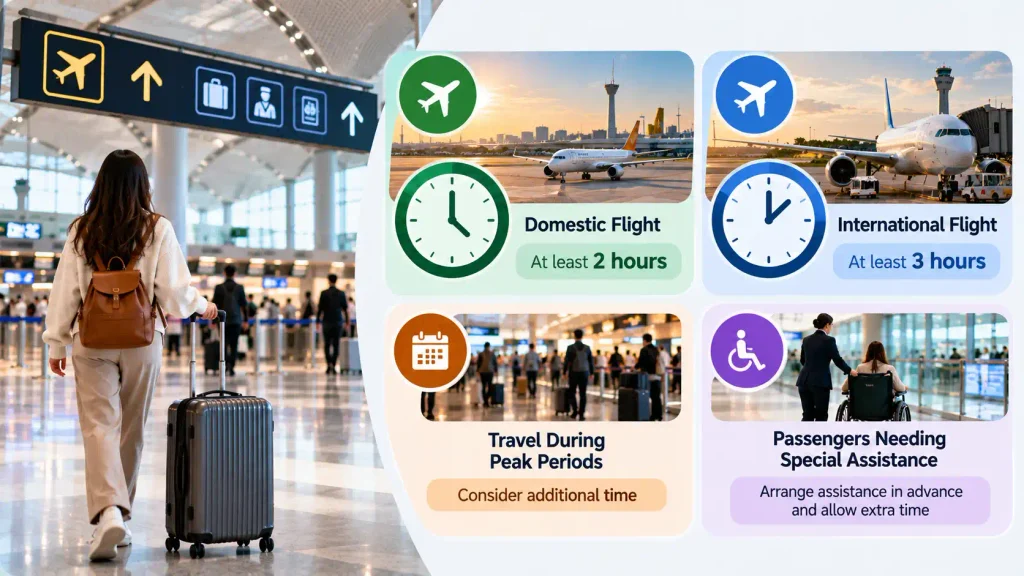
Turkish Airlines recommends arriving at least three hours before international departures and two hours before domestic departures.
These recommendations allow time for check-in, baggage drop, security screening, passport control where applicable, and walking to the departure gate.
| Flight type | Recommended arrival before departure |
| Domestic flight | At least 2 hours |
| International flight | At least 3 hours |
| Travel during peak periods | Consider additional time |
| Passengers needing special assistance | Arrange assistance in advance and allow extra time |
Other airlines may publish different reporting times and check-in deadlines.
How Does Check-In Work at IST?
Passengers can use airline check-in counters, eligible self-service kiosks, or online check-in.
Turkish Airlines currently identifies check-in islands D, E, F, G, H and J for eligible economy passengers and island L for certain premium passengers and status holders. The exact location can depend on the flight and passenger category.
After checking in, passengers should follow the signs for domestic or international departures and complete the applicable security and document checks.
Can Passengers Check In Online?
Yes. Many airlines operating at IST offer online check-in, subject to route and documentation requirements.
For Turkish Airlines, online check-in generally opens 24 hours before departure and closes 90 minutes before departure. Airport counter deadlines are different and can vary by station.
Even with a mobile boarding pass, passengers may need to visit a counter for checked baggage or travel-document verification.
How Do Connecting Flights Work at Istanbul Airport?
Connecting flights at Istanbul Airport generally take place within the same terminal building, but the required procedures depend on the itinerary.
Passengers transferring between international flights on a qualifying through-ticket may remain within the international transit area.
By contrast, connections involving domestic flights, separate tickets, or checked baggage that is not transferred automatically can require additional formalities.
What Happens During an International-to-International Connection?
For an eligible international connection on a single ticket, passengers generally follow international transfer signs and proceed through any required transfer security screening before reaching their next departure gate.
They normally do not need to enter Türkiye or collect checked baggage if the airline has arranged baggage transfer to the final destination.
Travelers without an onward boarding pass can use the appropriate transfer counter.
Turkish Airlines provides specific instructions for different connecting itineraries.
How Do International-to-Domestic Transfers Work?
Passengers arriving from abroad and continuing to a domestic destination generally need to complete Turkish immigration formalities.
Afterward, they follow the domestic transfer route and proceed through any required security checks.
Whether checked baggage must be collected at IST depends on the itinerary, ticket arrangement, and customs status of the final destination.
For example, baggage on an eligible through-ticket to a designated customs airport may be transferred onward, while separate-ticket passengers may need to collect and recheck their bags.
How Do Domestic-to-International Transfers Work?
Passengers arriving on a domestic flight and connecting to an international service must follow the international transfer route and complete the required passport checks.
On an eligible through-ticket, checked baggage may already be tagged to the final destination.
Travelers using separate tickets or airlines without an applicable transfer arrangement may need to collect baggage and check in again.
Is a One-Hour Layover Enough at Istanbul Airport?
A one-hour connection can be tight at IST, particularly when flights arrive or depart from distant gates.
Whether it is feasible depends on the airline’s permitted minimum connection time, whether the itinerary is protected on one ticket, the arrival punctuality, and the required screening procedures.
A connection sold by an airline as one itinerary may meet its minimum connection requirements, but that does not guarantee a stress-free transfer.
For separate tickets, a significantly longer buffer is advisable because passengers may need to complete immigration, collect baggage, and check in again.
Do Transit Passengers Need a Turkish Visa?
Passengers remaining within the international transit area generally do not need a Turkish entry visa solely for an eligible airside connection.
However, entry requirements change if the traveler must pass through immigration, collect baggage, change airports, or leave the secure transit area.
Visa and transit rules also depend on nationality, passport type, and itinerary. Travelers should verify the requirements through official Turkish government sources before departure.
What Airport Lounges Are Available at Istanbul Airport?
Istanbul Airport offers airline-operated lounges, independent premium lounges, and rest facilities for eligible passengers.
The most suitable option depends on the passenger’s airline, cabin, loyalty status, membership, and departure area.
| Lounge or facility | General location | Access considerations |
| Turkish Airlines Business Lounge | International departures | Eligible Business Class passengers |
| Turkish Airlines Miles&Smiles Lounge | International departures | Qualifying frequent flyer or alliance status |
| Turkish Airlines Domestic Lounge | Domestic departures | Eligible domestic passengers |
| iGA Lounge | International departures | Paid entry or qualifying memberships |
| iGA Domestic Lounge | Domestic departures | Paid entry or qualifying memberships |
| Pop Up Lounge | International departures | Applicable membership or contracted access |
| iGA Sleepod | International airside | Paid rest facility or qualifying benefit |
Turkish Airlines confirms separate domestic and international lounge facilities at IST. Priority Pass also lists iGA lounges, a Pop Up Lounge, and Sleepod services, with access depending on the membership.
Turkish Airlines ®+1
Who Can Access Turkish Airlines Lounges?
Turkish Airlines lounge eligibility depends on ticket class, Miles&Smiles status, Star Alliance status, and the applicable lounge’s admission rules.
Business Class passengers may qualify for the Business Lounge, while certain elite members may use the Miles&Smiles Lounge.
Not every Business Class ticket issued by another airline automatically grants access to every Turkish Airlines facility.
Travelers should verify eligibility using their ticket and loyalty details.
Can Economy Passengers Use the iGA Lounge?
Yes. Eligible economy passengers may access certain iGA lounges through paid admission or qualifying lounge memberships.
However, entry may depend on capacity, operating conditions, and the membership’s specific terms.
Passengers should check whether their lounge access applies to international or domestic departures before purchasing a pass.
Are There Hotels and Sleeping Facilities Inside Istanbul Airport?
Yes. Istanbul Airport offers accommodation and rest options for passengers with long layovers, early departures, or overnight connections.
The most suitable choice depends on whether the traveler wants to remain airside or can enter Türkiye.
Can Passengers Stay at YOTEL Istanbul Airport?
YOTEL operates accommodation at Istanbul Airport, with separate landside and airside hotel options.
The landside property is accessible from the public terminal area, while the airside option is designed for eligible international passengers who can access the secure transit zone.
Passengers should confirm their flight itinerary, visa requirements, and the hotel’s access instructions before making a reservation.
Are Sleeping Pods Available at IST?
Yes. iGA Sleepod provides compact resting spaces within the international airside area.
The operator places the Sleepod service near the elevators leading down toward the D gates.
These facilities can be useful for travelers who want a short rest without booking a conventional hotel room.
Can Travelers Sleep Overnight in the Terminal?
Travelers may find seating and designated rest facilities inside the airport, but comfort and access vary by area.
A passenger planning an overnight layover should check whether they can remain airside, whether their onward boarding pass is available, and whether any chosen lounge or rest facility operates overnight.
Where Can Passengers Eat and Shop at Istanbul Airport?
Istanbul Airport has extensive dining, retail, and duty-free areas, particularly in the international departures zone.
Passengers can find quick-service restaurants, cafés, full-service dining, convenience outlets, and stores selling travel essentials.
Are Restaurants Available After Security?
Yes. Both domestic and international departure areas have food and beverage outlets after security.
However, the selection varies by concourse, and not every outlet operates throughout the night.
Travelers with short connections should choose a restaurant near their departure gate rather than returning to the central shopping area.
Does Istanbul Airport Have Duty-Free Shopping?
Yes. International passengers can find duty-free retail outlets offering fragrances, cosmetics, confectionery, fashion, accessories, and other products.
Purchase allowances depend on the traveler’s destination and applicable customs regulations.
A product being sold duty-free does not necessarily mean it can be imported into the destination country without limits.
Can Passengers Buy Food During a Long Layover?
Yes. Travelers can use airport restaurants and cafés, subject to the opening hours of individual businesses.
Passengers with dietary requirements should check ingredient information directly with the retailer, particularly for allergies or religious dietary restrictions.
How Can Travelers Get From Istanbul Airport to the City Center?
Travelers can reach central Istanbul by metro, airport coach, public bus, taxi, or private transfer.
The best choice depends on the destination, luggage, budget, and time of arrival.
| Transport option | Suitable for | Main consideration |
| M11 metro | Travelers connecting to the rail network | Station access and onward transfers |
| Havaist airport coaches | Travelers heading to major city districts | Route, timetable, and traffic |
| IETT public buses | Budget-conscious travelers | Route coverage and journey duration |
| Taxi | Direct hotel or address transfers | Metered fare and traffic |
| Private transfer | Prearranged door-to-door travel | Booking price and pickup location |
| Rental car | Travel beyond central Istanbul | Parking and local driving conditions |
Türkiye’s State Airports Authority confirms metro, Havaist, IETT, taxi, and private vehicle access to IST.
Does Istanbul Airport Have a Metro Station?
Yes. The M11 metro line serves Istanbul Airport and connects it with stations including Gayrettepe and Kağıthane.
The line also extends toward Halkalı, providing additional rail connections across the wider network.
Travelers heading to Sultanahmet, for example, should expect to make onward rail connections rather than assume that the airport metro runs directly to the historic district.
The airport station is separate from the main passenger hall, so passengers should allow time to follow the signs and reach the platforms.
How Do Havaist Airport Buses Work?
Havaist operates airport coach services between IST and various parts of Istanbul.
Routes include destinations such as Taksim and other major transport districts, depending on the current network.
The operator identifies its airport boarding area on the arrivals-side level −2. Passengers should check the latest stop, schedule, fare, and payment methods before traveling.
Are Taxis Available at Istanbul Airport?
Yes. Licensed taxis serve the airport and operate throughout the day and night.
Journey duration depends heavily on traffic and the destination.
Travelers should use designated taxi services, confirm the appropriate vehicle category, and avoid accepting unsolicited transport offers inside the terminal.
How Long Does It Take to Reach Central Istanbul?
The journey varies considerably by destination and transport mode.
Turkish Airlines describes an average taxi journey of approximately 60 minutes, depending on traffic, but this is not a guaranteed travel time.
A traveler going to Taksim may have a different journey from someone staying in Sultanahmet or on the Asian side.
For important appointments or departing flights, allowing extra time is advisable.
What Accessibility Services Are Available at Istanbul Airport?
Istanbul Airport provides accessibility facilities and passenger assistance services for travelers with reduced mobility, disabilities, or other support needs.
These services can include accessible restrooms, elevators, designated routes, and assistance with moving through the terminal.
Can Passengers Request Wheelchair Assistance?
Yes. Passengers who require wheelchair or mobility assistance should request it through their airline before traveling.
The airline can coordinate applicable assistance for check-in, security, boarding, arrival, or transfers.
Travelers should describe their specific needs, including whether they can walk short distances or require assistance boarding the aircraft.
Are There Facilities for Families With Children?
Yes. Istanbul Airport provides family-oriented facilities, including baby care rooms and services intended to make travel with young children more manageable.
Families should check the terminal directory for the nearest facilities and allow extra time for security checks, meals, and reaching distant gates.
How Can Passengers Navigate the Terminal More Easily?
Passengers can use airport signage, information screens, and digital terminal maps.
Travelers with mobility limitations should avoid relying solely on estimated walking times because routes may involve elevators, security checkpoints, or assistance arrangements.
Does Istanbul Airport Have Wi-Fi, Charging Stations, and Other Passenger Services?
Yes. Istanbul Airport offers internet connectivity, charging facilities, information desks, and various passenger services throughout the terminal.
The availability of individual amenities depends on the location and operating conditions.
Is Free Wi-Fi Available at Istanbul Airport?
Wi-Fi access is available at IST, with connection and authentication procedures determined by the airport’s current service arrangements.
Passengers may need to complete a registration or verification process before connecting.
Travelers who require continuous internet access should also consider mobile roaming or an eligible eSIM, particularly if they plan to leave the airport.
Can Passengers Exchange Currency or Withdraw Cash?
Yes. ATMs and currency exchange services are available within the airport.
Exchange rates and transaction charges can differ between providers.
Travelers should compare the total amount received rather than assuming that every airport exchange counter offers the same rate.
Are Luggage Storage Services Available?
Yes. Istanbul Airport offers luggage storage services in designated areas.
Availability, operating hours, permitted items, and charges depend on the provider.
Passengers should confirm the storage location before leaving baggage, particularly if they need to return through security or immigration.
What Should Travelers Know About Parking at Istanbul Airport?
Istanbul Airport provides parking facilities for passengers and visitors arriving by private vehicle.
Parking charges depend on the parking area, vehicle category, and length of stay.
Travelers should verify current tariffs and any reservation options through the airport’s official channels.
For short visits, passengers should follow signs for the appropriate pickup or drop-off area rather than entering a long-stay parking section unnecessarily.
Related: Turkish Airlines Review: What to Know Before You Fly
Conclusion: What Should Travelers Remember Before Flying Through Istanbul Airport?
Istanbul Airport combines domestic and international operations within one large terminal, offering extensive airline connections, shopping, dining, lounges, and ground transportation services.
The most important consideration is time. Passengers should arrive early enough for check-in and security, confirm their departure gate, and account for the terminal’s long walking distances.
Connecting travelers should also verify whether their baggage transfers automatically and whether immigration or additional screening is required.
For departures and transfers alike, checking the latest airline instructions and official airport information is the most reliable way to avoid unnecessary delays.
Related FAQs!
No. Istanbul Airport (IST) is on the European side, while Sabiha Gökçen Airport (SAW) is on the Asian side. They are separate airports, and traveling between them requires ground transportation.
No. Domestic and international flights operate within the same main terminal building, using designated passenger processing areas and departure gates.
Yes. Passenger concourses are connected within the terminal, but distances can be substantial. Travelers should check their gate early and allow adequate walking time.
No interterminal train is required for the main passenger terminal because IST operates as a single-terminal airport. The M11 metro serves ground transportation to and from the airport.
Yes. Istanbul Airport operates around the clock, although individual restaurants, shops, lounges, and service counters may follow different schedules.
Yes, provided they meet Türkiye’s entry requirements and have enough time to leave the airport, visit the city, and return for their onward flight. Immigration, transportation, security, and check-in time must all be considered.
Yes. Turkish Airlines offers Touristanbul for eligible international connecting passengers with qualifying layovers of 6 to 24 hours, subject to program conditions and availability.
Eligible Turkish Airlines passengers may qualify for accommodation under the airline’s stopover or connection-related hotel programs. These programs have different requirements, so passengers should check the applicable eligibility rules before traveling.
Yes. English-language signage is widely available throughout the terminal, including directions for gates, security, passport control, baggage claim, and transfers.
The airport’s single-terminal arrangement simplifies navigation between domestic and international areas. However, its size makes early gate checks and careful time planning particularly important.