
Best Ways to Travel From Washington, D.C., to New York City
Traveling from Washington, D.C., to New York City is possible by train, bus, plane, or car, with Amtrak generally offering the best balance of speed, convenience, and comfort. The two cities are approximately 225 miles apart by road, and the journey can take under three hours by faster trains or considerably longer by road, depending on traffic.
The route connects two of the most visited cities in the United States, making it popular among business travelers, tourists, and residents. However, the fastest transportation option is not always the most affordable, and the cheapest ticket may involve longer travel times or less flexibility.
Amtrak provides direct rail service between central Washington and Manhattan, while intercity buses offer lower-cost alternatives. Flying is another option, although airport transfers and security procedures can reduce its time advantage.
This guide compares the main transportation options, their approximate journey times, advantages, limitations, and the situations in which each makes the most sense.
Check Out This Blog: How To Get Between Washington, DC & New York?
Washington, D.C., to New York City at a Glance
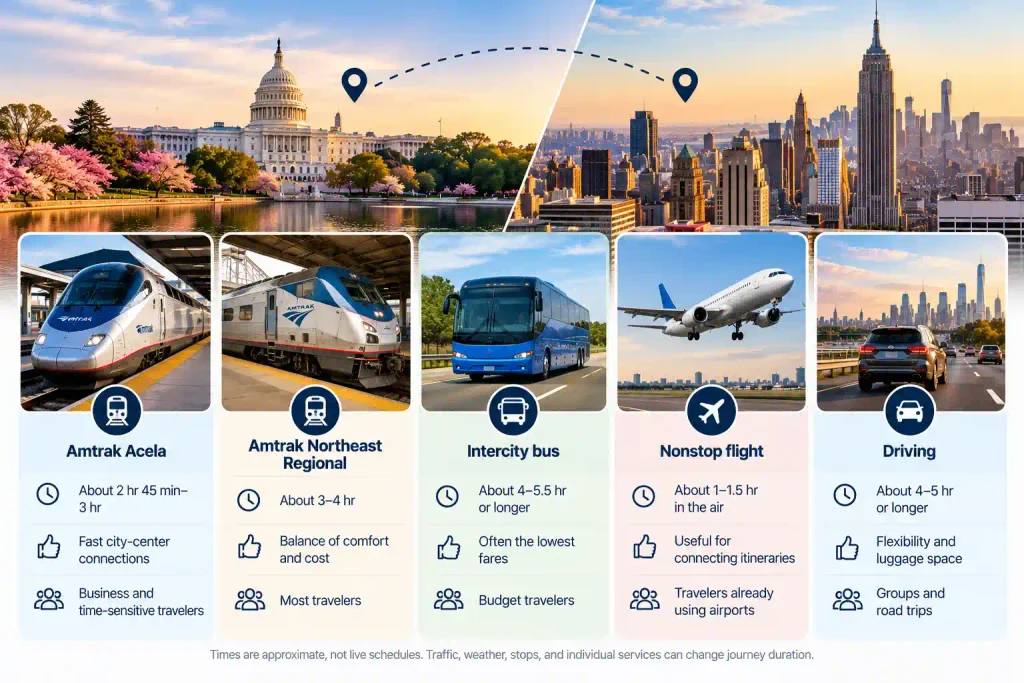
| Transportation | Approximate travel time | Main advantage | Best suited for |
| Amtrak Acela | About 2 hr 45 min–3 hr | Fast city-center connections | Business and time-sensitive travelers |
| Amtrak Northeast Regional | About 3–4 hr | Balance of comfort and cost | Most travelers |
| Intercity bus | About 4–5.5 hr or longer | Often the lowest fares | Budget travelers |
| Nonstop flight | About 1–1.5 hr in the air | Useful for connecting itineraries | Travelers already using airports |
| Driving | About 4–5 hr or longer | Flexibility and luggage space | Groups and road trips |
Times are approximate, not live schedules. Traffic, weather, stops, and individual services can change journey duration.
1. Taking Amtrak From Washington, D.C., to New York City
Amtrak is generally the most convenient transportation option between Washington, D.C., and New York City because trains connect centrally located stations without airport security lines or lengthy airport transfers.
Most direct services depart from Washington Union Station and arrive at New York Penn Station, inside Moynihan Train Hall or the connected station complex.
Amtrak Acela: The Fastest Rail Option
Acela is Amtrak’s premium high-speed service along the Northeast Corridor.
The Washington-to-New York journey typically takes approximately three hours, depending on the departure and scheduled stops.
Acela offers reserved seating and premium service options, making it especially suitable for business travelers.
Its main advantage is the combination of speed and convenient station locations.
Amtrak Northeast Regional: A Practical Alternative
Northeast Regional trains serve the same major cities but generally make more stops.
Journey times commonly range from approximately three to four hours.
These trains can offer better value than Acela, particularly when tickets are purchased in advance.
For travelers who do not need the fastest possible departure, Northeast Regional is often the strongest overall choice.
Where Do Amtrak Trains Depart and Arrive?
Washington Union Station is located near the U.S. Capitol and connects with Washington Metro services.
New York Penn Station is located in Midtown Manhattan, with access to subway services, taxis, and other local transportation.
The central station locations eliminate the need for separate airport transfers.
Is Amtrak Better Than Flying?
For most travelers going directly between central Washington and Manhattan, Amtrak is more practical than flying.
Although a nonstop flight has a shorter scheduled travel time, reaching the airport, clearing security, boarding, and traveling from the arrival airport can make the overall journey longer.
Rail travel also avoids much of the road congestion between the cities.
2. Traveling From Washington, D.C., to NYC by Bus
Taking a bus is often the most affordable way to travel between Washington, D.C., and New York City. Several intercity operators serve the route, with different departure points, amenities, and ticket conditions.
The journey usually takes approximately four to six hours, although congestion can extend travel times.
Popular Bus Operators
FlixBus operates scheduled services between the cities. Its published route information lists journeys starting at approximately four hours, with fares that vary by departure date and availability.
Greyhound also serves the corridor, with available journeys and boarding locations depending on the selected schedule.
Some services are operated through shared networks, so passengers should check the operating company shown on the ticket.
How Much Does a Bus From D.C. to New York Cost?
Bus fares change according to demand, booking time, and the selected service. Discounted tickets may be available when booked in advance.
For example, FlixBus currently advertises starting fares of approximately $29 on its route page, although this is not a guaranteed fare for a particular travel date.
Bus travel is particularly economical for passengers traveling alone with limited luggage.
What Facilities Are Available on Intercity Buses?
Depending on the operator and vehicle, amenities may include reclining seats, onboard Wi-Fi, charging outlets, restrooms, and luggage storage.
Passengers should confirm baggage allowances before departure, particularly when traveling with large suitcases.
Advantages and Disadvantages of Taking a Bus
The biggest advantage is cost. Bus tickets can be substantially cheaper than last-minute rail or air tickets.
However, buses share highways with other vehicles and are vulnerable to traffic delays around Baltimore, Philadelphia, northern New Jersey, and New York City.
Bus travel is most suitable for passengers who prioritize affordability over speed.
3. Flying From Washington, D.C., to New York City
Flying is another way to travel between Washington, D.C., and New York City, although it is not necessarily the fastest option when the entire journey is considered.
Nonstop flights typically take around one to one-and-a-half hours on the published schedule.
However, travelers must also account for airport transfers, security screening, boarding, baggage collection, and transportation into Manhattan.
Which Washington, D.C., Airports Can Be Used?
Ronald Reagan Washington National Airport (DCA) is generally the most convenient airport for travelers staying in central Washington.
It is located across the Potomac River in Arlington, Virginia, and is connected to the Washington Metro system.
Washington Dulles International Airport (IAD) is farther from downtown but may be convenient for passengers connecting from other flights.
Baltimore/Washington International Thurgood Marshall Airport (BWI) provides another regional option, particularly for travelers beginning their journey near Baltimore.
Which New York Airports Are Available?
| Airport | Location | Main consideration |
| LaGuardia Airport (LGA) | Queens | Convenient for many Manhattan-bound domestic travelers |
| John F. Kennedy International Airport (JFK) | Queens | Extensive international connections |
| Newark Liberty International Airport (EWR) | New Jersey | Useful for parts of Manhattan and New Jersey |
Airport choice can substantially affect the total journey time.
For example, a passenger arriving at JFK may use the AirTrain and connecting rail services to reach Manhattan, while a passenger arriving at LaGuardia can use bus connections or road transportation.
Is Flying Faster Than Taking the Train?
Not necessarily.
A hypothetical flight itinerary could involve:
| Journey stage | Approximate duration |
| Travel to Washington airport | 30–60 minutes |
| Security and boarding allowance | 60–90 minutes |
| Scheduled flight | 60–90 minutes |
| Airport exit and local transportation | 45–90 minutes |
| Estimated total | 3 hr 15 min–5 hr 30 min |
These are illustrative planning allowances rather than guaranteed airport transfer times.
A train taking approximately three hours between central stations may therefore be faster overall.
Flying makes more sense when the passenger is already at an airport, has a connecting itinerary, or finds a particularly convenient flight schedule.
4. Driving From Washington, D.C., to New York City
Driving offers flexibility but can be stressful because of heavy traffic along the Northeast Corridor.
The road distance is approximately 225 miles, depending on the starting point, destination, and chosen route.
Under favorable conditions, the drive can take around four hours. During busy periods, five to six hours or longer may be more realistic.
What Is the Best Driving Route?
The most direct route generally follows Interstate 95 north toward Baltimore, Delaware, and New Jersey before entering New York City.
Travelers may use sections of the following highways:
- Interstate 95.
- Baltimore-area interstate connections.
- Delaware Turnpike.
- New Jersey Turnpike.
- New York City access roads and tunnels.
The most suitable route depends on current traffic, toll preferences, and the final destination.
What Are the Main Driving Costs?
Driving costs extend beyond fuel.
Travelers should account for tolls, parking, possible rental-car charges, and any applicable New York City congestion pricing.
| Expense | What affects the cost |
| Fuel | Vehicle efficiency and fuel prices |
| Highway tolls | Selected route and payment method |
| Manhattan entry charges | Applicable congestion pricing rules |
| Parking | Neighborhood, garage, and length of stay |
| Rental vehicle | Rental duration, insurance, and drop-off conditions |
Manhattan parking can be expensive, particularly near Midtown hotels and major attractions.
When Is Driving Worthwhile?
Driving may be the best option for families or groups splitting expenses, passengers carrying bulky luggage, or travelers visiting destinations outside central New York City.
It can also be practical for itineraries involving multiple stops.
For a single passenger traveling directly from downtown Washington to Midtown Manhattan, however, rail travel will often be more convenient.
Which Is the Cheapest Way to Travel From Washington, D.C., to NYC?
Intercity buses are often the cheapest option, especially when tickets are booked in advance. However, discounted Amtrak Northeast Regional fares can sometimes compete with bus prices.
The cheapest transportation method depends on the travel date, departure time, number of passengers, and additional expenses.
For example, a group of four passengers may find driving economical when fuel and toll costs are divided. However, expensive parking in Manhattan can eliminate those savings.
Solo travelers should generally compare bus and Northeast Regional fares first.
Which Is the Fastest Way to Get From D.C. to NYC?
Amtrak Acela is generally the fastest practical option for traveling between central Washington and Midtown Manhattan.
Although nonstop flights spend less time in the air, airport transfers and boarding procedures increase the total journey duration.
Acela provides a direct connection between Washington Union Station and New York Penn Station, with scheduled journeys of approximately three hours.
Amtrak’s official Acela information confirms that the service connects the two cities and offers reserved seating, Wi-Fi, and onboard power outlets.
How to Choose the Best Transportation Option
The best choice depends on the purpose of the journey.
| Travel situation | Recommended option | Reason |
| Business meeting in Manhattan | Amtrak Acela | Fast central-station access |
| Affordable weekend trip | Bus or Northeast Regional | Lower-cost options |
| Traveling with children | Northeast Regional or car | Comfort or flexibility |
| Large group with luggage | Car | Shared costs and luggage capacity |
| Connecting to another flight | Plane | May fit an existing air itinerary |
| Same-day round trip | Acela | Minimizes travel time |
| Working during the journey | Amtrak | Seating, outlets, and Wi-Fi |
For most travelers, Northeast Regional offers the strongest balance of price, convenience, and journey time.
Tips for Traveling Between Washington, D.C., and New York
Book Tickets in Advance
Train, bus, and flight prices can rise as departure approaches, particularly during holidays and busy travel periods.
Booking early can improve the selection of departure times and fare options.
Compare the Total Journey Cost
The lowest advertised ticket price may not represent the cheapest overall journey.
Airport transfers, checked baggage, tolls, parking, and local transportation can increase expenses.
Allow Extra Time for Connections
Passengers connecting to international flights or important events should allow a substantial buffer.
Train delays, highway congestion, and airline disruptions can affect even carefully planned itineraries.
Consider the Arrival Location
New York Penn Station is convenient for Midtown Manhattan, but it may not be the ideal arrival point for every destination.
Travelers staying in Brooklyn, Queens, or New Jersey should compare onward transportation before booking.
Check Service Advisories
Amtrak, bus operators, and airlines may change schedules because of maintenance, weather, or operational disruptions.
Travelers should check official service advisories shortly before departure.
Read More Here: 16 Best Museums in Washington, D.C. to Visit
Final Thoughts
Traveling between Washington, D.C., and New York City is relatively straightforward, with several transportation options available throughout the day.
Amtrak is generally the best choice for travelers who prioritize convenience and predictable city-center connections. Acela offers faster journeys, while Northeast Regional can provide better value.
Intercity buses are attractive for budget-conscious travelers, whereas driving offers flexibility for groups and passengers carrying substantial luggage. Flying is most useful when it fits an existing air itinerary or provides a particularly convenient connection.
Before booking, travelers should compare total costs, departure and arrival locations, journey times, and cancellation conditions. The most suitable option is the one that matches the travel schedule without adding unnecessary expense or inconvenience.
Frequently Asked Questions
Washington, D.C., is approximately 225 miles from New York City by road. The exact distance depends on the starting point and destination.
Yes. Amtrak operates direct trains between Washington Union Station and New York Penn Station. These trains make intermediate stops, but passengers do not normally need to change trains.
Acela typically takes approximately three hours, while Northeast Regional services generally take around three to four hours, depending on the departure.
Some intercity bus services stop in or near Midtown Manhattan, but exact arrival locations vary by operator. Passengers should check the terminal address before booking.
Some intercity bus services stop in or near Midtown Manhattan, but exact arrival locations vary by operator. Passengers should check the terminal address before booking.
Yes. A same-day trip is possible, particularly by train. Early departures and late returns can provide several hours in New York City, although the journey makes for a long day.
Taking the train is generally more convenient for travelers heading to Manhattan. Driving may be preferable for groups, travelers carrying large items, or those visiting destinations outside the city center.
LaGuardia is generally the closest major New York-area airport to Midtown Manhattan by road. However, the fastest transfer depends on traffic and the final destination.
Yes. Acela and Northeast Regional offer complimentary onboard Wi-Fi, although connectivity and performance may vary during the journey.
Some long-distance Amtrak services operating along portions of the Northeast Corridor offer sleeping accommodations, but standard Acela and Northeast Regional trains do not have sleeper cabins.
For this relatively short journey, regular reserved seating is usually the more practical choice.