
First-Time Flying Standby: Tips, Rules, and What to Know
Flying standby for the first time is easier when travelers understand one essential rule: being on the standby list doesn’t guarantee a seat. Standby passengers wait for an available seat and are assigned one according to the airline’s rules, eligibility requirements, and priority system. The process can help eligible travelers catch an earlier flight or find an alternative after a disruption. Still, the experience depends heavily on the airline and the type of standby request.
Standby can also mean something different for airline employees and eligible family members who travel on a space-available basis. Those travelers generally face different rules and priorities than passengers with a confirmed ticket.
Before trying standby, travelers should understand how to join the list, what an airline app can and cannot tell them, how baggage and airport security work, and what happens if their names are not clear. These details can make the difference between a manageable change of plans and a stressful day at the airport.
Read this blog: The Best Flight Cancellation Insurance: What It Covers and When It’s Worth It
What Does Flying Standby Mean?
Flying standby means waiting for a seat on a flight without a confirmed seat assignment. The reason for joining the list determines which rules apply.
There are three common situations:
- Same-day standby: A ticketed passenger asks to travel on another eligible flight, often an earlier departure, while retaining the original reservation until the new seat is confirmed.
- Disruption-related standby: A passenger affected by a delay, flight cancellation, or missed connection seeks an alternative flight. The airline may rebook the passenger, place them on standby, or offer other options depending on the circumstances.
- Employee or space-available standby: Airline employees and eligible travelers using certain employee travel benefits wait for seats remaining after the airline accommodates higher-priority passengers.
These categories should not be confused. A ticketed passenger requesting an earlier flight may have a confirmed reservation on the original departure. An employee traveling on a space-available benefit may not have a confirmed seat on any particular flight.
Why Would Someone Choose to Fly Standby?
Standby can be useful when a traveler wants more flexibility, but it is not always the best solution.
To Catch an Earlier Flight
A traveler who finishes a meeting early or reaches the airport ahead of schedule might want to get home sooner. If the airline offers same-day standby for the ticket, joining the list can give you a chance to leave earlier without buying a new ticket.
However, a confirmed same-day change is different from standby. A confirmed change assigns a seat on the new flight when the request is approved; standby only gives the traveler a chance to receive a seat later.
To Manage a Travel Disruption
A delay can put a connection at risk, particularly when the onward flight is on a separate ticket. A traveler might look for an earlier flight to the connecting airport to protect the rest of the journey.
Consider someone flying from Chicago to New York before continuing to London on a separately booked ticket. If the first flight is delayed, an earlier departure could provide more time to collect checked luggage, check in for the international flight, and clear security again.
But standby is not a substitute for contacting the airline about a disrupted itinerary. Travelers should ask whether the airline can confirm a new seat or rebook them, rather than assuming standby is their only option.
To Use Space-Available Employee Benefits
Eligible airline employees and some family members may travel on standby under their employer’s travel program. These benefits offer flexibility, but they also involve uncertainty: the traveler may need to wait several departures before a seat becomes available.
Eligibility rules, priority order, fees, and restrictions depend on the airline’s employee travel policy. A general passenger standby guide does not necessarily apply to these arrangements.
How Does the Standby List Work?
When a traveler joins a standby list, the airline records the request and places the passenger in the queue according to its rules. As the departure approaches, the gate team reviews the flight’s remaining capacity and assigns available seats to eligible standby passengers.
The list can change after a traveler joins it. Other passengers may be added, higher-priority travelers may be accommodated first, and operational changes can affect how many seats are ultimately available.
Why Standby Priority Matters
Standby lists are not always simple first-come, first-served queues. Depending on the airline and type of request, priority may be influenced by factors such as:
- The reason for standby, including an airline-caused disruption.
- Frequent-flyer status or other qualifying benefits.
- Fare type, ticket conditions, or cabin.
- The airline’s employee travel rules, for space-available travelers.
- The time a request was registered, if the program uses it as a factor.
Not every airline uses every factor, and a benefit with one carrier may not apply to another.
A traveler who joins the list early may still appear below another passenger with higher priority. Likewise, a passenger with elite status may have an advantage under a particular airline’s rules, but that does not guarantee a seat.
What Does “Open Seats” Mean in the App?
An airline app may show several seats that appear available, but that number doesn’t guarantee every standby passenger will be accommodated.
Seat availability can change as confirmed passengers check in, reservations shift, and operations finalize. Airlines may also manage inventory differently than a passenger-facing seat map suggests.
For that reason, treat an app’s seat count as an estimate rather than a guarantee. Your position on the standby list and the number of seats displayed are useful, but neither confirms you will board.
What Should You Do Before Joining a Standby List?
Preparation matters because standby can leave travelers with little certainty about when they will depart.
1. Check Whether Your Ticket Qualifies
Start with the airline’s same-day change and standby rules. Some fares are excluded, and eligibility may depend on the route, original ticket, departure date, and operating carrier.
2. Compare Standby With a Confirmed Change
If a confirmed same-day change is available at a reasonable cost, it may be preferable when you need to arrive at a specific time.
Standby can be a sensible option if a traveler has schedule flexibility and wants to avoid the cost of a confirmed change. But if an important meeting, cruise departure, international connection, or event depends on arriving at a particular time, the uncertainty may not be worth it.
3. Join Through the Correct Channel
Many airlines let eligible passengers request same-day standby through the website or mobile app. In other situations, they may require assistance from a ticket-counter representative or gate agent.
4. Keep Your Original Flight Details
Save the original confirmation number, flight details, and boarding pass. If the standby request is not clear, these details help you confirm what happens next.
For ticketed same-day standby, the original reservation generally remains confirmed until the traveler receives a seat on the alternative flight. However, disruption-related rebooking and employee travel arrangements may work differently, so confirm the applicable rules with the airline.
5. Build Flexibility Into Your Day
Allow enough time for airport security, terminal transfers, and possible gate changes. If you are trying to catch an earlier flight, arriving early gives you more time to manage the request.
Avoid making plans that depend on the first standby attempt succeeding. If several flights operate on the same route, ask what alternatives exist if the list does not clear.
What Can You See in the Airline App?
An airline app can be one of the most useful tools when flying standby, but it is important to know which details to trust.
Depending on the airline, the app may show:
- Your position on the standby list.
- Other passengers on the list.
- The flight’s gate and departure information.
- A seat assignment once the request clears.
- Notifications about changes to your original flight.
Delta’s mobile app, for example, lets you view your place on the standby or upgrade list. Other airlines may display different information or update it at different times.
Why the App May Still Show Your Original Flight
If you request standby for an earlier departure, the app may continue to show your original confirmed flight as the primary itinerary until the new seat is assigned. That does not necessarily mean the standby request failed.
Check the app’s standby section and follow the gate agent’s instructions. If the flight information looks inconsistent, ask an airline representative to confirm your status instead of relying on a single screen.
Do Not Assume a Seat Is Yours Until It Is Assigned
A passenger may move up the list as other travelers are accommodated, but that movement does not guarantee boarding. Wait for the airline to issue or confirm the new boarding pass and seat assignment before treating the alternative flight as confirmed.
If your name clears, verify the flight number, destination, boarding time, and seat details. A quick check helps prevent confusion when several flights depart around the same time.
Can You Check a Bag Before Your Standby Seat Is Confirmed?
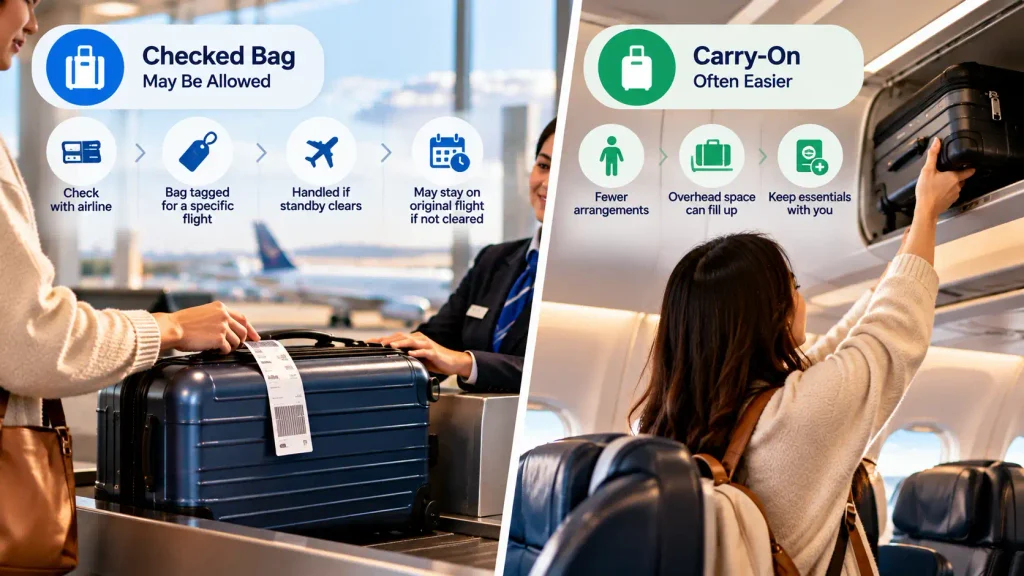
Sometimes, yes, but the process depends on the airline and the type of standby request. A ticketed passenger may be allowed to check luggage against the existing itinerary while waiting for an earlier flight. That does not mean the bag will automatically travel on the standby flight.
Airlines must match checked baggage to the correct passenger and flight. If the passenger clears standby, airport staff will handle the bag according to the carrier’s procedures. If the request fails, the bag may remain associated with the original flight or require further handling.
Before checking luggage, ask the airline representative:
- Whether the bag can be accepted before a standby seat is confirmed.
- Which flight the bag is tagged for.
- What happens if the standby request is not clear.
- Whether the bag needs to be retagged if the passenger receives a seat on another departure.
Is Traveling With Carry-On Luggage Easier?
Traveling light can make standby simpler. A passenger with only a personal item or carry-on has fewer baggage arrangements to consider if the flight changes.
However, carry-on baggage doesn’t guarantee easier boarding. Overhead-bin space can fill up, and the airline may require you to check some bags at the gate. Passengers should follow the gate agent’s instructions and keep essential medication, documents, valuables, and items needed during the journey accessible.
Can You Use TSA PreCheck With a Standby Ticket?
A standby request does not automatically guarantee TSA PreCheck access. Eligibility depends on the passenger’s security-screening status and the information shown on the boarding pass used at the checkpoint.
If a traveler has TSA PreCheck and their applicable boarding pass displays the indicator, they can generally use the designated lane, subject to TSA rules and checkpoint availability. However, a new standby boarding pass may show different information than the original pass.
Before entering the security line, check the boarding pass for the flight you intend to take. If the PreCheck indicator is missing, do not assume the original reservation’s status carries over. Ask the airline whether the new itinerary includes the correct passenger information and Known Traveler Number, and follow the airport’s screening instructions.
International travel may require additional screening, and TSA PreCheck does not replace passport, visa, or destination-entry requirements.
Can You Enter an Airport Lounge While Flying Standby?
Lounge access depends on the lounge’s own entry rules, the airline or card benefit used, and the travel documents the passenger can present. Standby travelers should not assume a lounge membership or premium credit card guarantees entry.
Some lounge programs require a same-day boarding pass; others specify a confirmed seat assignment or impose additional conditions. Airline-operated lounges may also have rules tied to the carrier, cabin, route, or elite status.
Before walking to a lounge, check its current policy and ask staff whether your particular standby status qualifies. A lounge agent may interpret a policy differently than a traveler, and you should never assume admission based on a previous visit.
Check This Out: Tokyo Haneda Centurion Lounge Guide: Access, Hours & Amenities
What If Your Lounge Access Depends on a Premium Cabin?
A business-class ticket on a separate onward flight does not automatically grant access to every airport lounge. The lounge may require a qualifying same-day boarding pass, a particular operating airline, or another condition.
If your itinerary includes separate tickets, carry the relevant boarding passes and be prepared to explain your travel plans. The lounge will decide whether the documents meet its entry requirements.
What Happens When the Flight Starts Boarding?
Standby passengers usually have to wait until the airline has processed passengers with confirmed seats before the gate team can assign the remaining seats. The exact timing depends on the carrier and the flight.
A typical sequence is:
- Passengers with confirmed seat assignments board according to the airline’s normal process.
- The gate team assesses remaining seats and any operational restrictions.
- Eligible standby passengers are assigned seats according to the applicable priority list.
- Cleared passengers receive or confirm their boarding passes and board as directed.
This sequence is a general guide, not a guarantee that every airline will follow identical steps. Standby passengers should remain near the gate, keep their phone charged, and listen for announcements.
Read this guide: Flying Business Class to Europe: Top Ways Compared
Why You Should Stay Near the Gate
A seat may become available close to departure if a passenger does not arrive or a reservation changes. If you leave the gate area and miss the announcement, you could miss your chance to board.
Stay where the gate team can find you, monitor the app, and make sure staff know you are waiting. Do not board based solely on seeing your name on an earlier version of the list; wait for confirmation and follow the agent’s instructions.
What If the Overhead Bins Are Full?
Standby passengers may board late, which can mean less overhead-bin space. Depending on the aircraft and airline’s procedures, the gate team may ask you to gate-check a carry-on.
Keep valuables and essential items in a small personal item that meets the airline’s rules. If your bag is checked at the gate, confirm where it will be collected at the destination and whether it will be available at the jet bridge or baggage claim.
What Happens if You Do Not Get a Seat?
If your standby request is not clear, the next step depends on why you were flying standby.
For a same-day request made by a ticketed passenger, the original confirmed flight generally remains available until the alternative seat is assigned. Check with the airline before leaving the airport, especially if the original departure has changed or boarding is about to begin.
For a disruption-related request, the airline may need to rebook you, offer another flight, or provide instructions based on the circumstances. Do not assume that failing to clear standby automatically secures a seat on the next departure.
For employee or space-available travel, the traveler may need to wait for another flight and follow the employer’s rules for listing and priority.
If your plans are time-sensitive, ask the agent about confirmed alternatives and the next available departures. A standby request should not be treated as a substitute for a confirmed reservation when you must arrive by a particular time.
How to Improve Your Chances of Getting a Standby Seat
No strategy can guarantee a seat, but a few habits can make the process more manageable.
- Understand the rules before joining. Confirm that your ticket and route qualify.
- Check alternative flights. A route with several departures may offer more opportunities than one with only a single daily flight.
- Join the list through the official channel. Make sure the request is registered.
- Monitor your position. Use the airline app where available, but treat the list as a changing snapshot.
- Stay near the gate. Listen for announcements and respond promptly if your name is called.
- Pack thoughtfully. Keep essentials accessible in case you must gate-check your carry-on.
- Keep your schedule flexible. Have a backup plan if the request is not clear.
- Ask about a confirmed change. If arrival time matters, compare the cost and availability of a confirmed seat before relying on standby.
Frequent-flyer status or other qualifying benefits may affect priority under some airline programs, but benefits vary and should not be treated as a guarantee.
Final Takeaway
Standby can offer useful flexibility, but a good first-time experience starts with realistic expectations. Learn the airline’s rules, keep your original reservation details, monitor the list, stay near the gate, and ask about checked baggage and security-screening details before switching flights.
Most importantly, decide how much uncertainty your trip can tolerate. If you have time to spare, standby may be worth trying. If a connection or arrival deadline is critical, a confirmed seat is usually the safer choice. Before travel, consult the airline’s current same-day change and standby policy, because eligibility, fees, and priority rules can change.
Frequently Asked Questions
It can be cheaper when the airline offers eligible same-day standby at no charge, but rules vary. Some travelers may qualify only for particular routes or fare types. Always compare the available standby option with a confirmed change and review the conditions attached to the original ticket.
Possibly, but getting seats for everyone can be harder than getting one seat. If only a few seats become available, some members of the group may clear while others remain on the list. Ask the airline about the options before requesting standby if the group must travel together.
Not necessarily. Same-day standby programs often restrict passengers to the same origin and destination and may prohibit changes to connection cities or the number of flight segments. Check the airline’s rules before requesting a different routing.
Do not cancel it simply because you have joined the standby list. For many same-day standby programs, the original flight remains confirmed until the alternative seat is assigned. Confirm the airline’s rules and make sure you understand what happens to the original reservation before taking any action.
It depends on the airline and program. Some same-day standby services are restricted to domestic or specified regional routes, while disruption-related rebooking follows different rules. Check the specific policy for your route and ticket.
No. If no seat becomes available or your request is not clear, you may need to take your original flight, accept another confirmed option, or wait for a later departure, depending on your situation and the airline’s rules.