
Avianca Boarding Groups and Process: A Complete Guide
Avianca boards passengers in groups based on fare type, eligible LifeMiles status, purchased priority boarding, and special assistance needs, with Business Class and eligible frequent flyers generally receiving earlier access to the aircraft. The exact boarding group appears on the passenger’s boarding pass, so travelers should check their individual flight details rather than rely on a group assignment from another itinerary.
Avianca’s boarding system organizes passengers before departure, but knowing the order is only part of the process. Travelers also need to understand when check-in opens, how priority boarding works, when to reach the gate, and what happens if they arrive after boarding has started.
This guide explains Avianca’s boarding groups, preboarding arrangements, priority boarding options, airport timelines, and practical steps passengers can take to avoid last-minute problems.
How Does Avianca Boarding Work?
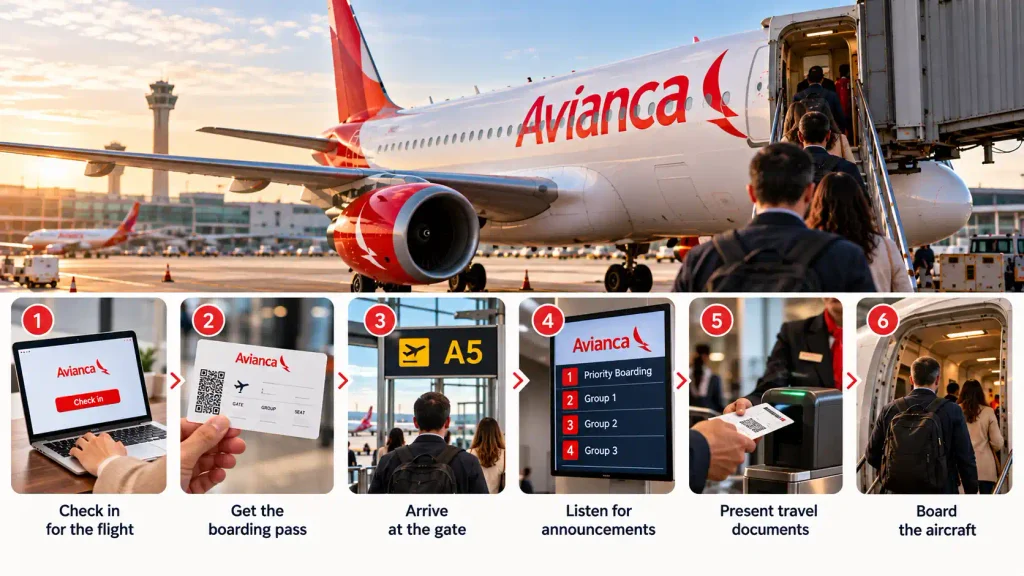
Avianca generally uses a group-based boarding system. Eligible passengers board in an assigned order, with priority categories called before general economy passengers. The airline may also provide preboarding for passengers who need assistance.
The process usually follows these steps:
- Check in for the flight: Complete online check-in or use an airport counter or kiosk when required.
- Get the boarding pass: Review the assigned boarding group, departure gate, seat, and other flight details.
- Arrive at the gate: Reach the correct boarding area well before the scheduled departure time.
- Listen for announcements: Gate staff announce when each group may line up and board.
- Present travel documents: Show the boarding pass and any required identification or travel documents.
- Board the aircraft: Follow staff instructions and find your assigned seat.
Boarding generally begins around 45 minutes before departure, according to Avianca’s published airport guidance. The airline states that boarding closes 15 minutes before departure. These deadlines are important because arriving at the airport is not the same as arriving at the gate on time.
Passengers should follow the specific times printed on their boarding pass and any instructions from airport staff.
Related: Avianca Review: Seats, Baggage, Fees & LifeMiles
Avianca Boarding Groups Explained
Avianca’s commonly reported boarding structure includes Groups A, B, C, and D, although the exact arrangements can vary by flight and aircraft. Passengers should use the group printed on their own boarding pass as the final reference.
| Boarding category | Passengers commonly included | What to know |
| Preboarding | Eligible passengers who need assistance, subject to arrangements | May be offered before the numbered or lettered groups |
| Group A | Business Class passengers and eligible LifeMiles Gold and Diamond members | Priority boarding category |
| Group B | Eligible LifeMiles Silver members and passengers who purchased priority boarding | Early boarding access depends on eligibility and service conditions |
| Group C | Many Economy passengers traveling on Classic or Flex fares without an added priority service | General economy boarding |
| Group D or a later group | Basic fare passengers and other passengers assigned to the final boarding group | The precise sequence may vary by aircraft or flight. |
This table is a practical overview, not a guarantee that every Avianca flight will use the same sequence. Boarding arrangements and eligibility may change according to the itinerary, fare conditions, frequent-flyer benefits, operational needs, and the service purchased.
Preboarding: Who Can Board Before the Main Groups?
Preboarding may be available to passengers who need additional assistance getting onto the aircraft. This can include travelers with reduced mobility, passengers using wheelchairs, and eligible families traveling with infants.
Passengers who believe they need preboarding should contact Avianca before departure when possible and speak with airport staff upon arrival. The airline can explain the assistance arrangements available for the specific airport and flight.
Preboarding does not necessarily mean a passenger can enter the aircraft immediately upon reaching the gate. The crew or ground team may still be preparing the aircraft, and passengers may be asked to wait until boarding can safely begin.
Travelers requesting accessibility assistance should allow extra time at the airport. Avianca advises passengers requiring special assistance to arrive at the counter earlier than the standard recommended arrival time.
Group A: Business Class and Eligible Elite Members
Group A is generally associated with Avianca Business Class and eligible LifeMiles Gold and Diamond members. These passengers board earlier than most economy travelers.
Early boarding helps passengers settle into their seats, organize personal items, and access available overhead-bin space before the cabin gets crowded.
However, the boarding group should not be confused with other benefits. A passenger’s boarding priority does not automatically establish eligibility for every airport service, such as lounge access, priority security, or additional baggage. Those benefits have separate eligibility requirements.
Passengers traveling on Business Class tickets should check their booking and boarding pass for the services included in their specific fare.
Group B: LifeMiles Silver and Priority Boarding Passengers
Group B commonly includes eligible LifeMiles Silver members and travelers who purchased Avianca’s priority boarding service.
Priority boarding is a paid service available on eligible Light, Classic, and Flex fares, subject to availability and restrictions. Avianca states that priority boarding allows eligible customers to use a priority line and board during the first boarding call. It is already included with Business fares.
The service is intended to improve boarding position and may help passengers access available carry-on storage earlier. It does not guarantee a particular overhead-bin space, because cabin capacity and other operational factors can affect availability.
Priority boarding is also different from priority check-in or security screening. Purchasing it does not automatically provide access to faster lines at every stage of the airport journey.
Passengers should confirm that the service appears in their booking or travel documents before relying on it.
Group C: Economy Classic and Flex Passengers
Many passengers traveling in Economy on Classic or Flex fares without priority boarding are assigned to Group C under the commonly reported system.
These travelers follow the airline’s general boarding announcements and should wait until their group is called before joining the boarding line, unless airport staff gives different instructions.
A later boarding position does not mean the passenger has a worse seat. Seat location and boarding order are separate matters. A passenger seated near the front of the economy cabin may still be in a later boarding group if the booking and boarding rules assign them to one.
Group C travelers should arrive at the gate early rather than wait until the announcement begins. This gives them time to check the gate, organize their documents, and respond to any last-minute changes.
Group D: Basic Fare and Final-Group Passengers
Basic fare passengers are commonly assigned to the final boarding group. Depending on the aircraft and flight, Avianca may use an additional group or adjust the sequence.
A later group can mean less time to choose among available overhead-bin spaces. This is particularly relevant for travelers carrying cabin baggage, so passengers should review the baggage allowance and conditions attached to their specific fare.
A basic fare may also have restrictions or additional charges for certain services. The precise conditions depend on the route and ticket purchased; travelers should not assume that every Basic fare includes the same baggage or airport services.
Passengers should check the boarding pass for their actual group and follow the gate team’s instructions if the airline changes the boarding order.
How to Get Priority Boarding on Avianca
Travelers may qualify for priority boarding through their cabin, eligible LifeMiles status, or a separately purchased service. The best option depends on how often they fly, the fare they booked, and the benefits already included in their reservation.
1. Book an Eligible Business Class Fare
Avianca’s Business fares include priority boarding. Eligible Business Class passengers generally board with the earlier priority category, although the gate team controls the actual sequence for each flight.
This can be useful for travelers who value early access to the cabin. However, booking Business Class solely for boarding priority may not be cost-effective if the other cabin benefits are not important to the traveler.
2. Qualify for LifeMiles Elite Benefits
LifeMiles is Avianca’s frequent-flyer program. Its elite tiers include Red Plus, Silver, Gold, and Diamond, with benefits varying by tier and applicable travel conditions.
Avianca identifies priority boarding as one of the benefits available to eligible elite members. Gold and Diamond members generally receive earlier boarding alongside Business Class passengers, while Silver members may qualify for a later priority group under the published boarding structure.
Elite benefits can change, and status alone should not be treated as a guarantee of every airport privilege. Check the current LifeMiles benefits and confirm that the status is recognized on the booking before travel.
3. Purchase Priority Boarding
Passengers on eligible Light, Classic, and Flex fares may be able to add priority boarding through Avianca’s website or during online check-in.
The service is subject to availability, capacity limits, and fare restrictions. Avianca states that it is not available on Basic fares on routes within the Americas. Other conditions may apply depending on the itinerary.
Priority boarding is an individual service. If several people are traveling on the same reservation and each wants the benefit, each eligible passenger may need the service added separately.
Before purchasing, passengers should verify:
- Whether the fare is eligible.
- Whether the service is available for the selected flight.
- Whether the booking confirms the purchase.
- Which boarding call and priority line apply.
- Whether the service covers the intended flight or only a particular segment.
For example, a family of three traveling on eligible fares should not assume that purchasing priority boarding for one passenger automatically gives all three the same benefit.
When Does Avianca Boarding Start and Close?
Avianca’s published guidance provides the following general timeline. These times are based on the scheduled departure, but passengers should always check the specific instructions for their flight.
| Airport milestone | General timing | Recommended action |
| Online check-in opens | 48 hours before departure; 24 hours for flights to or from the United States, Puerto Rico, and Canada | Check in as soon as the window opens if convenient |
| Recommended airport arrival for domestic flights | 2 hours before departure | Allow time for check-in, baggage, and security |
| Recommended airport arrival for international flights | 3 hours before departure | Allow additional time for document checks and international procedures |
| Domestic check-in closes | 45 minutes before departure | Complete check-in and baggage procedures before the deadline |
| International check-in closes | 60 minutes before departure | Confirm documents and check-in well in advance |
| Boarding begins | Around 45 minutes before departure | Be at the assigned gate with documents ready |
| Boarding closes | 15 minutes before departure under Avianca’s published guidance | Do not rely on the airline holding the aircraft for late passengers |
These times are general guidance, not a reason to arrive at the airport at the last possible minute. Queues, terminal distances, security screening, immigration, baggage drop, and document checks can take longer than expected.
Why Boarding Starts Before Departure
Airlines need time to get passengers seated, store cabin baggage, close the aircraft doors, and complete pre-departure procedures. Starting boarding before the scheduled departure gives the ground and cabin teams time to prepare the aircraft.
The boarding start time is therefore not the time passengers should aim to arrive at the airport. A traveler arriving 45 minutes before departure may already be too late to complete every required step.
A safer plan is to arrive at the airport according to Avianca’s recommended domestic or international timeline, complete check-in and security, and reach the gate before boarding starts.
What Happens If a Passenger Arrives Late?
Passengers must reach the assigned gate within the deadline set by Avianca. The airline’s conditions of carriage state that passengers who miss the gate deadline may lose their right to board, and their booking may be canceled under the applicable conditions.
If a passenger realizes they may be late, they should contact airport staff immediately rather than assume the aircraft will wait. Boarding closure is a separate deadline from the scheduled departure time.
How to Check Your Avianca Boarding Group
The simplest way to confirm your boarding group is to review the boarding pass for that flight. The group may also appear in the airline’s digital trip information.
Follow these steps:
- Check in online. Use Avianca’s check-in service when the window opens.
- Open the boarding pass. Look for the boarding group or boarding-zone information.
- Review the flight details. Confirm the date, flight number, airport, and gate information.
- Check for updates. Use the Avianca app or airport departure screens to follow gate changes and notifications.
- Ask staff if the group is unclear. The gate team can clarify where to wait and when to board.
Do not assume that the group assigned on an earlier flight will apply to a later segment. A multi-flight itinerary can have different boarding passes, gate procedures, and boarding groups for each flight.
Can the Boarding Group Change?
Operational requirements, aircraft configuration, passenger needs, and the services recorded on the booking can affect boarding arrangements. The airline may also direct passengers differently than usual.
If the group printed on a boarding pass conflicts with a general announcement, follow the latest instructions from authorized gate staff. If a purchased service or elite benefit is missing from the boarding information, ask the airline to verify the booking before boarding begins.
What Is Avianca’s Boarding Process at the Airport?
The boarding process involves more than joining a line when the right letter is announced. Passengers should prepare their documents, monitor the gate, and listen carefully for instructions.
Step 1: Complete Check-In
Avianca offers online check-in through its website and app during the airline’s designated check-in window. Passengers generally need their booking code and surname as shown in the reservation.
Some travelers may still need to visit an airport counter, including passengers requiring certain special services or traveling with pets or minors, depending on the applicable requirements.
If Avianca does not issue your boarding pass after online check-in, follow Avianca’s instructions and contact the airline or airport counter as needed.
Step 2: Prepare Travel Documents
Keep the boarding pass and required identification accessible. International travelers should also verify passport validity, visa requirements, and any other documents needed for their destination and transit points.
Document requirements depend on nationality, destination, itinerary, and applicable government rules. A boarding pass alone does not guarantee permission to travel if required documents are missing.
Step 3: Confirm the Departure Gate
Airport gate assignments can change. Check the airport departure screens and the Avianca app rather than relying exclusively on a gate number viewed much earlier.
Avianca recommends using its app notifications and airport displays to stay informed about flight details and gate announcements.
Step 4: Listen for Your Group
Wait for your assigned group to be called. If you have priority boarding, use the designated priority line or follow the instructions provided for your flight.
Avoid joining a line for an earlier group unless you are eligible or staff specifically invite you forward. An early queue position does not change the group recorded on the boarding pass.
Step 5: Board and Find Your Seat
At the boarding point, staff may scan the boarding pass and check identification or travel documents as required. Once admitted, follow the signs and crew instructions to find the assigned seat.
Store belongings in the locations permitted by the airline’s cabin-baggage rules. Keep essential documents and items you may need during the flight accessible.
Avianca Boarding With Children or Special Assistance Needs
Passengers traveling with children, infants, or people who need mobility assistance should check the airline’s arrangements before departure. The correct procedure can depend on the type of assistance required, the airport, and the itinerary.
Families Traveling With Infants
Eligible passengers traveling with infants may be able to request preboarding or receive instructions from airport staff about when to approach the gate. Families should confirm the applicable arrangements in advance rather than assuming every airport uses the same procedure.
Parents should keep required identification and travel documents ready and allow additional time for check-in and boarding preparations.
Passengers With Reduced Mobility
Travelers who need wheelchair assistance or other accessibility support should request the service through Avianca’s official channels as early as possible. The airline provides information on assistance for passengers with physical disabilities and directs travelers who need support to designated airport counters or assistance lines.
Arrive early enough to coordinate with airport staff. If you requested assistance but it isn’t immediately available, contact the airline or airport team rather than trying to manage the transfer alone.
Does Special Assistance Guarantee Immediate Boarding?
Not necessarily. Preboarding and assistance arrangements are designed to address passenger needs, but timing depends on operational readiness and the departure airport’s procedures.
Passengers should tell staff about their needs and follow their instructions. If they are unsure where to wait, they should ask the gate team before the general boarding process begins.
Tips for a Smoother Avianca Boarding Experience
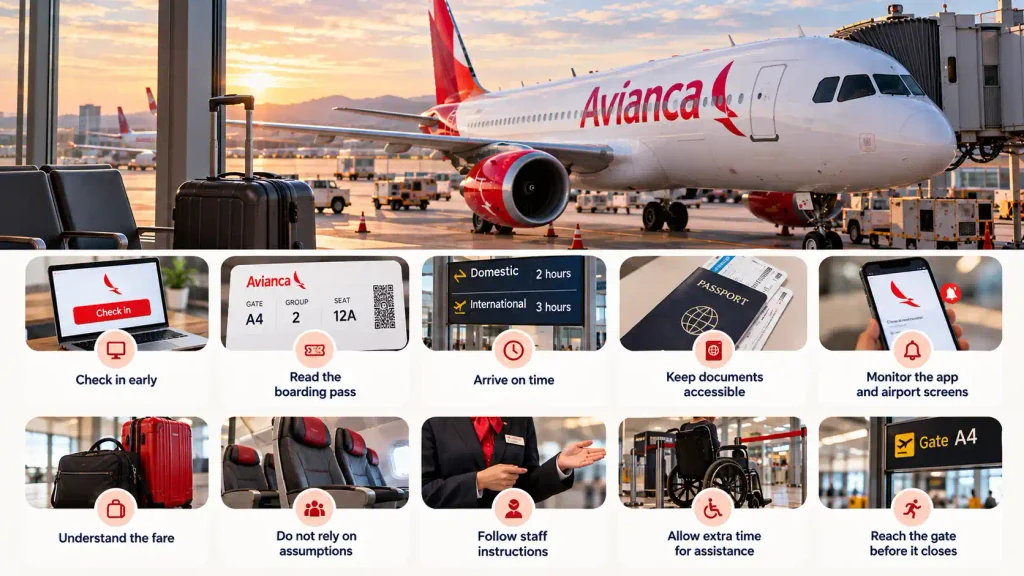
A few simple preparations can reduce gate confusion and help travelers meet the airline’s deadlines.
- Check in early: Use the online check-in window when available and confirm your boarding pass has been issued.
- Read the boarding pass: Verify the assigned group, gate, flight number, and departure time.
- Arrive according to the itinerary: Avianca recommends arriving two hours before domestic flights and three hours before international flights.
- Keep documents accessible: Avoid searching through packed luggage when boarding staff requests identification or travel documents.
- Monitor the app and airport screens: Gate assignments and flight information may change.
- Understand the fare: Check baggage and priority-boarding conditions before paying for an add-on.
- Do not rely on boarding-group assumptions: A previous flight, another passenger’s experience, or a general online guide may not reflect the current assignment.
- Follow staff instructions: Operational needs may alter the usual boarding sequence.
- Allow extra time for assistance: Passengers requiring accessibility services or special handling should plan ahead.
- Reach the gate before boarding closes: Avianca states that boarding closes 15 minutes before departure, so passengers should not treat the scheduled departure time as the gate-arrival deadline.
Check Out This Blog: Places to Visit in Canada
Final Takeaway
Avianca’s boarding process is easier to navigate when passengers understand their assigned group, check-in window, and gate deadline before arriving at the airport. Business Class passengers and eligible elite members generally board earlier, and qualifying fares may offer priority boarding. Basic fare passengers are commonly assigned to a later group.
Before every flight, check your boarding pass, confirm the latest gate information, review your fare’s baggage and priority-service conditions, and arrive within Avianca’s recommended airport timeline. These steps are more reliable than assuming the same boarding order applies to every flight.
Frequently Asked Questions
Group A generally includes Business Class passengers and eligible LifeMiles Gold and Diamond members. The exact assignment should be confirmed on the boarding pass for the flight.
The commonly reported Group B category includes eligible LifeMiles Silver members and passengers who purchased priority boarding. Eligibility and the actual boarding sequence may vary, so passengers should check their booking and boarding pass.
Basic fare passengers are commonly assigned to the final boarding group, often Group D when that group is used. The exact group can depend on the flight and aircraft, so the boarding pass is the most reliable reference.
Yes. Avianca offers priority boarding on eligible Light, Classic, and Flex fares, subject to availability and restrictions. It is included with Business fares and is not available on Basic fares on routes within the Americas, according to the airline’s published conditions.
Online check-in generally opens 48 hours before departure. For flights to or from the United States, Puerto Rico, and Canada, it opens 24 hours before departure. Passengers should verify the applicable window for their itinerary.
Avianca recommends arriving two hours before domestic flights and three hours before international flights. Additional time may be needed for special assistance, document checks, baggage drop, busy airports, or other itinerary-specific requirements.
Avianca’s published airport guidance states that boarding closes 15 minutes before departure. Travelers should follow the time shown on their boarding pass and the instructions issued by airport staff.
No, not automatically. Avianca describes priority boarding as a boarding service. Priority at check-in counters or security screening is separate and depends on the benefits or services available to the passenger.
Arriving early does not automatically grant an earlier boarding group. Passengers should wait until their assigned group is called unless gate staff authorize them to board earlier.
Check the latest boarding pass and booking information, then ask Avianca or gate staff to verify the assignment. Passengers who purchased priority boarding or hold eligible status should raise any discrepancy before boarding closes.
No. The commonly reported lettered sequence is a useful guide, but the exact structure can vary by flight, aircraft, and operational requirements. Passengers should follow the boarding group and announcements for their specific departure.
Passengers can use the official Avianca app, check airport departure screens, and listen to gate announcements. The app supports trip management, boarding-pass access, flight-status updates, and notifications.