
Europe’s Best Christmas Markets for a Festive 2026 Trip
Europe’s Christmas markets in 2026 begin opening from mid-November, transforming historic squares and city centers into festive destinations filled with traditional food, handmade gifts, lights, entertainment, and regional holiday customs. Some continue only until Christmas Eve, while others remain open through New Year’s Day or early January.
Choosing where to go can be difficult because the experience varies considerably by destination. Vienna surrounds grand architecture with several Advent markets, Nuremberg emphasizes centuries-old German traditions, Strasbourg fills its historic center with Christmas decorations, and Tallinn places its market amid a medieval Old Town.
This guide covers some of the best Christmas markets in Europe for 2026, including confirmed dates where they have been officially announced, what makes each destination distinctive, what to eat, and practical advice for planning a European Christmas market trip.
2026 Date Note: Christmas market schedules can change. Dates marked as confirmed below were checked against official tourism boards, city authorities, or event organizers. Always verify opening hours shortly before traveling.
European Christmas Markets 2026 at a Glance
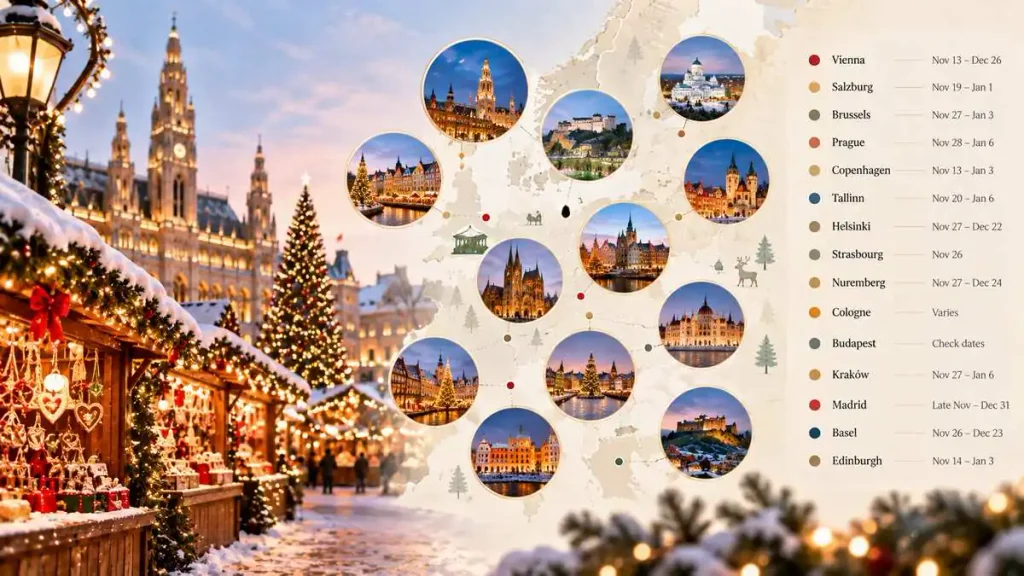
| Destination | Main Christmas Market | 2026 Dates |
| Vienna, Austria | Rathausplatz Christmas Market | Nov. 13-Dec. 26 |
| Salzburg, Austria | Salzburg Christkindlmarkt | Nov. 19-Jan. 1, 2027 |
| Brussels, Belgium | Winter Wonders | Nov. 27-Jan. 3, 2027 |
| Prague, Czech Republic | Old Town Square | Nov. 28-Jan. 6, 2027 |
| Copenhagen, Denmark | Christmas in Tivoli | Nov. 13-Jan. 3, 2027 |
| Tallinn, Estonia | Tallinn Christmas Market | Nov. 20-Jan. 6, 2027 |
| Helsinki, Finland | Helsinki Christmas Market | Nov. 27-Dec. 22 |
| Strasbourg, France | Strasbourg Christmas Market | Opens Nov. 26 |
| Nuremberg, Germany | Christkindlesmarkt | Nov. 27-Dec. 24 |
| Cologne, Germany | Multiple Christmas markets | Varies by market |
| Budapest, Hungary | Major central Christmas markets | Check individual 2026 organizer dates |
| Kraków, Poland | Main Market Square | Expected Nov. 27-Jan. 6, 2027* |
| Madrid, Spain | Plaza Mayor Christmas Market | Late Nov.-Dec. 31 |
| Basel, Switzerland | Basel Christmas Market | Nov. 26-Dec. 23 |
| Edinburgh, Scotland | Edinburgh’s Christmas | Nov. 14-Jan. 3, 2027 |
Kraków’s 2026-27 schedule was being presented as pre-season planning rather than a final city confirmation at the time of checking.
1. Vienna, Austria — A City Filled With Christmas Markets
Vienna is an excellent choice for travelers who want to experience several Christmas markets during one trip rather than relying on a single central event.
Its best-known festive market takes place at Rathausplatz in front of Vienna City Hall. The combination of illuminated architecture, market stalls, seasonal food, skating, and decorated parkland makes this one of the city’s major Advent attractions.
For 2026, the Viennese Christmas Market at Rathausplatz runs from November 13 through December 26, generally from 10 a.m. to 10 p.m. Christmas Eve has shorter opening hours.
What Makes Vienna Special?
Vienna’s strength is variety.
Visitors can move between markets that emphasize different experiences, including:
- Large traditional Christmas markets
- Palace settings
- Arts and crafts
- Food and drink
- Family activities
- Smaller neighborhood markets
This makes Vienna suitable for a multiday Christmas trip because travelers do not need to repeat the same market every evening.
What To Try
Look for Austrian seasonal favorites such as:
- Glühwein
- Punsch
- Sausages
- Roasted chestnuts
- Gingerbread
- Kaiserschmarrn
- Christmas cookies
Reusable mugs are common at Austrian Christmas markets. Visitors usually pay a deposit and can either return the mug or keep it as a souvenir.
2. Salzburg, Austria — Christmas Beneath a Baroque Skyline
Salzburg offers a more compact Christmas experience than Vienna, with historic architecture creating much of the atmosphere.
The Salzburg Christkindlmarkt takes place around Domplatz and Residenzplatz in the city’s historic center.
For 2026, the official Salzburg tourism site confirms that the market runs from November 19, 2026, through January 1, 2027.
The market’s history reaches back centuries, while its location near Salzburg Cathedral makes it particularly atmospheric after sunset.
Visitors can also encounter seasonal performances and traditional events. The 2026 program includes a Krampus run on December 5 and a Perchten run later in December.
Why Choose Salzburg?
Salzburg can work particularly well for travelers interested in combining:
- Christmas markets
- Historic architecture
- Classical music
- Alpine scenery
- Traditional Austrian food
It can also be paired with Vienna on a longer Austrian holiday.
3. Brussels, Belgium — Winter Wonders Spreads Across the City Center
Brussels offers something larger than a conventional market occupying one square.
Its Winter Wonders celebration spreads across central Brussels, including Grand-Place, Bourse, Sainte-Catherine, Marché aux Poissons, and other locations.
The City of Brussels confirms the 2026 edition will run from November 27, 2026, through January 3, 2027.
The event includes more than 200 chalets, alongside attractions such as a Ferris wheel, ice rink, merry-go-rounds, Christmas tree, entertainment, and a sound-and-light show at Grand-Place.
What To Eat in Brussels
A Christmas trip to Brussels provides plenty of opportunities to try Belgian favorites, including:
- Waffles
- Chocolate
- Fries
- Speculoos
- Seasonal drinks
- Belgian beer
Because the event occupies several parts of the city center, allow more than an hour or two if you want to see the main areas without rushing.
4. Prague, Czech Republic — Christmas in the Historic Old Town
Few settings suit Christmas lights quite like Prague’s Old Town.
The city’s major market takes over Old Town Square, surrounded by historic buildings and within walking distance of many central attractions.
Prague City Tourism currently lists the Old Town Square Christmas Market from November 28, 2026, through January 6, 2027. The Wenceslas Square Christmas Market is scheduled for the same period.
Other Prague markets begin earlier. For example, the Christmas Market at Náměstí Míru is scheduled from November 20 through December 24.
Why Prague Works Well for a Christmas Break
Central Prague is relatively compact for sightseeing, allowing visitors to combine festive markets with landmarks such as:
- Old Town Square
- Charles Bridge
- Prague Castle
- Wenceslas Square
- Historic churches
Prague also gives travelers a useful advantage after Christmas: its main Old Town and Wenceslas Square markets continue into early January.
5. Copenhagen, Denmark — Christmas Inside Tivoli Gardens
Copenhagen’s festive season has a different character from the traditional town-square markets found across Germany and Austria.
One of its signature experiences is Christmas in Tivoli Gardens.
The 2026 Christmas season at Tivoli is scheduled from November 13, 2026, through January 3, 2027.
The gardens combine Christmas decorations and illuminated scenery with entertainment, food, attractions, and Tivoli’s existing amusement-park setting.
Unlike many European public Christmas markets, Tivoli requires admission, so include the entrance price when budgeting.
What Makes Copenhagen Different?
Copenhagen works well for travelers interested in the Danish idea of hygge — warmth, comfort, food, lights, and socializing during the dark winter months.
Expect:
- Elaborate lighting
- Decorated gardens
- Seasonal food
- Christmas stalls
- Entertainment
- Family attractions
Copenhagen also has smaller festive markets elsewhere in the city, so Tivoli does not have to be your only Christmas stop.
6. Tallinn, Estonia — A Christmas Market in a Medieval Old Town
Tallinn delivers one of Europe’s most distinctive settings for a winter trip.
The city’s Christmas market occupies Town Hall Square, surrounded by the architecture and cobbled streets of Tallinn’s medieval Old Town.
Visit Tallinn confirms that the 2026 Christmas Market will take place from November 20, 2026, through January 6, 2027.
A large Christmas tree stands in Town Hall Square, while festive events extend beyond the central market to other parts of the city.
Why Visit Tallinn at Christmas?
Tallinn is particularly attractive if you want:
- Medieval surroundings
- A compact historic center
- Cold winter atmosphere
- Traditional festive food
- A market continuing after Christmas
- A Baltic rather than Central European Christmas experience
Winter temperatures can be considerably colder than in Western European Christmas-market cities, so appropriate footwear and insulated clothing matter.
7. Helsinki, Finland — Finnish Crafts and Food at Senate Square
Helsinki’s main Christmas market, Tuomaan Markkinat, takes place at Senate Square beneath Helsinki Cathedral.
For 2026, the event runs from November 27 through December 22.
The market emphasizes Finnish producers, crafts, gifts, food, and sustainability. MyHelsinki describes it as the city’s oldest outdoor Christmas market and notes that its traditional carousel remains one of its recognizable features.
What To Look For
Travelers can browse for:
- Finnish crafts
- Locally produced gifts
- Seasonal foods
- Baked goods
- Hot drinks
- Sustainable products
Helsinki can also be paired with Tallinn. Ferries connect the 2 capitals, making it possible to experience Finnish and Estonian Christmas traditions on the same trip, subject to winter schedules and weather conditions.
8. Strasbourg, France — The “Capital of Christmas”
Strasbourg has one of Europe’s longest-standing Christmas-market traditions.
Its festive history, Alsatian architecture, enormous Christmas tree, decorated streets, and multiple market locations have helped establish the city as a major December destination.
Strasbourg’s tourism office says the city’s Christmas celebrations begin on November 26 in 2026.
The market tradition dates back centuries, with Strasbourg’s Christkindelsmärik developing after the city became Protestant in the 16th century.
What Makes Strasbourg Stand Out?
The market is not the only attraction. Much of central Strasbourg participates in the festive season through:
- Elaborate building decorations
- Illuminated streets
- Christmas trees
- Market stalls
- Seasonal food
- Historic squares
Alsace also contains several smaller towns famous for their festive atmosphere, making Strasbourg a useful base for a wider Christmas-market itinerary.
9. Nuremberg, Germany — One of Germany’s Classic Christmas Markets
Germany has an enormous number of Christmas markets, but Nuremberg Christkindlesmarkt remains one of its most recognizable.
For 2026, the market is officially scheduled from November 27 through December 24 at Hauptmarkt.
Around 180 wooden stalls traditionally decorated with red-and-white roofs fill the square. Visitors can shop for Christmas decorations, traditional crafts, food, and gifts.
What Should You Eat?
Nuremberg is particularly associated with:
- Nürnberger Rostbratwurst
- Lebkuchen
- Glühwein
The market also includes a Children’s Christmas and a Sister Cities Market.
Important Timing Detail]
Unlike Christmas markets that continue into January, Nuremberg’s main Christkindlesmarkt ends on Christmas Eve.
If this market is a priority, plan your trip before December 24 rather than assuming it will remain open between Christmas and New Year.
10. Cologne, Germany — Several Markets in One Destination
Cologne is another strong option for travelers who want multiple markets without repeatedly changing hotels.
Instead of one dominant Christmas fair, markets appear around different parts of the city, each with its own design and atmosphere.
The city’s 2026 Christmas schedule includes events at locations such as:
- Cologne Cathedral area
- Neumarkt
- Old Town
- Rudolfplatz
- Rheinauhafen
- Chlodwigplatz
Dates vary by market. Several central markets begin in mid-November and finish around December 23, while some seasonal events extend into January.
Why Cologne?
Cologne is useful for travelers who want variety without taking day trips.
You can spend the morning sightseeing, visit one market in the afternoon, and walk to another after dark.
Its major rail connections also make Cologne practical for a multicity Christmas trip through Germany or neighboring countries.
11. Budapest, Hungary — Festive Markets Around the City Center
Budapest’s Christmas season usually centers on markets around St. Stephen’s Basilica and Vörösmarty Square, with additional festive events elsewhere in the Hungarian capital.
Advent Basilica is particularly known for its illuminated Basilica backdrop, craft stalls, food, seasonal programs, and light displays.
However, travelers planning a 2026 trip should be careful with dates. At the time of research, the Advent Basilica organizer’s official site was still displaying its 2025-26 schedule, rather than a finalized 2026-27 calendar.
Some tourism sources are already publishing projected 2026 dates, but until the individual organizers confirm their calendars, travelers should verify the exact schedule before booking around a particular market.
What To Try in Budapest
Common Hungarian festive foods and drinks include:
- Kürtőskalács, or chimney cake
- Goulash
- Sausages
- Lángos
- Mulled wine
Budapest can also be appealing for travelers who want to combine Christmas markets with thermal baths, Danube views, historic architecture, and indoor attractions during cold weather.
12. Kraków, Poland — A Christmas Market in Rynek Główny
Kraków’s main Christmas market takes place in Rynek Główny, the enormous medieval Main Market Square in the heart of the Old Town.
Current pre-season information places the 2026-27 market from November 27, 2026, through January 6, 2027, although the source notes that final dates are confirmed by the city closer to the event.
That distinction is worth remembering when making nonrefundable travel arrangements.
What To Eat
Polish winter food suits cold evenings particularly well. Look for:
- Pierogi
- Grilled meats
- Polish soups
- Oscypek-style grilled cheese
- Gingerbread
- Pastries
- Mulled drinks
Kraków’s Old Town is compact enough that the Christmas market can be combined easily with sightseeing.
13. Madrid, Spain — A Different Kind of European Christmas Market
Christmas markets do not have to involve snow and freezing temperatures.
Madrid’s Plaza Mayor Christmas Market provides a distinctly Spanish alternative to the Central European Advent-market experience.
Madrid’s official tourism site says the market will operate from late November through December 31, 2026. It traditionally contains 104 stalls selling items such as Nativity figures, decorations, toys, and novelty products.
Entry is free.
Why Choose Madrid?
Madrid can appeal to travelers who want:
- Milder winter conditions
- Christmas lights
- Nativity traditions
- Shopping
- Spanish food
- Late-night city life
It also demonstrates how different Christmas-market traditions can be across Europe. Not every market follows the German-style combination of wooden chalets, Glühwein, and snowy streets.
14. Basel, Switzerland — Christmas Across 2 Historic Squares
Basel’s Christmas market takes place primarily across Barfüsserplatz and Münsterplatz.
The 2026 edition is confirmed for November 26 through December 23, generally operating from 11 a.m. until 8:30 p.m.
The event features around 150 selected stalls and food stands, according to Basel-Stadt’s market information.
Why Basel Works for a Christmas Trip
Basel offers a compact Old Town and a location near the borders of France and Germany.
That geography makes it interesting for travelers planning a cross-border festive itinerary. Depending on your schedule, a Basel stay can be combined with destinations in Alsace or southwestern Germany.
15. Edinburgh, Scotland — Markets, Rides, and Hogmanay Season
Edinburgh’s Christmas celebration mixes a traditional festive market with city-center entertainment and attractions.
For 2026, Edinburgh’s Christmas runs from November 14, 2026, through January 3, 2027.
Festive activities are centered around 3 main locations:
- East Princes Street Gardens
- West Princes Street Gardens
- George Street
The East Princes Street Gardens area hosts the main Christmas market.
Edinburgh is especially useful for travelers who want to stay through New Year, as the city’s Christmas festivities lead into its famous Hogmanay season.
Which European Christmas Market Should You Visit?
The right destination depends more on the experience you want than on finding a single “best” market.
| If You Want… | Consider… |
| Classic German tradition | Nuremberg |
| Several markets in one city | Vienna or Cologne |
| Medieval surroundings | Tallinn or Prague |
| Baroque architecture | Salzburg |
| A huge city-wide event | Brussels |
| Alsatian Christmas atmosphere | Strasbourg |
| Nordic Christmas | Helsinki or Copenhagen |
| Markets after Christmas | Prague, Tallinn, Brussels, Copenhagen |
| A milder climate | Madrid |
| Polish food and Old Town scenery | Kraków |
| Swiss Christmas atmosphere | Basel |
| Christmas plus New Year celebrations | Edinburgh |
| Thermal baths plus festive markets | Budapest |
This is not a ranking. Each destination offers a different combination of atmosphere, food, architecture, weather, dates, and additional attractions.
When Do Christmas Markets Start in Europe?
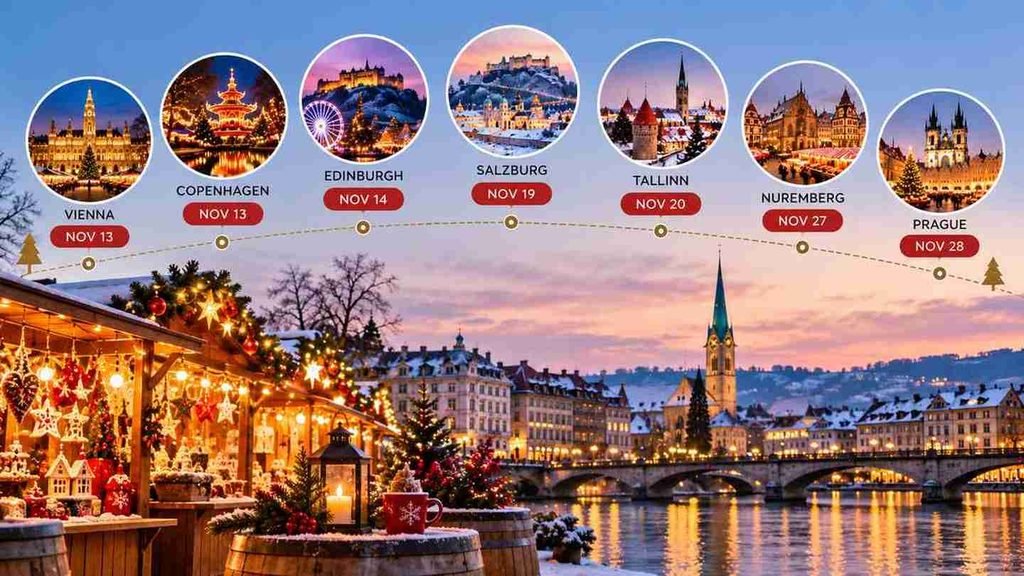
Most major European Christmas markets begin between mid-November and the first weekend of Advent.
For 2026, for example:
- Vienna Rathausplatz opens November 13.
- Copenhagen’s Christmas at Tivoli starts November 13.
- Edinburgh’s Christmas starts November 14.
- Salzburg begins November 19.
- Tallinn opens November 20.
- Nuremberg begins November 27.
- Prague’s major Old Town market begins November 28.
This makes late November through mid-December a particularly practical period for travelers who want the widest selection of markets operating simultaneously.
Do European Christmas Markets Stay Open After Christmas?
Some do, but many traditional Advent markets close on or shortly before Christmas.
For example, Nuremberg ends on December 24 and Basel on December 23.
By comparison, several destinations continue into January:
- Prague: through January 6, 2027
- Tallinn: through January 6, 2027
- Brussels: through January 3, 2027
- Copenhagen’s Tivoli: through January 3, 2027
- Edinburgh: through January 3, 2027
- Salzburg: through January 1, 2027
If you’re traveling between Christmas and New Year, check the closing date before choosing the destination.
What Can You Buy at European Christmas Markets?
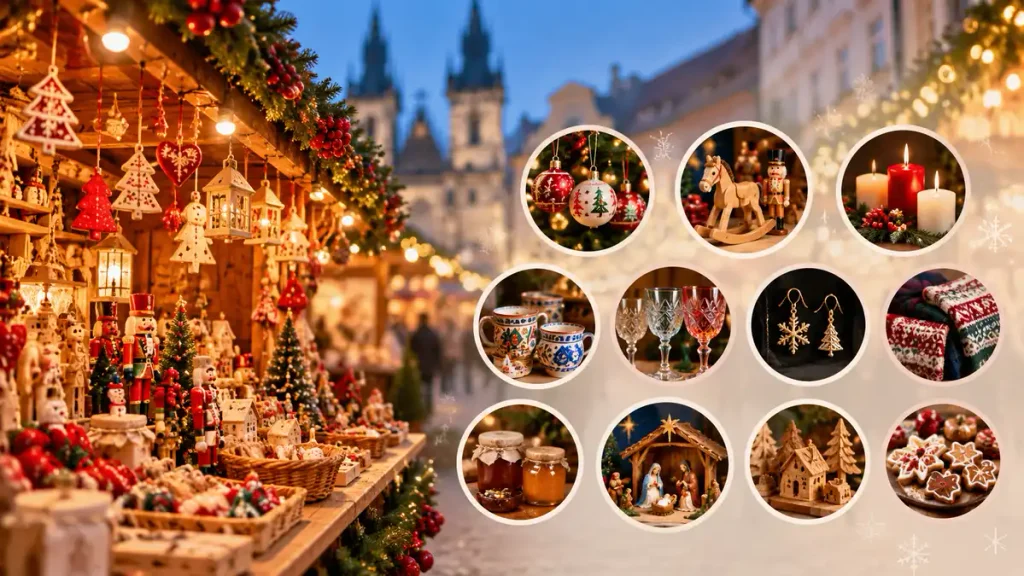
Products differ by country and market, but common items include:
- Handmade Christmas ornaments
- Wooden toys
- Candles
- Ceramics
- Glassware
- Jewelry
- Wool clothing
- Local food products
- Nativity decorations
- Regional crafts
- Christmas sweets
Markets with stricter artisan requirements may provide more locally produced merchandise, while larger commercial markets can have a broader mix of products.
If buying gifts is a major reason for your trip, visit during the daytime when stalls can be easier to browse than during busy evening periods.
What Food Should You Try at European Christmas Markets?
Food is one of the best reasons to visit more than one country because Christmas specialties change considerably across Europe.
You might encounter:
| Destination | Foods and Drinks To Look For |
| Germany | Bratwurst, Lebkuchen, Glühwein |
| Austria | Punsch, sausages, roasted chestnuts |
| Belgium | Waffles, chocolate, fries |
| Czech Republic | Sausages, pastries, mulled drinks |
| Finland | Seasonal pastries, hot drinks, Finnish specialties |
| France/Alsace | Bredele, regional dishes, vin chaud |
| Hungary | Chimney cake, lángos, goulash |
| Poland | Pierogi, grilled cheese, soups |
| Spain | Churros, sweets, regional Christmas foods |
| Switzerland | Raclette, cheese dishes, mulled wine |
Prices at Christmas markets can be higher than at ordinary local restaurants, so travelers on a budget may want to combine market snacks with meals elsewhere.
How Many Days Do You Need for a Christmas Market Trip?
For a single city, 2 to 3 full days is usually enough to combine Christmas markets with major sightseeing.
A longer itinerary works well when cities have easy rail connections.
For example, travelers could build trips around combinations such as:
- Vienna + Salzburg
- Prague + Vienna
- Cologne + Brussels
- Strasbourg + Basel
- Helsinki + Tallinn
Do not pack too many cities into a short trip. Winter weather, shorter daylight hours, train delays, and luggage can make rapid city-hopping less enjoyable than it appears on a map.
Tips for Visiting European Christmas Markets in 2026
Book Hotels Early
Popular market destinations can experience strong accommodation demand on Advent weekends. Booking early provides more choice, particularly if you want to stay within walking distance of the historic center.
Visit on Weekdays
Friday and Saturday evenings are often among the busiest periods. A Tuesday or Wednesday afternoon can provide a much calmer experience.
Go Once During the Day and Again After Dark
Daylight is better for examining crafts and shopping. After dark, lights and illuminated architecture create the atmosphere most travelers associate with Christmas markets.
Carry More Than One Payment Method
Card acceptance has improved substantially, but smaller vendors may still prefer or require cash. Carry an appropriate amount of local currency where necessary.
Remember that not every European country uses the euro. The Czech Republic, Hungary, Poland, Denmark, Sweden, Switzerland, and the U.K., for example, use their own currencies.
Dress for Hours Outdoors
A market visit can involve standing outside for several hours.
Pack:
- Warm layers
- Waterproof outerwear
- Gloves
- Hat
- Comfortable waterproof footwear
- Warm socks
Conditions in Tallinn or Helsinki can differ considerably from Madrid or Strasbourg, so check the forecast shortly before departure.
Understand Cup Deposits
Many Central European markets serve drinks in reusable mugs. You pay for the drink plus a deposit for the mug.
Return it to receive the deposit back, or keep it as a souvenir.
Check Christmas Eve and Christmas Day Hours
Do not assume normal opening hours apply on December 24 and 25.
Vienna’s Rathausplatz market, for example, closes earlier on Christmas Eve, while Nuremberg’s Christkindlesmarkt ends at 2 p.m. on December 24.
Are European Christmas Markets Free?
Most traditional outdoor European Christmas markets are free to enter, including major markets in places such as Nuremberg, Brussels, Basel, Prague, and Madrid.
However, individual attractions inside or alongside the markets—such as ice skating, Ferris wheels, rides, concerts, or workshops—may require payment.
Some festive destinations also charge general admission. Christmas at Tivoli Gardens in Copenhagen, for example, is held inside the ticketed amusement park.
Check whether you’re visiting a public market or a ticketed attraction when calculating your budget.
Final Thoughts
Europe’s Christmas markets are not one uniform experience. A Nuremberg trip centers on traditional German Advent culture, Strasbourg combines Alsatian history with extensive city decorations, Tallinn provides a medieval Baltic setting, and Copenhagen turns Tivoli Gardens into a full festive attraction.
For the broadest choice in 2026, late November through mid-December is the safest travel period because most major markets will be operating simultaneously. Travelers visiting after Christmas should focus on cities with confirmed January closing dates, such as Prague, Tallinn, Brussels, Copenhagen, and Edinburgh.
Most importantly, verify the exact dates and holiday opening hours shortly before traveling. Christmas-market schedules can vary by location, and different markets within the same city may open and close on different dates.
Frequently Asked Questions
November and December are the main Christmas-market months. Most markets open between mid- and late November. Some close before or on December 24, while others continue through New Year’s Day or early January.
Confirmed examples include the major Prague markets, Tallinn Christmas Market, Brussels Winter Wonders, Christmas in Tivoli, Edinburgh’s Christmas, and Salzburg Christkindlmarkt. Their closing dates range from January 1 to January 6, 2027.
Germany has many different Christmas-market experiences. Nuremberg is particularly well known for its traditional Christkindlesmarkt, while Cologne suits travelers who want several differently themed markets within one city.
It varies. Some markets close before Christmas Day, some have reduced holiday hours, and others continue operating. Check the official schedule of the individual market rather than assuming normal opening times.
It is useful to carry some cash even where cards are widely accepted. Payment policies vary between stalls, particularly at smaller markets and independent craft vendors.
Prague and Tallinn are particularly convenient options in this guide because their main 2026 Christmas markets are scheduled through January 6, 2027.
Several European markets have very old traditions, and claims about the “oldest” depend on how a Christmas market is defined and documented. Strasbourg traces its Christkindelsmärik to the 16th century, while Nuremberg’s market also has centuries of history. It is more accurate to describe these as among Europe’s historic Christmas markets rather than assign one undisputed title.
Yes. Early to mid-December provides a particularly wide choice because most major Christmas markets are operating by then and markets that close before Christmas have not yet ended. Expect cold weather, short daylight hours, and larger weekend crowds.