
17 Best Credit Cards for citizenM Hotel Travelers
The 17 best travel credit cards in September 2026 span flexible points cards, premium cards with lounge access, hotel cards, airline cards, business products, and no-annual-fee options, with the right choice depending on how a traveler spends and redeems rewards.
Travel credit cards have become much more varied than simply earning points on airlines tickets. Some now combine transferable rewards with hotel credits, airport lounge access, travel insurance, elite status, anniversary awards, or statement credits. Others keep things simple with a flat rewards rate and no annual fee.
For travelers booking hotels including stays at brands such as citizenM card selection can matter because the best card depends on whether the traveler values flexible points, direct hotel rewards, elite benefits, travel protections, or a straightforward statement credit.
The cards below are not ranked as a universal “winner.” Instead, each matches a particular travel profile so readers can compare benefits, annual fees, rewards structures, and current welcome offers.
Quick Comparison: 17 Travel Credit Cards for September 2026
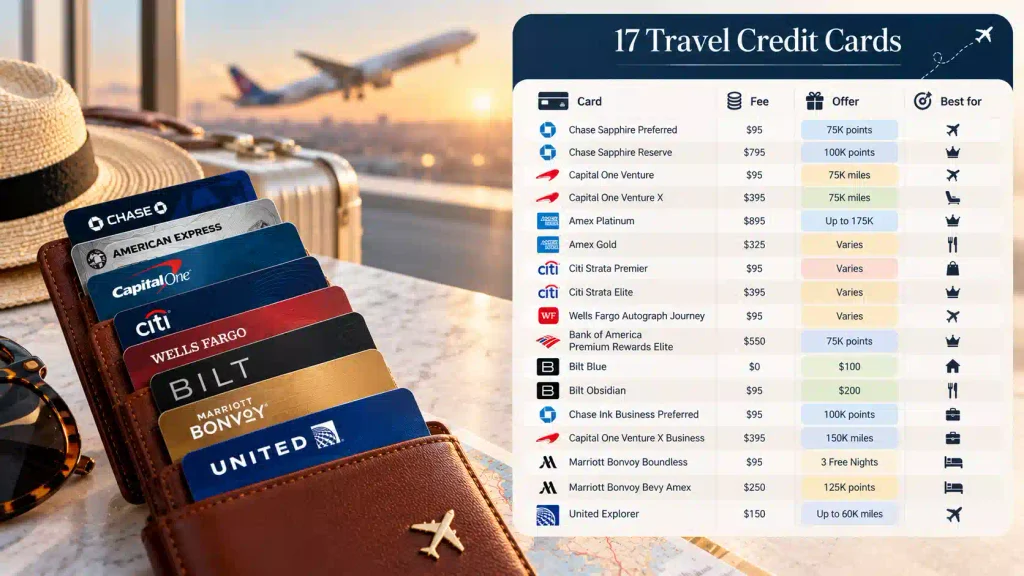
| Card | Annual fee | Current welcome offer* | Best suited for |
| Chase Sapphire Preferred | $95 | 75,000 points | Flexible travel rewards |
| Chase Sapphire Reserve | $795 | 100,000 points | Premium travel benefits |
| Capital One Venture | $95 | 75,000 miles + $300 travel credit | Simple travel rewards |
| Capital One Venture X | $395 | 75,000 miles | Premium value and lounges |
| Amex Platinum | $895 | Up to 175,000 points | Luxury travel |
| Amex Gold | $325 | Offer varies | Dining and everyday rewards |
| Citi Strata Premier | $95 | Offer varies | Broad bonus categories |
| Citi Strata Elite | $595 | Offer varies | Premium Citi travel rewards |
| Wells Fargo Autograph Journey | $95 | Offer varies | Airline and hotel spending |
| Bank of America Premium Rewards Elite | $550 | 75,000 points | Premium flexible rewards |
| Bilt Blue | $0 | $100 Bilt Cash | Renters and low-fee travel rewards |
| Bilt Obsidian | $95 | $200 Bilt Cash | Dining, groceries, and travel |
| Chase Ink Business Preferred | $95 | 100,000 points | Business travel spending |
| Capital One Venture X Business | $395 | 150,000 miles | High-spend businesses |
| Marriott Bonvoy Boundless | $95 | 3 Free Night Awards | Marriott stays |
| Marriott Bonvoy Bevy Amex | $250 | 125,000 points + $150 credit** | Marriott-focused travelers |
| United Explorer | $150 after first year | Up to 60,000 miles | United flyers |
1. Chase Sapphire Preferred Card
The Chase Sapphire Preferred Card remains a relatively accessible entry point for travelers who want transferable points without paying a premium-card annual fee.
As of September 2026, the public offer is 75,000 Ultimate Rewards points after spending $5,000 within the first three months, with a $95 annual fee.
Its main attraction is flexibility. Chase Ultimate Rewards points can be transferred to participating airline and hotel loyalty programs, making the card useful for travelers who do not want to commit to a single airline or hotel chain.
It can work particularly well for someone taking several domestic trips each year while occasionally booking international flights or hotel stays.
Best for: Travelers wanting one flexible points card at a moderate annual fee.
2. Chase Sapphire Reserve
The Chase Sapphire Reserve is designed for travelers who can make use of substantial premium benefits.
Its current September 2026 public offer is 100,000 points after $6,000 in purchases during the first three months, while the annual fee is $795. Chase currently advertises $5,000+ in first-year value under its stated assumptions, including its travel and lifestyle benefits.
The card earns enhanced rewards through Chase Travel and offers elevated earning on eligible flights and hotels booked directly. Premium travel protections and airport-lounge benefits are another major part of the proposition.
The important question is not whether the benefits look impressive on paper, but whether the cardholder will actually use enough of them to justify the annual fee.
Best for: Frequent travelers who regularly use premium travel credits, lounges, and transferable points.
3. Capital One Venture Rewards Card
The Capital One Venture Rewards Credit Card targets travelers who prefer a straightforward rewards structure.
The current offer includes 75,000 bonus miles after spending $4,000 within three months, plus a one-time $300 Capital One Travel credit for eligible hotel and vacation-rental bookings during the first cardholder year. The annual fee is $95.
The card earns unlimited 2X miles on purchases, with an elevated 5X rate on eligible hotels, vacation rentals, and rental cars booked through Capital One Travel.
Its simple earning model means travelers do not have to memorize numerous spending categories.
Best for: Travelers who want a simple 2X-everywhere travel rewards structure.
4. Capital One Venture X Rewards Credit Card
The Capital One Venture X Rewards Credit Card combines premium travel features with a comparatively moderate $395 annual fee.
Capital One currently lists a 75,000-mile welcome bonus, a $300 annual Capital One Travel credit, and a 10,000-mile anniversary bonus. Cardholders also receive access to Capital One Lounges and a broader Priority Pass lounge network after enrollment.
The card can be particularly interesting for travelers who can consistently use the annual travel credit and anniversary miles.
It also earns 2X miles on everyday purchases, while Capital One Travel bookings can earn substantially higher rates on selected categories.
Best for: Frequent travelers looking for premium perks without an ultra-premium annual fee.
5. The Platinum Card from American Express
The Platinum Card® from American Express occupies the luxury end of the travel-card market.
Its annual fee is currently $895, while the public welcome offer can be as high as 175,000 Membership Rewards points after meeting the required spending threshold; actual offers can vary by applicant.
Its appeal comes less from a single rewards category and more from its collection of travel and lifestyle benefits. These include access to the American Express Global Lounge Collection and up to $600 per year in statement credits for eligible prepaid hotel bookings through American Express Travel.
The card is most compelling for travelers who can naturally use multiple benefits, rather than treating every credit as a coupon they must force into their spending.
Best for: Frequent luxury travelers who value lounge access and premium hotel benefits.
6. American Express Gold Card
The American Express® Gold Card is particularly relevant to travelers whose everyday spending includes substantial dining and food purchases.
Unlike a premium card whose value is concentrated around lounges and hotel credits, the Gold Card can generate much of its value through everyday spending categories.
Its Membership Rewards points can also be transferred to participating travel partners, giving cardholders flexibility when booking flights and other travel.
Travelers should review the current annual fee, monthly or annual credits, earning categories, and welcome offers directly with American Express before applying because these terms can change.
Best for: Travelers who spend heavily on dining and want transferable Membership Rewards points.
7. Citi Strata Premier Card
The Citi Strata Premier Card is a mid-tier travel card built around multiple bonus categories rather than a single airline or hotel brand.
NerdWallet currently includes it among its September 2026 recommended travel cards, highlighting its broad points-earning structure.
The card can make sense for travelers who want transferable Citi ThankYou Points while earning elevated rewards across several everyday categories.
Its $95 annual fee also places it in a lower-cost segment than premium cards such as the Sapphire Reserve, Platinum Card or Citi Strata Elite.
Best for: Travelers wanting multiple bonus categories and transferable Citi points without a premium annual fee.
8. Citi Strata Elite Card
The Citi Strata Elite Card is Citi’s premium travel offering and carries a $595 annual fee.
Its rewards structure includes high earning rates for selected travel booked through Citi Travel, and it also includes premium travel and lifestyle benefits.
One notable feature is a $300 annual hotel benefit for qualifying stays booked through Citi Travel, according to current reporting.
Because the annual fee is substantial, the card is best for travelers who can use its credits and premium benefits repeatedly.
Best for: Frequent travelers already comfortable using Citi ThankYou Rewards and premium travel credits.
9. Wells Fargo Autograph Journey Card
The Wells Fargo Autograph Journey℠ Card is a $95-annual-fee travel card designed around direct airline and hotel purchases.
Wells Fargo’s product launch materials describe earning 5X points on hotels, 4X on airlines, 3X on other travel and dining, and 1X on other purchases, along with a $50 annual airfare statement credit.
That structure makes it useful for travelers who prefer booking hotels and flights directly rather than concentrating all bookings in a travel portal.
The card also participates in Wells Fargo’s transferable rewards ecosystem.
Best for: Travelers who book hotels and airfare directly and want strong category earnings.
10. Bank of America Premium Rewards Elite
The Bank of America® Premium Rewards® Elite Credit Card carries a $550 annual fee and currently advertises 75,000 online bonus points after $5,000 in purchases during the first 90 days.
The card earns 2 points per dollar on travel and dining and 1.5 points on other purchases. It also offers premium travel benefits including Priority Pass lounge access and a collection of statement credits.
Bank of America Preferred Rewards members may find the broader Bank of America rewards ecosystem particularly relevant when comparing this card with competitors.
Best for: Bank of America and Merrill customers who can take advantage of the bank’s broader rewards relationship.
11. Bilt Blue Card
The Bilt Blue Card is a newer way for travelers to earn rewards without an annual fee.
Bilt currently lists a $0 annual fee, no transaction fee for eligible housing payments, and rewards including up to 4X at Bilt dining partners, 3X on hotels through Bilt Travel, 3X on Lyft, 2X on flights through Bilt Travel, and 1X on other everyday purchases.
The card is particularly relevant to renters or homeowners participating in Bilt’s housing rewards ecosystem.
Best for: Travelers who want a no-annual-fee card connected to housing rewards.
12. Bilt Obsidian Card
The Bilt Obsidian Card has a $95 annual fee and targets cardholders with substantial dining, grocery, and travel spending.
Bilt currently lists up to 6X at participating dining partners, 3X on a chosen dining or grocery category, 4X on hotels booked through Bilt Travel, 3X on flights booked through Bilt Travel, and 2X on other travel. It also provides a $100 annual Bilt Travel hotel credit.
For someone who already uses Bilt’s ecosystem, the Obsidian card can provide a more rewarding structure than the no-fee Blue version.
Best for: Bilt users who spend heavily on food and travel.
13. Chase Ink Business Preferred
The Ink Business Preferred® Credit Card is one of the strongest options on this list for small-business owners with substantial qualifying travel or business expenses.
Chase currently offers 100,000 Ultimate Rewards points after $8,000 in purchases during the first three months, with a $95 annual fee.
The card earns 3X points on combined qualifying travel and business categories up to $150,000 per account anniversary year. Qualifying categories include travel, shipping purchases, Internet, cable, phone services, and advertising purchases with social media sites and search engines.
Best for: Business owners with significant travel and category-specific business spending.
14. Capital One Venture X Business
The Capital One Venture X Business is built for businesses with high spending and travel needs.
Capital One currently lists a 150,000-mile welcome bonus after $30,000 in spending during the first three months, a $395 annual fee, a $300 annual Capital One Business Travel credit, and 10,000 anniversary miles.
It earns unlimited 2X miles on purchases, with 10X on hotels and rental cars and 5X on flights and vacation rentals booked through Capital One Business Travel.
The card is structured as a charge card with no preset spending limit, although Capital One notes that purchasing power can adjust based on spending behavior, payment history, and other factors.
Best for: High-spend businesses that can meet a large welcome-bonus requirement.
15. Marriott Bonvoy Boundless Card
The Marriott Bonvoy Boundless® Credit Card is the most directly relevant option for travelers who regularly stay at Marriott properties.
As of September 2026, Chase lists a welcome offer of three Free Night Awards after $3,000 in eligible purchases within the first three months, with each award redeemable at properties costing up to 50,000 points per night, subject to the card’s terms. The annual fee is $95.
The card also provides automatic Silver Elite status and 15 Elite Night Credits each year.
This can be especially useful for travelers who prefer Marriott’s portfolio and want hotel-specific benefits instead of flexible points.
Best for: Marriott loyalists who want annual hotel-night benefits and elite-night credits.
16. Marriott Bonvoy Bevy American Express Card
The Marriott Bonvoy Bevy® American Express Card targets travelers who stay frequently at Marriott properties but want a higher-end hotel card.
Marriott currently offers 125,000 Marriott Bonvoy bonus points plus a $150 statement credit after $5,000 in purchases during the first six months, with the offer ending September 30, 2026. The annual fee is $250.
The card earns 6X Marriott Bonvoy points on eligible Marriott purchases, while Marriott’s loyalty program provides additional points on qualifying stays.
Travelers considering this card should watch the offer expiration date, since the September 30 deadline means the welcome offer may change during the month.
Best for: Frequent Marriott guests who can use the card’s hotel-specific benefits.
How Should Travelers Choose Among These Cards?

No single travel card makes sense for every traveler. A useful comparison starts with how you’ll actually use the card.
For a first travel rewards card
The Chase Sapphire Preferred and Capital One Venture are relatively straightforward choices to research. Both have $95 annual fees, while their rewards systems offer flexibility rather than locking the cardholder into one airline.
For premium travel
The Chase Sapphire Reserve, Capital One Venture X, American Express Platinum, Citi Strata Elite, and Bank of America Premium Rewards Elite occupy the premium segment.
A practical comparison should focus on lounge access, annual credits, hotel benefits, travel protections, and the travel spending required to justify the annual fee.
For hotel rewards
Hotel-specific cards become more compelling when travelers regularly stay with one chain.
For Marriott guests, the Marriott Bonvoy Boundless and Marriott Bonvoy Bevy cards provide Marriott-specific rewards and benefits. A flexible points card can be preferable for travelers who move between multiple hotel brands.
For business travel
The Ink Business Preferred and Venture X Business have very different structures.
Ink Business Preferred is designed around category-based Ultimate Rewards earning. At the same time, Venture X Business emphasizes a simple 2X earning rate alongside premium travel benefits and a large spending requirement for its current welcome bonus.
For no annual fee
The Bilt Blue Card offers a $0 annual fee, while Discover it Miles also has no annual fee and earns 1.5X miles on purchases. Discover automatically matches miles earned during the first year under its current Miles Match program.
These products appeal to travelers who want rewards without paying for a premium benefits package.
What About Booking Hotels Such as citizenM?
A travel credit card does not automatically make every hotel booking more valuable.
Suppose a traveler is considering a three-night stay at citizenM. There are several questions to check before paying:
- Does the card offer bonus rewards for direct hotel purchases?
- Is the booking made through a qualifying travel portal?
- Does the card provide a hotel credit that applies to the reservation?
- Would booking through a portal affect hotel loyalty benefits?
- Does the traveler value flexible points more than hotel-specific points?
- Is the room rate lower when booked directly?
For example, a card offering 5X through a travel portal may appear more rewarding than a card earning 2X on direct hotel purchases. However, a direct booking may cost less or have different cancellation terms. The right comparison considers total cost and benefits, not just the advertised points multiplier.
How Much Are Travel Credit Card Points Worth?

Points do not have one universal cash value.
A point may have a fixed value for certain redemptions on one card but potentially a different value when transferred to an airline or hotel partner. The final value depends on how you redeem them.
For example, 75,000 flexible points could potentially cover a certain amount of travel through an issuer’s booking system, while transferring those points to a loyalty program could produce a different result.
Travelers should therefore compare:
- Number of points earned.
- Transfer partners.
- Redemption options.
- Annual fees.
- Credits actually usable.
- Travel protections.
- Opportunity cost of using another card.
Are Travel Credit Cards Worth the Annual Fee?
A travel card can be worth its annual fee when the cardholder naturally uses enough of its rewards and benefits to exceed that cost.
For example, a $395 card with a $300 annual travel credit is not automatically “worth $300” to someone who would never make eligible bookings through the required travel channel. Likewise, a lounge membership has little practical value to someone who rarely travels through airports with participating lounges.
The better calculation is personal:
Realistic annual value = rewards earned + benefits actually used − annual fee
A traveler should use conservative estimates rather than assigning full advertised values to benefits they may not use.
Important Things to Check Before Applying
Credit card terms can change quickly. Before submitting an application, travelers should verify:
- Current welcome offer
- Required spending
- Annual fee
- APR
- Foreign transaction fees
- Transfer partners
- Travel-credit restrictions
- Lounge access rules
- Hotel and airline eligibility
- Redemption rates
- Application eligibility
- Existing-card restrictions
- Expiration dates for limited-time offers
Welcome bonuses can also have restrictions based on previous ownership or previous bonuses. Chase, for example, explicitly notes eligibility restrictions on several products, while individual offers may vary by application channel.
Final Takeaway
The September 2026 travel-card market offers options for nearly every type of traveler, from the $0-annual-fee Bilt Blue and Discover it Miles to premium products such as the American Express Platinum and Chase Sapphire Reserve, plus hotel- and airline-specific cards for travelers who consistently use one loyalty program.
The most useful comparison is not simply the size of a welcome bonus. Travelers should look at the annual fee, realistic rewards earnings, transferable partners, credits they will actually use, travel protections, and booking restrictions.
For hotel stays, including a property such as citizenM, the smartest approach is to compare the card’s rewards with the hotel’s direct rate, portal rate, loyalty benefits, and cancellation conditions before booking. Since card offers and benefits can change, always check the issuer’s current terms immediately before applying.
Frequently Asked Questions
The answer depends on the traveler’s priorities. Flexible-points cards such as Chase Sapphire Preferred, premium cards such as Capital One Venture X and American Express Platinum, hotel cards such as Marriott Bonvoy Boundless, and airline cards such as United Explorer serve different purposes.
Several cards in this list have a $95 annual fee, including Chase Sapphire Preferred, Capital One Venture, Citi Strata Premier, Wells Fargo Autograph Journey, and Chase Ink Business Preferred.
Hotel-specific cards can be useful for loyalists. The Marriott Bonvoy Boundless and Marriott Bonvoy Bevy are designed specifically for Marriott stays, while flexible cards can be better for travelers who use several hotel brands.
Yes, you can generally use a standard credit card to pay for an eligible citizenM reservation, subject to the property’s accepted payment methods and booking terms. The more important question is whether the card provides bonus rewards or credits for the particular booking channel.
They can be worth it for travelers who naturally use the included credits, lounge access, hotel benefits, and other perks. Someone who rarely travels may find a lower-fee card more practical.
A no-fee card can make sense for occasional travelers or people who do not want to manage annual credits. Discover it Miles and Bilt Blue are two no-annual-fee examples, although their rewards systems differ.
Many premium travel cards generally target applicants with good-to-excellent credit, but approval depends on the issuer’s underwriting criteria and the applicant’s complete financial profile. No particular credit score guarantees approval.
It depends on travel habits. Someone who flies frequently may value lounge access, free bags, and travel protections, while another traveler may prefer transferable points that can be used across different airlines and hotels.