
The Best Ways to Fly From Los Angeles to Seattle
The easiest way to fly from Los Angeles (LAX) to Seattle (SEA) is generally to take a nonstop flight, with Alaska Airlines and Delta Airlines offering particularly extensive schedules alongside nonstop options from Frontier and, on applicable dates, Southwest. The trip covers roughly 950 miles, and nonstop flying time is usually around 2 hours and 45 minutes to just over 3 hours, depending on the flight and operating conditions.
Because Los Angeles and Seattle are major West Coast markets, passengers have plenty of choice. But the lowest ticket price is not necessarily the most useful fare. Baggage charges, basic-economy restrictions, departure times, loyalty benefits, seat selection, and flexibility can all change which flight makes the most sense.
Here is what travelers should know when comparing the best ways to fly from Los Angeles International Airport (LAX to Seattle-Tacoma International Airport (SEA) in 2026.
LAX to Seattle Flight Information at a Glance
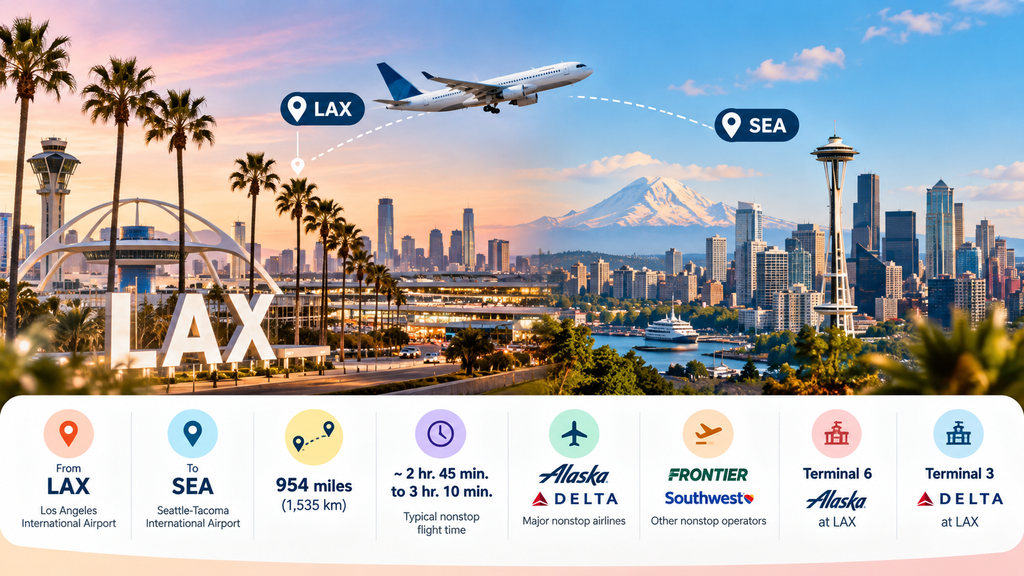
Late-September 2026 schedules show numerous daily departures, particularly from Alaska and Delta. For example, Alaska schedules flights throughout the day from early morning into the evening, while Delta also offers morning, afternoon, and evening options. Schedules change seasonally, so passengers should always check the operating airline before booking.
| Detail | LAX to SEA |
| Departure airport | Los Angeles International Airport (LAX) |
| Arrival airport | Seattle-Tacoma International Airport (SEA) |
| Approximate distance | 954 miles/1,535 km |
| Typical nonstop flight time | About 2 hr. 45 min. to 3 hr. 10 min. |
| Major high-frequency nonstop airlines | Alaska Airlines and Delta Air Lines |
| Other nonstop operators | Frontier; Southwest on applicable schedules |
| Alaska departure terminal at LAX | Terminal 6 |
| Delta departure terminal at LAX | Terminal 3 |
Which Airlines Fly Nonstop From LAX to Seattle?
Current September 2026 schedules show nonstop LAX–SEA flights operated by several airlines, including:
- Alaska Airlines
- Delta Airlines
- Frontier Airlines
- Southwest Airlines on applicable dates/schedules
The important distinction is frequency.
Alaska and Delta provide particularly extensive schedules on the route. During the week of September 21–27, for example, published schedules show multiple daily Alaska and Delta departures spread across the day.
A larger schedule can matter almost as much as price.
If you need to reach Seattle before lunch, return after a meeting, or want more alternatives if a flight is disrupted, an airline operating several daily departures may provide more useful options than one operating less frequently.
How Long Is the Flight From Los Angeles to Seattle?
A nonstop flight from LAX to SEA generally takes around 3 hours, although scheduled duration varies by departure. Current schedules include flights of roughly 2 hours and 44 minutes to just over 3 hours.
Actual time in the air can differ because of:
- Winds
- Air traffic
- Taxi time
- Weather
- Routing
- Airport congestion
A connection is normally unnecessary when traveling specifically between LAX and SEA because there are numerous nonstop options.
Unless a connecting itinerary produces a substantial fare saving or serves another specific purpose, the extra travel time usually makes a nonstop flight more practical on a route this short.
Flying Alaska Airlines From LAX to Seattle
Alaska Airlines has one of the strongest schedules between Los Angeles and Seattle, which is unsurprising given Seattle’s importance within its network. In late September 2026, Alaska schedules numerous daily nonstop departures from LAX Terminal 6, with flights available from morning through evening.
That schedule flexibility is one of the airline’s most useful advantages on this route.
Alaska Saver vs. Main Cabin
Travelers searching for Alaska’s lowest prices may encounter a Saver fare. Saver includes a carry-on bag and personal item, but comes with restrictions. Seats are assigned at check-in, Saver passengers generally board last, and ticket flexibility is limited.
A particularly important 2026 change affects loyalty earnings.
For Saver fares booked on or after June 11, 2026 and flown on or after August 1, 2026, travelers do not earn Atmos Rewards points or status points. The miles flown still count toward Alaska’s Million Miler lifetime calculation.
That makes comparing Saver with Main Cabin worthwhile for passengers who value Atmos Rewards earnings, seat selection, and greater flexibility.
Alaska Baggage
Alaska permits passengers to bring 1 carry-on bag plus 1 personal item. Its published carry-on limit is 22 × 14 × 9 inches.
Checked baggage generally costs extra for ordinary economy travelers, although elite status, qualifying credit cards, premium fares, and other exemptions can provide baggage benefits.
Because baggage policies and applicable exemptions can change, check your specific reservation before deciding which fare offers the better overall value.
Flying Delta From Los Angeles to Seattle
Delta is another major choice for the LAX–SEA route. Current September 2026 schedules show multiple Delta departures every day, including early-morning, midday, afternoon, and evening services from LAX Terminal 3. That makes Delta particularly useful for passengers who want several departure-time choices.
Delta Main Basic
Delta’s former Basic Economy product is now called Delta Main Basic. It is designed for travelers prioritizing a lower fare over flexibility. Main Basic passengers receive the standard onboard Main Cabin experience, including complimentary snacks, nonalcoholic beverages, and inflight entertainment where available, but the ticket carries important restrictions.
Main Basic does not include benefits such as:
- Advance standard seat selection
- Mileage accrual
- Medallion status credit
- Complimentary or paid upgrades
- Same-day confirmed changes
- Same-day standby
- Sky Club access based on the ticket
Passengers concerned about seat choice, loyalty earnings, or flexibility should compare Main Basic with Delta’s less restrictive options rather than choosing entirely on price.
Delta Baggage Fees
Delta currently charges ordinary Delta Main and Delta Comfort customers traveling domestically $45 for the first standard checked bag and $55 for the second, absent an applicable status, credit-card, military, or other exemption. A carry-on and personal item are included.
That means a traveler checking luggage should incorporate the baggage charge into the actual trip price. For example, a $20 difference between two airlines can quickly become irrelevant if the cheaper ticket comes with baggage charges or restrictions that the other option avoids.
What About Southwest From LAX to Seattle?
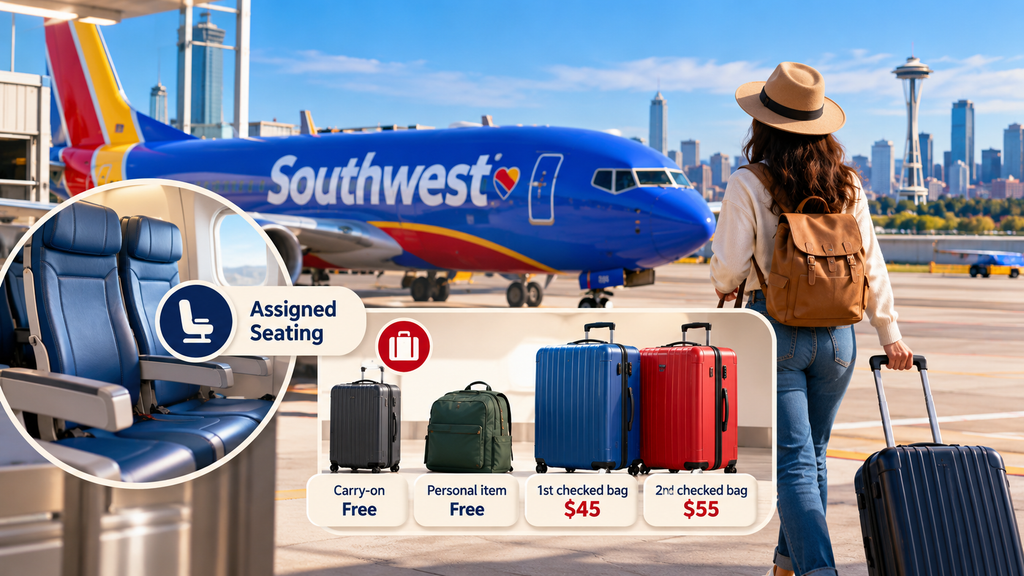
Southwest also sells LAX–SEA service, but travelers familiar with the airline’s older policies should pay attention because Southwest product changed significantly in 2026.
The airline now uses assigned seating. As of January 27, 2026, passengers select specific seats depending on their fare and booking conditions, with Extra Legroom, Preferred, and Standard seats available. Basic-fare customers generally receive their seat at check-in.
The baggage policy has changed too. For U.S. mainland travel booked or changed on or after April 9, 2026, ordinary passengers on Basic, Choice, and Choice Preferred fares generally pay:
| Bag | Current Fee |
| Carry-on | Free |
| Personal item | Free |
| First checked bag | $45 |
| Second checked bag | $55 |
Choice Extra includes the first 2 checked bags, while qualifying Rapid Rewards elite members and eligible credit cardmembers may receive baggage benefits.
Travelers should therefore avoid relying on the historic assumption that every Southwest passenger automatically receives 2 free checked bags.
What About Frontier Airlines?
Frontier can appear on current nonstop LAX–SEA schedules as another ultra-low-cost option. The main consideration with an ultra-low-cost carrier is the total cost after extras. A very low base fare can be attractive for someone carrying only a small personal item. But a traveler who needs a carry-on, checked luggage, advance seat selection, or greater flexibility should add those services before comparing Frontier with Alaska, Delta, or Southwest.
A simple comparison should therefore look like:
Base fare + baggage + seat + other required extras = realistic trip price rather than comparing base fares alone.
Which Airline Has the Most Convenient Schedule?
For travelers who prioritize departure-time choice, Alaska and Delta currently provide especially strong schedules on LAX–SEA.
For example, schedules for late September 2026 show Alaska departures from early morning into the evening and Delta departures at approximately 7 a.m., 9:38 a.m., noon, 2 p.m., late afternoon, and evening, with exact schedules varying by date.
Why does frequency matter?
Imagine you are flying to Seattle for an afternoon meeting. An airline offering an early-morning flight plus several later departures provides more scheduling choices than a carrier with only one convenient flight that day. More frequency can also provide additional rebooking possibilities when operations are disrupted, although alternate-flight availability is never guaranteed.
Always check the schedule for your actual travel date because airline frequencies change.
Which Airline Is Better if You Are Checking a Bag?
There is no single answer because baggage costs depend on the fare, status, credit card benefits, and airline.
For example, Delta currently charges $45 for the first standard domestic checked bag for ordinary Delta Main customers without a qualifying exemption. Southwest also charges $45 for the first checked bag on several standard fare types for travel booked or changed under its current policy. Eligible airline credit cards and elite status can change this calculation substantially.
For that reason, compare the fare after baggage benefits rather than assuming one airline always has the lowest luggage cost.
Is First Class Worth It From LAX to Seattle?
Premium cabins are available on some LAX–SEA flights, but whether paying for one makes sense depends on the fare difference and your priorities.
The flight is only about 3 hours.
A premium cabin can nevertheless provide benefits such as:
- More spacious seating
- Priority boarding
- Complimentary checked-bag allowance, depending on airline
- Enhanced onboard service
- Greater ticket flexibility with certain fares
- Priority airport services
Business travelers or passengers who value space may find the upgrade useful.
For someone simply trying to reach Seattle economically, however, a standard economy seat may be sufficient for such a relatively short flight.
Instead of deciding based solely on cabin name, compare the actual price difference and included benefits on your date.
How To Fly From LAX to Seattle Using Points and Miles
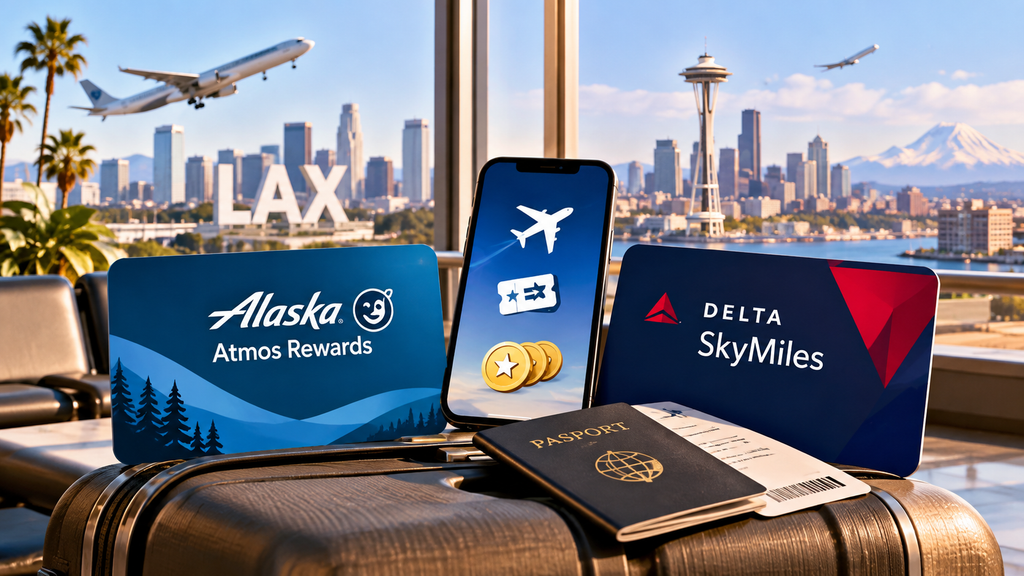
Award travel can be another way to book the route, particularly for travelers already holding airline miles or transferable credit-card rewards.
Alaska Atmos Rewards
Alaska’s loyalty program is now called Atmos Rewards. Members can redeem points toward award travel on Alaska and its airline partners. However, travelers buying cash tickets should remember that new Saver tickets flown after the August 2026 earning change generally do not earn Atmos points when booked under the applicable new rules.
Award pricing can vary, so compare the required points with the cash fare before redeeming.
Delta SkyMiles
Delta allows SkyMiles members to book award travel on Delta-operated flights without blackout dates. Award pricing varies, and Delta’s flexible award calendar can help travelers compare dates.
For a short domestic flight, calculate the value you are receiving before automatically using miles. For example, if a flight has an unusually inexpensive cash fare but requires a relatively large number of miles, paying cash and keeping the miles for another trip may be worth considering.
What Are LAX and SEA Like for This Trip?
Flying from Los Angeles to Seattle involves two of the busiest airports on the West Coast. Knowing the terminals, transportation options, and basic airport layout at LAX and SEA can make it easier to plan your departure and onward journey.
Departing From Los Angeles International Airport
LAX is a large airport, so knowing your operating airline and terminal before leaving for the airport can save time.
Current route schedules commonly place:
- Alaska in Terminal 6
- Delta in Terminal 3
Terminal assignments can change, so confirm the terminal in the airline app or through LAX before departure.
Los Angeles traffic is another important consideration. Ground travel to LAX can be unpredictable, particularly during busy periods, so build adequate time into your journey.
Arriving at Seattle-Tacoma International Airport
SEA is Seattle’s principal commercial airport and lies south of downtown Seattle. After arrival, passengers can continue toward Seattle using rental cars, taxis, rideshare services, buses, or Sound Transit’s Link light rail. For travelers heading into central Seattle, light rail can be particularly useful because it avoids highway traffic and connects the airport with multiple parts of the city.
Should You Book the Cheapest LAX–SEA Fare?
Not automatically. Instead, compare what the ticket actually includes. Suppose you find:
Flight A: $89
Flight B: $119
At first glance, Flight A saves $30. But if Flight A requires you to pay $45 for a checked bag while Flight B includes a bag through your fare, status, or credit-card benefit, the second option could have the lower effective cost.
Also consider:
- Seat-selection charges
- Checked baggage
- Carry-on restrictions
- Loyalty earnings
- Cancellation rules
- Change restrictions
- Departure time
- Arrival time
- Airline status benefits
- Credit-card benefits
The most useful fare is the one that provides what your trip actually requires.
Tips for Booking LAX to Seattle Flights
Start by comparing nonstop flights rather than automatically choosing the first low fare displayed. Then check the full trip cost. If two flights have similar prices, departure time may be the deciding factor. An early flight can give you more of the day in Seattle, while an evening departure may allow you to work a full day in Los Angeles before leaving.
Travelers should also:
- Check baggage fees before purchasing.
- Compare basic fares with standard economy.
- Consider loyalty status and airline credit-card benefits.
- Check award prices as well as cash fares.
- Confirm your LAX terminal before departure.
- Leave enough time for Los Angeles traffic.
- Avoid adding a connection merely to save a small amount.
- Recheck schedules shortly before traveling.
Which LAX–SEA Flight Should You Choose?
For this route, the most practical choice depends on schedule, total fare, baggage needs, and loyalty benefits rather than one airline being universally superior.
Alaska and Delta deserve particular attention because of their extensive current nonstop schedules. Travelers loyal to some airlines may find their nonstop services more useful when status or credit-card benefits apply. Southwest can also work on applicable schedules, but passengers should account for its newer assigned-seating and checked-bag policies. Frontier can appeal to travelers prioritizing a low base fare, provided optional charges do not erase the savings.
Since LAX–SEA is a short route with substantial nonstop competition, it usually makes sense to start with nonstop departure times, narrow the options to those that fit your schedule, and then compare the final price after baggage and other extras.
Final Thoughts
Travelers flying from Los Angeles to Seattle benefit from an unusually competitive short-haul market, with multiple airlines offering nonstop service and Alaska and Delta providing particularly broad schedules. Rather than searching only for the cheapest advertised fare, compare departure time, final price after baggage and seats, fare restrictions, loyalty benefits, and award options. On a flight of roughly 3 hours, avoiding an inconvenient connection or restrictive fare can easily be more valuable than a modest difference in the headline ticket price.
Check the operating airline’s latest schedule and fare conditions immediately before booking, since frequencies, aircraft, prices, terminals, and baggage policies can change.
Frequently Asked Questions
LAX and SEA are approximately 954 miles (1,535 kilometers) apart on the nonstop route.
Most nonstop scheduled flights take roughly 2 hours and 45 minutes to just over 3 hours, although actual travel time varies.
Yes. Alaska operates numerous nonstop flights between LAX and SEA and currently departs from Terminal 6 at LAX.
Yes. Delta operates multiple daily nonstop LAX–SEA flights in current schedules, generally from Terminal 3 at LAX.
Yes. Alaska Saver passengers can bring 1 carry-on and 1 personal item, although Saver customers normally board last and overhead-bin availability is not guaranteed.
Delta permits a carry-on and personal item, while checked baggage is subject to applicable charges. Main Basic also comes with restrictions involving seat selection, mileage earning, upgrades, and same-day changes.
No. Under Southwest’s current policy, Basic, Choice, and Choice Preferred customers generally pay $45 for the first checked bag and $55 for the second on applicable U.S. mainland tickets booked or changed from April 9, 2026. Choice Extra and certain qualifying customers receive baggage benefits.
Usually, a nonstop itinerary is more convenient because LAX–SEA has numerous nonstop departures and takes around 3 hours. A connection may make sense if it provides substantial savings or serves another specific itinerary need.
Yes. Alaska Atmos Rewards, Delta SkyMiles can potentially be used for eligible award flights. Availability and the number of miles or points required vary by airline and travel date.