
Alaska Airlines Boarding Groups — Everything You Need to Know
Alaska Airlines uses six lettered boarding groups, A through F, following preboarding and priority boarding for eligible passengers. The boarding order depends on factors such as ticket type, seat location, Atmos Rewards elite status, military eligibility, family travel, and qualifying credit card benefits.
First Class passengers and Atmos Titanium members receive priority boarding before the lettered groups begin. Other elite members, Premium Class passengers, eligible credit cardholders, and Main Cabin travelers board according to their assigned group. Saver fare passengers generally board last, in Group F.
The airline displays the boarding group on each passenger’s boarding pass, making it easier to identify when to approach the gate. Boarding progress is also shown on screens at many airport gates.
Understanding the Alaska Airlines boarding process is particularly useful for passengers traveling with carry-on luggage, families with young children, and travelers hoping to receive earlier boarding privileges.
This guide explains the complete Alaska Airlines boarding order for 2026, including who qualifies for each group, when boarding begins, how priority boarding works, and what passengers should know before arriving at the airport.
Alaska Airlines Boarding Groups at a Glance
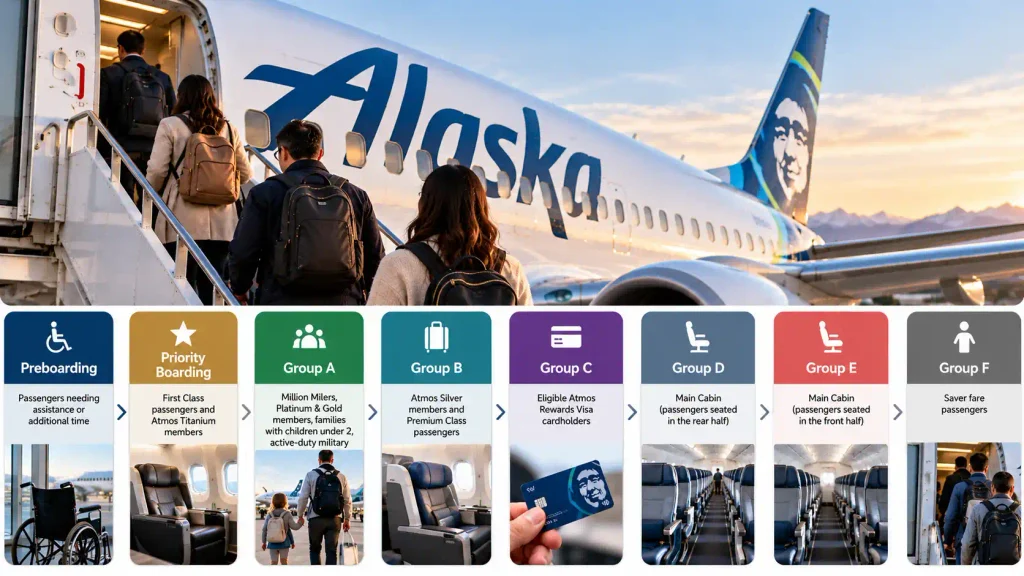
Alaska Airlines follows a structured boarding sequence, beginning with passengers requiring additional assistance and ending with Saver fare travelers.
| Boarding order | Eligible passengers |
| Preboarding | Passengers with disabilities who require assistance or additional boarding time |
| Priority boarding | First Class passengers and Atmos Titanium members |
| Group A | Atmos Million Milers, Platinum and Gold members; families with children under 2; active-duty military personnel |
| Group B | Atmos Silver members and Premium Class passengers |
| Group C | Eligible Atmos Rewards Visa cardholders who booked using a qualifying card |
| Group D | Main Cabin passengers seated in the rear half of the aircraft |
| Group E | Main Cabin passengers seated in the front half of the aircraft |
| Group F | Saver fare passengers |
This is the current sequence published by Alaska Airlines. Certain aircraft do not have First Class or Premium Class seating, so the applicable stages may differ.
How Does the Alaska Airlines Boarding Process Work?
Alaska Airlines organizes passengers into designated boarding categories to manage the flow of travelers entering the aircraft.
The process starts with preboarding for eligible passengers who need assistance or additional time. First Class passengers and Atmos Titanium members follow, after which the airline calls Groups A through F.
For regular Main Cabin travelers without an earlier boarding entitlement, Alaska generally boards passengers seated toward the rear of the aircraft before those seated toward the front.
The airline uses boarding pass group letters and airport gate displays to communicate boarding progress.
For example, a passenger assigned Group D should wait until the gate agent announces Group D or the airport display indicates that the group is boarding.
This avoids unnecessary crowding near the boarding lane and helps gate personnel manage passengers in the correct order.
Alaska Airlines Boarding Groups Explained
Preboarding: Passengers Requiring Additional Assistance
Preboarding is the first stage of Alaska Airlines’ boarding process.
It is intended for passengers with disabilities who need assistance or additional time to board the aircraft.
Depending on individual requirements, this may include travelers who need help moving through the boarding area or transferring to an aircraft seat.
Preboarding is separate from standard priority boarding. It is based on accessibility and assistance requirements rather than fare class or loyalty status.
Passengers who need boarding assistance should inform airline personnel so appropriate arrangements can be made.
Priority Boarding: First Class and Atmos Titanium
Priority boarding follows preboarding and takes place before the airline begins calling Groups A through F.
Eligible passengers include:
- Travelers holding First Class tickets.
- Atmos Rewards Titanium elite members.
This category allows eligible passengers to board ahead of most other travelers.
First Class passengers may benefit from additional time to settle into their seats and store cabin baggage.
Atmos Titanium is the highest tier in the airline’s loyalty program, and priority boarding is among its premium travel privileges.
Some Alaska aircraft do not offer First Class seating. On these flights, the published boarding sequence may begin with Group A instead.
Group A: High-Tier Elite Members, Military Personnel, and Families
Group A is the first lettered boarding group.
It includes:
- Atmos Rewards Million Miler members.
- Atmos Platinum members.
- Atmos Gold members.
- Families traveling with children younger than 2.
- Active-duty military personnel.
Group A combines loyalty-based priority with certain family and military boarding privileges.
For example, a family traveling with an 18-month-old child may qualify for Group A even when holding standard Main Cabin tickets.
The same applies to eligible active-duty military personnel.
Passengers should check their boarding passes and follow gate instructions, as specific travel circumstances may affect how the entitlement is applied.
Group B: Atmos Silver and Premium Class Passengers
Group B follows Group A and provides earlier boarding for eligible lower-tier elite members and Premium Class travelers.
The group includes:
- Atmos Silver members.
- Passengers holding Premium Class seats.
Premium Class is Alaska Airlines‘ extra-legroom seating option, generally located toward the front of the Main Cabin.
Travelers who purchase eligible Premium Class seating may receive Group B boarding without holding elite status.
This makes Premium Class a potential option for passengers who value earlier boarding along with additional legroom.
However, some aircraft do not feature Premium Class seats.
Group C: Eligible Atmos Rewards Credit Cardholders
Group C is designated for eligible Atmos Rewards Visa cardholders who book their flights using a qualifying Atmos Rewards Visa card.
This benefit can provide earlier boarding than standard Main Cabin groups.
However, simply holding a qualifying credit card does not necessarily guarantee Group C boarding on every reservation.
The card’s published terms, booking method, and applicable eligibility requirements must be satisfied.
For example, a traveler who purchases an eligible Main Cabin ticket with a qualifying Atmos Rewards Visa card may receive Group C rather than Group D or E.
Travelers should confirm that the correct boarding group appears on the boarding pass before departure.
Group D: Main Cabin Passengers Seated Toward the Rear
Group D includes Main Cabin passengers seated in the back half of the aircraft who do not qualify for an earlier group.
This is generally the first boarding category for regular Main Cabin travelers without elite status or qualifying credit card benefits.
Alaska’s approach allows passengers seated farther from the aircraft entrance to board before those seated closer to the front.
For example, a passenger holding a regular Main Cabin ticket with a seat in the rear portion of the aircraft may be assigned Group D.
The precise dividing point between the front and rear sections depends on the aircraft configuration.
Group E: Main Cabin Passengers Seated Toward the Front
Group E includes Main Cabin passengers seated in the front half of the aircraft who do not have an earlier boarding entitlement.
Although these passengers may be seated closer to the aircraft entrance, they board after Group D.
This is part of Alaska Airlines’ rear-to-front boarding arrangement for standard Main Cabin passengers.
A traveler seated in the front portion of the Main Cabin should therefore not assume that a lower row number automatically means earlier boarding.
Group F: Saver Fare Passengers
Group F is the final scheduled boarding group and generally includes passengers traveling on Alaska Airlines Saver fares.
Saver is the airline’s more restrictive economy fare option.
Although Saver passengers travel in the Main Cabin, they usually receive later boarding priority than travelers holding standard Main Cabin tickets.
This distinction can matter when overhead bin space becomes limited.
Passengers considering Saver fares should compare the lower ticket price with restrictions involving seat selection, changes, cancellations, and boarding priority.
A Saver ticket does not automatically prevent a passenger from bringing permitted carry-on baggage, but later boarding can increase the possibility that larger carry-on bags need to be checked at the gate.
Related: Is an Alaska Airlines Atmos Credit Card Worth It?
How Early Does Alaska Airlines Start Boarding?
Alaska Airlines recommends that passengers arrive at the departure gate at least 50 minutes before the scheduled flight departure, ready to board.
The actual boarding start time varies by flight, aircraft, airport, and operational conditions.
Boarding may begin approximately 30–45 minutes before departure on many flights, but this should not be treated as a fixed rule for every itinerary.
For example, a flight scheduled to depart at 10:00 a.m. may begin boarding around 9:20 a.m. However, the actual boarding time should be checked on the airline’s flight-status page, boarding pass, or airport displays.
The recommended gate arrival time is separate from airport check-in and security screening deadlines.
Alaska Airlines Boarding Timeline
- At least 50 minutes before departure
Arrive at the gate, check the boarding pass, and confirm the departure gate and boarding group. - When boarding begins
Eligible passengers requiring preboarding assistance enter first. - Priority boarding
First Class passengers and Atmos Titanium members board, where applicable. - Groups A, B, and C
Eligible elite members, qualifying families, military personnel, Premium Class passengers, and eligible cardholders board in sequence. - Groups D, E, and F
Remaining Main Cabin passengers board, followed by Saver fare travelers.
The timeline illustrates the sequence rather than guaranteed intervals between boarding groups.
How to Find the Boarding Group on an Alaska Airlines Ticket
The assigned boarding group appears on the passenger’s boarding pass.
Travelers can generally access their boarding passes through the Alaska Airlines mobile app, online check-in, or an airport check-in counter or kiosk.
The boarding group may appear as a letter, such as A, B, C, D, E, or F.
Passengers should review the boarding pass after checking in, particularly when an upgrade, seat change, or other reservation modification has occurred.
Can the Boarding Group Change After Check-In?
Yes. Boarding assignments may change when a passenger receives an eligible seat upgrade, the reservation is modified, or the airline makes an operational adjustment.
For example, a traveler initially assigned Group E may receive an eligible Premium Class upgrade and subsequently receive Group B boarding.
The updated boarding pass should be used to confirm the current assignment.
How to Get Priority Boarding on Alaska Airlines
Priority boarding is available through several qualifying travel arrangements, although not every method provides the same boarding position.
Book an Alaska Airlines First Class Ticket
First Class passengers receive priority boarding ahead of the lettered groups on aircraft offering that cabin.
This is the most direct fare-based method of obtaining the airline’s priority boarding benefit.
However, purchasing First Class solely for earlier boarding may not be economical. The fare difference should be evaluated alongside seating, baggage, dining, and other included benefits.
Qualify for Atmos Rewards Elite Status
Atmos Rewards elite status can provide earlier boarding.
| Atmos Rewards status | Boarding priority |
| Titanium | Priority boarding |
| Platinum | Group A |
| Gold | Group A |
| Silver | Group B |
Higher status levels can also provide additional benefits, including eligible upgrades, checked baggage allowances, and other airport privileges.
Purchase Premium Class Seating
Eligible Premium Class passengers receive Group B boarding.
This option may be more affordable than purchasing First Class and can provide additional legroom alongside earlier boarding.
The availability and price of Premium Class seating depend on the flight and aircraft.
Use an Eligible Atmos Rewards Visa Card
Qualifying Atmos Rewards Visa cardholders can receive Group C boarding when they meet the applicable card and booking requirements.
This may be valuable for regular Main Cabin travelers who would otherwise receive Groups D or E.
Cardholders should review the benefit terms, including whether the ticket must be purchased with the eligible card.
Does Alaska Airlines Board Families First?
Alaska Airlines provides Group A boarding for families traveling with children younger than 2.
This allows eligible families to board before most Main Cabin passengers.
However, families with older children do not automatically receive Group A boarding solely because they are traveling together.
For example, a family traveling with a 6-year-old child may receive the group associated with its purchased tickets, seating, or qualifying loyalty benefits.
Families requiring disability-related boarding assistance may qualify for preboarding based on individual needs.
Does Alaska Airlines Offer Military Priority Boarding?
Yes. Active-duty military personnel are included in Group A under Alaska Airlines’ published boarding process.
This benefit provides earlier boarding than standard Main Cabin Groups D, E, and F.
Military travelers should be prepared to present appropriate identification when requested and follow the instructions of the gate agent.
The airline’s military boarding benefit should not be confused with other military travel benefits, which may have separate eligibility requirements.
Does Alaska Airlines Board From Back to Front?
Alaska Airlines generally boards standard Main Cabin passengers from the rear half of the aircraft toward the front half.
This is reflected in the boarding sequence:
- Group D: Main Cabin seats in the back half.
- Group E: Main Cabin seats in the front half.
However, this rear-to-front approach does not apply uniformly to every passenger.
Travelers with First Class tickets, eligible elite status, Premium Class seats, or qualifying credit card benefits may board earlier regardless of where their assigned seat is located.
Saver passengers generally remain in Group F.
What Happens if a Passenger Misses the Assigned Boarding Group?
Passengers who arrive after their boarding group has already been called can generally proceed to the boarding lane if boarding remains open and the gate agent permits entry.
For example, a Group B passenger arriving while Group D is boarding would ordinarily be able to board at that point.
Missing the boarding group does not necessarily mean missing the flight.
However, arriving after the airline’s final boarding cutoff can result in denied boarding, even if the aircraft is still parked at the gate.
Passengers should therefore distinguish between missing their assigned group and missing the airline’s boarding deadline.
Does Boarding Early Guarantee Overhead Bin Space?
No. Earlier boarding may improve the chance of finding available overhead bin space, but it does not guarantee that space will be available near a passenger’s seat.
Aircraft type, passenger load, cabin baggage volume, and crew instructions can affect storage availability.
Group F passengers may be more likely to encounter limited overhead space because they board after the other scheduled groups.
When overhead compartments are full, airline personnel may require some carry-on bags to be checked at the gate.
Travelers should keep medications, valuables, identification, and essential electronics in a smaller personal item that can remain accessible.
Tips for a Smooth Alaska Airlines Boarding Experience
The following practices can help passengers avoid unnecessary delays at the departure gate.
- Check the boarding group in advance. The assigned letter appears on the boarding pass and determines when the passenger should enter the boarding lane.
- Arrive at the gate early. Alaska recommends being at the gate at least 50 minutes before departure.
- Monitor gate changes. Airport displays and airline notifications should be checked because departure gates may change.
- Keep travel documents accessible. Boarding passes and required identification should be ready when approaching the gate.
- Follow gate announcements. Boarding may progress faster or slower than expected.
- Understand fare restrictions. Saver passengers should account for later boarding and more restrictive seating arrangements.
- Avoid crowding the boarding lane. Waiting until the assigned group is called helps maintain an organized process.
Passengers traveling on connecting itineraries should also confirm the boarding details for each flight, particularly when different airlines operate individual segments.
Final Thoughts
Alaska Airlines’ boarding process uses six lettered groups, A through F, following preboarding and priority boarding. The assigned group depends on ticket type, seat location, loyalty status, and certain passenger eligibility requirements.
For travelers with standard Main Cabin tickets, boarding generally follows a rear-to-front sequence. Premium Class, eligible Atmos Rewards membership, and qualifying credit card benefits can provide earlier access, while Saver passengers usually board last.
The most useful preparation is to check the boarding pass, arrive at the gate at least 50 minutes before departure, and follow the current boarding announcements. The official Alaska Airlines boarding guide provides the latest group assignments and procedures.
Frequently Asked Questions!
Alaska Airlines has six lettered boarding groups, A through F. Preboarding and priority boarding occur before the lettered groups.
Preboarding takes place first for passengers with disabilities who require assistance or additional time. Priority boarding follows, with Group A being the first lettered group.
Group A includes Atmos Million Milers, Atmos Platinum and Gold members, active-duty military personnel, and families with children younger than 2.
Group A includes Atmos Million Milers, Atmos Platinum and Gold members, active-duty military personnel, and families with children younger than 2.
Group C is for eligible Atmos Rewards Visa cardholders who book their flights using a qualifying card and meet the applicable benefit requirements.
Group D includes regular Main Cabin passengers seated in the back half of the aircraft who do not qualify for an earlier boarding group.
Group E includes Main Cabin passengers seated in the front half of the aircraft without earlier boarding privileges.
Group F is generally assigned to Saver fare passengers and is the final scheduled boarding group.
Alaska Airlines does not generally offer a universal standalone priority boarding purchase for every ticket. Earlier boarding may be available through eligible First Class or Premium Class seating, elite status, or qualifying credit card benefits.
Yes. First Class passengers receive priority boarding before Group A on aircraft offering First Class seating.
Travelers wishing to board together should generally follow the later assigned group unless gate personnel authorizes another arrangement. Earlier boarding privileges should not be assumed to extend automatically to every companion.