
How Much Does a Business Class Flight to Rome Cost?
A round-trip business class flight from the United States to Rome can cost approximately $3,300 to $6,000 or more per passenger, depending on the departure airport, airline, travel dates, and whether the itinerary includes a connection.
Rome attracts travelers interested in historic landmarks, Italian cuisine, cultural experiences, and luxury vacations. Business class can make the journey more comfortable, particularly on overnight transatlantic flights lasting eight hours or longer.
However, airfare can vary by thousands of dollars between airlines and routes. Comparing nonstop services, connecting flights, seasonal demand, and premium cabin benefits can help travelers find better value.
How Much Is a Business Class Ticket to Rome From the USA?
Business class airfare to Rome varies considerably across major U.S. departure cities. Some connecting itineraries offer lower fares than nonstop flights, especially on longer routes.
The following figures come from a November 6, 2026 fare comparison for round-trip flights to Rome Fiumicino Airport (FCO), departing May 12 and returning May 20, 2027.
| Departure city | Lowest business fare | Typical business fare | Lowest nonstop fare |
|---|---|---|---|
| New York (JFK) | $3,333 | $3,857 | $3,590 |
| Washington Dulles (IAD) | $3,760 | $5,999 | $8,672 |
| Chicago O’Hare (ORD) | $3,271 | $4,290 | $4,268 |
| Los Angeles (LAX) | $4,076 | $5,151 | $9,433 |
All amounts are in USD, per passenger, round-trip, including taxes. These are historical fare-search examples, not currently available booking prices.
Chicago offered the lowest starting fare in this comparison, while New York had the lowest typical business class fare among the four departure cities.
Which Airlines Offer Business Class Flights to Rome?
Several international airlines offer business class flights to Rome, including nonstop services from selected U.S. cities and connecting itineraries through European hubs.
| Airline | Common routing | Business class experience |
|---|---|---|
| ITA Airways | Nonstop from selected U.S. cities | Lie-flat seats on many long-haul aircraft, Italian dining |
| Delta Air Lines | Selected nonstop routes | Delta One seating on eligible aircraft |
| United Airlines | Selected nonstop routes | United Polaris on eligible long-haul services |
| American Airlines | Selected nonstop routes | Premium long-haul seating and dining |
| Lufthansa | Via Frankfurt or Munich | Business class seating and lounge access |
| Air France | Via Paris | Premium cabin service and dining |
| KLM | Via Amsterdam | Long-haul business class seating |
| SWISS | Via Zurich | Premium seating and Swiss hospitality |
| British Airways | Via London | Club World or Club Suite, depending on aircraft |
Aircraft configurations, lounge access, baggage allowances, and fare conditions differ by airline and ticket type.
Are Nonstop Business Class Flights to Rome More Expensive?
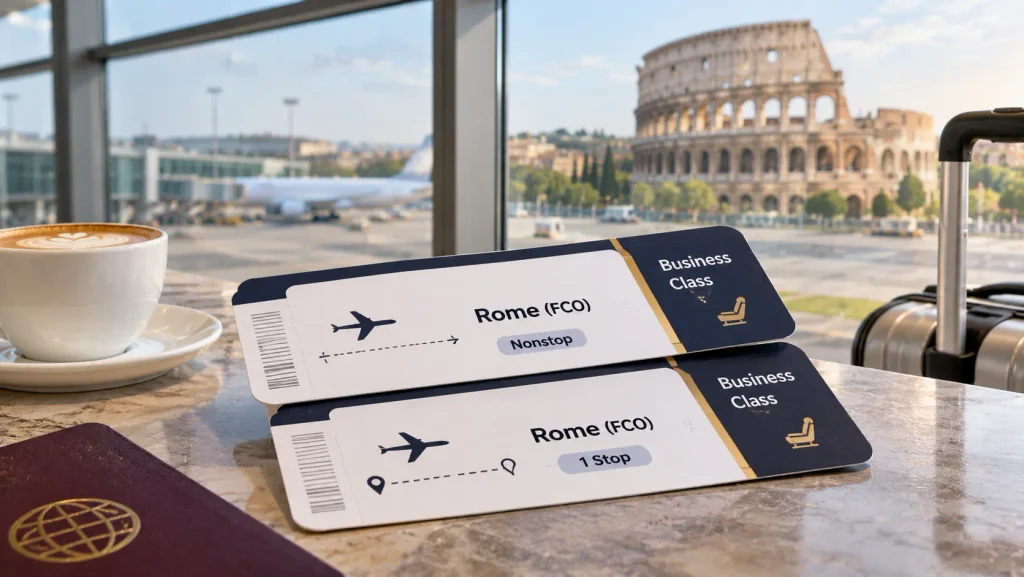
Nonstop business class flights to Rome are often more expensive than connecting flights, although the price difference depends on the departure city and available fares.
For example, the referenced fare comparison showed nonstop business class starting at $3,590 from New York but $9,433 from Los Angeles.
Connecting through Paris, Amsterdam, Frankfurt, Zurich, or London may reduce airfare, but it also increases total journey time.
Travelers should compare both the ticket price and the convenience of avoiding an additional flight.
How Long Does a Business Class Flight to Rome Take?
Flight duration depends on the departure airport, routing, and prevailing winds.
| Departure city | Approximate nonstop flight time |
|---|---|
| New York | 8.5–9 hours |
| Washington, D.C. | 9–10 hours |
| Chicago | 9–10 hours |
| Los Angeles | Around 12.5 hours |
Connecting flights can take several additional hours depending on the layover.
Westbound return flights to the United States often take longer than eastbound journeys.
What Amenities Are Included in Business Class to Rome?
Business class generally provides additional comfort and airport services compared with economy class.
Common amenities include:
- Fully flat beds on many long-haul aircraft.
- Priority check-in and boarding.
- Access to eligible airport lounges.
- Premium meals and beverages.
- Increased checked baggage allowances.
- Enhanced entertainment and personal space.
- Bedding and amenity kits on selected flights.
Some discounted business class fares may exclude certain services, including complimentary advance seat selection or flexible ticket changes.
Travelers should check the exact fare conditions before purchasing.
When Is the Cheapest Time to Fly Business Class to Rome?
Business class flights to Rome may be more affordable during quieter travel periods, particularly from November through March, excluding major holidays.
| Travel period | General demand | Pricing considerations |
|---|---|---|
| January–February | Lower | Potentially better fares |
| March–April | Variable to high | Easter travel can increase demand |
| May–June | High | Popular sightseeing season |
| July–August | High leisure demand | Business fares may vary |
| September–October | Moderate to high | Popular autumn travel period |
| November–early December | Often lower | Potential fare opportunities |
| Christmas–New Year | High | Holiday demand can raise prices |
Rome’s pleasant spring and autumn weather attracts significant tourism, while winter generally offers fewer crowds.
However, seasonal patterns do not guarantee lower fares on every route.
Is Business Class to Rome Worth the Extra Cost?
Business class may be worthwhile for travelers prioritizing sleep, comfort, and convenience during overnight transatlantic flights.
A fully flat bed can be particularly valuable for passengers arriving in Rome with sightseeing plans, business meetings, or important commitments.
However, the price difference can be substantial. In the referenced comparison, typical business class fares were approximately 4.6–5.9 times the corresponding typical economy fares.
Premium economy may offer a more affordable alternative for travelers who want wider seats and additional legroom without paying for business class.
How Can Travelers Find Cheap Business Class Flights to Rome?
Travelers can potentially reduce business class airfare by comparing departure cities, airlines, and alternative booking arrangements.
- Compare nearby airports: Departure city differences can significantly affect fares.
- Consider one-stop flights: Connecting itineraries may offer substantial savings.
- Adjust travel dates: Flying a few days earlier or later may reveal lower prices.
- Use airline miles: Eligible loyalty points can reduce the cash cost of award flights.
- Compare mixed-cabin tickets: Business class on the overnight segment and premium economy on the return may cost less.
- Explore multi-city itineraries: Arriving in Rome and departing from Milan or Venice can sometimes provide better overall value.
- Review fare restrictions: Lower-priced business tickets may have stricter refund or change conditions.
Should Travelers Fly Into Rome Fiumicino Airport?
Rome Fiumicino Airport (FCO), also known as Leonardo da Vinci International Airport, is the main international gateway for long-haul business class flights to Rome.
The airport offers connections to central Rome through trains, taxis, private transfers, and other ground transportation.
Rome Ciampino Airport (CIA) primarily serves short-haul and low-cost services, making Fiumicino the more relevant arrival airport for most transatlantic business class travelers.
What Should Travelers Check Before Booking Business Class to Rome?
Travelers should confirm the cabin and ticket conditions before paying, particularly when booking connecting flights.
Important details include seat configuration, baggage allowances, lounge eligibility, connection duration, and refund restrictions.
A ticket advertised as business class may include a shorter connecting segment with a different seat type or cabin.
Checking every flight segment helps passengers avoid paying premium prices for an itinerary that does not provide the expected comfort.
Frequently Asked Questions
Business class fares from major U.S. cities started at approximately $3,271–$4,076 in the referenced search, while typical fares ranged from $3,857 to $5,999. Actual prices depend on availability and travel dates.
ITA Airways, Delta Air Lines, United Airlines, and American Airlines offer nonstop or selected direct-route options, while Lufthansa, Air France, KLM, and SWISS provide connecting alternatives. The best airline depends on the route, aircraft, and price.
It can be. New York had the lowest typical business class fare in the referenced comparison, although Chicago offered the lowest starting fare.
Based on the illustrative typical fares, two round-trip business class tickets could cost approximately $7,714–$11,998 or more.
Yes. Eligible loyalty points or miles can be redeemed for business class award flights, subject to availability, program rules, taxes, and fees.
January, February, and parts of November may offer lower fares due to reduced leisure demand. Christmas, New Year, and other busy travel periods can still be expensive.
Business class may be worthwhile for passengers who want to sleep comfortably, arrive rested, and enjoy premium airport services. However, premium economy may offer better value for travelers with smaller budgets.