
Is It Possible to Correct Passenger Information on Air Canada?
Air Canada allows passengers to request corrections to eligible name errors and updates following legal name changes, but an ordinary ticket generally cannot be transferred to a completely different traveler. The available correction process depends on the type of error, the ticket’s issuing channel, and whether other airlines are included in the itinerary.
A misplaced letter or an outdated surname may appear insignificant during booking, but the discrepancy can become important when a traveler presents a passport or other government-issued identification. Not every mismatch requires the same solution, and canceling a reservation before checking the correction options may create unnecessary expenses.
Understanding the difference between a name correction, a legal name update, and a passenger substitution is therefore essential. This guide examines what Air Canada permits, how requests are handled, which documents may be necessary, and what travelers should check before departure.
Related: Air Canada Review: Flights, Cabins & Travel Services
What Does the Air Canada Name Change and Correction Policy Allow?
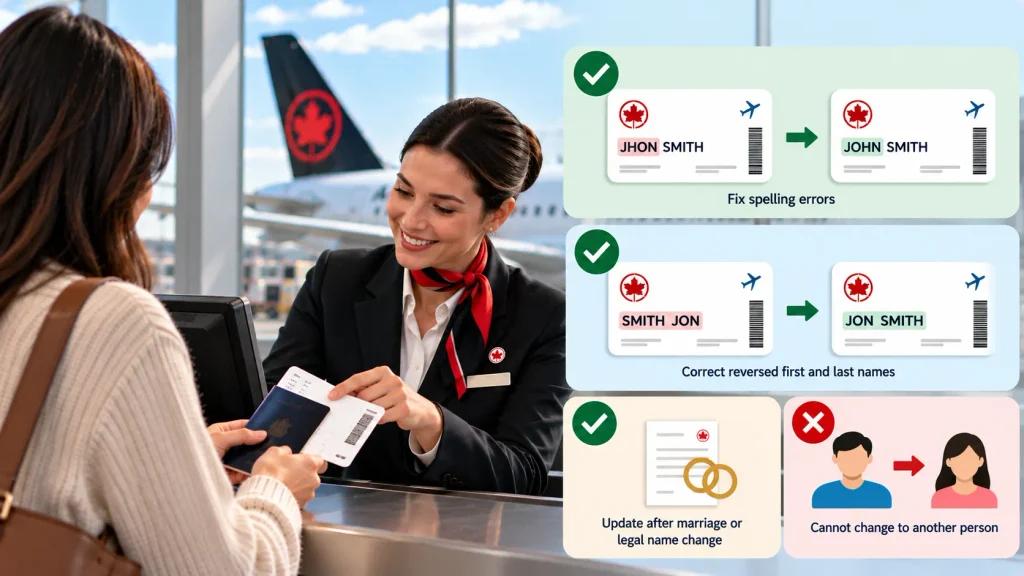
Air Canada’s name correction rules are designed primarily to resolve errors affecting the original passenger’s reservation. They do not establish a general right to replace the booked passenger with another individual.
The following comparison explains the main distinctions.
| Name-related situation | General treatment | What the traveler should do |
| Minor spelling or typing mistake | Correction may be permitted | Request an amendment through the appropriate booking channel |
| First and last names entered in reverse order | May qualify for correction | Ask the airline or ticket issuer to review the name fields |
| Missing middle name | Not automatically a ticket-changing error | Check identification and travel-document requirements |
| Incorrect or incomplete surname | Requires review | Request correction before travel |
| Marriage or divorce resulting in a new legal name | May be supported by legal documentation | Contact the ticket issuer with relevant documents |
| Court-ordered legal name change | Requires verification | Provide supporting legal records |
| Changing the ticket to another person | Generally not permitted on an ordinary ticket | Review cancellation and new-booking options |
| Ticket involving another airline | Additional rules may apply | Confirm requirements with the issuing carrier |
What Is the Difference Between a Name Correction and a Name Change on Air Canada?
A name correction fixes an error in the original traveler’s booking, while a passenger name change may involve replacing that traveler with someone else.
For example, changing Jennifer Thomson to Jennifer Thompson to match the passenger’s passport is a correction. Replacing Jennifer Thompson with Michael Thompson would involve a different traveler and is not an ordinary correction.
This distinction matters because an airline may be able to amend an existing ticket without permitting the transfer of that ticket’s ownership.
Can a Passenger Transfer an Air Canada Ticket to Someone Else?
An ordinary Air Canada ticket is generally non-transferable. A passenger who cannot travel should not assume that a friend or family member can use the reservation simply by changing the name.
The available alternatives depend on the fare conditions and may include cancellation for a refund or credit, followed by a separate booking for the replacement traveler.
Some specialized commercial arrangements may have different terms, so travelers holding group or corporate tickets should consult their booking agreement rather than assume standard individual-ticket rules apply.
Are There Exceptions for Corporate Name Changes?
Yes. Air Canada’s official tariffs provide a limited exception for eligible tickets purchased under qualifying corporate programs. In these cases, a different employee or designated traveler may be substituted, subject to fare, route, and ticket restrictions.
These exceptions are not the same as allowing unrestricted transfers of ordinary personal bookings. Corporate substitutions can involve specific fees and must meet the airline’s eligibility criteria.
Which Name Errors Can Air Canada Correct?
Air Canada’s published name-correction guidance covers misspelled first and last names and updates needed to reflect legal travel documents. Its procedures distinguish between Air Canada-only reservations and itineraries involving other airlines.
Can Air Canada Fix a Misspelled First or Last Name?
Yes. A misspelled first or last name may be corrected when the ticket qualifies under Air Canada’s procedures.
For example, a reservation issued as Catherine Martin instead of Katherine Martin should be reviewed as a possible correction for the same traveler, rather than a request to transfer the ticket.
Air Canada’s published agency guidance covers eligible tickets issued on its 014 ticket stock and provides a complimentary correction process for qualifying Air Canada-operated itineraries.
Does Air Canada Require Middle Name Corrections?
Not necessarily. Air Canada’s name-correction document expressly states that a middle-name correction is not required under that policy.
This is an important distinction: a passenger should not automatically purchase another ticket because the middle name is missing or abbreviated.
However, the traveler’s identification, advance passenger information, and any applicable immigration requirements must still be accurate. If the mismatch raises a question, the passenger should seek confirmation from Air Canada before departure.
Can Air Canada Correct Reversed First and Last Names?
A reservation with the first and last names entered into the wrong fields should be referred to Air Canada or the issuing travel agency for review.
Because this is a name-field problem rather than a new passenger, it may be handled through a correction process. The airline must confirm the appropriate procedure, especially where another carrier operates part of the itinerary.
What Happens if a Passenger Has Two Surnames or a Hyphenated Name?
Passengers with compound surnames should ensure the booking reflects their legal travel documents in a form accepted by the reservation system.
For example, Sofia Garcia Lopez should not assume that dropping Lopez is acceptable merely because the first surname appears correctly.
Likewise, names containing hyphens, spaces, or accented characters may be displayed differently by airline reservation systems. Travelers should verify the recognized formatting rather than assume every difference is an error.
Can Air Canada Update a Name After Marriage, Divorce, or Another Legal Change?
Yes. Air Canada’s official name-correction policy provides for changes needed to match legal travel documents following marriage, divorce, adoption, or gender transition.
These requests are different from substituting an unrelated traveler because the reservation remains associated with the same person.
The airline’s published documentation requirements include a passport and supporting evidence of the legal change.
What Documents May Be Required for a Legal Name Change?
Air Canada’s policy identifies the following documents for relevant legal name updates:
- A copy of the passenger’s passport.
- A marriage certificate, where applicable.
- A divorce decree or certificate, where applicable.
- A government-issued legal name-change filing.
The required combination depends on the reason for the change. Travelers should submit documents only through the channel confirmed by Air Canada or their authorized ticket issuer.
What if the Passport Still Shows the Passenger’s Former Name?
A passenger who changes their surname after booking should first determine which valid passport and supporting documents will be used for travel.
For example, if a reservation was made under Emma Roberts and the traveler subsequently becomes Emma Wilson, the appropriate ticket update depends on the documents that will be presented for the journey.
The traveler should avoid changing the ticket independently of the passport or immigration documents. Where the passport has already been updated, the airline should be contacted about correcting the reservation.
How Much Does Air Canada Charge for a Name Correction or Change?
Air Canada’s charges depend on the type of request and the itinerary. There is no single universal fee that applies to every spelling correction, legal name update, and corporate passenger substitution.
Its published name-correction guidance provides complimentary corrections for eligible Air Canada-only itineraries. For certain itineraries involving other airlines, the guidance identifies a CA50/US50 fee plus applicable taxes per ticket, with a separate process for documented legal changes.
| Request | Published fee treatment |
| Eligible correction on an Air Canada-only itinerary | Complimentary under the published correction procedure |
| Correction involving another airline | A CA50/US50 fee plus tax is identified in the published agency guidance |
| Documented legal name change | Special documentation and waiver procedures may apply |
| Eligible corporate passenger substitution | Fee depends on fare, route, and corporate agreement |
| Ineligible passenger transfer | No standard transfer fee; cancellation and rebooking rules may apply |
For any request, the ticket issuer should confirm the actual charge before processing. Rebooking may also involve a different fare, even where a correction fee is waived.
How Much Are Corporate Passenger Name Changes?
Air Canada’s tariffs specify fees for eligible corporate name substitutions. The amounts below are corporate-program charges, not general name-correction fees.
| Eligible corporate fare | Within Canada | Canada–US and specified nearby markets | Other international destinations |
| Standard | CA$125 | CA/US125 | CA/US250 |
| Flex | CA$60 | CA/US60 | CA/US250 |
| Premium Economy Standard / Lowest | CA$60 | CA/US60 | CA/US250 |
| Business Standard / Lowest | CA$60 | CA/US60 | CA/US250 |
For international travel, the nearby-market category covers Canada–US travel and specified Caribbean, Central American, and Mexican destinations, excluding Mexico City. Taxes, fare differences, and other applicable charges may be additional.
Corporate name substitutions are restricted to fully unused tickets, must be requested by an authorized corporate representative, and are excluded for Basic fares, codeshare or interline itineraries, group bookings, and Air Canada Vacations packages.
How Can Passengers Correct a Name on an Air Canada Ticket?
Passengers who booked directly with Air Canada should contact the airline’s reservations team for a name correction. Travelers who booked through an agency should generally begin with the issuing agency.
Air Canada’s official booking guidance states that passenger information cannot be changed through the standard online booking-management interface.
A practical correction process involves:
- Reviewing the booking: Compare the passenger name on the confirmation with the relevant travel document.
- Identifying the issue: Determine whether it is a spelling error, legal name update, or request to substitute a different person.
- Checking the ticket: Confirm whether it was issued by Air Canada and whether partner airlines appear on the itinerary.
- Contacting the correct provider: Approach Air Canada for a direct booking or the issuing travel agency for an agency booking.
- Providing supporting documents: Supply the correct spelling and legal documentation if requested.
- Confirming any charges: Ask whether the request can be processed as a complimentary correction or requires rebooking.
- Reviewing the updated ticket: Verify the passenger details and all flight segments after processing.
Can an Air Canada Name Be Changed Through Manage Booking?
Not through the standard self-service name-editing function. Air Canada’s published booking FAQ specifically identifies passenger information as something that cannot be changed online.
Although My Bookings supports various flight and service changes, passengers should contact the airline for corrections involving the ticketed name.
How Soon Should an Incorrect Name Be Reported?
An incorrect name should be reported immediately after the booking confirmation is received.
Air Canada advises customers who booked through its website to contact the airline within 24 hours of completing the booking if they discover an error, including a misspelled passenger name.
This does not mean every later correction is prohibited. Rather, early contact can make it easier to resolve a booking problem before fare changes, ticket reissuance, or departure deadlines complicate the process.
What Happens When an Air Canada Ticket Includes Another Airline?
Name corrections involving partner-operated flights can be more complicated because multiple reservation and ticketing systems may be involved.
Air Canada’s published agency policy separates itineraries operated entirely by Air Canada, Air Canada Rouge, or Air Canada Express from reservations containing flights operated by other airlines.
For qualifying Air Canada-only itineraries, the policy provides a direct correction and reissuance process. For itineraries involving other airlines, its documented process may require a new booking, cancellation of the original reservation, and refund handling.
Can a Name Be Corrected on an Air Canada Codeshare Flight?
A correction may require rebooking rather than a simple amendment when the itinerary includes a codeshare flight operated by another carrier.
For example, a passenger may book a trip through Air Canada but have a connecting segment operated by a partner airline. Changing the passenger name in one reservation record does not necessarily guarantee that the change has been accepted across the entire itinerary.
The traveler should ask the ticket issuer to verify the corrected details for every segment before departure.
Why Does the Ticket Number Matter?
The ticket number can help determine which airline issued the ticket and which correction procedures apply.
Air Canada’s published name-correction guidance specifically addresses tickets issued on 014 ticket stock, which identifies Air Canada-issued tickets.
Passengers should therefore provide both the booking reference and ticket number when contacting the airline or travel agency.
What Should Travelers Know About Domestic and International Name Requirements?
The appropriate identification documents depend on the itinerary, the traveler’s citizenship, and the countries involved.
A domestic Canadian journey and a flight crossing an international border may have different documentation requirements. A name correction should be evaluated against the documents actually required for the trip.
Does the Name on an Air Canada International Ticket Need to Match the Passport?
The passenger information should correspond to the passport and other required travel documents.
A material discrepancy between the booking and passport may create problems during document verification or check-in. Travelers should resolve spelling and surname differences in advance rather than rely on airport staff to interpret the discrepancy.
However, differences involving middle names, spacing, or system formatting do not necessarily require reissuing the ticket. Air Canada should confirm whether a particular difference needs correction.
What if the Name on a Visa Is Different From the Ticket?
Passengers should verify that their visa or other entry authorization is consistent with the identity documents used for travel.
Correcting an airline ticket does not amend an immigration document. If a passport has been renewed under a different legal name, the traveler may also need to review the validity of existing travel authorizations.
The applicable rules depend on the destination and the traveler’s nationality.
Can Air Canada Correct a Name After Check-In?
A name problem discovered after check-in requires immediate assistance from Air Canada, but passengers should not assume that a correction can be completed before departure.
Ticket reissuance may be necessary, and some requests may be impossible to complete at the airport.
The best approach is to report the discrepancy before checking in. If a correction is completed after a boarding pass has already been issued, the passenger should verify whether a new boarding pass is required.
What Happens if an Air Canada Name Correction Is Refused?
A correction may be declined if the request does not qualify under the applicable ticketing procedure or effectively attempts to replace the original passenger.
The available next step depends on the reason for refusal.
A passenger whose legal name has changed may be asked for additional supporting documents. A traveler with a partner-airline itinerary may need the ticket issuer to arrange a new reservation. Someone attempting an ineligible passenger transfer may need to cancel and purchase a separate ticket.
Before making a new booking, travelers should confirm the refund or credit value of the original ticket and any applicable cancellation conditions.
Conclusion
The most useful distinction is between correcting the original traveler’s identity and replacing that traveler altogether. Air Canada provides procedures for eligible spelling errors and documented legal name changes, while ordinary passenger transfers are generally restricted. Certain corporate tickets have separate substitution provisions.
Before requesting a change, travelers should review their identification documents, ticket number, issuing channel, and operating airlines. Reporting an error promptly gives the airline or ticket issuer more time to identify the correct procedure and explain any charges.
A corrected ticket should be checked carefully before departure, especially when the journey includes international travel or flights operated by partner airlines.
Frequently Asked Questions
Yes. Air Canada’s published correction procedure allows complimentary corrections on qualifying Air Canada-issued tickets for itineraries operated entirely by Air Canada, Air Canada Rouge, or Air Canada Express. Other itineraries may involve charges or rebooking.
Air Canada’s published name-correction document does not establish a universal three-character limit. Passengers should not assume that a correction is automatically accepted or rejected based solely on the number of incorrect letters.
Yes, passengers can contact Air Canada about booking errors within 24 hours. The airline specifically recommends this timeframe for errors discovered after booking directly through its website.
A correction can be requested when a child’s name has been entered incorrectly. The issuing airline or agency must determine the appropriate procedure, and the corrected details should correspond to the child’s required travel documents.
Yes. Air Canada’s published policy recognizes legal name changes following marriage and provides a documentation-based correction process.
Award reservations may be subject to separate ticketing and program rules. Passengers should contact Air Canada or Aeroplan support rather than assume the procedure for a paid cash ticket applies unchanged.
The applicable procedure must be confirmed with Air Canada. Corporate passenger substitutions are restricted to fully unused tickets, while an identity correction during an ongoing journey requires separate handling.
Passengers can request assistance at the airport, but approval is not guaranteed. Complex ticket reissuance and corporate passenger substitutions should be arranged before the day of departure.
Air Canada Vacations applies separate package-booking conditions. Certain name changes may be permitted, subject to destination-specific deadlines, supplier restrictions, availability, and fees. Travelers must contact Air Canada Vacations rather than rely on standard flight-only ticket rules.
Not necessarily. When a booking includes other airlines, the ticket issuer should confirm that the corrected information is reflected across all relevant flight segments.