
How Do You Change a Japan Airlines Flight? Policy & Steps
Japan Airlines allows passengers to change eligible flight reservations in, but whether you can reschedule depends on the ticket’s fare rules, route, booking channel, and seat availability. Some fares permit changes with a possible fare difference, while restrictive tickets may not allow voluntary modifications at all.
The airline also applies different procedures to domestic flights within Japan and international journeys. For example, a flexible domestic ticket may allow changes before departure, while an international booking may have specific online rebooking deadlines and additional service charges.
Understanding the Japan Airlines flight change policy before modifying a reservation can help travelers avoid unnecessary expenses and protect their remaining flights. This guide explains which tickets you can change, how to reschedule online, what fees may apply, and how the rules differ when Japan Airlines changes or cancels a flight.
Related: JAL Free Domestic Flights in Japan: How to Qualify
What Is the Japan Airlines Flight Change Policy?
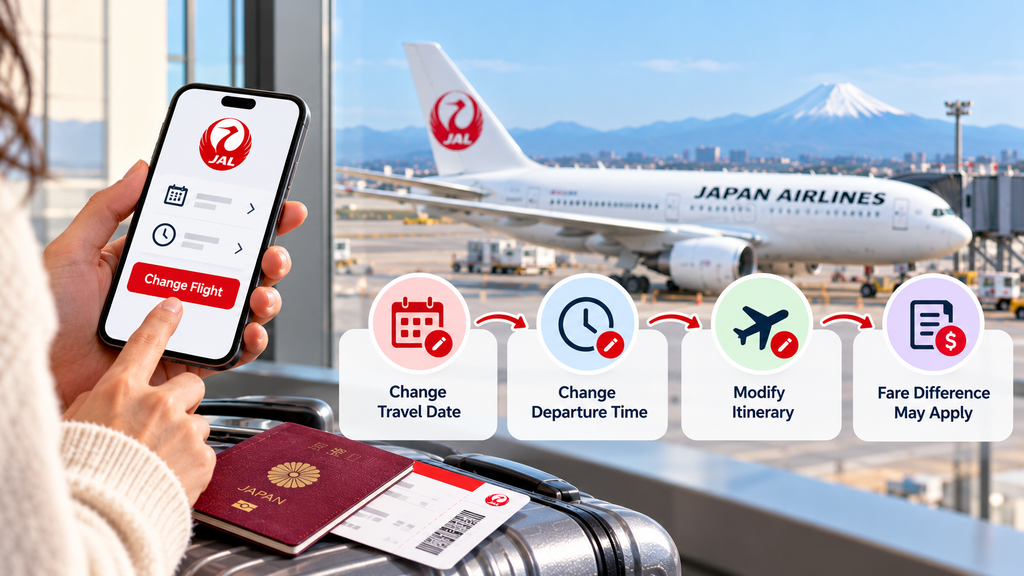
Japan Airlines allows voluntary flight changes when the ticket’s fare conditions permit them. Eligible passengers may be able to modify their travel date, departure time, or certain itinerary details, although a new fare calculation and additional charges may apply.
The airline distinguishes between changes passengers request and those required because of flight disruptions. If a traveler voluntarily selects another flight, the original ticket conditions generally determine the cost. When JAL cancels a service or makes a qualifying operational change, special rebooking arrangements may be available.
JAL confirms that international ticket changes are subject to fare regulations and may require handling fees or payment of a fare difference.
| Booking situation | Are changes permitted? | Possible cost |
| Domestic Flex fare | Yes, subject to conditions | Fare difference may apply |
| Domestic Saver fare | Generally no | Cancellation and new booking may be necessary |
| Domestic Special Saver fare | Generally no | Refund conditions and new fare apply |
| Eligible international flexible fare | Yes | Fare difference, change fee, or service fee |
| Restrictive international fare | May be prohibited | Cancellation and rebooking may be necessary |
| Flight canceled by JAL | Alternative arrangements may be available | Special disruption rules apply |
| Ticket purchased through an agency | Depends on ticket rules | Airline and agency charges may apply |
The fare rules displayed during booking are the most reliable starting point for determining whether a particular ticket can be changed.
Which Japan Airlines Domestic Fares Allow Flight Changes?
Japan Airlines uses different fare categories for domestic flights within Japan. Not all tickets offer the same flexibility, even on the same route.
According to JAL’s domestic fare rules, Flex, JAL CARD Flex, Business Flex, Shareholder’s Flex, Remote Island Flex, and Specific Route Flex generally permit reservation changes.
By contrast, Saver, Special Saver, Round Trip Saver, and Promotion fares do not ordinarily allow voluntary reservation changes. Sky Mate and Senior Citizen fares also have restrictions.
How Do Flexible and Discounted Domestic Tickets Compare?
Japan Airlines domestic fares offer different levels of flexibility depending on the ticket type. Flexible fares generally allow flight changes, subject to availability and fare differences, while discounted options like Saver and Special Saver typically restrict voluntary modifications.
| Domestic fare type | Reservation change | Important condition |
| Flex | Permitted | Fare difference may apply |
| JAL CARD Flex | Permitted | Eligibility restrictions apply |
| Business Flex | Permitted | Available to eligible JAL online members |
| Shareholder’s Flex | Permitted | Shareholder discount conditions apply |
| Saver | Not permitted | Original ticket refund rules apply |
| Special Saver | Not permitted | New reservation generally required |
| Round Trip Saver | Not permitted | Fare restrictions apply |
| Promotion | Not permitted | Promotional conditions apply |
A passenger holding a Flex ticket from Tokyo Haneda to Osaka Itami, for example, may be able to move to another eligible flight if seats are available.
A passenger holding a Special Saver ticket on the same route generally cannot simply change the departure time. Instead, the traveler may need to cancel the original reservation under its refund conditions and purchase another ticket.
This difference makes fare selection especially important for travelers with uncertain schedules.
Can International Japan Airlines Flights Be Changed After Booking?
Yes. JAL allows changes to eligible international tickets, but permitted modifications depend on the fare rules of the original booking.
International fares may have different restrictions on departure dates, routes, booking classes, and ticket reissuance. A changeable ticket may also need to be rebooked into the same or a higher permitted booking class.
For instance, a traveler booked from Los Angeles to Tokyo who wants to depart two days later may be able to reschedule if the fare allows changes and suitable seats are available. The airline may recalculate the ticket price using the fare available at the time of the change.
JAL also notes that international fare conditions can change after ticket reissuance so that different rules may apply to the newly issued ticket.
Also Worth Reading: Inside Japan Airlines’ A350-1000 First Class
How Can Passengers Change a Japan Airlines Flight Online?
Eligible passengers can modify their bookings through the official Japan Airlines website. The online process is generally convenient for straightforward date or flight changes, although not every reservation qualifies for self-service modifications.
- Visit the official Japan Airlines website and select Manage Booking.
- Retrieve the reservation using the requested booking information or JAL Mileage Bank account.
- Review the itinerary and check whether the reservation change option is available.
- Select the eligible flight and search for the preferred date or departure time.
- Compare available flights, revised fares, and any applicable charges.
- Confirm the new itinerary and complete any required payment.
- Check the updated e-ticket and confirmation before traveling.
JAL’s international online change procedure is subject to eligibility requirements. Some bookings, including certain reservations involving additional services or partner arrangements, may require assistance through the airline’s Contact Center.
What Are the Online Flight Change Deadlines for Japan Airlines?
The deadline depends on whether the journey is domestic or international and whether the request is voluntary or caused by an airline disruption.
| Flight or change type | Published timing requirement |
| Domestic voluntary changes | At least 20 minutes before scheduled departure |
| International voluntary online change before travel starts | At least 72 hours before the first flight |
| International voluntary online change after travel starts | At least 24 hours before the original flight |
| International disruption-related online rebooking | At least 2 hours before the alternate flight departs |
These deadlines apply to the specified procedures and do not guarantee that every ticket can be changed.
For example, the 72-hour rule concerns eligibility for JAL’s standard international online rebooking service. It does not mean that every international ticket becomes impossible to change within 72 hours of departure.
Passengers closer to departure should contact JAL to establish whether another authorized procedure remains available.
JAL publishes these timing requirements in its official international change instructions and domestic reservation rules.
How Much Does Japan Airlines Charge to Change a Flight?
Japan Airlines does not have a single fixed flight change fee that covers every domestic and international ticket. The total cost can include a fare difference, a fare-rule change penalty, and an applicable ticket service fee.
These charges serve different purposes.
What Is the Difference Between a Change Fee and a Fare Difference?
A change fee is a charge imposed under the applicable ticket conditions for modifying a reservation.
A fare difference is the difference between the original ticket price and the price calculated for the replacement itinerary.
For example, suppose a passenger purchased a changeable domestic ticket for ¥30,000, and the replacement flight costs ¥35,000. The traveler may need to pay the ¥5,000 difference, even if the ticket has no separate change penalty.
JAL confirms that eligible domestic reservation changes can result in an additional charge or refund based on the revised fare.
Does Japan Airlines Charge a Ticket Service Fee?
For international tickets, JAL publishes separate ticket service fees for certain transactions completed through its Contact Center or airport counters.
| Place of transaction | JAL website | Contact Center or airport counter |
| Japan | No ticket service fee | ¥5,500 |
| United States | No ticket service fee | US$50 |
| Canada | No ticket service fee | CAD$50 |
Published examples from JAL’s international ticket service fee schedule. Currency, location, ticket type, and exemptions may affect the amount charged.
These service fees are separate from any fare difference or change penalty.
Travelers should also understand that avoiding a website ticket service fee does not automatically mean they can change the reservation without additional payment.
Can Japan Airlines Flights Be Changed on the Same Day?
Domestic JAL flights may be changed on the departure date when the ticket permits changes and the request is completed within the applicable deadline.
JAL’s domestic rules require ordinary reservation changes to be completed at least 20 minutes before scheduled departure. A flexible fare may therefore allow a same-day change, subject to seat availability and any fare adjustment.
However, this does not apply to domestic Saver or Special Saver fares, which generally prohibit voluntary reservation changes.
International flights have different restrictions. JAL’s ordinary online rebooking deadlines mean that a same-day voluntary change may not be available through the website.
Travelers seeking an urgent international change should contact the airline rather than assuming that domestic same-day rules apply.
What Happens When Japan Airlines Cancels or Reschedules a Flight?
When Japan Airlines cancels a flight or makes a qualifying involuntary schedule change, passengers may be eligible for alternative transportation or a refund without the ordinary change or refund penalties.
For affected international tickets issued by JAL, the airline states that passengers can be rebooked on an eligible JAL Group flight, subject to availability and booking conditions. Additional fare, tax, or mileage differences resulting from an approved involuntary change are not charged to the passenger.
Passengers who no longer wish to travel may instead request reimbursement for the applicable unused ticket value.
These procedures cover qualifying disruptions caused by weather, natural disasters, mechanical problems, and other operational circumstances.
Can Passengers Rebook for Free After a JAL Domestic Flight Disruption?
Yes. JAL provides special handling for eligible domestic flights that are canceled, significantly delayed, or expected to be disrupted.
The airline says affected passengers can change their reservations at no extra cost. Eligible replacement flights may be selected within the ticket’s validity period or within 30 days of the original scheduled departure, whichever period is longer.
Even normally nonchangeable fares such as Saver and Special Saver may qualify for a one-time change under these disruption arrangements. Further changes may be allowed if the replacement flight is also disrupted.
Can Travelers Choose a Refund Instead of Rebooking?
Yes. Passengers affected by qualifying JAL cancellations or schedule changes may request refunds under the airline’s involuntary refund rules.
For eligible unused international tickets, JAL generally refunds the applicable fare, taxes, and charges without a cancellation penalty. For partially used tickets, the refund is calculated for the unused portions.
Travelers who purchased tickets through travel agencies should contact the original issuer to arrange the refund.
Can Passengers Change a Japan Airlines Ticket Purchased Through a Travel Agency?
Passengers who booked through a travel agency or third-party website should generally contact the original ticket issuer for voluntary changes.
An agency-issued ticket may involve additional ticketing restrictions or service charges. JAL’s website may not support all modifications to such reservations.
However, JAL states that you can view or modify certain airline-caused schedule changes online even if you purchased the ticket through another provider. The issuing agency may still need to complete the ticket reissue or process a refund.
For example, a traveler who booked a JAL-operated flight through an online travel agency should first check the ticket issuer and booking conditions before attempting to change the itinerary independently.
Can Passengers Change the Destination on a Japan Airlines Ticket?
Changing the destination is more complicated than selecting another departure time. JAL must determine whether the original fare permits a route change and whether the replacement itinerary can be ticketed under the applicable rules.
On international flights, some changeable fares may permit itinerary adjustments, but a new fare calculation and ticket reissue can be necessary. Other fares restrict changes to particular routes or booking classes.
For example, a passenger wishing to replace a Tokyo–Singapore flight with Tokyo–Bangkok should not assume that the airline will treat the request as a simple date change.
JAL’s international fare rules determine whether the proposed change is possible.
Does Japan Airlines Allow Passenger Name Changes?
Japan Airlines tickets are generally nontransferable. A passenger cannot replace the original ticket holder with another person simply by changing the name on the reservation.
JAL’s international ticket purchase conditions state that passengers cannot change their name after ticket issuance. Its domestic booking guidance also prohibits changes to passenger information, including names.
If the wrong person was entered during booking, you may need to cancel and purchase a new ticket. Refund eligibility depends on the original fare conditions.
Passengers who discover a minor spelling discrepancy should contact JAL promptly for guidance rather than attempting to alter the ticket themselves.
Can Japan Airlines Award Tickets Be Changed?
Japan Airlines Mileage Bank award tickets have separate conditions governing changes, cancellations, and mileage refunds.
Travelers should not assume that the rules for paid Flex tickets apply to award reservations. Eligibility can depend on the award type, available seats, ticket validity, and whether travel has already started.
For example, changing an award flight from Tokyo to Osaka to a different departure date may require eligible award-seat availability rather than ordinary cash-fare availability.
Passengers should review the specific JAL Mileage Bank award rules and confirm whether the requested modification is permitted before canceling an existing award booking.
What Happens If a Passenger Misses a Japan Airlines Flight?
Missing a scheduled flight can restrict the ability to use or change the remaining ticket.
For domestic reservations, JAL states that ordinary changes must be completed before departure. If a passenger fails to board without changing or canceling in advance, JAL may cancel subsequent reservations on the itinerary.
Even a normally changeable fare may lose its rebooking flexibility once the scheduled departure has passed.
International no-show consequences depend on the ticket’s conditions of carriage and fare rules.
Passengers who expect to miss a flight should contact JAL or their booking provider before departure and ask how to protect any remaining connecting or return flights.
Can Passengers Change Only One Flight in a Connecting Itinerary?
Changing one segment of a connecting reservation may affect the entire journey, particularly when the flights were priced together.
For domestic bookings, JAL explains that modifying part of a connecting sector can require the airline to search for available seats again across the revised itinerary. Previously reserved flights are not necessarily guaranteed to remain available under the new arrangement.
For example, a traveler connecting from Tokyo through Okinawa to Miyako may need to have both flights reassessed when changing the first departure.
Passengers should therefore review the complete itinerary before confirming a partial change, especially when international connections or partner airlines are involved.
What Should Passengers Check Before Changing a JAL Flight?
Before confirming a new itinerary, travelers should consider both the financial consequences and the practical details of their journey.
- Fare eligibility: Confirm that the original ticket allows voluntary changes.
- Available flights: Check whether suitable seats are offered in the permitted booking class.
- Additional costs: Review fare differences, change penalties, and service fees separately.
- Departure deadlines: Complete the request within the applicable change window.
- Connecting flights: Verify that the replacement itinerary preserves sufficient connection time.
- Optional services: Check whether paid seats, special meals, and other services remain confirmed.
- Travel documents: Ensure the new dates are compatible with passport and visa requirements.
Wrapping Up
The Japan Airlines flight change policy in 2026 offers different levels of flexibility depending on the fare purchased and the type of journey. Domestic Flex fares generally permit reservation changes, while Saver and Special Saver fares are more restrictive. International ticket changes depend on fare regulations, booking eligibility, and applicable service charges.
Travelers should check their ticket conditions before selecting another flight, especially when changing a connecting itinerary or using a third-party booking provider. If JAL cancels or significantly changes the original flight, passengers should review the airline’s special rebooking and refund procedures before accepting additional charges.
Frequently Asked Questions
Yes, in certain circumstances. Eligible domestic flexible fares may be changed without a separate change penalty, although fare differences can apply. Qualifying airline-caused disruptions may also allow rebooking without additional charges.
JAL does not publish a universal rule that lets every passenger change any ticket for free within 24 hours of booking. Travelers should review their fare conditions and any applicable market-specific cancellation protections.
Some changeable tickets may permit multiple modifications within their validity period, subject to fare rules and additional costs. However, certain disruption-related arrangements and ticket types impose separate restrictions.
Business Class tickets may be changeable, but cabin class alone does not determine eligibility. The purchased fare family, booking class, and ticket conditions control whether a change is permitted.
An earlier flight may be selected when the fare permits changes and seats are available. Domestic passengers must observe the applicable predeparture deadline, while international changes follow separate procedures.
For eligible domestic fare changes, JAL may charge or refund the difference between the original and replacement fares. International refunds or credits resulting from voluntary changes depend on the applicable fare rules.
Changes after check-in may require additional assistance and may be restricted. For disruption-related international online changes, JAL states that passengers who have already checked baggage cannot use the website to change their flights.
A passenger who cannot travel due to illness should contact JAL and explain the circumstances. The airline’s domestic guidance provides cancellation-charge exemptions when you submit qualifying medical documentation, but this should not be interpreted as a universal free rebooking policy for all tickets.