
How To Get Between Terminals at Los Angeles Airport
Passengers can travel between terminals at Los Angeles International Airport (LAX) by walking through post-security connections, using outdoor pedestrian routes, or taking the airport’s free terminal shuttle. The best option depends on the departure terminal, whether the passenger has already cleared security, and whether the passenger must collect checked baggage.
LAX has a horseshoe-shaped terminal layout, with domestic and international flights operating from different areas of the airport. Although its terminals are connected, transfers aren’t always as straightforward as following a single corridor. Some routes involve underground passages, elevated walkways, or shuttle buses, while international arrivals may require immigration, customs, and another security screening.
Knowing which route to use can save considerable time during a connection. This guide explains how to move between LAX terminals, where to find shuttle stops, how long transfers may take, and what passengers should know about the airport’s ongoing construction projects.
Related: Best Flights From Los Angeles (LAX) to Seattle (SEA): Guide
What Are the Different Ways to Travel Between LAX Terminals?
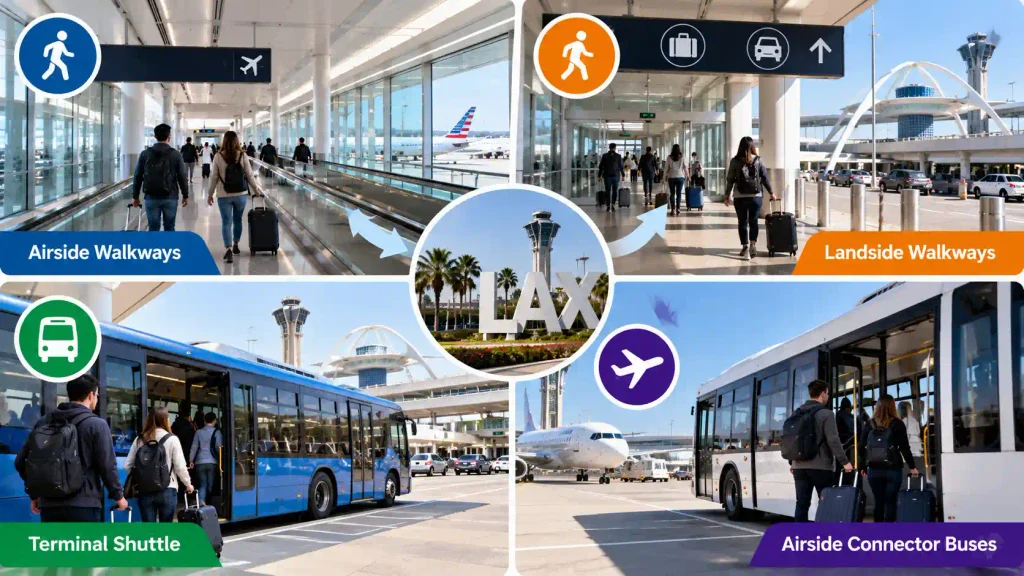
LAX offers several ways to move between terminals, but the best option depends on whether you’re inside or outside the secure departure area.
Passengers who have already passed through security can generally use the airport’s interconnected walkways. Those arriving from an international flight, collecting baggage, or checking in with another airline may need to use the public-side walkways or terminal shuttle instead.
| Transportation option | Where it operates | Best suited for | Security screening |
| Airside pedestrian walkways | Inside the secure terminal areas | Connecting passengers with through-checked baggage | Usually not repeated |
| Landside pedestrian walkways | Outside security | Passengers changing check-in areas or collecting baggage | Required before the next flight |
| Free terminal connector shuttle | Outside terminals, arrivals level | Travelers with luggage or longer landside transfers | Required after returning airside |
| Designated airside connector buses | Selected gate and remote-terminal locations | Passengers assigned to bus-served gates | Usually not repeated when remaining airside |
LAX confirms that passengers can move across its terminal complex after security using interconnected pedestrian routes. The airport also provides courtesy shuttle services for airline connections.
How Are the Terminals Arranged at LAX?
Los Angeles International Airport arranges its terminals around a central roadway and parking area. Terminals 1, 2, and 3 are on the north side, while Terminals 4, 5, 6, 7, and 8 are on the south side.
Tom Bradley International Terminal, also called Terminal B, sits at the western end of the complex and connects the northern and southern terminal areas.
Which LAX Terminals Are Connected After Security?
LAX’s post-security pedestrian network allows travelers to reach the major terminal areas without routinely leaving the secure zone.
The principal connections include:
- Terminal 1 to the Terminal 3 complex
- Terminal 3 to Tom Bradley International Terminal (Terminal B)
- Terminal B to Terminal 4
- Terminal 4 toward Terminal 6 through the southern terminal connector network
- Terminal 6 to Terminal 7
- Terminal 7 to Terminal 8
The airport describes the full post-security route from Terminal 1 to Terminal 8 as approximately two miles long. That distance makes walking possible, but it may not be convenient for every passenger.
Important for 2026: Terminal 5 is closed for redevelopment, with reopening anticipated in 2028. Travelers should follow current signage around the affected southern terminal connections rather than assume all former Terminal 5 facilities remain accessible.
Can Passengers Walk Between LAX Terminals Without Going Through Security Again?
Yes. LAX allows ticketed passengers to walk between connected terminals after security, as long as they don’t need to exit the secure area to collect baggage, complete arrival formalities, or visit an outside check-in counter.
This is especially useful for domestic connections. For example, a traveler arriving at Terminal 3 and departing from Terminal B can generally follow the airside connector rather than leaving the building and passing through another TSA checkpoint.
However, an airside connection does not guarantee that every passenger can remain behind security. International arrivals, separate bookings, and certain baggage arrangements may require a different procedure.
How Can Passengers Walk From Terminal 1 to Terminal 3?
Terminal 1 connects to the Terminal 3 complex through the airport’s northern pedestrian network. Passengers with an onward flight can follow the airside connection signs toward Terminal 3 and its departure gates.
Terminal 2 remains an important check-in location for certain airlines, although the expanded Terminal 3 operation has integrated its former gate areas.
For example, a passenger checking in at Terminal 2 may ultimately depart from a gate identified as part of Terminal 3. The traveler should follow the airline instructions rather than assume the check-in building and boarding gate are in the same terminal.
LAX confirms that several airlines continue to use Terminal 2 for check-in while operating departures from Terminal 3.
How Can Passengers Travel From Terminal 3 to Terminal B?
The Delta Sky Way pedestrian connection connects Terminal 3 and Tom Bradley International Terminal.
The route allows eligible connecting passengers to move between the northern departure concourses and Terminal B without returning to the public side of the airport.
This connection is especially useful for travelers transferring from a domestic flight to an international departure.
Passengers should follow signs toward Terminal B or the international terminal connector. Those assigned to the West Gates at Tom Bradley must continue farther into the international terminal complex.
How Can Passengers Get From Terminal B to Terminal 4?
Terminal B connects to Terminal 4 through an elevated post-security pedestrian passage.
This route provides an important link between international departures and flights operating from the southern terminal area.
A traveler arriving at Terminal 4 for an onward departure from Terminal B can generally use this connection without another security check, as long as they remain airside and don’t need to collect baggage or clear customs.
The passage includes moving walkways along parts of the route, but passengers should allow extra time to reach their specific departure gate.
How Can Passengers Travel Between Terminals 6, 7, and 8?
Terminals 6, 7, and 8 are linked through the southern airside pedestrian network.
Travelers can follow the marked corridors between these terminals, making connections possible without leaving the secure departure area.
Terminals 7 and 8 are especially closely integrated. Passengers connecting between their gates generally have a shorter route than travelers moving across the entire airport.
Those traveling from Terminal 6 toward Terminal B can continue through the southern connector network, subject to any construction-related restrictions.
Is There a Free Shuttle Between Terminals at LAX?
Yes. LAX operates a free terminal connector shuttle for passengers traveling between terminals outside security.
The terminal connector service operates 24 hours a day. It travels around the airport’s central terminal roadway, offering an alternative to walking with luggage or crossing between distant terminals.
Where Can Passengers Find the LAX Terminal Shuttle?
Passengers can find the terminal connector shuttle stops on the Lower/Arrivals Level outside the terminals.
The airport’s current terminal location guidance directs travelers to the designated pink LAX Shuttles signs. Older airport instructions also refer to blue Airline Connections signs, so travelers should follow the signs currently displayed at their terminal.
The process is straightforward:
- Leave the terminal and proceed to the Lower/Arrivals Level.
- Find the designated LAX shuttle boarding area.
- Confirm that the arriving bus is the terminal connector service.
- Board the free shuttle and remain on it until the required terminal.
- Follow the departure signs to the airline’s check-in or security area.
Passengers should avoid confusing the terminal connector with buses serving economy parking, rental-car facilities, or the Metro Transit Center. These services have different destinations.
How Long Does It Take to Walk Between LAX Terminals?
Walking times vary widely by terminal pair, departure gate, crowd levels, and whether a passenger uses the airside or landside route.
LAX’s official May 2026 guidance recommends allowing about 10–15 minutes to walk between terminals. This is a useful general planning estimate, but the actual distance can be shorter or longer depending on the route.
| Transfer | General planning estimate | Main consideration |
| Terminal 1 to Terminal 3 | Around 10–15 minutes | Northern connector and gate location |
| Terminal 3 to Terminal B | Around 10–15 minutes | Connector and international gate distance |
| Terminal B to Terminal 4 | Around 10–15 minutes | Elevated pedestrian connection |
| Terminal 6 to Terminal 7 | Around 10–15 minutes | Southern connector |
| Terminal 7 to Terminal 8 | Often a shorter walk | Closely connected departure areas |
| Terminal 1 to Terminal 8 | Substantially longer | Approximately two-mile airside route |
Times are planning estimates, not measured gate-to-gate guarantees. Terminal 5 construction may affect routes through the southern terminal area.
A traveler moving from Terminal 3 to Terminal B may need only a short terminal transfer. Still, the total journey can increase considerably if the departure gate is in the West Gates concourse.
For this reason, the gate number often matters more than the terminal number alone.
How Can Passengers Reach the West Gates at Tom Bradley International Terminal?
The West Gates at Tom Bradley are a separate departure concourse associated with Terminal B. A pedestrian passage connects them to the main international terminal, and designated airside shuttle services also serve them.
Passengers departing from the West Gates should not assume that reaching the main Terminal B building means they have arrived at their boarding gate.
Some airlines direct passengers to check in at Terminal 1 before taking an airside bus to their departure gates at the West Gates.
LAX specifically identifies certain Terminal 1 airlines whose passengers take a bus to Terminal B for their flights.
Can Passengers Take an Airside Shuttle From Terminal 1 to the West Gates?
Yes. LAX provides an airside bus connection serving the Terminal 1 area and the West Gates at Tom Bradley.
This service is different from the public-side terminal connector shuttle. It is intended for passengers transferring within the secure airport environment.
Travelers should follow signs to the designated bus gate and confirm the shuttle serves their assigned departure concourse.
Passengers should also check their airline’s boarding instructions because bus boarding locations and procedures can change with terminal operations.
What Should International Connecting Passengers Know About LAX Transfers?
International connections at LAX can involve additional formalities that differ from domestic-to-domestic transfers.
Passengers arriving in the United States from abroad generally must complete U.S. immigration and customs procedures before continuing to another flight, unless their journey qualifies for an applicable preclearance arrangement.
This means that even a passenger with a connecting boarding pass may need to leave the secure area before returning to the departure terminal.
How Does an International-to-Domestic Connection Work at LAX?
A passenger arriving internationally and continuing on a domestic flight will generally follow this sequence:
- Arrive at the designated international arrival facility.
- Complete U.S. passport control.
- Collect checked baggage when required.
- Clear customs.
- Recheck baggage at the appropriate transfer facility, if available.
- Proceed to the next departure terminal.
- Complete TSA security screening before boarding the domestic flight.
For example, a traveler arriving at Terminal B from Tokyo and connecting to a domestic flight departing from Terminal 7 should account for immigration, baggage handling, terminal transfer, and security screening.
Although Terminal B and Terminal 7 are connected airside, the international arrival process may prevent the traveler from connecting directly.
Do Domestic-to-International Passengers Need to Clear Security Again?
Not necessarily. A passenger arriving on a domestic flight and continuing to an international departure may stay within the secure terminal network if they have a boarding pass and checked baggage is transferred to the final destination.
For example, a traveler flying from San Francisco to LAX and then continuing to London on a single eligible reservation may be able to walk to the international departure gate without another TSA screening.
However, passengers on separate tickets may need to collect and recheck baggage, depending on the airlines and their baggage agreements.
How Do Separate Tickets Affect Terminal Transfers at LAX?
Travelers holding separate flight reservations should allow more time than passengers with protected connections on a single ticket.
When flights are booked separately, the first airline may not transfer checked baggage to the second airline. Passengers may therefore need to go to baggage claim, travel to another terminal, check in again, and go through security.
There is also an important financial difference. If the first flight arrives late and the second flight is missed, the onward airline may not be responsible for providing a replacement flight.
For example, a traveler buying one ticket to LAX and a separate international ticket from Terminal B should plan for baggage collection and another check-in process.
The passenger should verify the second airline’s check-in cutoff time rather than relying only on the scheduled departure time.
How Much Connection Time Should Passengers Allow at LAX?
The minimum connection time depends on the airlines, ticket arrangement, arrival country, and whether passengers must collect checked baggage.
A short domestic connection between nearby terminals may require only a walk through the secure area. An international arrival followed by a domestic departure can take much longer because of immigration, customs, baggage handling, and security.
For practical planning, the following ranges can be useful:
| Connection type | Suggested planning allowance |
| Domestic to domestic, single ticket | Around 1.5–2 hours |
| Domestic to international, single ticket | Around 2–3 hours |
| International arrival to domestic departure | Around 3 hours or more |
| Separate tickets requiring baggage collection and recheck | Around 3–4 hours or more |
These are conservative planning suggestions, not official LAX minimum connection times or guaranteed sufficient intervals. Actual airline requirements and arrival processing times vary.
Passengers should also distinguish between the scheduled arrival time and when they can actually start walking to their next gate. Aircraft taxiing, deplaning, and long distances within a terminal can eat into the available connection time.
Is the LAX Automated People Mover Operating in October 2026?
No. As of October 2026, the LAX Automated People Mover, branded SkyLink, has not opened for passenger service.
The elevated train is designed to connect the airport’s central terminal area with facilities including the Metro Transit Center, parking, and rental-car services. However, its opening has been delayed repeatedly, with the latest projected start moving into 2027.
Passengers should therefore continue using the airport’s existing pedestrian routes and shuttle services.
The Automated People Mover should also not be confused with the existing airside terminal connections. Its primary purpose is to improve access between the terminal area and ground transportation facilities, rather than replace every gate-to-gate pedestrian route.
Don’t Miss This Guide: Best Ways to Fly From LAX to Chicago (ORD) With Points
Can Passengers With Reduced Mobility Get Assistance Between LAX Terminals?
Yes. Passengers who require mobility assistance should arrange support through their airline before traveling.
Assistance may include wheelchair services, guidance through the terminal, and transportation arrangements appropriate to the passenger’s needs.
The airport long pedestrian routes can be challenging for travelers with reduced mobility, especially when connections involve distant gates or areas affected by construction.
Passengers should provide the airline with details of their assistance requirements and confirm whether support will continue across connecting flights.
Under U.S. accessibility requirements, airlines must assist eligible passengers with disabilities. The arrangements may depend on the operating airline and the type of assistance requested.
Final Words
The most practical way to move between LAX terminals is to determine whether you can complete the connection inside the secure area. Passengers with through-checked baggage and valid onward boarding passes can often use the pedestrian network, avoiding another security screening. Those collecting baggage or changing check-in locations may find the free terminal shuttle more convenient.
Travelers should also consider Terminal 5’s ongoing closure, the additional procedures for international arrivals, and the distance to their actual boarding gate. Checking the latest airport map and airline instructions before departure can make a substantial difference, especially during a short connection.
Frequently Asked Questions
Yes. Passengers can use the connected airside pedestrian network to travel from Terminal 1 through the northern terminal complex to Terminal B. A designated airside bus also serves certain Terminal 1 connections to the West Gates.
Yes. The southern terminal network connects these areas, but Terminal 5 is closed for construction in 2026. Passengers should check the current walking route and follow posted signs around the affected area.
Yes. Terminals 7 and 8 are closely connected within the secure area, allowing passengers to move between their gates without normally repeating security screening.
Yes. The airport lists the terminal connector shuttle as a 24-hour service. Actual waiting times can vary, so travelers should confirm the designated boarding area.
LAX generally permits ticketed passengers with valid same-day boarding passes to enter other terminals for dining, shopping, and connections. However, travelers should confirm the relevant checkpoint is open and that they can reach their assigned departure gate.
No. LAX has underground pedestrian passages in parts of its terminal network, but no underground train system. Its Automated People Mover is an elevated rail project and was not open to passengers as of October 2026.
Not always. On eligible connecting reservations, checked baggage may be transferred automatically. However, international arrivals and separate-ticket journeys may require you to collect and recheck your baggage.
Walking can be faster for nearby terminals or when roadway traffic is heavy. The shuttle may be more practical for longer landside transfers, passengers carrying multiple bags, or travelers who prefer not to walk long distances.