
How Many Bags Can You Bring on Southwest? Carry-On, Checked & Liquids
The Southwest Airlines baggage policy allows every ticketed passenger to bring one free carry-on bag measuring up to 24 × 16 × 10 inches and one free personal item, while standard checked bags must weigh no more than 50 pounds and measure no more than 62 linear inches. Checked baggage is no longer free for everyone. For most U.S. mainland bookings made or voluntarily changed on or after April 9, 2026, Southwest charges $45 for the first checked bag and $55 for the second, although certain fares and loyalty benefits include free baggage.
These details matter when comparing flight prices. A ticket that appears inexpensive at first may cost considerably more once checked luggage is added, particularly for a family traveling with several suitcases. Liquid restrictions introduce another consideration because the amount you can pack in your cabin bag differs from what is permitted in checked luggage.
This guide explains Southwest’s 2026 baggage allowances, current fees, suitcase dimensions, TSA liquid restrictions, special equipment rules, and what happens when luggage is delayed or damaged.
See This Guide: Southwest Flash Sale Offered Up to 40% Off Flights
What Is Southwest Airlines Baggage Policy in 2026?
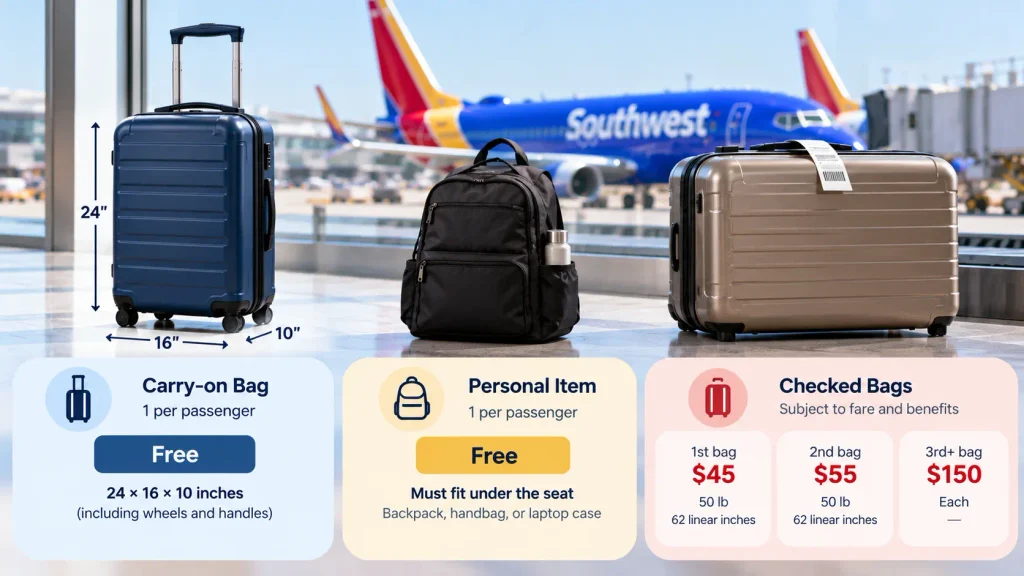
Southwest’s baggage policy separates luggage into three main categories: carry-on bags, personal items, and checked baggage. Each category has different requirements for size, storage, and charges.
Here is a quick comparison of the standard rules.
| Baggage type | Allowance | Size or weight restriction | Standard fee |
| Carry-on bag | 1 per passenger | 24 × 16 × 10 inches | Free |
| Personal item | 1 per passenger | Must fit under the seat | Free |
| First checked bag | Subject to fare and benefits | 50 lb; 62 linear inches | $45 |
| Second checked bag | Subject to fare and benefits | 50 lb; 62 linear inches | $55 |
| Third or additional checked bag | Subject to acceptance limits | Additional restrictions apply | $150 each |
Checked-bag prices shown are standard U.S. mainland rates for reservations ticketed or voluntarily changed on or after April 9, 2026. Eligible passengers may receive free bags. Different dates, routes, and special baggage categories can have different charges.
Southwest introduced checked-bag charges in May 2025 and increased its standard first- and second-bag fees by $10 in April 2026. Consequently, older articles describing two complimentary checked bags for every passenger no longer reflect the current policy.
Read More Here: Southwest Airlines International Routes & 15 Destinations
How Many Carry-On Bags Can You Bring on Southwest?
Southwest allows one carry-on bag and one personal item per ticketed passenger, regardless of whether you purchased Basic, Choice, Choice Preferred, or Choice Extra.
Your carry-on must fit in the overhead compartment, while your personal item belongs under the seat in front of you.
For example, you could bring a small rolling suitcase containing clothing and a backpack holding your laptop, documents, and headphones. Both items are allowed without a baggage charge, provided they meet the relevant requirements.
What Is the Southwest Carry-On Size Limit?
Carry-on suitcase
24 × 16 × 10
Inches, including wheels and handles
Personal item
Under-seat fit
Backpack, handbag, or laptop case
Official Southwest carry-on and personal-item requirements.
Southwest’s maximum carry-on dimensions are:
- Length: 24 inches (60.96 cm)
- Width: 16 inches (40.64 cm)
- Height: 10 inches (25.4 cm)
The airline measures the complete exterior of the bag, including wheels, handles, and attachments.
Suppose your suitcase measures 23 × 15 × 9 inches. It falls within the published carry-on dimensions. However, a suitcase measuring 25 × 15 × 9 inches exceeds the permitted length, even though its other measurements are acceptable.
Does Southwest Have a Carry-On Weight Limit?
Southwest does not publish a general numerical weight limit for standard carry-on baggage on its current carry-on policy page.
However, the bag must be suitable for safe cabin storage. Passengers should be able to handle their luggage safely and follow crew instructions.
The absence of a published weight limit does not mean that exceptionally heavy or difficult-to-handle luggage will necessarily be accepted in the cabin.
Can a Backpack Count as a Personal Item?
Yes. Southwest accepts backpacks as personal items when they fit beneath the seat in front of the passenger.
Other common examples include handbags, briefcases, laptop bags, and small camera bags.
A large hiking backpack that cannot fit under the seat may need to be treated as your main carry-on instead.
If your bag exceeds the cabin allowance, Southwest advises checking it at the ticket counter before proceeding to the departure gate.
What Is Southwest’s Checked Baggage Allowance?
Southwest’s standard checked baggage allowance permits suitcases weighing up to 50 pounds (approximately 23 kg) and measuring up to 62 linear inches (approximately 157 cm).
The number of complimentary checked bags depends on your ticket, Rapid Rewards status, eligible credit card benefits, and other qualifying exemptions.
How Do You Measure a Checked Bag Correctly?
Checked luggage is measured using its combined length, width, and height rather than three separate maximum dimensions.
The calculation is:
Linearinches=Length+Width+Height
For example, a suitcase measuring 28 × 20 × 14 inches has a total measurement of:
28+20+14=62inches
That suitcase meets Southwest’s standard size limit, assuming those measurements include the handles and wheels.
A suitcase measuring 30 × 20 × 15 inches totals 65 linear inches and exceeds the standard allowance.
This is why checking the dimensions printed on a suitcase’s product label is not always enough. Measure the complete packed bag, including protruding components.
How Much Does Southwest Charge for Checked Bags in 2026?
For standard U.S. mainland travel ticketed or voluntarily changed on or after April 9, 2026, Southwest charges $45 for the first checked bag and $55 for the second on Basic, Choice, and Choice Preferred fares.
Choice Extra includes two standard checked bags at no additional charge.
| Southwest fare | First checked bag | Second checked bag |
| Basic | $45 | $55 |
| Choice | $45 | $55 |
| Choice Preferred | $45 | $55 |
| Choice Extra | Free | Free |
These are one-way charges, not round-trip totals.
How Much Would You Pay for Two Bags on a Round Trip?
Consider a passenger traveling from Denver to Orlando and returning on a Choice fare, with two standard checked bags on each flight.
First bag, each direction
$45
Second bag, each direction
$55
One-way baggage total
$100
Round-trip baggage total
$200
This example assumes the same two bags are checked in both directions, no complimentary-bag benefits apply, and standard mainland rates remain applicable.
It also illustrates why travelers should compare the total price of different fare options, not just the ticket’s advertised base fare.
What if You Booked Before April 9, 2026?
Southwest’s April 2026 price increase does not automatically apply to every existing reservation.
For qualifying U.S. mainland bookings ticketed before April 9, 2026, the previous standard fees were $35 for the first checked bag and $45 for the second.
However, voluntarily changing an existing reservation on or after April 9 can trigger the updated baggage rates.
Southwest confirmed this distinction in its official fee-change announcement.
Who Still Gets Free Checked Bags on Southwest?
Although Southwest discontinued its former universal two-free-bags benefit, several passenger categories retain complimentary checked baggage.
| Passenger category | First checked bag | Second checked bag |
| Choice Extra fare | Free | Free |
| Rapid Rewards A-List Preferred | Free | Free |
| Rapid Rewards A-List | Free | $35 |
| Eligible Rapid Rewards credit cardholder | Free | $55 |
| Eligible active-duty military passenger | Free | Free |
These figures reflect Southwest’s published U.S. mainland schedule for the current booking period. Special rules and exceptions apply.
Can Your Travel Companions Receive the Same Benefits?
Certain Southwest baggage benefits extend to as many as eight additional passengers traveling on the same reservation.
For example, an eligible Rapid Rewards credit cardholder can receive a first-checked-bag waiver for themselves and up to eight companions on the same booking, subject to the program’s conditions.
The primary cardholder’s Rapid Rewards number must be included in the reservation, and the eligible card account must meet the applicable requirements.
Similarly, qualifying A-List and A-List Preferred benefits can extend to accompanying passengers on the same reservation.
These benefits generally do not apply to partner-airline bookings.
What Happens if Your Southwest Checked Bag Is Overweight or Oversized?
Southwest charges additional fees when checked baggage exceeds its standard weight or size allowance.
These charges are separate from the ordinary checked-bag fee and can make a heavily packed suitcase significantly more expensive to transport.
How Much Are Southwest’s Overweight Baggage Fees?
| Checked bag weight | Additional charge |
| Up to 50 lb | No overweight fee |
| 51–70 lb | $100 |
| 71–100 lb | $200 |
| Over 100 lb | Not accepted as ordinary checked baggage |
For standard U.S. mainland travel, the overweight charge is added to the applicable checked-bag fee.
For example, if your first checked bag weighs 60 pounds and your ticket does not include free checked luggage, the charge may be:
$45 standard baggage fee + $100 overweight fee = $145 one way.
These charges can differ for certain special items and routes.
How Much Does Southwest Charge for Oversized Bags?
For ordinary checked baggage on U.S. mainland routes, Southwest publishes a $200 oversized charge for bags measuring 63–80 linear inches, in addition to the standard baggage fee.
An ordinary suitcase exceeding the accepted dimensions may need alternative transportation arrangements.
If the same bag is both oversized and overweight, Southwest’s published fee schedule provides a combined $200 additional charge rather than automatically adding both separate penalties, provided the bag meets the relevant acceptance conditions.
Special equipment, such as certain sporting goods and musical instruments, has different dimensional allowances.
Related: Southwest Airlines Ends Free Bags: Major Changes in 2026
What Is Southwest’s Liquid Policy for Carry-On Bags?
Southwest passengers departing from U.S. airports must follow the Transportation Security Administration’s 3-1-1 liquids rule when passing through airport security.
The standard rule limits liquids, gels, aerosols, creams, and pastes in carry-on baggage to containers holding no more than 3.4 fluid ounces (100 milliliters) each.
TSA 3-1-1 Liquid Rule
- 3.4 oz
100 mL maximum per container
- 1 quart
Clear, resealable liquids bag
- 1 bag
Per passenger
Standard U.S. airport screening rule; exceptions apply for qualifying medical and infant-related liquids.
Which Toiletries Count as Liquids?
Common examples include shampoo, conditioner, lotion, perfume, toothpaste, liquid foundation, sunscreen, and shaving gel.
The rule applies to the container’s capacity, not merely the quantity remaining inside it.
For example, a 200 mL shampoo bottle containing only 50 mL of shampoo does not meet the ordinary 100 mL container limit.
A collection of 100 mL travel-size bottles may be carried if they fit within the permitted quart-sized bag.
Can You Bring a Water Bottle Through Airport Security?
You can generally take an empty reusable water bottle through a U.S. security checkpoint.
A full bottle containing more than 100 mL of ordinary drinking water will generally not meet the standard carry-on liquid restrictions.
A practical solution is to carry an empty bottle and refill it after security screening, where permitted.
Can You Bring Larger Liquids in Southwest Checked Baggage?
Yes. Larger containers of many ordinary liquids, such as shampoo, lotion, and other non-hazardous toiletries, may be packed in checked baggage.
However, checked luggage is not exempt from all liquid restrictions.
The FAA regulates certain aerosols, alcoholic beverages, flammable substances, and hazardous materials. For example, some permitted medicinal and toiletry aerosols have limits on the amount per container and the total quantity per passenger.
When packing larger toiletries, seal bottle caps carefully and place containers inside leak-resistant bags to protect your clothing.
Before packing an unfamiliar substance, use the TSA’s What Can I Bring? list to check whether it is permitted.
Are Baby Formula, Breast Milk, and Liquid Medicines Exempt From the 3-1-1 Rule?
Yes. TSA permits medically necessary liquids and certain infant-related items in quantities exceeding 3.4 ounces.
Examples include:
- Liquid medications needed during travel.
- Breast milk and infant formula.
- Toddler drinks and baby food.
- Necessary cooling accessories, including qualifying ice packs.
These items do not need to fit inside the standard quart-sized liquids bag.
Inform the TSA officer about the items at the checkpoint and make them available for separate screening.
The infant does not have to be traveling with you for qualifying breast milk or formula to be permitted.
What Items Are Restricted in Southwest Carry-On and Checked Baggage?
Southwest passengers must follow applicable airline, TSA, and FAA safety requirements.
Some items are restricted in the cabin, while others are prohibited from checked baggage because they present fire or other safety risks.
| Item | Carry-on baggage | Checked baggage |
| Standard toiletries within TSA limits | Allowed | Generally allowed |
| Power banks | Allowed, subject to battery limits | Not allowed |
| Spare lithium batteries | Allowed, subject to battery limits | Not allowed |
| Laptops and smartphones | Allowed | May be permitted under conditions; carry-on preferred |
| Ordinary sharp knives | Generally prohibited | Generally permitted if safely packed |
| Fireworks and explosives | Prohibited | Prohibited |
| Certain hazardous or flammable liquids | Restricted or prohibited | Restricted or prohibited |
Battery rules depend on watt-hour capacity and the device involved.
For example, most ordinary personal-use power banks rated at 100 watt-hours or less are permitted in carry-on baggage, while some larger batteries require airline approval. Power banks and spare lithium batteries must not be packed in checked luggage.
If Southwest requires you to check a carry-on bag at the gate, remove any power banks and spare lithium batteries first.
Can You Bring Sports Equipment or Musical Instruments on Southwest?
Yes. Southwest accepts various types of sports equipment and musical instruments, subject to the item’s dimensions, weight, packaging, and the airline’s special baggage rules.
Examples include golf equipment, bicycles, skis, and musical instruments.
However, acceptance does not necessarily mean that transportation is free.
Many qualifying sports items are treated as standard checked baggage. Certain equipment may receive an oversized-fee waiver, while overweight or excess-bag charges can still apply.
Southwest also publishes special dimensional allowances for musical instruments that differ from those for ordinary suitcases.
If you plan to travel with an unusually large or fragile item, check the applicable equipment-specific policy before departure rather than assuming that the standard suitcase rules apply.
Are Strollers, Car Seats, and Mobility Aids Treated Like Regular Baggage?
Not always. Equipment used by infants, children, or passengers with disabilities may qualify for different handling and baggage arrangements.
For example, car seats and strollers are not necessarily treated in the same way as an ordinary additional suitcase.
Assistive devices and mobility equipment also have specific accessibility and safety protections. Some battery-powered mobility aids require advance coordination because of battery-handling requirements.
If you are traveling with a wheelchair, stroller, car seat, or another specialized item, confirm its acceptance, handling arrangements, and any documentation requirements before reaching the airport.
How Can You Check and Pay for Southwest Baggage?
Southwest allows eligible passengers to check bags digitally after checking in, beginning 24 hours before scheduled departure.
You can also use self-service baggage kiosks at participating airports or visit a Southwest ticket counter.
The general process is straightforward:
- Check in through Southwest’s website or mobile app.
- Add your checked baggage where the option is available.
- Review any applicable baggage charges.
- Complete payment and follow the airport’s bag-tagging instructions.
- Drop off your suitcase at the designated baggage counter.
Southwest notes that additional overweight or oversized fees paid at the airport require a physical credit card; contactless and mobile payment methods are not accepted for those charges.
How Early Must You Check Your Bags?
Southwest publishes the following general baggage check-in deadlines:
| Flight category | General baggage deadline |
| Domestic flights | At least 45 minutes before departure |
| International flights | At least 60 minutes before departure |
| Flights departing St. Thomas | At least 90 minutes before departure |
| Flights departing Aruba | At least 75 minutes before departure |
These are minimum deadlines, not recommended airport arrival times.
Airport-specific requirements may differ, and passengers should allow additional time for baggage queues and security screening.
What Should You Do if Southwest Loses, Delays, or Damages Your Bag?
If your checked suitcase does not arrive at the baggage carousel, report the problem to Southwest as soon as possible.
Southwest operates baggage service offices at airports and provides online reporting options for passengers who have already left the airport.
How Do You Report Delayed or Missing Baggage?
Visit the Southwest Baggage Service Office near the baggage claim area. Staff can help create a report and provide information about the next steps.
You can also use Southwest’s online baggage reporting and tracking services.
Keep your baggage tag, boarding pass, and incident reference number.
Southwest publishes the following reporting deadlines:
| Baggage problem | Reporting deadline |
| Domestic delayed or missing bag | Within 4 hours of the applicable arrival or baggage receipt event |
| Domestic damaged bag | Within 24 hours of the applicable arrival or baggage receipt event |
| International baggage damage | Within 7 calendar days |
| International baggage delay | Within 21 calendar days |
If Southwest cannot locate a missing bag after five days, passengers can submit a claim through its baggage claims portal using the incident number.
Can You Receive Reimbursement for Delayed Baggage?
Potentially, yes. Reimbursement depends on the circumstances, applicable liability rules, and the expenses involved.
If your suitcase is delayed and you need to purchase essential toiletries or clothing, keep the receipts and document why the purchases were necessary.
Airline liability is not unlimited, and reimbursement may depend on whether the expenses were reasonable and properly documented.
Use Southwest’s official baggage assistance page to begin the appropriate process.
What Changes When Your Southwest Itinerary Includes a Partner Airline?
A journey involving Southwest and another airline may have different baggage conditions from an itinerary operated entirely by Southwest.
The operating carrier, ticket structure, and applicable interline baggage rules can affect carry-on dimensions, checked-bag charges, and free-bag benefits.
Southwest specifically states that its complimentary checked-bag benefits do not apply to flights booked with a partner carrier under the standard benefit terms.
For example, a passenger connecting from a Southwest-operated flight to another airline should not assume that Southwest’s 24 × 16 × 10-inch carry-on allowance or checked-bag benefits automatically apply to the next flight.
Check the baggage terms displayed on your ticket and confirm the operating airline’s requirements before departure.
How Can You Avoid Unexpected Southwest Baggage Charges?
The best way to control baggage costs is to check your allowance before purchasing a fare, not after packing your suitcase.
A few practical decisions can make a meaningful difference:
- Compare total ticket costs. Include expected baggage charges when comparing Basic, Choice, and Choice Extra fares.
- Measure your suitcase externally. Wheels, handles, and other attachments count toward the published dimensions.
- Weigh checked luggage at home. A bag slightly over 50 pounds can trigger a substantial surcharge.
- Check complimentary-bag benefits. Rapid Rewards status, eligible credit cards, and other exemptions may reduce the total.
- Separate cabin essentials. Keep documents, medication, valuables, and permitted electronics accessible.
- Review special-item restrictions. Sports equipment, musical instruments, and mobility aids may have separate requirements.
One particularly useful habit is to leave some space and weight allowance in your checked bag for the return journey. Shopping during a trip can easily push a suitcase above the standard weight limit.
Check Out This Blog: Southwest Vacations: Can You Save Money on Packages?
What Should You Remember Before Packing for Southwest?
Southwest still provides a complimentary carry-on bag and personal item, but its checked-baggage pricing has changed significantly. For many travelers, the most important calculation is no longer simply how many suitcases they can bring, but how much those suitcases will add to the total fare.
Before departure, confirm your ticket’s baggage benefits, measure and weigh each suitcase, and review TSA restrictions for liquids and batteries. Travelers carrying special equipment or flying on partner-airline itineraries should also check the additional conditions that apply to their journey.
Related FAQs!
Not for every passenger. Choice Extra travelers, A-List Preferred members, and certain other eligible passengers retain complimentary checked-bag benefits. Most Basic, Choice, and Choice Preferred passengers pay standard checked-bag charges unless another exemption applies.
Not ordinarily as three separate baggage items. Southwest permits one carry-on and one personal item. If your purse and backpack are separate personal items, you may need to combine them or check an item.
Yes. Southwest states that an approved pet carrier counts as either the passenger’s carry-on bag or personal item. Separate pet transportation requirements and charges apply.
Yes. Toothpaste is treated as a paste under TSA screening rules and must generally be in a container of 3.4 ounces (100 mL) or less, fitting inside the permitted liquids bag.
Many solid foods are permitted in carry-on baggage. However, liquid or gel-like foods, such as soups, sauces, and certain spreads, may be subject to TSA’s liquid restrictions.
Certain laptops may be permitted in checked baggage if they meet FAA battery requirements and are completely powered off and protected. However, carrying laptops in the cabin is preferable for safety and protection against damage or loss.
Yes. The published standard charge for a third or additional checked bag on U.S. mainland travel is $150 per bag. Additional weight and size charges may apply.
No. Southwest publishes separate interisland Hawaii baggage charges and benefits, including certain allowances for qualifying Hawaii residents. Do not use the U.S. mainland fee table to estimate every Hawaii itinerary.