
Can Pets Travel in Cargo on Aeromexico? Policy, Limits & Rules
Aeromexico allows eligible dogs and cats to travel in the passenger cabin when the combined weight of the pet and carrier does not exceed 9 kg (approximately 20 lb). Larger eligible animals may travel in the aircraft hold, subject to a combined weight limit of 45 kg (approximately 99 lb), while Aeromexico Cargo offers a separate service for qualifying live-animal shipments. Importantly, the airline’s current published pet policy does not impose a general six-hour flight-duration limit on these services.
For pet owners, the challenge is not simply finding a flight that accepts animals. The pet’s size, carrier, breed, destination, documentation, and available space must all meet the airline’s requirements. A small dog might qualify for cabin travel but still be unable to board if its carrier does not fit under the seat or the destination requires additional veterinary documentation.
This guide explains the Aeromexico pet policy for 2026, including cabin weight restrictions, checked-pet transportation, cargo arrangements, flight-duration rules, fees, health documents, and international travel requirements.
What Is Aeromexico’s Pet Policy in 2026?
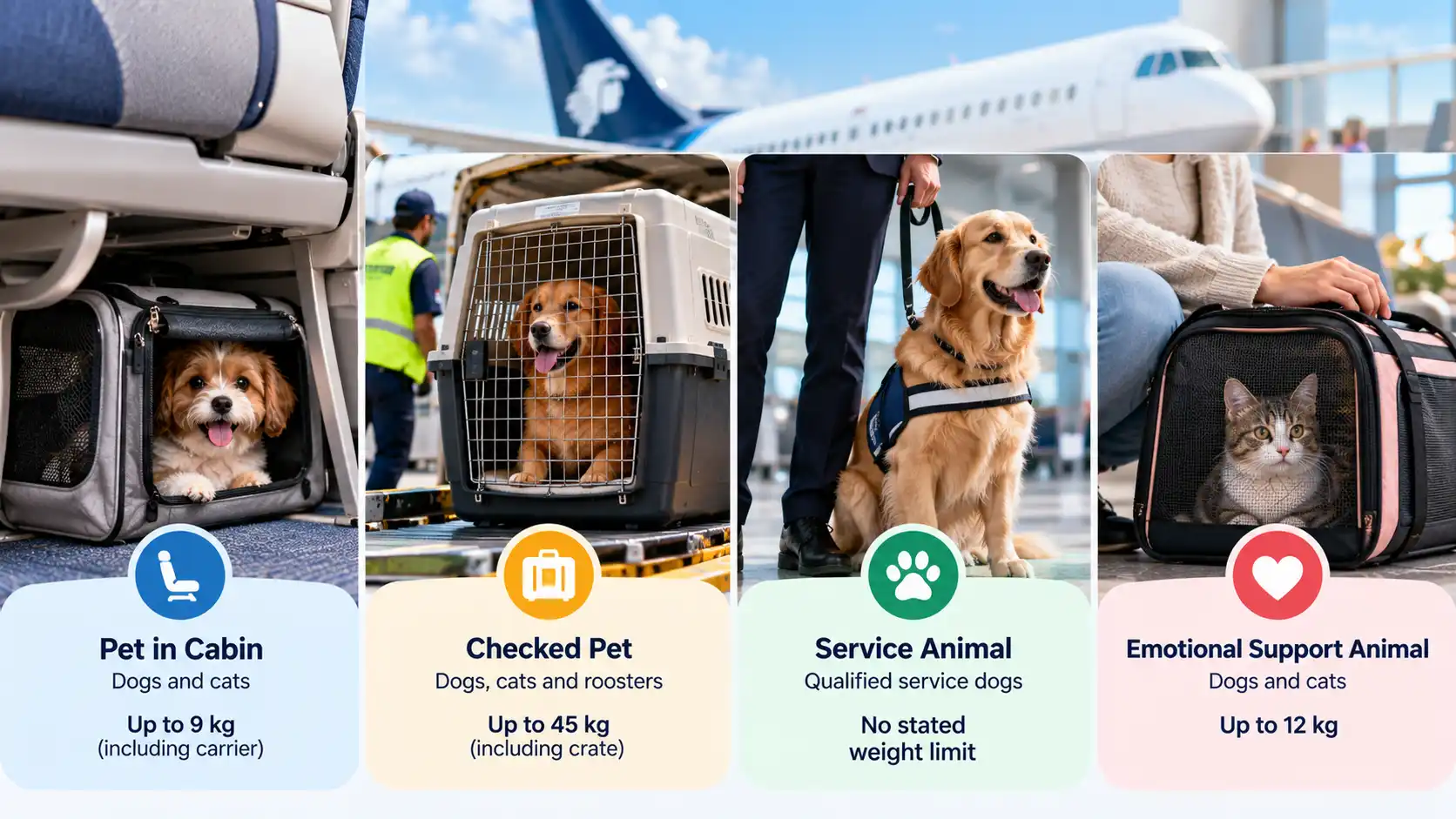
The Aeromexico pet policy provides different transportation arrangements according to the animal’s species, size, travel requirements, and eligibility.
The airline identifies four main categories: pets traveling under the passenger seat, pets transported in the aircraft hold, trained service animals, and eligible emotional support animals.
These services have different conditions and should not be treated as interchangeable.
What Are the Main Aeromexico Pet Travel Rules?
| Travel category | Eligible animals | Maximum combined weight | Flight-duration restriction |
| Pet in cabin (PETC) | Dogs and cats | 9 kg, including carrier | No general time limit |
| Checked pet (AVIH) | Eligible dogs, cats and roosters | 45 kg, including crate | No general time limit |
| Service animal (SVAN) | Qualified service dogs | No stated weight limit | No general time limit |
| Emotional support animal (ESAN) | Eligible dogs and cats | 12 kg | No general time limit |
These limits are taken from Aeromexico’s published pet transportation table. Country-specific rules, service conditions, and aircraft restrictions still apply.
The main distinction is between animals that can remain with their owners in the passenger cabin and those that require a separate transportation arrangement.
A small cat weighing 4 kg, for example, may qualify for under-seat travel if its carrier and the itinerary satisfy the airline’s requirements. A much larger dog may need checked-pet transportation or a separately arranged cargo shipment.
Before purchasing tickets, travelers should confirm which service is available on their intended flight.
Does Aeromexico Have a Six-Hour Rule for Pets?
No general six-hour limit appears in Aeromexico’s current official pet transportation table.
The airline explicitly lists its standard under-seat pet service and checked-pet service as having no flight-duration limit, provided the applicable destination-country requirements are satisfied.
This is an important distinction because several third-party pet travel guides still describe a six-hour maximum for cabin animals.
That information does not match the current general flight-duration rule published by Aeroméxico.
Can Pets Travel on Aeroméxico Flights Longer Than Six Hours?
Potentially, yes.
A pet may be accepted on a flight lasting more than six hours if the animal meets the applicable transportation conditions and the service is available for that itinerary.
However, the absence of a general six-hour limit does not guarantee acceptance on every long-haul flight.
Other restrictions may still affect the booking, including aircraft configuration, destination regulations, available pet spaces, and the animal’s health.
Why Should Travelers Check the Flight Duration Anyway?
Longer flights require more preparation even when the airline does not prohibit pet transportation based on duration.
For example, a dog traveling on an eight-hour flight may need to remain inside its carrier throughout the journey. Its ability to rest comfortably, access appropriate ventilation, and tolerate extended confinement matters considerably.
Owners should discuss long-distance travel with a veterinarian, particularly if the animal is elderly, anxious, or has an existing medical condition.
The practical question is not only whether the flight is permitted, but whether the transportation arrangement is suitable for that particular animal.
What Are Aeromexico’s Cabin Pet Weight and Carrier Limits?
Aeromexico permits eligible dogs and cats to travel in the passenger cabin under its PETC service when the combined weight of the animal and carrier is no more than 9 kg.
The carrier must fit in the approved under-seat space and satisfy the airline’s requirements for safe containment.
The pet must remain secured inside its carrier during the flight.
Does the 9 kg Limit Include the Carrier?
Yes. The weight restriction applies to the pet and its transportation container together.
Example: Checking Cabin Pet Eligibility
Dog’s weight
7.4 kg
Empty carrier
1.2 kg
Combined weight
8.6 kg
Within the 9 kg cabin weight limit
Illustrative weights only. Carrier dimensions, animal comfort, and other eligibility requirements must also be satisfied.
A common mistake is weighing only the animal and forgetting the carrier, bedding, or other permitted contents.
Weigh the complete travel setup before departure.
What Size Carrier Does Aeromexico Allow in the Cabin?
The carrier must fit under the seat and meet the size specifications applicable to the flight.
Third-party descriptions commonly list dimensions around 40 × 30 × 20 cm, but the exact current maximum dimensions were not independently confirmed from Aeromexico’s accessible official specifications during this review.
Travelers should therefore verify the accepted length, width, and height with Aeromexico before purchasing a carrier.
A suitable container should also provide adequate ventilation, a secure closure, a leak-resistant base, and enough interior space for the animal to remain in a natural position.
The U.S. Federal Aviation Administration confirms that cabin pet carriers must fit beneath the seat without obstructing access to the aisle and must be properly stowed during aircraft movement, takeoff, and landing.
Can a Pet Sit on the Passenger’s Lap?
No. Ordinary cabin pets travel inside their approved carriers rather than sitting freely on a passenger’s lap or occupying a separate passenger seat.
The carrier should remain secured in the designated under-seat location according to crew instructions.
Passengers should not assume that buying an extra seat permits a pet to travel outside its container.
How Many Pets Can Travel in the Cabin?
Aeromexico limits pet acceptance according to available space and operating conditions.
Although some third-party guides mention a fixed number of pets per aircraft, a single fleet-wide maximum was not verified from the airline’s current official policy.
Travelers should confirm availability for the exact flight, including the aircraft type and cabin.
This is particularly important during busy holiday periods when pet spaces may be limited.
Can Larger Dogs and Cats Travel in Aeromexico’s Aircraft Hold?
Yes. Aeromexico offers checked-pet transportation, identified as AVIH, for eligible animals that cannot travel under the passenger seat.
Its published general allowance is 45 kg for the animal and transportation crate combined. Eligible species include dogs, cats, and roosters, although species-specific and destination restrictions apply.
How Is Checked-Pet Transportation Different From Cabin Travel?
| Feature | Cabin pet (PETC) | Checked pet (AVIH) |
| Location | Under passenger seat | Designated aircraft hold |
| Weight limit | 9 kg including carrier | 45 kg including crate |
| Container | Approved under-seat carrier | Suitable rigid transportation crate |
| Access during flight | Pet remains near owner | Owner cannot access pet |
| Reservation | Advance confirmation required | Advance confirmation required |
| Main considerations | Seat space and cabin availability | Crate specifications, aircraft and animal eligibility |
Checked-pet transportation is not the same as ordinary checked baggage. Live animals require dedicated handling and suitable aircraft conditions.
Before selecting this option, confirm that the aircraft operating your flight can accommodate the animal.
What Type of Crate Is Required for Hold Transportation?
Animals traveling in the hold need a suitable rigid crate that satisfies the airline’s live-animal transportation standards.
The crate should be strong enough to prevent escape, properly ventilated, securely fastened, and large enough for the animal to stand naturally, turn around, and lie down.
For example, a dog weighing 27 kg should not be placed in a small crate merely to reduce transportation costs. The animal’s comfort and safety are essential parts of the acceptance process.
Crates must also be suitable for airport handling, and the airline may reject damaged or improperly constructed containers.
What Is the Difference Between Aeromexico Checked Pets and Cargo?
Checked-pet transportation and Aeromexico Cargo are separate services.
A checked pet generally travels on the passenger’s itinerary under the airline’s checked-animal arrangements.
Aeromexico Cargo, by contrast, handles live animals as shipments under separate booking, documentation, acceptance, and delivery procedures.
The cargo service is particularly relevant when an animal cannot be accommodated through the ordinary passenger pet program or must travel under a separate shipping arrangement.
What Animals Does Aeromexico Cargo Accept?
Aeromexico Cargo publishes detailed conditions for live-animal shipments, including restrictions based on species, age, health, breed, and container suitability.
Its rules prohibit transporting certain animals, including:
- Sick animals.
- Pregnant or nursing animals.
- Dogs and cats younger than four months.
- Brachycephalic, or short-nosed, dogs and cats.
- Certain other restricted species.
The cargo service also lists an acceptable temperature range of approximately 7°C to 35°C (45°F to 95°F) for animal transportation.
These are Aeromexico Cargo conditions. They should not automatically be treated as identical to every requirement under the passenger checked-pet service.
Can a Pet Travel Without Its Owner?
A separately arranged cargo shipment may be possible, subject to Aeromexico Cargo’s acceptance requirements.
This is different from adding a pet to an existing passenger reservation.
Cargo bookings can require different documents, shipper information, receiving-party arrangements, and delivery procedures.
Travelers should contact Aeromexico Cargo’s live-animal service before making arrangements for an animal traveling separately.
Does Aeromexico Allow Snub-Nosed Dogs and Cats?
Short-nosed, or brachycephalic, breeds face additional restrictions because their anatomy can make breathing and temperature regulation more difficult.
Examples include pugs, bulldogs, Boston terriers, and Persian cats.
Aeromexico Cargo expressly prohibits brachycephalic dogs and cats under its live-animal shipment rules.
Can a Pug or Bulldog Travel in the Cabin?
Cabin eligibility must be confirmed directly with Aeromexico.
A small brachycephalic animal may meet the ordinary cabin weight requirement, but weight alone does not establish that the breed will be accepted.
Owners should confirm the specific breed policy and seek veterinary advice before booking.
Why Are Flat-Faced Animals More Vulnerable During Air Travel?
Many brachycephalic animals have narrowed airways, which can increase the risk of respiratory distress.
Stress, heat, and changes in environmental conditions may worsen these difficulties.
Even when a particular transportation arrangement is technically available, the animal’s health should remain the deciding factor.
A veterinarian familiar with the pet’s medical history can help assess whether flying is appropriate.
How Much Does Aeromexico Charge to Travel With a Pet?
Aeromexico charges for ordinary pet transportation, with prices depending on the service selected, route, and applicable travel conditions.
The airline publishes a separate pet transportation fee section and identifies high-season travel periods for 2026.
However, a complete, reliably extractable current fee table was not available from the official page during this review. Consequently, a single fixed fee should not be presented as universally applicable.
What Factors Can Affect Aeromexico Pet Fees?
| Pricing factor | Why it matters |
| Domestic or international itinerary | Different route categories may have different charges |
| Cabin or checked-pet service | Transportation methods have separate pricing |
| Travel season | Seasonal charges may apply |
| Number of animals | Additional animals may require separate arrangements |
| Cargo transportation | Quoted independently from passenger pet fees |
| Destination requirements | Veterinary, permit, or inspection expenses may be additional |
For example, a passenger traveling domestically within Mexico may receive a different pet transportation quote from someone flying internationally.
The total cost can also include the carrier or crate, veterinary examinations, and required documentation.
Before purchasing a non-refundable ticket, ask Aeromexico for the exact pet transportation charge for each flight segment.
How Can You Book a Pet on Aeromexico?
Pet transportation should be confirmed with the airline before the passenger reservation is finalized whenever possible.
Aeromexico requires advance arrangements, and acceptance is subject to applicable restrictions and available capacity.
What Steps Should Travelers Follow?
- Check the pet’s eligibility. Confirm species, breed, age, health, and combined weight with the carrier.
- Choose the transportation method. Determine whether the animal qualifies for cabin travel, checked-pet transportation, or a cargo arrangement.
- Review the itinerary. Confirm that every flight and operating carrier accepts the requested service.
- Contact Aeromexico. Request the service and confirm availability.
- Review the total cost. Ask about charges for each segment and any seasonal differences.
- Prepare the documents. Arrange the required veterinary certificates, vaccinations, and import permits.
- Obtain confirmation. Verify that the pet service is recorded against the correct reservation.
Travelers can begin with Aeromexico’s official pet transportation page.
Can You Add a Pet After Booking Your Flight?
A pet may be added to an existing reservation if the airline accepts the request and the necessary space remains available.
However, booking the passenger ticket does not automatically reserve transportation for the animal.
If the pet cannot be accommodated on the selected flight, changing the itinerary may involve additional ticket costs.
This makes early confirmation particularly important for travelers with limited flexibility.
What Documents Are Required to Fly With a Pet on Aeromexico?
Aeromexico requires passengers to comply with the applicable veterinary and destination-country regulations.
Depending on the journey, documents may include a veterinary health certificate, vaccination record, identification information, and government import or export permits.
The precise requirements vary considerably by country.
Which Documents Should Pet Owners Check?
| Document | When it may be needed |
| Veterinary health certificate | Airline or destination requires proof of health |
| Rabies vaccination record | Required by destination or transportation rules |
| Parasite treatment record | Certain international destinations |
| Microchip information | Countries requiring permanent animal identification |
| Import permit | Destinations with advance animal-entry approval |
| CDC Dog Import Form | Dogs entering or returning to the United States |
| Cargo shipment documents | Animals transported through Aeromexico Cargo |
A document accepted by the airline is not necessarily sufficient for immigration or veterinary entry clearance.
Travelers must satisfy both the carrier’s conditions and the destination government’s rules.
What Are the Rules for Flying With Pets to Mexico?
Mexico’s animal-entry requirements are administered by the Servicio Nacional de Sanidad, Inocuidad y Calidad Agroalimentaria (SENASICA).
Dogs and cats arriving in Mexico undergo inspection, and the required paperwork depends partly on the country from which the animal is arriving.
SENASICA’s updated 2026 guidance distinguishes animals arriving from the United States or Canada from those arriving from other countries.
Do Dogs and Cats Arriving From the United States Need a Health Certificate?
Under SENASICA’s general entry procedures for dogs and cats arriving from the United States or Canada, travelers are not required to present the usual veterinary health certificate or vaccination record to SENASICA.
The animal is still subject to inspection on arrival.
Importantly, this exemption from SENASICA’s standard documentary requirements does not eliminate separate airline documentation requirements or other applicable animal-health measures.
For example, the 2026 SENASICA guidance identifies additional New World screwworm-related documentation for certain animals arriving from the United States.
What if the Pet Is Arriving From Another Country?
For animals arriving from countries outside the United States and Canada, SENASICA generally requires additional veterinary documentation.
Its published requirements include a health certificate issued within the permitted validity period, relevant rabies vaccination information, and parasite treatment details.
The general health certificate validity period is up to 15 days before entry.
Travelers should check the latest country-specific requirements before departure rather than relying on a universal international pet checklist.
What Are the Requirements for Flying With a Dog to the United States?
Dogs entering or returning to the United States must meet the Centers for Disease Control and Prevention’s import requirements.
Under the rules in effect in 2026, all entering dogs must:
- Be at least six months old.
- Have a detectable microchip.
- Appear healthy upon arrival.
- Have a valid CDC Dog Import Form receipt.
- Meet any additional requirements based on rabies risk, vaccination history, and countries visited.
The CDC requires the form receipt to be shown to the airline before boarding.
Does a Dog Returning to the United States Need the CDC Form?
Yes. The requirement applies to dogs returning to the United States as well as those entering for the first time.
For example, a U.S. resident who takes a dog to Mexico for a short holiday must still comply with the applicable CDC entry requirements when returning home.
For dogs that have spent the preceding six months only in rabies-free or low-risk countries, the CDC Dog Import Form is generally the only CDC document required, although age, microchip, and health requirements still apply.
Dogs with travel histories involving high-risk countries face additional conditions.
Can a Puppy Younger Than Six Months Fly From Mexico to the United States?
No. Under the CDC’s general dog import requirements, a dog must be at least six months old to enter the United States.
Even if an airline accepts a younger puppy for transportation on another route, that does not override the U.S. entry restriction.
Owners should check the puppy’s age on the actual arrival date before making a reservation.
Does Aeromexico Accept Service Animals and Emotional Support Animals?
Aeromexico identifies trained service dogs and eligible emotional support animals as separate transportation categories.
Its published policy lists no general weight limit for qualified service dogs and a 12 kg limit for eligible emotional support animals, with additional size and documentation conditions.
Can a Trained Service Dog Travel in the Cabin?
Qualified service dogs may travel in the passenger cabin under the airline’s service-animal procedures.
The requirements differ from those for ordinary pets.
For flights to, from, or within the United States, applicable U.S. Department of Transportation rules recognize qualifying trained service dogs and permit airlines to request the prescribed DOT forms.
A service dog is not subject to the ordinary 9 kg cabin pet allowance merely because it accompanies a passenger.
Are Emotional Support Animals Treated the Same as Service Dogs?
No. Emotional support animals and trained service dogs are distinct categories.
Aeromexico’s general pet transportation page lists an emotional support animal service, but eligibility and documentation depend on the itinerary and applicable jurisdiction.
Under U.S. DOT rules, airlines are not required to recognize emotional support animals as service animals.
Therefore, travelers should not assume that an emotional support animal qualifies for free cabin transportation or an exemption from ordinary pet restrictions on every route.
Confirm the specific conditions with Aeromexico before booking.
Can Pets Travel on Connecting Aeromexico Flights?
Connecting itineraries may be possible, but each flight must be checked for pet acceptance.
A connection introduces additional considerations, including handling arrangements, aircraft changes, transit-country requirements, and whether the animal remains under the same transportation service.
For example, a passenger traveling from Guadalajara to an international destination through Mexico City should confirm that the pet is accepted on both flight segments.
The airline should also explain whether the owner must complete any additional procedures during the connection.
What Happens if Another Airline Operates Part of the Journey?
The operating airline’s pet transportation rules apply to the flight it operates.
A pet accepted by Aeromexico may not automatically be accepted by a partner carrier, even if both flights appear on one reservation.
This is particularly important for codeshare itineraries.
Before booking, verify the operating carrier for every segment and obtain confirmation that the pet can travel throughout the journey.
How Can Travelers Prepare Their Pets for a Flight?
A pet’s preparation should begin well before the departure date.
An approved carrier and valid documents are essential, but owners should also help the animal become comfortable with its travel environment.
What Should You Do Before Departure?
- Introduce the carrier gradually and allow the animal to rest inside it at home.
- Check that the animal can stand, turn, and lie down comfortably.
- Confirm that identification and contact details are current.
- Keep required veterinary documents readily accessible.
- Plan feeding, hydration, and relief breaks with veterinary guidance.
- Check airport procedures and allow additional time for pet check-in.
For animals traveling in the hold, pay particular attention to crate quality, temperature restrictions, and the airline’s handling arrangements.
Should You Sedate a Pet Before Flying?
Sedation should not be used without veterinary guidance.
Sedatives can affect an animal’s breathing, balance, and ability to regulate body temperature.
Owners should consult a veterinarian about the animal’s health and whether medication is appropriate.
Do not administer a sedative simply because the animal seems nervous about flying.
What Mistakes Should You Avoid When Flying With Pets on Aeromexico?
Pet travel problems frequently arise from small details that were not confirmed before booking.
- Relying on the outdated six-hour rule: Aeromexico’s current general policy does not impose that limit.
- Weighing only the animal: The cabin and checked-pet limits include the transportation container.
- Purchasing the wrong carrier: An unsuitable container may prevent the animal from being accepted.
- Ignoring breed restrictions: Short-nosed animals face additional transportation limitations.
- Booking the pet too late: Availability is not guaranteed simply because a passenger seat remains available.
- Overlooking international regulations: A pet may satisfy the airline’s requirements but fail the destination’s entry conditions.
- Assuming cargo and checked-pet transportation are identical: These services have different procedures.
- Failing to check return-trip rules: Entry requirements may differ significantly between countries.
The most useful precaution is to confirm the complete journey—including the return flight—before making non-refundable travel arrangements.
Related: SeatSpy Guide 2026: Features, Pricing, and Award Flights
Conclusion: What Should You Confirm Before Flying With a Pet on Aeromexico?
Aeromexico’s pet policy offers several transportation options, but the correct choice depends on the animal’s size, breed, health, and itinerary. Small eligible dogs and cats can travel in the cabin within the 9 kg combined weight limit, while checked-pet transportation generally accommodates eligible animals up to 45 kg including the crate.
The six-hour rule is not part of Aeromexico’s current published general pet transportation limits, so travelers should avoid relying on older descriptions when planning longer journeys. Instead, they should confirm the actual aircraft and route restrictions, secure the appropriate pet reservation, and review the destination’s veterinary and entry requirements.
The most effective approach is to arrange pet transportation before finalizing the passenger ticket. That leaves time to address carrier specifications, documentation, availability, and any restrictions that could otherwise prevent the animal from traveling.
Related FAQs!
No, not under the standard 9 kg PETC limit. The combined weight of the dog and carrier must not exceed 9 kg. Other transportation options depend on the animal’s eligibility.
Yes. Eligible cats can travel under the airline’s cabin pet service, subject to the same 9 kg combined weight limit and applicable carrier requirements.
Travelers should confirm the airline’s current animal-per-carrier restrictions before booking. Do not assume that two small animals can share a container merely because their combined weight is below 9 kg.
Acceptance depends on the specific cabin, aircraft configuration, and available under-seat storage. Confirm the arrangement for the exact flight before purchasing a premium-cabin ticket.
The ordinary checked-pet service has a 45 kg combined animal-and-crate limit. For a larger animal, contact Aeromexico Cargo to determine whether an eligible shipping arrangement is available.
Young animals may be accepted only when they satisfy the applicable age, health, and destination requirements. Aeromexico’s general pet information states that animals younger than eight weeks are not accepted, while cargo and certain destinations impose stricter minimum ages.
Potentially, yes. The current official policy does not impose a general six-hour maximum. The animal must still satisfy the service’s other conditions, and acceptance must be confirmed for the itinerary.
Aeromexico’s standard under-seat pet service identifies dogs and cats as eligible animals. Other species are not automatically accepted under that service. Contact the airline or its cargo division for species-specific options.
Cabin pet carriers are subject to aircraft carry-on stowage requirements. The FAA treats cabin pet containers as carry-on baggage for regulatory purposes, but passengers should confirm how Aeromexico applies the carrier to their specific fare’s baggage allowance.
Yes. A pet may be refused if the animal, carrier, documentation, or transportation conditions do not meet the applicable requirements at check-in.
The most reliable starting point is Aeromexico’s official pet transportation policy. Travelers can also consult the AirlineLocations airline directory for additional airline-related information.