
The Global Entry Program: From Application to Airport – Plus Map of Locations and Kiosks
The Global Entry program is a U.S. Customs and Border Protection (CBP) Trusted Traveler Program that allows approved, low-risk travelers to complete expedited immigration processing when entering the United States at participating airports. Membership costs $120 for five years and includes TSA PreCheck eligibility for qualifying members.
Global Entry is particularly useful for frequent international travelers because it can reduce the time spent completing immigration formalities after arriving in the United States. Instead of following the standard passport control process, eligible members use dedicated Global Entry facilities, which increasingly rely on facial comparison technology.
However, approval is not automatic. Applicants must meet eligibility requirements, undergo a background check, and complete an interview or another approved enrollment procedure.
The program is available to U.S. citizens, U.S. lawful permanent residents, and eligible citizens of certain partner countries. Participation rules, interview procedures, and airport facilities can vary.
This guide explains Global Entry eligibility, application steps, fees, interview requirements, enrollment locations, airport arrival procedures, and the differences between Global Entry and TSA PreCheck.
Global Entry Program at a Glance
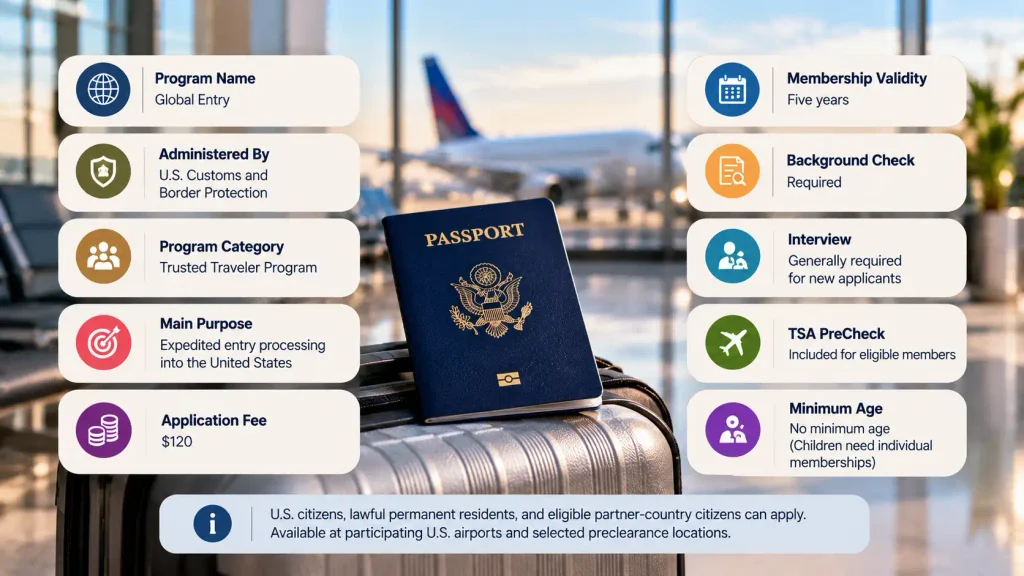
| Feature | Details |
| Program name | Global Entry |
| Administered by | U.S. Customs and Border Protection |
| Program category | Trusted Traveler Program |
| Main purpose | Expedited entry processing into the United States |
| Application fee | $120 |
| Membership validity | Five years |
| Application platform | Trusted Traveler Programs (TTP) website |
| Background check | Required |
| Interview | Generally required for new applicants |
| TSA PreCheck | Included for eligible members |
| Minimum age | No minimum age |
| Children | Must have individual memberships |
| International eligibility | U.S. citizens, lawful permanent residents, and eligible partner-country citizens |
| Airport availability | Participating U.S. airports and selected preclearance locations |
| Renewal | Available through the TTP account |
| Official website | CBP Global Entry |
The $120 fee applies to applications submitted under the current fee structure. Eligible applicants under age 18 may qualify for a fee waiver when a parent or legal guardian is enrolled in or applying for Global Entry.
What Is Global Entry and How Does It Work?
Global Entry is designed to simplify the U.S. arrival process for travelers who have been reviewed and approved by CBP.
When an approved member arrives at a participating airport, the traveler follows signs for Global Entry rather than joining the regular passport control queue.
At many airports, the process uses facial comparison technology to verify the traveler’s identity.
Depending on the airport and operational conditions, the traveler may receive instructions to proceed directly to a CBP officer or may need additional processing.
How Global Entry Works at the Airport
- An approved member arrives on an international flight at a participating airport.
- The traveler follows signs directing Global Entry members to the designated processing area.
- The traveler uses the available Global Entry identity verification process.
- CBP verifies the traveler’s identity and eligibility.
- The traveler follows any instructions provided by CBP personnel.
- After immigration processing, the traveler proceeds to baggage claim and customs procedures, as applicable.
Global Entry can shorten immigration processing, but it does not eliminate customs responsibilities.
Members must still comply with U.S. entry laws, declare applicable goods, and follow instructions from CBP officers.
Does Global Entry Guarantee Faster Entry?
No. Global Entry provides access to expedited processing, but actual waiting times depend on airport traffic, staffing, technology, and security requirements.
CBP may select any traveler for additional examination, including an approved Global Entry member.
Membership does not guarantee admission to the United States.
Who Is Eligible for Global Entry?
Global Entry is available to U.S. citizens, U.S. nationals, lawful permanent residents, and eligible foreign nationals from countries that participate in trusted traveler arrangements with the United States.
Applicants must satisfy CBP’s security and admissibility requirements. Citizenship alone does not guarantee approval.
Global Entry Eligibility for International Travelers
CBP has established eligibility arrangements with several countries, including:
| Country | Global Entry eligibility |
| United States | U.S. citizens, nationals, and lawful permanent residents |
| India | Eligible Indian citizens |
| United Kingdom | Eligible British citizens |
| Germany | Eligible German citizens |
| South Korea | Eligible South Korean citizens |
| Japan | Eligible Japanese citizens |
| Singapore | Eligible Singapore citizens |
| Switzerland | Eligible Swiss citizens |
| Mexico | Eligible Mexican nationals |
| Colombia | Eligible Colombian citizens |
| Argentina | Eligible Argentine citizens |
| Brazil | Eligible Brazilian citizens |
| Panama | Eligible Panamanian citizens |
| Taiwan | Eligible Taiwanese passport holders meeting applicable requirements |
Partner-country requirements are not identical. Some applicants must complete additional national background checks or obtain approval through their home country’s authorities.
The current list and nationality-specific instructions are maintained on the official CBP eligibility page.
Can Indian Citizens Apply for Global Entry?
Yes. Eligible Indian citizens can apply for Global Entry, including individuals who travel frequently between India and the United States.
However, Indian applicants must complete additional background verification through Indian authorities.
The process generally involves submitting the U.S. Global Entry application and completing the required procedures through India’s Passport Seva system.
CBP advises that Indian government vetting can take six months to two years, making early application particularly important.
Can Children Apply for Global Entry?
Yes. There is no minimum age for Global Entry.
Every child must have an individual application and membership, even when traveling with approved parents.
Applicants younger than 18 require parental or legal guardian consent, and a parent or guardian must attend the interview.
Children under 18 may qualify for a waived application fee when a parent or legal guardian is already enrolled in or applying for an eligible Trusted Traveler Program.
Who May Be Denied Global Entry?
CBP can deny an application when the applicant does not satisfy its low-risk eligibility standards.
Possible reasons include:
- Providing false or incomplete application information.
- Having certain criminal convictions or pending charges.
- Being subject to an ongoing law enforcement investigation.
- Violating customs, immigration, or agricultural regulations.
- Being inadmissible to the United States.
- Being unable to establish low-risk traveler status.
A previous arrest does not necessarily mean every applicant will be denied, but applicants must disclose all requested information accurately.
CBP evaluates applications individually.
How to Apply for Global Entry in 2026
Start your Global Entry application online through the official Trusted Traveler Programs website.
Applicants should use the government portal to avoid unnecessary third-party processing charges.
Step 1: Create a Trusted Traveler Programs Account
Visit ttp.dhs.gov and create an account.
Each applicant, including a child, must have an individual TTP account.
Step 2: Complete the Global Entry Application
The application requests information such as personal identification, citizenship, passport details, address history, employment information, and travel-related background.
Applicants should ensure that the information matches their official documents.
Inaccurate or incomplete details can delay processing or affect eligibility.
Step 3: Pay the Application Fee
Submit the application and pay the applicable $120 fee unless an eligible minor’s fee waiver applies.
The fee is generally nonrefundable, including when an application is denied.
Step 4: Wait for Conditional Approval
CBP reviews the application and conducts the required security checks.
Applicants can monitor their status through the TTP dashboard.
Conditional approval means that the initial review has been completed successfully, but it is not the same as full Global Entry membership.
Step 5: Complete the Interview
Conditionally approved applicants can generally complete the required interview through an enrollment center or Enrollment on Arrival.
A CBP officer verifies the applicant’s identity, documents, and eligibility.
Step 6: Receive Final Approval
After successful completion of the required checks and interview, CBP provides its final decision through the TTP account.
Approved members can begin using eligible Global Entry benefits.
The official application instructions are available through CBP.
How Long Does Global Entry Approval Take?
Global Entry processing times vary significantly.
CBP reports that many applications complete the initial vetting stage within approximately two weeks. However, applications requiring additional review may take several months or considerably longer.
The total enrollment timeline also depends on interview availability.
| Application stage | Expected timing |
| Online application | Depends on applicant preparation |
| Initial CBP review | Many applications processed within approximately two weeks |
| Additional background review | May take several months or longer |
| Interview scheduling | Depends on location and appointment availability |
| Final approval | Depends on completed review and interview outcome |
CBP’s June 2026 guidance notes that applications requiring additional review can take approximately 3–16 months or longer.
Applicants should avoid making nonrefundable travel arrangements based on an expected approval date.
What Happens During the Global Entry Interview?
The Global Entry interview is a security and identity verification appointment conducted by a CBP officer.
The officer reviews the applicant’s documents, confirms relevant information, and determines whether the applicant meets the program’s requirements.
Documents Required for the Interview
Applicants should generally bring:
- A valid passport.
- Another acceptable form of identification, such as a driver’s license.
- Proof of current residence when required.
- A permanent resident card, if applicable.
- Any additional documents requested by CBP.
Travelers holding multiple passports should bring the relevant documents so their information can be reviewed and updated.
What Questions Are Asked?
Questions may cover residence, employment, international travel, customs compliance, and application details.
The interview is intended to verify information rather than test general travel knowledge.
Applicants should answer accurately and provide clarification when requested.
Can the Interview Be Completed Without an Appointment?
Yes, conditionally approved applicants may use Enrollment on Arrival at participating airports instead of scheduling a conventional enrollment center appointment.
However, this option is only available during qualifying arrivals and depends on operational availability.
What Is Global Entry Enrollment on Arrival?
Enrollment on Arrival (EoA) allows conditionally approved applicants to complete their Global Entry interviews during an eligible international arrival.
This option can eliminate the need for a separate enrollment center appointment.
For example, a conditionally approved traveler returning from London to New York may be able to complete the Global Entry interview at JFK Airport while undergoing U.S. immigration processing.
How to Use Enrollment on Arrival
After landing at a participating airport, the applicant should follow the relevant signs or ask CBP personnel where Enrollment on Arrival interviews are conducted.
The traveler must have conditional approval and the required documents.
No separate interview appointment is generally needed.
However, interviews depend on officer availability and local operating arrangements. Travelers should not assume that an interview will be possible during every arrival.
Can Enrollment on Arrival Be Used on a Domestic Flight?
No. Enrollment on Arrival is associated with international arrivals and certain U.S. preclearance facilities.
A traveler arriving on a domestic flight cannot use the program simply because the airport has an Enrollment on Arrival location.
Where Are Global Entry Kiosks Located?
Global Entry processing facilities are available at many major U.S. international airports and selected overseas preclearance locations.
The exact location depends on the airport’s international arrivals layout.
Some airports have traditional kiosks, while others use newer touchless identity verification systems.
The term Global Entry kiosk is therefore often used broadly, even though a traveler may encounter a facial comparison portal instead of a conventional touchscreen machine.
Major U.S. Airports With Global Entry Facilities
| Airport | Code | Location |
| Hartsfield-Jackson Atlanta International Airport | ATL | Atlanta, Georgia |
| John F. Kennedy International Airport | JFK | New York |
| Newark Liberty International Airport | EWR | Newark, New Jersey |
| Boston Logan International Airport | BOS | Boston, Massachusetts |
| Washington Dulles International Airport | IAD | Washington metropolitan area |
| Baltimore/Washington International Airport | BWI | Maryland |
| Philadelphia International Airport | PHL | Philadelphia, Pennsylvania |
| Miami International Airport | MIA | Miami, Florida |
| Orlando International Airport | MCO | Orlando, Florida |
| Fort Lauderdale-Hollywood International Airport | FLL | Fort Lauderdale, Florida |
| Chicago O’Hare International Airport | ORD | Chicago, Illinois |
| Detroit Metropolitan Airport | DTW | Detroit, Michigan |
| Minneapolis–Saint Paul International Airport | MSP | Minnesota |
| Dallas Fort Worth International Airport | DFW | Dallas–Fort Worth, Texas |
| George Bush Intercontinental Airport | IAH | Houston, Texas |
| Denver International Airport | DEN | Denver, Colorado |
| Phoenix Sky Harbor International Airport | PHX | Phoenix, Arizona |
| Harry Reid International Airport | LAS | Las Vegas, Nevada |
| Los Angeles International Airport | LAX | Los Angeles, California |
| San Francisco International Airport | SFO | San Francisco, California |
| San Diego International Airport | SAN | San Diego, California |
| Seattle–Tacoma International Airport | SEA | Seattle, Washington |
| Portland International Airport | PDX | Portland, Oregon |
| Honolulu International Airport | HNL | Honolulu, Hawaii |
| Charlotte Douglas International Airport | CLT | Charlotte, North Carolina |
This table is a representative selection, not a complete directory. CBP maintains airport-specific information, and terminal arrangements can change.
Map of Major Global Entry Airport Locations
Map shows selected airports with Global Entry processing, not individual kiosk coordinates. Global Entry access and interview services are separate facilities and may operate in different areas.
Where Are the Kiosks Inside an Airport?
Global Entry processing is normally located in the international arrivals inspection area.
The facilities are generally encountered after passengers leave the aircraft and before completing entry formalities.
At airports with multiple international terminals, more than one Global Entry processing area may be available.
Passengers should follow the signs for Global Entry rather than relying on a terminal number from an older travel guide.
International Airports With U.S. Global Entry Preclearance
Some airports outside the United States operate U.S. CBP preclearance facilities.
Preclearance allows eligible travelers to complete U.S. immigration and customs procedures before boarding their flights to the United States.
Selected examples include:
| Airport | Country or territory |
| Toronto Pearson International Airport (YYZ) | Canada |
| Vancouver International Airport (YVR) | Canada |
| Montréal–Trudeau International Airport (YUL) | Canada |
| Calgary International Airport (YYC) | Canada |
| Dublin Airport (DUB) | Ireland |
| Shannon Airport (SNN) | Ireland |
| Queen Beatrix International Airport (AUA) | Aruba |
| L.F. Wade International Airport (BDA) | Bermuda |
| Lynden Pindling International Airport (NAS) | Bahamas |
| Zayed International Airport (AUH) | United Arab Emirates |
These airports have U.S. preclearance operations, but specific Global Entry services and Enrollment on Arrival arrangements should be verified separately.
For example, travelers departing Dublin for the United States may complete U.S. entry processing in Ireland rather than waiting until landing in the United States.
Global Entry Kiosks vs. Global Entry Mobile App
Global Entry members may also be able to use the free Global Entry Mobile application at participating locations.
The app is designed to reduce the need to interact with a physical kiosk.
How Does the Global Entry Mobile App Work?
Eligible members use the app to submit their arrival information and photograph through a supported mobile device.
After completing the required steps, the traveler follows the instructions provided for Global Entry mobile processing.
The app does not replace the need for a valid Global Entry membership.
It is also different from the Mobile Passport Control application, which serves a broader group of eligible travelers.
CBP confirms that successful Global Entry Mobile app users do not need to use a physical kiosk or portal for that arrival.
Which Option Is Better?
| Feature | Global Entry airport processing | Global Entry Mobile app |
| Membership required | Yes | Yes |
| Identity verification | Airport-based technology | Supported mobile-device process |
| Smartphone required | No | Yes |
| Available everywhere | No | No |
| CBP inspection rules apply | Yes | Yes |
| Main advantage | Dedicated airport processing | Potentially fewer steps at supported locations |
Travelers should use whichever option is available and permitted at the arrival airport.
Global Entry vs. TSA PreCheck: What Is the Difference?
Global Entry and TSA PreCheck serve different purposes.
Global Entry expedites immigration processing when entering the United States, while TSA PreCheck expedites security screening before eligible flights depart from participating U.S. airports.
Approved Global Entry members are also eligible for TSA PreCheck benefits.
| Feature | Global Entry | TSA PreCheck |
| Administered by | CBP | TSA |
| Primary purpose | Expedited U.S. arrival processing | Expedited airport security screening |
| Application fee | $120 | Depends on enrollment provider |
| Membership validity | Five years | Five years |
| International arrivals benefit | Yes | No |
| Expedited departure security | Included for eligible members | Yes |
| Background screening | Required | Required |
| Interview or enrollment appointment | Generally required | Enrollment process required |
| Best suited for | Frequent international travelers | Primarily domestic travelers |
Travelers who frequently return to the United States from overseas may find Global Entry more useful because it includes both types of benefits.
How to Use TSA PreCheck With Global Entry
Approved Global Entry members receive a membership number called a PASSID.
Airlines use this number as the Known Traveler Number (KTN).
Steps to Activate TSA PreCheck Benefits
- Locate the PASSID in the Trusted Traveler Programs account.
- Enter it in the airline reservation’s Known Traveler Number field.
- Ensure the passenger name and date of birth match the membership information.
- Complete check-in.
- Verify that the boarding pass displays the TSA PreCheck indicator.
The number can also be stored in participating airline loyalty profiles.
The TSA PreCheck indicator must appear on the boarding pass for access to the expedited screening lane. Eligibility does not guarantee expedited screening on every trip.
Does Global Entry Work for International Flights Departing the United States?
Global Entry primarily provides expedited processing when entering the United States.
It does not provide a special outbound immigration procedure for departing passengers.
However, eligible members may receive TSA PreCheck screening benefits before qualifying flights departing from participating U.S. airports.
For example, a Global Entry member departing New York for Paris may use TSA PreCheck if the boarding pass displays the appropriate indicator.
Upon returning to New York, the same traveler may use Global Entry for U.S. arrival processing.
Does Global Entry Include a Physical Membership Card?
Some Global Entry members receive physical cards, but the card is not required to use Global Entry at airports.
Airport processing generally relies on identity verification and the traveler’s membership records.
Global Entry cards are relevant mainly to certain eligible land and sea border crossings.
CBP confirms that a physical card is not required for Global Entry airport benefits.
Can a Global Entry Card Replace a Passport?
Not for international air travel.
Travelers must still carry the travel documents required for their journey, including passports and visas where applicable.
The card also does not grant permission to enter countries for which the traveler lacks the required documentation.
How to Renew Global Entry Membership
Global Entry membership lasts five years.
Members become eligible to submit a renewal application one year before their membership expires.
The renewal process is completed through the TTP account.
Global Entry Renewal Process
- Sign in to the official TTP website.
- Select the Global Entry renewal option.
- Review and update personal information.
- Submit the renewal application.
- Pay the applicable fee.
- Complete an additional interview if CBP requires one.
CBP may approve a renewal without another interview, but this is not guaranteed.
Can Global Entry Be Used While Renewal Is Pending?
Yes, under certain conditions.
Members who submit their renewal application before the membership expiration date can generally continue using their benefits for up to 24 months after expiration while the renewal is pending.
Applications submitted after expiration may not qualify for this extension.
What Happens if a Global Entry Application Is Denied?
Applicants whose Global Entry applications are denied can review the decision information provided through their TTP accounts.
Depending on the circumstances, applicants may be able to request reconsideration or pursue another applicable review procedure.
Common Reasons for Denial
Denials can involve criminal history, customs violations, immigration concerns, inaccurate application information, or an inability to establish low-risk status.
A denial does not necessarily mean that the applicant is prohibited from traveling to the United States.
Global Entry eligibility and U.S. admission eligibility are separate determinations.
Is Global Entry Worth the $120 Fee?
Global Entry can be worthwhile for travelers who enter the United States internationally several times during the five-year membership period.
At $120 for five years, the fee averages $24 annually.
For frequent international travelers, the potential time savings at immigration and the included TSA PreCheck eligibility can make the membership attractive.
However, travelers who rarely fly internationally may find standalone TSA PreCheck sufficient.
When Global Entry Is Most Useful
Global Entry may be particularly valuable for travelers who:
- Frequently return to the United States from international destinations.
- Travel through busy international airports.
- Have connecting flights after arriving in the United States.
- Also want TSA PreCheck eligibility.
- Can complete the application and interview process well before an upcoming trip.
When Global Entry May Not Be Necessary
The program may offer limited value to travelers who rarely visit the United States, do not meet eligibility requirements, or primarily travel domestically.
Application processing time is another consideration. A traveler expecting only one upcoming U.S. trip may not receive approval before departure.
Final Thoughts
Global Entry offers an effective way for eligible travelers to reduce immigration processing time when entering the United States. Its five-year membership, dedicated arrival facilities, and TSA PreCheck eligibility make it particularly useful for frequent international passengers.
The main challenge is obtaining approval. Background checks, interview availability, and nationality-specific requirements can make the application process lengthy.
Travelers considering Global Entry should verify eligibility, apply through the official TTP website, and review the airport’s current processing arrangements before traveling. Once approved, keeping passport information and airline reservations accurate helps ensure the available benefits work as intended.
Frequently Asked Questions!
Global Entry costs $120 for a five-year membership. Eligible applicants under 18 may qualify for a fee waiver.
Membership is valid for five years. Members can generally begin renewing one year before expiration.
No. Global Entry is available at participating airports and selected preclearance locations. Facilities and procedures vary.
No. Global Entry expedites U.S. arrival processing, while TSA PreCheck provides expedited security screening before eligible flights.
Children must have individual Global Entry memberships to use the program with approved family members.
No. CBP may waive the renewal interview for eligible members, although some applicants must complete another interview.
Yes. CBP may refer any traveler for additional inspection. Global Entry membership does not exempt travelers from U.S. customs or immigration requirements.
Members should follow airport signage and CBP officer instructions. At participating airports, CBP has procedures for processing members when Global Entry technology is unavailable.
Yes. A physical Global Entry card is not required for airport processing.
No. Global Entry expedites eligible immigration processing but does not guarantee faster baggage delivery.