
Heathrow Terminal Transfers: Free Trains, Buses & Walks
Passengers can travel between terminals at London Heathrow Airport (LHR) using free trains, the London Underground, pedestrian walkways, or dedicated flight-connection buses. The best transfer method depends on the departure terminal, whether the passenger has entered the UK, and whether the flights are booked together.
Heathrow has four operating passenger terminals: Terminals 2, 3, 4, and 5. A pedestrian walkway connects Terminals 2 and 3, while Terminals 4 and 5 are located farther away and generally require a train or bus transfer.
Passengers connecting between flights on a single booking should follow the purple Flight Connections signs. Those transferring between terminals before check-in, or traveling on separate tickets, can use the airport’s landside public transportation services.
Although inter-terminal transportation is generally free, transfers may involve additional security screening, immigration, baggage collection, and walking.
This guide explains Heathrow’s terminal layout, free transportation options, transfer routes, estimated journey times, baggage procedures, and important considerations for connecting flights.
Also Worth Reading: How To Get Between Terminals at Chicago O’Hare (ORD)
London Heathrow Airport Terminal Transfers at a Glance
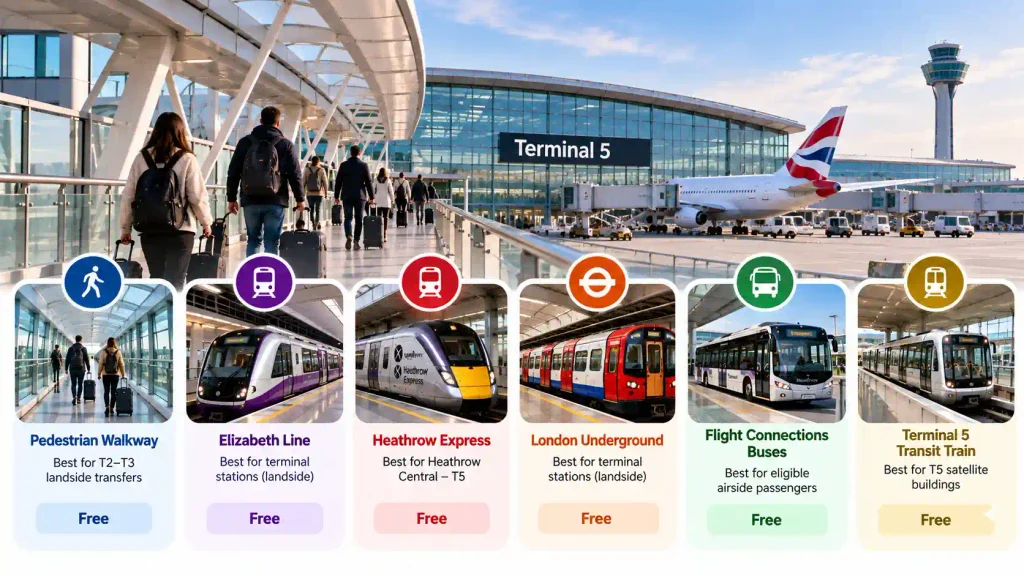
Heathrow provides several transportation options for passengers moving between terminals. Understanding the difference between airside and landside transfers is essential before selecting a route.
| Transfer method | Best suited for | Cost |
| Pedestrian walkway | Landside transfers between T2 and T3 | Free |
| Elizabeth line | Landside transfers between terminal stations | Free within airport transfer zone |
| Heathrow Express | Landside transfers between Heathrow Central and T5 | Free for eligible inter-terminal journeys |
| London Underground | Landside transfers between terminal stations | Free within airport transfer zone |
| Flight Connections buses | Eligible airside connecting passengers | Free |
| H30 bus | Selected landside routes, including T4–T5 | Free |
| Terminal 5 transit train | Transfers between T5 satellite buildings | Free |
The right service depends on the terminal pair and whether passengers transfer airside or landside. Heathrow advises connecting passengers to follow its dedicated connections route rather than traveling between terminals independently.
Understanding London Heathrow Airport’s Terminal Layout
London Heathrow Airport operates four main passenger terminals, each serving different airlines and destinations.
Terminals 2 and 3 are located close together in the airport’s central area. Terminal 4 is positioned toward the southern side of the airport, while Terminal 5 occupies a separate area to the west.
The airport also contains satellite buildings connected to the main terminals through underground walkways or internal transit systems.
Terminal 2 — The Queen’s Terminal
Terminal 2 handles domestic and international flights and serves several Star Alliance airlines.
The main terminal building contains check-in facilities, security checkpoints, departure lounges, restaurants, and retail outlets.
Terminal 2 also includes the T2B satellite building, which accommodates additional departure gates.
Passengers traveling between the main building and T2B use an internal pedestrian route with moving walkways.
The terminal is connected to Terminal 3 through an underground pedestrian passage.
Terminal 3 — International Flight Operations
Terminal 3 accommodates numerous international services, including long-haul flights.
The building has check-in facilities on the ground floor and departure lounges on the upper level.
Its departure gates are spread across several corridors, so walking time is a key consideration.
Terminal 3 shares the Heathrow Central rail station area with Terminal 2, providing convenient access to public transportation.
Terminal 4 — Southern Airport Terminal
Terminal 4 is located separately from the central terminal complex.
Passengers transferring to or from Terminal 4 generally use rail services or the appropriate bus connection.
The terminal has its own Underground and Elizabeth line stations, alongside check-in, security, departure lounges, and arrival facilities.
Because Terminal 4 is not connected to Terminals 2, 3, or 5 by a public pedestrian walkway, passengers should allow time for the transfer service.
Terminal 5 — Main Building and Satellite Terminals
Terminal 5 includes a main terminal building and two satellite facilities, Terminal 5B and Terminal 5C.
The satellite buildings add departure gates and connect to the main building via an internal transit train and pedestrian passages.
Terminal 5 has its own railway station, connecting to Heathrow Central and central London.
The terminal’s size means it’s important to distinguish between transferring to Terminal 5 and traveling onward to a specific departure gate within Terminal 5.
What Is the Difference Between Airside and Landside Transfers?
Heathrow terminal transfers fall into two main categories: airside connections and landside journeys.
Airside transfers are designed for passengers connecting between flights without formally entering the United Kingdom. Eligible passengers follow the purple Flight Connections signs and use designated transfer routes, including airport buses.
Landside transfers take place outside the secure departure area. These are relevant to passengers who have completed immigration and customs, are changing terminals before checking in, or have booked separate flights requiring a new check-in.
| Airside connection | Landside transfer |
| Generally used for single-ticket connections | Used for self-connections and public terminal transfers |
| Follow purple Flight Connections signs | Follow train, Underground, or terminal signs |
| Dedicated transfer buses between terminals | Public trains, Underground, walkways, or buses |
| Checked bags are often transferred automatically | Bags may need to be collected and rechecked |
| Security screening is required | Departure security is required after check-in |
| UK immigration depends on onward journey | Entering the UK requires immigration clearance |
Heathrow’s official guidance states that passengers on separately booked flights must normally pass through immigration, collect checked baggage, and check in again.
How to Travel Between Heathrow Terminals Before Security
Passengers transferring landside can use the Elizabeth line, Heathrow Express, Piccadilly line, or designated pedestrian routes.
These services are especially useful for passengers changing terminals after collecting luggage or arriving by public transportation.
1. Elizabeth Line — Free Inter-Terminal Train Transfers
The Elizabeth line connects Heathrow Central, Terminal 4, and Terminal 5.
Heathrow Central serves Terminals 2 and 3, while the other terminals have separate railway stations.
Passengers can use the Elizabeth line for free journeys entirely within Heathrow’s designated terminal transfer area.
You can use an Oyster card or contactless payment card to pass through the station barriers without being charged an inter-terminal fare.
Alternatively, station ticket machines offer free inter-terminal transfer tickets.
These tickets are intended for eligible airport transfers and are not valid for travel into central London.
For travel between Terminals 4 and 5, passengers generally need to change trains at Heathrow Central.
2. Heathrow Express — Fast Transfers Between Central Terminals and T5
Heathrow Express connects Heathrow Central with Terminal 5.
Passengers traveling between these airport stations can use the service for free.
The service is useful for landside transfers between Terminals 2 or 3 and Terminal 5.
However, Heathrow Express does not provide a direct train between Terminal 4 and Terminal 5.
Travelers departing from Terminal 4 should use the appropriate Elizabeth line connection or another designated transfer route.
3. London Underground — Free Piccadilly Line Transfers
The London Underground Piccadilly line serves Heathrow Terminals 2 and 3, Terminal 4, and Terminal 5.
Transfers within the airport’s designated free travel area are free when passengers use an Oyster card or contactless payment method.
The Piccadilly line can be useful when rail schedules or terminal locations make it preferable to the Elizabeth line.
However, the route to Terminal 4 operates differently from the Terminal 5 branch.
For certain journeys, passengers must change trains at Hatton Cross.
The free travel arrangement does not extend to journeys outside Heathrow’s designated area.
4. Walking Between Terminals 2 and 3
Terminals 2 and 3 are the only Heathrow passenger terminals connected by a public pedestrian walkway.
The walk takes approximately 10 minutes, depending on the starting point, luggage, and walking speed.
From Terminal 2, passengers should follow signs toward Terminal 3 and descend to the underground pedestrian passage.
The route passes near the railway station area before continuing toward Terminal 3.
Passengers traveling in the opposite direction can follow signs from Terminal 3 toward Terminal 2.
Moving walkways are available along parts of the route.
Walking is often more practical than taking a train for this short terminal-to-terminal journey.
5. H30 Bus — Free Travel Between Terminals 4 and 5
Heathrow’s H30 bus offers a free landside connection between Terminal 4 and Terminal 5, via the airport’s cargo area.
The airport’s published free travel map lists service at about 20-minute intervals, though timetables and operating hours may change.
The H30 is particularly useful for passengers traveling directly between Terminals 4 and 5 who want to avoid changing trains at Heathrow Central.
The service also covers selected airport stops, including Hatton Cross and the central bus station on certain journeys.
Passengers should verify the latest route and departure times before relying on the service for a tight connection.
How to Transfer Between Heathrow Terminals After Security
Airside terminal transfers are designed for passengers connecting between flights on eligible itineraries.
Unlike landside journeys, these transfers use dedicated airport facilities rather than the public train network.
Heathrow provides free Flight Connections buses between terminals.
Step-by-Step Flight Connection Process
- After leaving the aircraft, follow the purple Flight Connections signs.
- Check the flight information screens to confirm the onward departure terminal.
- Follow the designated route toward the appropriate terminal transfer bus.
- Board the free connection bus when directed by airport staff.
- Complete the required security screening at the connecting terminal.
- Proceed to the departure lounge and check the gate information screens.
Heathrow states that inter-terminal connection buses generally operate at approximately 10-minute intervals.
However, total connection times depend on walking distances, passenger volumes, and security processing.
Are Flight Connections Buses Free?
Yes. Dedicated Flight Connections buses are complimentary for eligible connecting passengers.
These buses operate within the airport’s controlled transfer system and should not be confused with public buses serving the landside terminal forecourts.
Passengers traveling on separate tickets generally need to complete the normal arrivals process instead of using the airside connection route.
Heathrow Terminal-to-Terminal Transfer Routes
The following table summarizes the main landside transfer options.
| Terminal transfer | Recommended method | Important detail |
| Terminal 2 ↔ Terminal 3 | Walk | Approximately 10 minutes |
| Terminal 2 ↔ Terminal 4 | Elizabeth line | Use Heathrow Central |
| Terminal 2 ↔ Terminal 5 | Elizabeth line or Heathrow Express | Free inter-terminal rail travel |
| Terminal 3 ↔ Terminal 4 | Elizabeth line | Access via Heathrow Central |
| Terminal 3 ↔ Terminal 5 | Elizabeth line or Heathrow Express | Access via Heathrow Central |
| Terminal 4 ↔ Terminal 5 | H30 bus or Elizabeth line | Train journeys generally require a change at Heathrow Central |
These recommendations apply to landside passengers. Eligible airside connecting passengers should follow the purple signs and use Heathrow’s dedicated transfer arrangements.
How Long Does It Take to Change Terminals at Heathrow?
Terminal transfer times vary by route, transportation method, and passenger circumstances.
Walking between Terminals 2 and 3 takes approximately 10 minutes.
A rail transfer via Heathrow Central may take around 20 minutes or longer, including station access, waiting, and walking.
For Terminal 4-to-Terminal 5 journeys, changing trains can take even longer.
These estimates cover transportation only, not the full flight connection process.
| Route | Approximate walking time |
| Terminal 2 to Terminal 3 | 10 minutes |
| Terminal 5 main building to T5B | 10 minutes |
| Terminal 5 main building to T5C | 15 minutes |
Walking times can be longer for passengers with reduced mobility or those traveling with young children.
Security screening, immigration, and boarding procedures take extra time.
How to Get Between Terminal 5A, 5B, and 5C
Terminal 5 consists of a main building and two satellite terminals.
The main building is commonly identified as Terminal 5A, while the satellite facilities are known as Terminal 5B and Terminal 5C.
Terminal 5A to Terminal 5B
Passengers can use the internal transit train or underground pedestrian walkway.
The journey generally takes approximately 10 minutes, depending on the departure gate and walking speed.
The underground walkway includes moving walkways to assist passengers.
Terminal 5A to Terminal 5C
Terminal 5C is farther from the main building.
Passengers can reach it using the internal transit train or pedestrian passage.
The journey generally takes approximately 15 minutes.
Important Terminal 5 Transfer Considerations
Passengers should confirm the departure gate before traveling to a satellite terminal.
The internal transit system is designed for airport passengers and does not require a separate fare.
However, the route used for returning from a satellite building may differ from the departure route.
Follow official airport signs, especially if you arrive at satellite gates and need to connect onward.
Do Passengers Need to Clear Security Again at Heathrow?
Yes. Heathrow requires connecting passengers to pass through security screening before boarding their onward flights.
This applies even when passengers remain airside, and their checked baggage is transferred automatically.
Passengers should follow the instructions displayed at the security checkpoint regarding liquids and electronic devices.
Heathrow’s current connections guidance allows liquids in containers up to 2 liters and large electrical items to remain in cabin baggage during connection screening. Security rules can change, so checkpoint instructions take priority.
Is Immigration Required When Changing Terminals?
Immigration requirements depend on the journey.
Passengers connecting from one international flight to another may remain within the airside connections system without entering the UK, provided their itinerary and travel documents permit this.
Passengers connecting from an international flight to a UK domestic flight must complete the applicable immigration procedures.
Travelers entering the UK to collect baggage or complete a separate check-in must also satisfy UK entry requirements.
A visa or transit visa may be necessary depending on nationality, documentation, and whether the passenger passes through UK border control.
What Happens to Checked Baggage During a Heathrow Connection?
Checked baggage is often transferred automatically when flights are booked on one ticket, and the airlines have suitable baggage transfer arrangements.
In such cases, passengers generally do not need to visit baggage reclaim at Heathrow.
However, passengers should check the baggage tag and airline confirmation before departure.
Connecting Flights on Separate Tickets
Passengers with separately booked flights generally need to collect checked baggage after arriving at Heathrow.
The process involves clearing immigration, collecting luggage, passing customs, traveling to the onward terminal, and completing check-in again.
A new baggage allowance or additional fee may apply according to the operating airline’s conditions.
Separate-ticket connections also carry greater risk if the first flight arrives late, because the onward airline may not automatically rebook you.
Accessibility and Special Assistance for Terminal Transfers
Heathrow provides accessible routes, lifts, ramps, and assistance services for passengers with mobility requirements.
Dedicated Flight Connections buses are accessible, while assistance teams can help passengers move between terminals.
Eligible passengers may receive wheelchair assistance or support from airport personnel during the connection process.
Heathrow recommends requesting assistance through the airline, travel agent, or tour operator at least 48 hours before travel.
Same-day assistance may be available, but advance arrangements increase the likelihood of receiving the support you need.
Tips for a Smooth Heathrow Terminal Transfer
A smooth Heathrow terminal transfer requires careful planning, sufficient connection time, and awareness of available transportation options. Passengers should confirm their departure terminal, baggage arrangements, security requirements, and flight schedules to avoid unnecessary connection delays.
- Confirm the departure terminal: Terminal assignments can change, so check your flight information before travel.
- Follow the correct signs: Purple signs are intended for eligible flight connections, while public transport signs serve landside journeys.
- Allow additional time: Train waiting periods, security screening, and long walks can increase the overall journey.
- Check baggage arrangements: Passengers should confirm whether their checked luggage transfers automatically.
- Verify travel documents: UK immigration and transit requirements depend on the itinerary and nationality.
- Check transportation schedules: Early-morning and late-night services may operate differently from daytime schedules.
- Request accessibility assistance early: Advance arrangements are particularly important for connections between distant terminals.
Final Thoughts
Traveling between London Heathrow Airport terminals is straightforward when you choose the right transportation method.
A pedestrian walkway connects terminals 2 and 3, while the Elizabeth line, Heathrow Express, and Piccadilly line provide free landside connections across the airport. The H30 bus offers an underground pedestrian walkway that connects terminals 2 and 3. For connecting flights on a single eligible itinerary, use the dedicated Flight Connections system rather than leaving the secure airport area unnecessarily.
Before traveling, check the departure terminal, baggage arrangements, immigration requirements, and available connection time.
Frequently Asked Questions
Yes. Heathrow provides free inter-terminal rail travel, designated Underground journeys, Flight Connections buses, and the H30 bus. Oyster or contactless payment may be required to access station barriers.
Yes. Pedestrian walkways connect Terminals 2 and 3. The journey takes approximately 10 minutes. There is no direct train between Heathrow Terminals 4 and 5.
There is generally no direct Elizabeth line service between Terminals 4 and 5. Passengers can change trains at Heathrow Central or use the free H30 bus.
Not always. Checked baggage is often transferred automatically on eligible single-ticket itineraries. Passengers traveling on separate tickets generally need to collect and recheck their luggage.
The required connection time depends on the terminals, airline, route, security requirements, and baggage arrangements. Airlines set minimum connection times for eligible itineraries, while passengers on separate tickets should allow considerably more time.
Yes, eligible airside connecting passengers can use Heathrow’s Flight Connections system without entering the UK. However, travel-document requirements and immigration rules depend on the specific journey.