
Cathay Pacific Boarding Groups: A Complete Guide
Cathay Pacific boarding groups determine when passengers can board, with priority based on travel class, eligible loyalty status, seat location, and qualifying credit card benefits. The airline’s current system uses numbered groups, so travelers should check their boarding pass, listen for gate announcements, and join the designated boarding lane when their group is called.
Cathay Pacific introduced group boarding across its network to help manage queues and reduce congestion around aircraft aisles. Instead of asking every passenger to join a general line, the system assigns passengers to groups that are called in sequence. Eligible premium-cabin passengers and frequent flyers may receive priority boarding, while economy passengers are generally organized by seat location.
Understanding the process can help passengers avoid unnecessary waiting, prepare their travel documents, and board on time. This guide explains the boarding groups, priority eligibility, airport procedures, departure timing, and practical steps travelers should follow before flying with Cathay Pacific.
| Boarding detail | What passengers should know |
| Boarding system | Numbered boarding groups |
| Group numbers | Group 0 through Group 6, with Group 7 also used on Airbus A321neo aircraft |
| Group 0 | Pre-boarding |
| Priority boarding | Available to eligible premium-cabin passengers, loyalty members, oneworld members, and qualifying co-branded cardholders |
| Economy boarding | Generally organized from the rear of the aircraft toward the front |
| Emergency exit-row seats | Passengers in these seats are invited to board early in Group 4 |
| Where to find the group | Paper or digital boarding pass |
| Boarding begins | Published guidance states boarding begins 35 minutes before departure |
| Gate closure | 15 minutes before scheduled departure |
| Hong Kong departure procedure | Contactless e-boarding gates are used |
| Boarding lane | Follow the signage for the assigned group |
These details reflect Cathay Pacific’s published group-boarding guidance. The exact group allocation depends on the passenger’s booking and eligibility, so the boarding pass and airport announcements remain the most reliable references for an individual flight.
1. How Does Cathay Pacific Boarding Work?
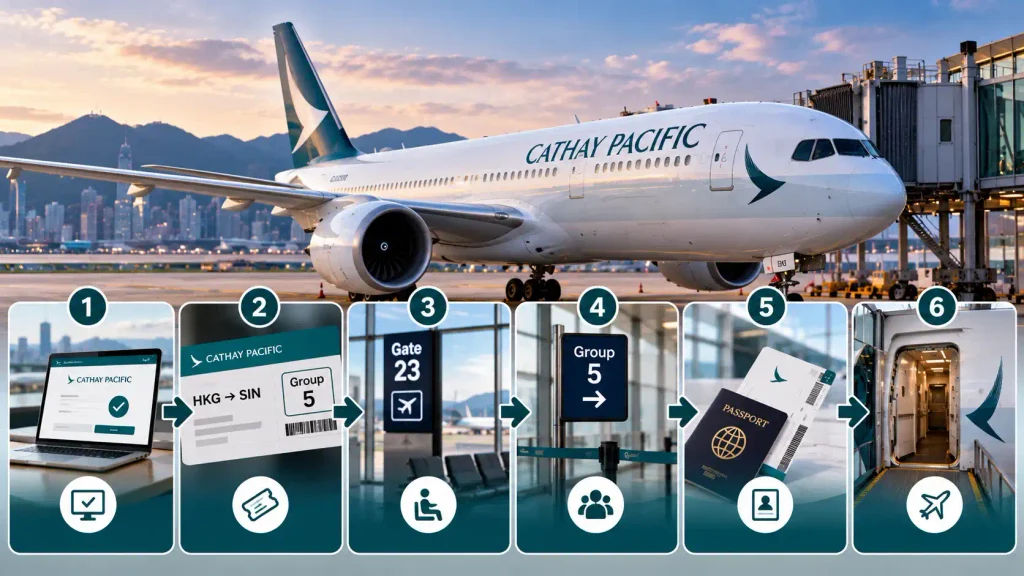
Cathay Pacific uses a numbered boarding system, inviting passengers to board in a planned sequence. The aim is to make the process more orderly, reduce congestion at the gate, and give passengers a clearer indication of when to approach the aircraft.
The gate assigns a boarding group before boarding and displays it on the passenger’s boarding pass. Once the gate team announces the relevant group, passengers should proceed through the designated lane with their boarding pass and required travel documents ready.
What happens during boarding?
The process typically follows these steps:
- Check in: Complete online check-in or use an available airport check-in facility.
- Review the boarding pass: Find the assigned group, departure gate, and boarding time.
- Wait near the gate: Stay in the boarding area and listen for announcements rather than forming a queue too early.
- Follow the group call: Approach the designated lane when the assigned group is invited to board.
- Present travel documents: Have your boarding pass and passport ready, as required.
- Proceed through the gate: Follow airport signage and staff instructions to enter the aircraft.
For example, a passenger assigned to Group 5 should generally wait until Group 5 is called rather than joining the Group 2 lane. Arriving at the gate early is sensible, but standing in line before the correct group is announced is not necessary under the group-boarding system.
Why does Cathay Pacific use boarding groups?
Boarding several hundred passengers can create congestion when many people enter the aircraft aisle simultaneously. Passengers may need to find their seats, place bags in overhead lockers, and let others pass.
A group-based process helps control passenger flow. Organizing economy boarding according to seat location can also reduce the number of people moving against one another in the aisle.
The system does not eliminate every delay. Passengers may still need extra time for mobility assistance, cabin baggage, or questions about seat assignments. However, following the assigned group helps keep the process organized.
2. What Are Cathay Pacific’s Boarding Groups?
Cathay Pacific’s published system uses Groups 0 through 6, with Group 7 also used on Airbus A321neo aircraft. Group 0 is for pre-boarding, followed by the numbered groups in ascending order.
Groups 1 to 3 provide priority boarding to eligible passengers, including those traveling in First, Business, and Premium Economy, along with qualifying loyalty members and co-branded credit cardholders. The remaining groups organize other passengers, with economy boarding generally proceeding from the back of the aircraft toward the front.
Check the exact allocation on your individual boarding pass, as it can depend on multiple eligibility and seating factors.
Group 0: Pre-boarding
Group 0 is designated for pre-boarding. It allows passengers who qualify for this stage to board before the numbered groups begin.
Passengers who require additional boarding assistance should contact Cathay Pacific in advance to understand the arrangements available for their journey. Airport staff can confirm the procedure applicable to the departure airport and flight.
Pre-boarding arrangements are distinct from the priority boarding groups assigned to premium-cabin passengers and eligible loyalty members.
Groups 1–3: Priority boarding
Groups 1, 2, and 3 are used for priority boarding. Eligibility can be based on cabin class, Cathay membership tier, qualifying oneworld status, and eligible co-branded credit card benefits.
Passengers in these groups should still follow the group displayed on their boarding pass or eligible digital membership card. Holding a loyalty membership or premium-cabin ticket does not mean a passenger should choose a group independently.
Groups 4–6: General boarding
Later groups board after other passengers, including economy travelers whose seat location or eligibility places them in those groups. Cathay Pacific generally boards economy passengers from the rear of the aircraft toward the front.
Passengers seated in higher-numbered rows near the back may therefore be called before those seated closer to the front. This approach makes it easier for passengers to reach their seats and stow their cabin baggage.
Group 7: Airbus A321neo flights
Cathay Pacific’s published guidance notes that Group 7 may be used on Airbus A321neo aircraft. This means the final boarding group number may not be the same across all aircraft types.
Passengers should avoid assuming that all flights end boarding at Group 6. The group printed on the boarding pass and the gate announcements take precedence over general descriptions of the system.
3. Who Gets Priority Boarding on Cathay Pacific?
Priority boarding is available to eligible passengers based on their cabin class, loyalty status, and certain qualifying co-branded credit card benefits. It lets eligible travelers board before general boarding groups.
The main eligibility categories include:
- First Class passengers.
- Business Class passengers.
- Premium Economy passengers.
- Eligible Cathay Diamond members.
- Eligible Cathay Gold members.
- Eligible Cathay Silver members.
- Qualifying oneworld members, subject to applicable status benefits.
- Eligible co-branded credit cardholders with a designated priority boarding group.
Not every passenger in these broad categories will necessarily receive the same group number. The group allocation depends on the applicable rules and the details of the booking.
First Class and Business Class
First and Business Class passengers are included in the priority boarding system. Their boarding benefits let them board before passengers assigned to general boarding groups.
Travelers should follow the group indicated on their boarding pass rather than rely on assumptions about cabin order. This is particularly important when traveling on an itinerary with multiple flight segments or where the operating airline differs between flights.
Premium Economy passengers
Premium Economy passengers also qualify for priority boarding through Groups 1 to 3 under Cathay Pacific’s published guidance.
The assigned group should appear on the boarding pass. Passengers should check it after completing check-in, especially if their booking has been changed or reissued.
Cathay membership status
Cathay Diamond, Gold, and Silver members are included among the eligible priority-boarding categories. Membership status can affect the group assigned to a passenger, but the exact allocation depends on the airline’s current eligibility rules and the booking.
Passengers should confirm that their membership details are correctly attached to the reservation. If the expected priority group does not appear, they can ask Cathay Pacific staff to review the booking and applicable benefit.
oneworld status
Eligible members of the oneworld alliance may also qualify for priority boarding when traveling on Cathay Pacific. The applicable benefit depends on the membership tier and the rules governing the journey.
Passengers should not assume that every airline loyalty membership provides the same boarding privileges. They should check the status benefits applicable to their specific program and flight.
Eligible co-branded credit cards
Some qualifying co-branded credit cardholders may receive priority boarding. Cathay Pacific advises eligible cardholders to check the priority boarding group displayed on their digital membership card and present it to the boarding team when required.
Card benefits can be subject to eligibility terms, and not every credit card issued in partnership with an airline provides this benefit. Travelers should check the card’s current terms before relying on priority boarding.
4. How Is a Cathay Pacific Boarding Group Assigned?
A passenger’s boarding group can depend on the cabin of travel, Cathay or oneworld membership tier, seat location, and eligible co-branded credit card benefits.
This means two passengers on the same flight may receive different groups even if they are traveling together. A premium-cabin ticket or qualifying membership status may grant priority boarding, while an economy passenger without an eligible benefit may be assigned a group based on seat location.
Seat location and economy boarding
For economy passengers, Cathay Pacific generally boards from the rear of the aircraft toward the front. Passengers seated in higher-numbered rows toward the back are called before those in lower-numbered rows closer to the front.
For example, a passenger seated near the rear of the aircraft may be assigned an earlier general boarding group than someone seated near the front. This arrangement is intended to reduce aisle congestion as passengers find their seats and store bags.
The group number should not be calculated independently from the seat number. Passengers should always use the boarding group printed on their boarding pass, as other eligibility factors may affect the allocation.
Traveling with people on the same booking
Cathay Pacific states that passengers traveling together on the same booking will board together. Their boarding group may be based on seat numbers or the highest eligible Cathay or oneworld membership tier of a passenger in the booking.
This can help families and travel companions who want to board together rather than enter the aircraft separately. However, passengers should check the group displayed on their boarding passes and follow any instructions from airport staff if the booking details do not appear consistent.
Emergency exit-row seats
Passengers seated in an emergency exit row are invited to board early in Group 4. The airline notes that these passengers must place all cabin baggage in an overhead locker.
This early boarding arrangement gives exit-row passengers time to store their cabin baggage before taking their seats. Passengers should still comply with all cabin-baggage restrictions and any safety instructions given by the crew.
5. How to Find Your Cathay Pacific Boarding Group
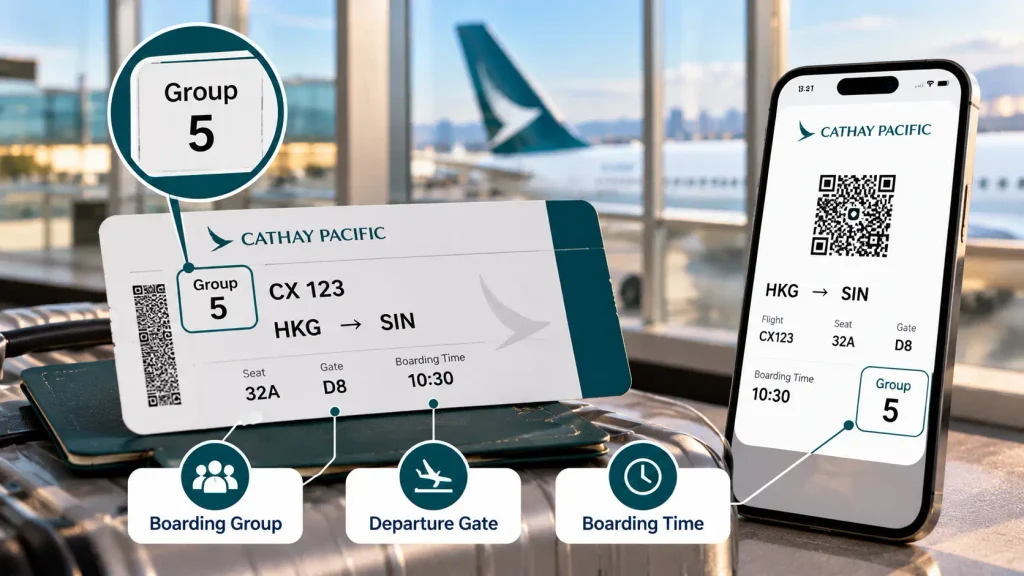
The boarding group is printed on the paper or digital boarding pass. On a paper boarding pass, Cathay Pacific directs passengers to look near the top-left area above the flight information. The group number is also shown on the digital boarding pass.
Eligible co-branded credit cardholders should check the priority group displayed on their digital membership card, as instructed by the airline.
Before leaving the check-in area, travelers should confirm three details:
- Boarding group: The number indicates when to approach the gate.
- Departure gate: Gates can change, so passengers should monitor airport screens and announcements.
- Boarding time: This indicates when to be ready for boarding.
A boarding pass may be updated after a schedule change, seat reassignment, or other booking adjustment. Checking the latest version helps prevent confusion at the gate.
If the group is missing or doesn’t match the passenger’s eligibility, ask Cathay Pacific staff to verify the assignment before boarding begins.
6. When Does Cathay Pacific Boarding Start?
Cathay Pacific’s published group-boarding guidance states that boarding begins 35 minutes before scheduled departure. Boarding times may appear on the boarding pass, and passengers should follow the time and instructions for their flight.
The airline also advises passengers to arrive at the gate promptly because the gate closes 15 minutes before scheduled departure. This cutoff applies to Cathay Pacific flights from 1 June 2026, following a change from the previous 10-minute gate-closure period.
| Timing point | Current guidance |
| Boarding begins | 35 minutes before scheduled departure, according to published group-boarding guidance |
| Gate closes | 15 minutes before scheduled departure |
| What to follow | The boarding pass, gate displays, and announcements |
The boarding start time and the gate-closure time serve different purposes. Boarding may begin well before departure, but passengers must not treat the published departure time as the latest time they can reach the gate.
For example, if a flight is scheduled to depart at 10:00 a.m., a 15-minute gate closure means the gate closes at 9:45 a.m. Passengers should aim to be at the gate well before then, ready for their group to be called.
Airport security queues, immigration checks, long terminal walks, and gate changes can all affect how much time is needed before boarding. Travelers should allow enough time for their departure airport’s requirements.
7. What Is the Boarding Process at Hong Kong International Airport?
Cathay Pacific uses contactless e-boarding gates for departures from Hong Kong International Airport. Passengers should follow airport signage and gate instructions.
The general process remains the same: check the boarding group, wait in the boarding area, and approach the designated lane when the group is called. Passengers should keep their boarding pass and passport ready, as required for the journey.
Contactless e-boarding gates
The contactless gates are part of the airport’s boarding procedure for Cathay Pacific departures from Hong Kong. Passengers should follow the on-screen instructions and staff directions when using them.
Travelers should not assume that every airport on the Cathay Pacific network uses the same gate technology. Procedures and facilities can differ by departure location, so passengers flying from another airport should follow the local signage and instructions.
Keep travel documents accessible.
Even when using a digital boarding pass, travelers should have their passport and other required travel documents available. Document checks may be necessary before boarding, depending on the route and airport.
Passengers traveling internationally should also confirm that they meet the entry and transit requirements for their destination. Boarding eligibility and immigration permission are separate matters; having a boarding pass does not replace the need for valid travel documents.
8. Online Check-In and Boarding Pass Preparation
Online check-in can help travelers prepare for boarding before arriving at the airport. Cathay Pacific provides online check-in and airport self-service options, subject to the eligibility and procedures applicable to the journey.
After check-in, passengers should save their boarding pass and verify the assigned group. Those using a digital pass should ensure their phone is charged and the pass is accessible when needed.
What to check before leaving for the airport
Before departure, travelers should confirm:
- The flight number and scheduled departure time.
- The assigned boarding group.
- The departure terminal and gate information, where available.
- The passport and travel documents required for the destination.
- Any airport-specific requirement to collect or present a paper boarding pass.
- Whether the booking has special handling or assistance requirements.
Digital boarding-pass availability varies by airport and passenger circumstances. For example, Cathay Pacific’s guidance for India notes that passengers departing from Bengaluru, Chennai, Delhi, Hyderabad, and Mumbai must obtain a paper boarding pass at the airport for immigration clearance, even where a digital pass is provided for terminal entry.
Passengers should review the current instructions for their departure airport rather than assume a mobile boarding pass will suffice at every stage.
10. Practical Tips for a Smoother Cathay Pacific Boarding Experience
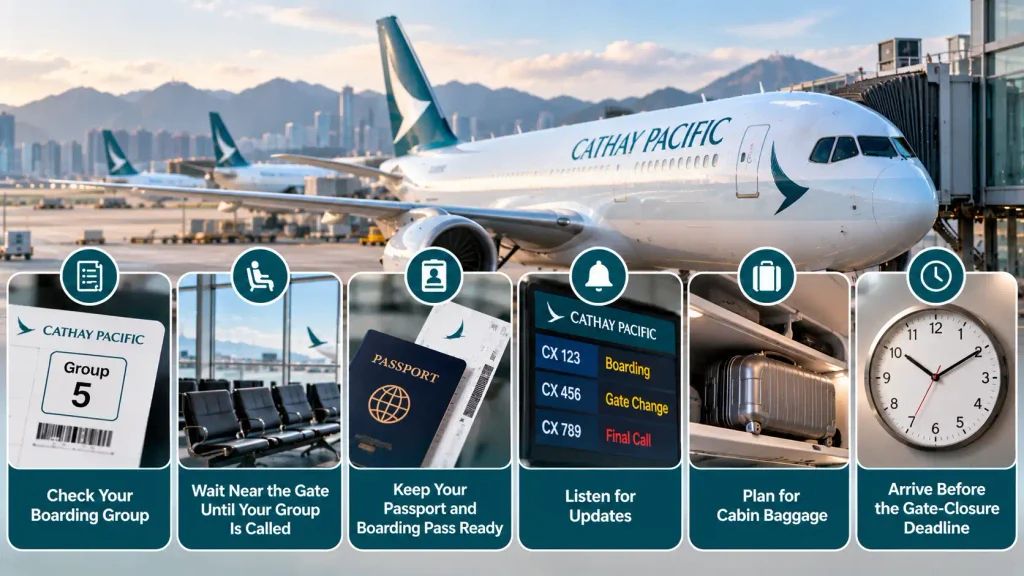
A little preparation can make boarding easier, especially at a busy international airport.
Check the group instead of guessing
Do not assume that cabin class or seat location automatically tells you the correct group. Review your boarding pass, as it reflects the group assigned to your specific booking.
Wait near the gate without forming a queue too early
Cathay Pacific’s group system is designed for passengers to wait in the gate area until their group is called. Staying nearby makes it easier to hear announcements and respond promptly.
Keep your passport and boarding pass ready
Keeping documents accessible reduces delays when you approach the boarding lane. Digital-pass users should make sure their phone has enough battery and that the pass opens without difficulty.
Listen for changes
Airport staff may announce gate changes, revised boarding instructions, or other operational updates. Check the airport information screens and your boarding pass, especially if there is a long wait between check-in and boarding.
Plan for cabin baggage
Passengers should make sure their cabin baggage meets the applicable rules and can be stored safely. Those seated in emergency exit rows should note the requirement to place all cabin baggage in an overhead locker.
Arrive before the gate-closure deadline
Do not plan to reach the gate at the last minute. The 15-minute gate-closure rule means that a passenger who arrives after the cutoff may be unable to board, even when the flight has not departed.
Final Takeaway
Cathay Pacific’s numbered boarding system gives passengers a clear group to follow and prioritizes eligible premium-cabin travelers, loyalty members, and qualifying cardholders. Economy passengers are generally organized from the rear of the aircraft forward, while Group 0 is reserved for pre-boarding and Group 7 may be used on A321neo aircraft.
Before leaving for the airport, travelers should check their boarding pass, confirm the gate and boarding time, and keep travel documents accessible. Most importantly, the gate closes 15 minutes before scheduled departure, so arriving early is essential. Check the airline’s current instructions for the departure airport to avoid relying on outdated boarding information.
Frequently Asked Questions
Cathay Pacific has introduced group boarding across its network. The current system assigns numbered groups, but the group sequence and allocation can vary by aircraft, seat location, cabin, and passenger eligibility.
The group number appears on the paper or digital boarding pass. Cathay Pacific advises passengers with eligible co-branded credit cards to check their digital membership card for the applicable priority boarding group.
Group 0 is used for pre-boarding. Groups 1 to 3 provide priority boarding for eligible premium-cabin passengers, Cathay members, oneworld members, and qualifying co-branded credit cardholders. The remaining groups board in sequence.
Generally, yes. Cathay Pacific organizes economy boarding from the rear of the aircraft toward the front, so passengers in higher-numbered rows may board before those seated closer to the front. The assigned boarding pass group remains the definitive reference.
Cathay Pacific states that passengers traveling together on the same booking will board together. The group may be based on seat numbers or the highest eligible Cathay or oneworld membership tier within the booking. Passengers should check their boarding passes and follow instructions from gate staff.
Cathay Pacific boarding gates close 15 minutes before scheduled departure under the rule effective from 1 June 2026. Passengers should arrive at the gate early and follow the boarding time shown on their pass.
If boarding is still in progress, passengers should approach the gate and follow staff instructions. They should not assume they can board once the gate has closed, as the airline may refuse boarding after the cutoff.
Cathay Silver members are included among the eligible priority-boarding categories under Cathay Pacific’s published guidance. The precise group depends on the applicable rules and should be confirmed on the boarding pass.
Eligible oneworld members may receive priority boarding, subject to the applicable membership tier and benefit rules. Travelers should verify their eligibility rather than assume that every oneworld membership level qualifies.
Many airports accept digital boarding passes, but availability and document requirements can vary. Some departures require a paper boarding pass for specific checks. Passengers should review Cathay Pacific’s instructions for their departure airport and keep their passport available.
Passengers seated in emergency exit rows are invited to board early in Group 4. Cathay Pacific notes that they must store all cabin baggage in an overhead locker.
No. Cathay Pacific’s guidance states that boarding normally ends with Group 6, but Group 7 may be used on Airbus A321neo aircraft. Passengers should rely on the group shown on their own boarding pass.