
When to Visit the Philippines: Weather and Travel Tips
The best time to visit the Philippines is generally December to February, when much of the country has a cooler, drier season. However, the ideal month varies by island, activity, and tolerance for heat and rain. The Philippines officially has a dry season from December to May and a rainy season from June to November. Still, its regional climate patterns are more complicated than those broad dates suggest.
For a first trip that combines beaches, island hopping, sightseeing, and outdoor activities, January and February are particularly reliable choices. March and April remain dry in many destinations but can become very hot, while May marks the transition toward wetter conditions. The wet season from June onward doesn’t mean constant rain everywhere, but travelers should plan for heavier showers and tropical cyclones, especially later in the season.
Because the Philippines is an archipelago of thousands of islands, weather can differ considerably between destinations. This guide breaks down the best time to visit by month, region, activity, crowds, and travel style so travelers can choose dates that match their itinerary.
What Is the Best Month to Visit the Philippines?
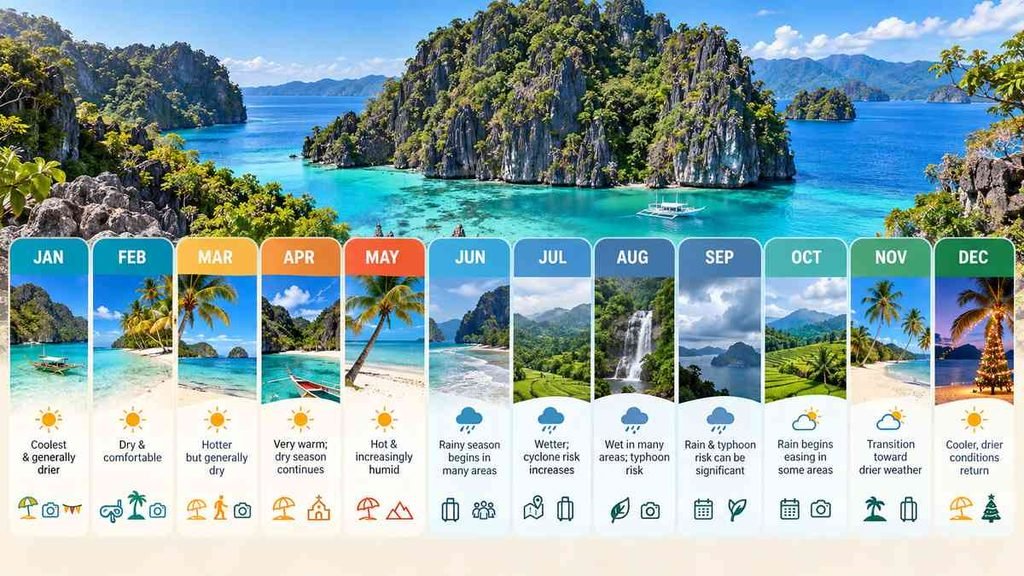
January and February are among the best months for an all-around Philippines vacation. Temperatures are relatively comfortable, rainfall is generally lower in many destinations, and the country is in the cool-dry portion of its broad seasonal cycle.
PAGASA, the Philippine Atmospheric, Geophysical and Astronomical Services Administration, identifies December through February as the country’s cool-dry season, followed by the hot-dry season from March through May. Across the Philippines, the average annual temperature is about 26.6°C, with January generally the coolest month and May the warmest on average.
| Month | General conditions | Best for |
| January | Coolest part of dry season; generally drier | Beaches, sightseeing, festivals |
| February | Dry and relatively comfortable | Island hopping, diving, sightseeing |
| March | Hotter but generally dry | Beaches, outdoor activities |
| April | Very warm; dry season continues | Beach trips, Easter travel |
| May | Hot and increasingly humid | Beaches, mountain escapes |
| June | Rainy season begins in many areas | Flexible itineraries, fewer crowds |
| July | Wetter; cyclone risk increases | Regional travel with flexibility |
| August | Wet in many areas; typhoon risk | Select destinations, festivals |
| September | Rain and typhoon risk can be significant | Flexible, lower-season trips |
| October | Rain begins easing in some areas | Late-month travel, festivals |
| November | Transition toward drier weather | Shoulder-season travel |
| December | Cooler, drier conditions return | Beaches, Christmas/New Year travel |
These are broad national patterns. The Philippines has four recognized climate types, and some areas have no pronounced dry season or receive substantial rainfall at different times of year.
Why December to February Is the Best Overall Period
December through February offers one of the most convenient combinations of weather and accessibility for a Philippines itinerary.
The temperatures are still tropical, but the cooler dry-season period is generally more comfortable than the hotter months of March, April, and May. Audley Travel identifies December to February as its preferred overall travel window, noting that temperatures are typically around 24°C to 31°C during this period and that the country’s islands and more remote areas are generally accessible.
This period works particularly well for a multi-stop trip such as:
Manila → Palawan → Cebu → Bohol
Travelers can combine city sightseeing with beaches, snorkeling, diving, and island excursions without making the itinerary entirely dependent on wet-season weather.
The trade-off is demand. Christmas, New Year, and other holiday periods can be busy, so book accommodation and transportation well ahead of departure.
Is January a Good Time to Visit the Philippines?
Yes. January is one of the best months for a Philippines vacation, especially for travelers who want a mix of beaches, cultural attractions, and outdoor activities.
It is part of the cool dry season, although “cool” remains relative in a tropical country. Audley notes that January offers cooler temperatures without being cold and is generally one of the driest parts of the year.
January is also a month of notable festivals.
Major celebrations include:
- Ati-Atihan in Kalibo
- Sinulog in Cebu
- Dinagyang in Iloilo
- Feast of the Black Nazarene in Manila
These events can draw large crowds and temporarily increase local transportation and accommodation demand. Travelers planning around a particular festival should confirm the current event schedule rather than relying on a generic annual date.
Is February the Best Time to Visit the Philippines?
February is arguably one of the easiest months for a first-time visit. It falls within the dry season, and temperatures are generally more comfortable than during the hotter spring months.
It is particularly useful for itineraries involving:
- Boracay
- Palawan
- Cebu
- Bohol
- Manila
- Island hopping
- Diving and snorkeling
Audley specifically describes February as an excellent time to visit because the rainy season has passed and temperatures remain relatively comfortable for exploring.
Travelers should still check destination-specific weather forecasts because the country’s climate is not uniform.
Is March or April a Good Time to Visit the Philippines?
March and April are still within the dry season, but temperatures rise noticeably.
PAGASA identifies March through May as the hot dry season, with May having the highest average national temperature.
March
March can be a good choice for travelers who prioritize beaches and generally dry conditions but can tolerate heat.
It is also useful for outdoor activities if excursions are scheduled early in the day. A traveler hiking, visiting waterfalls, or exploring archaeological and cultural attractions may find mornings much more comfortable than afternoons.
April
April is typically one of the hottest periods of the year. Audley notes that temperatures peak around this time, with the final month of the dry season bringing particularly warm conditions.
Easter can also affect travel demand. Travelers planning an April trip should reserve accommodation early if their dates coincide with the Easter holiday period.
For a beach-focused trip, however, April can be attractive because the weather remains broadly favorable in many destinations.
Is May a Good Time to Visit the Philippines?
May sits at the boundary between the hot dry season and the wetter period.
It can still be a worthwhile month, especially for travelers who do not mind heat. Audley notes that May can still offer a high chance of dry weather, while mountainous and coastal locations can provide some relief from the heat in lowland areas.
The main disadvantage is temperature. Travelers planning extensive sightseeing should prepare for high humidity and strong sun.
May can therefore be a reasonable compromise for people seeking:
- Warm beach conditions
- Fewer peak-season crowds
- Green landscapes
- Coastal and mountain destinations
What Is the Philippines Like From June to October?
June through October broadly falls within the country’s rainy season, although rainfall patterns vary substantially by region.
PAGASA officially defines June through November as the national rainy season.
Rain doesn’t necessarily mean an entire vacation will be washed out. Tropical rainfall often arrives in heavy bursts rather than producing continuous rain all day. However, wet-season travel requires greater flexibility because storms can disrupt flights, ferries, island excursions, and road transportation.
The risk increases from July through October because PAGASA identifies this period as the peak of the Philippine typhoon season, with nearly 70% of tropical cyclones developing during these months.
June
June is a transition month. Rain begins increasing in many parts of the country, although conditions can still be favorable in some destinations.
Audley’s regional guidance notes that rainfall begins in the north and progresses southward, with Cebu potentially remaining relatively dry for much of June.
This makes June potentially useful for travelers willing to choose their destination carefully rather than expecting identical weather across the archipelago.
July and August
Rainfall generally becomes more significant.
Audley notes that northern areas are often particularly affected in July, while central areas such as Cebu can experience comparatively different conditions. By August, typhoon season becomes a more important consideration.
Travelers visiting during these months should avoid building an itinerary with tightly connected flights and ferries. A missed boat caused by bad weather can have a much larger effect when there is no buffer between destinations.
September
September is one of the more challenging months for a nationwide Philippines itinerary.
Audley advises against September travel because heavy rainfall and the possibility of typhoons can affect plans.
This does not mean every destination experiences poor weather every day, but travelers choosing September should be comfortable with uncertainty and should monitor official weather advisories.
October
October can be a transition period, particularly toward the end of the month.
Audley notes that rainfall generally begins to ease toward the end of October, although typhoons can still occur. Late October or early November can therefore be more attractive than the heart of the wet season for travelers with flexible dates.
Is November a Good Time to Visit the Philippines?
November can be an excellent shoulder-season choice, especially toward the end of the month.
Under PAGASA’s simplified national classification, the broad dry season begins again in November, although regional rainfall differences remain important.
Audley recommends leaning toward late November because tropical storms can still occur earlier in the month.
For travelers who want to avoid the busiest Christmas period while finding increasingly favorable weather, late November can be a useful compromise.
When Is the Best Time to Visit the Philippines for Beaches?
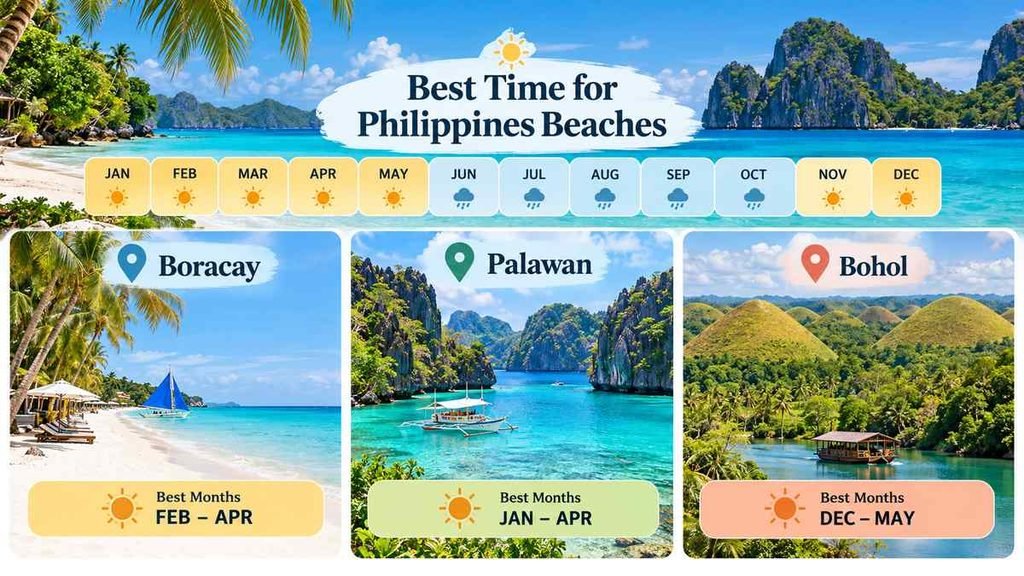
For a classic beach vacation, December through May is generally the most useful period, with January through April particularly attractive for travelers prioritizing drier conditions.
However, the ideal month depends on the destination.
Boracay
Boracay has a tropical climate and can receive substantial rainfall during the wet season. Audley’s climate table shows considerably higher rainfall from June through October than during February through April.
For travelers prioritizing White Beach and water activities, the drier months are generally easier to plan around.
Palawan
Palawan is popular for island hopping, lagoons, snorkeling, and diving. The dry-season months are generally more convenient for boat excursions, although weather can change quickly in any tropical environment.
Audley’s climate data shows Palawan receiving comparatively less rainfall from January through April than in several later months.
Bohol
Bohol and Panglao are year-round destinations, but drier months can make boat trips and outdoor activities easier to organize. Audley’s climate table shows rainfall occurring throughout the year, with variations rather than a complete absence of rain during the dry season.
What Is the Best Time to Visit the Philippines for Diving and Snorkeling?
December through May is generally a convenient period for travelers who want to combine diving or snorkeling with island hopping, although marine conditions vary by location and season.
The Philippines lies within the Coral Triangle and is recognized for its marine biodiversity. Popular diving destinations include Cebu, Bohol, Palawan, and areas around Mindanao.
Travelers should choose a destination based on the species or experience they want, rather than assuming one month is ideal everywhere.
For example, a trip planned around a specific whale shark, sardine run, or manta ray experience should follow the local seasonal pattern for that destination, not simply the country’s overall dry season.
Best Time to Visit the Philippines for Hiking
For hiking, December to February and the shoulder months around November and March can provide more comfortable conditions than the hottest or wettest periods.
Banaue and northern Luzon illustrate why regional conditions matter. PAGASA records substantially higher rainfall in Baguio during June through October than in the first few months of the year.
Hikers should also consider trail conditions. Heavy rain can turn mountain paths muddy or slippery and may affect road access to remote villages.
If Banaue or Batad is a major part of the itinerary, travelers should allow some flexibility rather than scheduling a same-day connection to an international flight.
Best Time to Visit Manila
You can visit Manila year-round because it is primarily a city destination rather than a seasonal beach resort.
For walking, sightseeing, and outdoor attractions, January through February offers a more comfortable combination of temperature and rainfall than the hottest months.
The wet season can bring heavy rain, which may slow road travel. Manila’s metropolitan traffic already makes journey times unpredictable, so travelers should allow additional time for airport transfers during periods of poor weather.
Best Time to Visit Cebu
Cebu can be more flexible than some other destinations.
Audley notes that Cebu can remain relatively dry during parts of June and that its climate table shows comparatively moderate rainfall across several months rather than an extreme dry/wet split.
For a first visit focused on beaches, diving, and cultural attractions, January through April remains a straightforward choice. Travelers visiting during the wet season should monitor marine and weather conditions before booking island excursions.
Best Time to Visit the Philippines for Festivals
Festival timing can be a reason to travel outside the classic beach season.
Some notable annual events include:
- Sinulog — Cebu, usually January
- Ati-Atihan — Kalibo, usually January
- Dinagyang — Iloilo, usually January
- Panagbenga — Baguio, generally February
- Pahiyas — Quezon province, May
- Kadayawan — Davao, August
- MassKara — Bacolod, October
- Lanzones Festival — Camiguin, October
Dates and schedules can change, so travelers should verify the official festival information before booking flights and accommodation.
Festival travel also changes the normal travel equation. A destination may be busier and more expensive during its biggest event, but the cultural experience can be substantially different from visiting at another time.
Best Time to Visit the Philippines by Travel Style
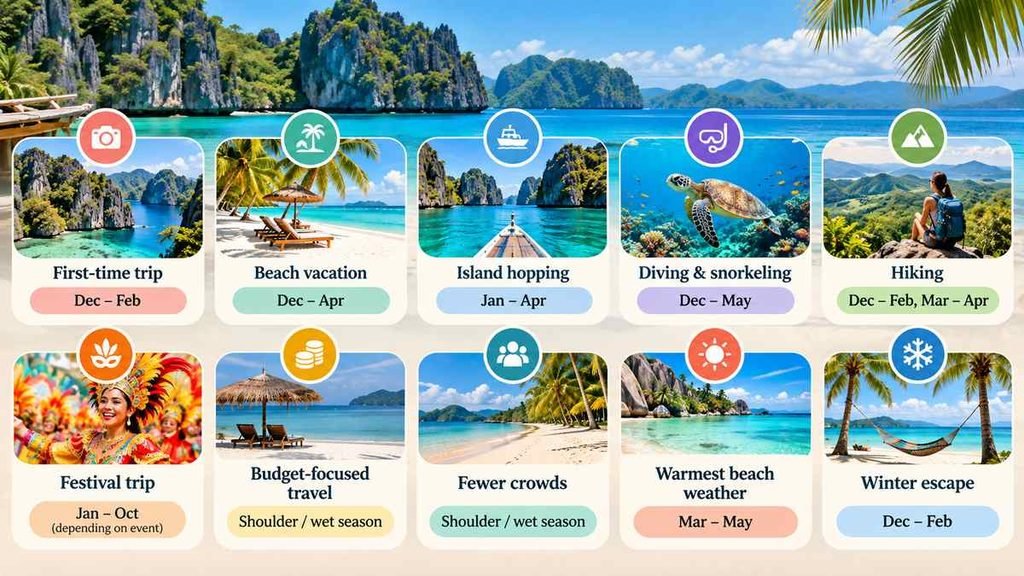
The best time to visit the Philippines varies by travel style and destination. Beachgoers can plan around drier months, while adventure seekers may prefer favorable conditions for island-hopping and outdoor activities. Culture enthusiasts can explore cities and heritage sites year-round, with local festivals adding seasonal appeal.
| Travel style | Best period | Main reason |
| First-time Philippines trip | December–February | Cooler, generally drier conditions |
| Beach vacation | December–April | Better chance of dry weather |
| Island hopping | January–April | Generally favorable conditions |
| Diving and snorkeling | December–May | Useful dry-season window |
| Hiking | December–February, March–April | Cooler than the hottest months |
| Festival trip | January–October, depending on event | Festival-specific timing |
| Budget-focused travel | Shoulder/wet season | Potentially lower demand |
| Fewer crowds | Shoulder or wet season | Lower tourism demand in many areas |
| Warmest beach weather | March–May | Hot dry season |
| Winter escape | December–February | Tropical weather during northern winter |
The “best” period depends on the trip. A traveler looking for the driest weather may choose differently from someone prioritizing lower hotel prices or a particular festival.
When Is the Cheapest Time to Visit the Philippines?
No single nationwide cheapest month exists because airfare and hotel prices depend on destination, school holidays, festivals, property type, and demand.
However, shoulder and wet-season travel can offer better value than the busiest dry-season periods. The trade-off is a greater possibility of rain and weather-related disruption.
Travelers looking for value can compare:
- May versus February
- November versus December
- Weekdays versus weekends
- Major islands versus smaller destinations
- Independent hotels versus major resorts
- Flexible dates around festivals and holidays
A lower room rate doesn’t necessarily mean a lower overall trip cost. If heavy weather forces a traveler to cancel a ferry or add an extra hotel night, savings can disappear quickly.
When Is the Philippines Most Crowded?
The busiest periods vary by destination, but Christmas, New Year, major festivals, and the peak dry season can increase demand.
December is particularly important because international travelers seeking winter sunshine overlap with domestic holiday travel.
January can also become busy around major festivals such as Sinulog and Ati-Atihan.
For travelers who prefer fewer visitors, late November or selected shoulder-season periods can be worth considering, provided weather flexibility is acceptable.
How Typhoons Affect the Best Time to Visit the Philippines
Typhoons are one of the main reasons to choose travel dates carefully.
PAGASA reports that an average of about 20 tropical cyclones enter the Philippine Area of Responsibility each year, with approximately eight or nine crossing the Philippines. The peak of the country’s typhoon season is July through October.
That does not mean every July-to-October trip will encounter a typhoon. It means the statistical risk is higher, and travelers should build more flexibility into their transportation plans.
During the wetter months, it is sensible to:
- Monitor PAGASA advisories.
- Avoid tight same-day flight-and-ferry connections.
- Keep important activities flexible.
- Consider travel insurance that covers relevant disruptions.
- Check airlines and ferry operating updates before departure.
- Leave buffer days before an international flight.
Travelers should rely on official weather warnings rather than social-media forecasts when a tropical cyclone is developing.
What Should Travelers Pack for the Philippines?
Packing depends on the season and destination, but most travelers should consider:
- Lightweight, breathable clothing
- Comfortable walking shoes
- Swimwear
- Sun protection
- Insect repellent
- A lightweight rain jacket
- Quick-drying clothing
- A small dry bag for boat trips
- A warmer layer for air-conditioned transportation
- Appropriate clothing for churches and cultural sites
For wet-season travel, waterproof phone protection and quick-drying footwear can be particularly useful.
For dry-season travel, sun protection is more important than packing heavy rain gear.
How Long Should a Philippines Trip Be?
The number of days depends largely on how many islands you include.
7 Days
A week works best with one or two main destinations, such as Manila and Palawan or Cebu and Bohol.
Trying to visit four or five islands in seven days can turn the vacation into a sequence of airport and ferry transfers.
10 Days
Ten days allows a more balanced itinerary, such as:
Manila → Bohol → Cebu → Palawan
However, travelers should allow time for transfers between islands.
14 Days
Two weeks provides more flexibility and makes it easier to combine cities, beaches, diving, hiking, and cultural attractions.
The Philippines rewards slower travel because geographical distance can be deceptive. Two islands that look close on a map may require multiple flights, ferries,s or road transfers.
Conclusion
For most travelers, December through February is the best overall time to visit the Philippines, with January and February offering particularly comfortable conditions for a broad itinerary. March and April extend the dry season but bring more heat, while November can be an attractive shoulder-season option.
The right dates ultimately depend on the destination. A beach-focused trip to Palawan or Boracay has different requirements from a hiking trip to Banaue or a festival visit to Cebu. Travelers heading into the July-to-October typhoon peak should also leave extra flexibility for flights, ferries, and outdoor activities. Check regional forecasts and current PAGASA advisories before departure, as Philippine weather can vary considerably from one island to another.
Frequently Asked Questions
Both can be excellent. December has pleasant dry-season conditions but can be busier around Christmas and New Year. February is also within the cool dry season and can offer a particularly comfortable combination of weather and sightseeing.
PAGASA broadly defines the rainy season as June through November, although individual regions can follow different rainfall patterns.
Yes, but travelers should be more flexible. Rain isn’t always continuous, and some destinations can have useful weather windows, but tropical storms can disrupt island transportation and outdoor activities.
There is no single nationwide answer because rainfall varies widely by region. January and February are generally among the drier months in many popular destinations, but some parts of the country have different rainfall patterns.
April can be very hot, but it remains part of the dry season. It works well for beaches and water activities, but travelers planning extensive sightseeing should schedule outdoor activities for cooler parts of the day.
October is a transitional month. Rain can begin easing toward the end of the month, but typhoons remain possible, so late October can be preferable to earlier in the month for travelers seeking improving weather.
The drier months, particularly December through April, are generally convenient for Palawan’s island-hopping and outdoor activities. Conditions can still vary, so travelers should check local forecasts before boat excursions.
The dry-season months are generally the easiest for planning a beach vacation in Boracay. February through April are among the drier periods in Audley’s climate data, while rainfall increases considerably during the middle and later part of the year.
January or February is a strong choice for a first trip because these months fall within the cool dry season and work well for combining major cities, beaches, and outdoor attractions.