
16 Ink Business Preferred Benefits & $4,800+ Value
The Ink Business Preferred Credit Card can deliver more than $4,800 in potential first-year value when you fully use its 100,000-point welcome offer, bonus-earning categories, travel protections, and purchase benefits. However, actual value depends on your spending and redemption habits. The card currently charges a $95 annual fee and offers 100,000 Ultimate Rewards points after $8,000 in purchases during the first three months for eligible new cardmembers.
The headline bonus is only one part of the card. For businesses that spend heavily on travel, shipping, digital advertising, internet, cable and phone services, the Ink Business Preferred can generate substantial rewards throughout the year. It also offers travel insurance, rental-car protection, cell phone coverage, purchase protection, and other features that can be valuable when needed.
The $4,800+ figure used in this article should therefore be viewed as an illustrative value estimate, not money that Chase guarantees a cardholder will receive. The following 16 benefits explain where that potential value comes from.
Ink Business Preferred Benefits at a Glance
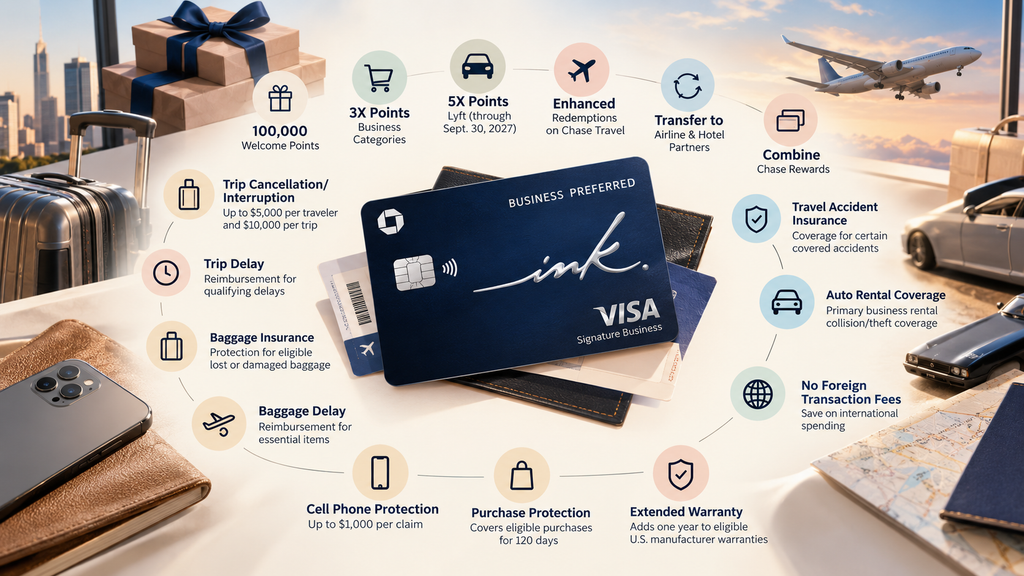
The Ink Business Preferred Credit Card combines flexible rewards with valuable business travel benefits. Cardholders can earn points on eligible business purchases, redeem rewards through Chase, and access features designed for managing business spending. Its benefits can be especially useful for businesses with significant travel and operating expenses.
| Benefit | What it offers | Potential value depends on |
| 1. Welcome offer | 100,000 points after $8,000 in eligible purchases | Redemption strategy |
| 2. 3X business categories | 3 points per $1 on up to $150,000 combined annual category spend | Business spending |
| 3. 5X Lyft | 5 total points per $1 through Sept. 30, 2027 | Lyft usage |
| 4. Chase Travel redemption | Points can receive Points Boost offers | Specific booking |
| 5. Transfer partners | Airline and hotel loyalty transfers | Award availability |
| 6. Combine Chase rewards | Eligible Chase rewards can be combined | Other Chase cards owned |
| 7. Trip cancellation/interruption | Up to $5,000 per covered traveler and $10,000 per trip | Eligible claims |
| 8. Trip delay coverage | Reimbursement for qualifying lengthy delays | Actual disruption |
| 9. Baggage insurance | Protection for eligible lost or damaged baggage | Covered loss |
| 10. Baggage delay | Reimbursement for eligible essentials after a covered delay | Actual delay |
| 11. Travel accident insurance | Coverage for certain covered accidents | Actual covered event |
| 12. Auto rental coverage | Primary business rental collision/theft coverage | Eligible rental |
| 13. No foreign transaction fees | No foreign transaction fee | International spending |
| 14. Cell phone protection | Up to $1,000 per claim, subject to deductible and limits | Eligible phone damage/theft |
| 15. Purchase protection | Eligible purchases covered for 120 days | Covered damage/theft |
| 16. Extended warranty | Adds one year to eligible U.S. manufacturer warranties | Eligible purchases |
1. A 100,000-Point Welcome Offer
The current Ink Business Preferred welcome offer is 100,000 Ultimate Rewards points after spending $8,000 on purchases within the first three months of account opening, subject to Chase’s eligibility requirements. The current annual fee is $95.
This is potentially the card’s largest first-year benefit.
The value depends heavily on how you redeem the points. For example, 100,000 points are not automatically worth $2,000 in cash. A cardholder’s realized value can vary substantially depending on whether they use the points for cash back, Chase Travel bookings, or transfers to airline and hotel programs.
A business owner who already expects to spend $8,000 on legitimate operating expenses during the first three months may find the spending requirement easier to incorporate into normal cash flow than someone who would need to manufacture spending to qualify.
Important: The welcome offer can change, and Chase states that the new-cardmember bonus may not be available to someone who has previously held the card.
2. 3X Points on Up to $150,000 in Key Business Spending
The Ink Business Preferred earns 3 points per $1 on the first $150,000 in combined purchases each account anniversary year across four categories:
- Travel
- Shipping purchases
- Internet, cable and phone services
- Advertising purchases made with social media sites and search engines
After you reach the $150,000 combined limit, those purchases earn the standard 1 point per $1 rate. Other eligible purchases also earn 1 point per $1, with no stated annual points cap.
For example, if a business spends $20,000 on qualifying digital advertising and $10,000 on travel during its account anniversary year, that $30,000 could generate 90,000 points at the 3X rate, assuming the purchases qualify under Chase’s definitions.
The key is matching the card to actual business expenses rather than trying to maximize a theoretical $150,000 limit.
3. 5X Points on Lyft Purchases
A newer benefit gives Ink Business Preferred cardmembers 5 total points per $1 on Lyft purchases through September 30, 2027.
For a business traveler who regularly uses Lyft for airport transfers, client meetings, or local transportation, this can add a useful stream of Ultimate Rewards points.
For example, $100 in qualifying Lyft rides would generate 500 points under the current promotion.
The benefit is temporary, so travelers should check the current terms after September 30, 2027 rather than assuming the 5X rate will continue indefinitely.
4. Chase Travel Points Boost Opportunities
Ink Business Preferred points can be used through Chase Travel, where eligible bookings may receive Points Boost offers that increase the effective redemption value on selected travel purchases. The exact boost depends on the booking and the offer displayed through Chase Travel.
This distinction matters because it is no longer appropriate to assume every Chase Travel redemption uses a single fixed multiplier.
A traveler might see a qualifying hotel with a Points Boost offer while another flight or hotel receives a different redemption rate. Check the actual booking screen before transferring or spending points.
5. Transfers to Airline and Hotel Partners
One of the most important Ink Business Preferred benefits is access to Chase Ultimate Rewards transfer partners.
Current airline partners include programs such as:
- Air Canada Aeroplan
- British Airways Club
- Flying Blue
- Iberia
- JetBlue TrueBlue
- Singapore Airlines KrisFlyer
- Southwest Rapid Rewards
- Virgin Atlantic Flying Club
- Aer Lingus AerClub
Hotel partners include IHG One Rewards, Marriott Bonvoy, and World of Hyatt, among others.
Transfers are generally made in 1,000-point increments, and Chase states that transfers are final.
One important 2026 change concerns World of Hyatt. Chase’s current information states that Ink Business Preferred points will transfer to World of Hyatt at 4:3 beginning October 1, 2026, for existing cardmembers, with the same ratio applying to new cardmembers from that date.
That makes it especially important to check the current transfer ratio before moving points.
6. The Ability to Combine Eligible Chase Rewards
Business owners who use multiple Chase Ultimate Rewards cards may be able to combine rewards instead of treating each point’s balance separately.
For example, a business could use one Chase card for a category where it earns a stronger return, then combine eligible rewards with the Ink Business Preferred account for access to broader redemption options, including travel-partner transfers.
This can turn smaller reward balances into a larger pool of points.
Eligibility and account-linking requirements apply, so cardholders should review Chase’s current Ultimate Rewards rules before combining rewards.
7. Trip Cancellation and Interruption Insurance
The Ink Business Preferred includes trip cancellation and interruption coverage for qualifying trips paid for with the card.
Chase currently states that eligible cardmembers can receive up to $5,000 per covered traveler and $10,000 per trip for prepaid, non-refundable travel expenses when a covered reason cancels or interrupts a trip. Covered expenses can include passenger fares, tours, and hotels.
This can matter when a business trip represents several thousand dollars in prepaid expenses.
However, the benefit is not blanket cancellation insurance. Covered reasons, exclusions, documentation requirements, and other limitations apply. Review the card’s Guide to Benefits before relying on the coverage.
8. Trip Delay Protection

Long travel delays can create unexpected hotel, meal and transportation expenses.
The Ink Business Preferred provides trip-delay protection for qualifying situations. The current Guide to Benefits determines the precise coverage conditions, delay threshold, and reimbursement rules.
This is particularly useful for business travelers who need to continue a trip after an airlines disruption rather than simply abandoning the itinerary.
A traveler should keep receipts for reasonable expenses and obtain any required documentation from the carrier if a covered delay occurs.
9. Baggage Insurance
Baggage protection can reimburse eligible luggage that is lost, damaged, or otherwise covered by the card’s benefit terms.
This can be valuable for business travelers carrying clothing, work equipment and other necessary items.
However, travelers should not assume every item inside a suitcase receives unlimited protection. Benefit limits, exclusions and sub-limits can apply to particular categories of property.
The safest approach is to keep valuable electronics, essential documents and irreplaceable items in carry-on baggage whenever possible.
10. Baggage Delay Protection
Baggage delay coverage addresses a different problem: the traveler arrives, but the checked bag does not.
Eligible cardmembers may receive reimbursement for necessary purchases when a qualifying baggage delay occurs, subject to the terms and limits in the Guide to Benefits.
For example, a business traveler whose checked bag is delayed may need to purchase basic clothing or toiletries before attending a meeting.
Receipts matter. Travelers should retain documentation for purchases and evidence of the baggage delay when submitting a claim.
11. Travel Accident Insurance
Travel accident coverage provides benefits for certain serious injuries or death resulting from covered accidents during qualifying travel.
The exact benefit depends on the circumstances and the applicable coverage provision. Travel accident insurance should therefore be viewed as an additional card benefit, not a substitute for comprehensive travel or medical insurance.
Chase lists travel accident insurance among the travel protections associated with Ink Business Preferred.
12. Primary Auto Rental Coverage for Business Rentals
The card provides primary auto rental coverage for business rentals, subject to the applicable terms.
Chase states that eligible coverage can reimburse up to $60,000 for theft and collision damage for most rental vehicles with an MSRP of $125,000 or less. Cardmembers generally need to decline the rental company’s collision coverage and charge the entire rental cost to the card.
This does not mean every type of car-rental liability is covered. For example, liability coverage is separate.
The distinction between business and personal rentals is also important. Cardholders should review the Guide to Benefits before assuming that a personal vacation rental receives the same primary coverage.
13. No Foreign Transaction Fees
The Ink Business Preferred has no foreign transaction fees, which can be particularly useful for companies that regularly purchase services or travel internationally.
For example, a business paying $5,000 in eligible foreign-currency purchases would avoid a fee that a card charging a 3% foreign transaction fee would otherwise impose.
That can make the benefit valuable even for businesses that don’t travel frequently, as long as they regularly make international purchases.
14. Cell Phone Theft and Damage Protection
Cell phone protection is one of the card’s more distinctive benefits.
Chase currently states that cardmembers can receive up to $1,000 per claim for covered cell phone theft or damage when the phone is listed on the monthly cell phone bill and the eligible card pays that bill. The deductible is $100 per claim, with a maximum of three claims in 12 months.
That means a qualifying claim could provide up to $900 after the deductible, subject to the terms and the actual cost of the covered loss.
For a business with several employee phones, the protection can potentially cover more than just the owner’s device.
Importantly, the benefit has exclusions. A cardholder should read the current Guide to Benefits to understand what constitutes covered theft or damage and which phones qualify.
15. Purchase Protection
Purchase Protection covers eligible new purchases against certain damage or theft for a defined period.
Chase currently states that eligible purchases are covered for 120 days from the purchase date, up to $10,000 per item, subject to the applicable terms and limitations.
This can help businesses buying expensive equipment.
Imagine a company purchases a $2,000 laptop with the card, and the device suffers qualifying accidental damage within the covered period. The card’s purchase protection may provide an additional avenue for reimbursement, assuming the incident and product qualify.
Purchase protection is not a replacement for commercial property insurance, and exclusions apply.
16. Extended Warranty Protection
The final benefit is extended warranty coverage.
Chase says the card can add one additional year to an eligible U.S. manufacturer’s warranty of three years or less, subject to the benefit’s conditions.
This can help with business equipment such as computers, cameras, office technology, and other qualifying purchases.
For example, a product with a two-year eligible manufacturer’s warranty could potentially receive an additional year of coverage through the card’s benefit.
Cardholders should retain the original receipt, warranty documentation, and card statement because documentation may be required for a claim.
How the $4,800+ Value Can Add Up
Treat the headline “$4,800+” figure carefully.
The reference article’s calculation uses its own points valuation and estimated dollar values for benefits. It is not a Chase guarantee and should not be interpreted as a fixed return.
A more useful way to understand the potential is to separate guaranteed card terms from estimated personal value.
For example:
| Value source | Why the value varies |
| 100,000-point welcome offer | Depends on qualifying spend and redemption |
| 3X category rewards | Depends on business spending |
| Lyft 5X | Depends on Lyft usage |
| Transfer partners | Depends on award availability and redemption |
| Travel protections | Worth most when a covered event actually occurs |
| Cell phone protection | Depends on eligible damage/theft claims |
| Purchase protection | Depends on covered purchases and incidents |
| Extended warranty | Depends on qualifying purchases and claims |
| No foreign transaction fees | Depends on international spending |
The supplied reference estimates the card’s benefits at about $2,850 before the welcome bonus and roughly $4,850 including the bonus under its assumptions.
Those figures are useful as a valuation framework, but they should not be presented as guaranteed earnings. A business that spends little in the 3X categories, never uses Lyft, does not travel internationally, and never files a protection claim could realize substantially less.
Conversely, a business with significant qualifying expenses and sophisticated travel redemptions could potentially extract considerably more value.
Who Can Get the Most Value From Ink Business Preferred?

The card’s structure is particularly relevant to businesses with recurring expenses in its bonus categories.
It may fit businesses such as:
- Digital marketing agencies buying social media advertising
- E-commerce companies paying shipping expenses
- Consultants with substantial business travel
- Remote businesses paying internet and phone bills
- Businesses with employees who travel frequently
- Companies that regularly rent vehicles for business trips
Chase itself notes that businesses with significant spending on shipping, digital advertising, utilities and travel may find the card’s rewards structure relevant.
A simple spending audit can help. Add up the business’s annual travel, qualifying advertising, shipping,g and internet/phone expenses and compare that figure with the card’s $150,000 combined 3X ceiling.
What the Ink Business Preferred Does Not Offer
Understanding the omissions is just as important as understanding the benefits.
The Ink Business Preferred does not include airport lounge access. Chase specifically contrasts the card with its Sapphire Reserve for Business, which includes lounge access.
The card also should not be treated as an automatic substitute for:
- Comprehensive travel insurance
- Business liability insurance
- Commercial property insurance
- Health or medical insurance
- Rental-car liability insurance
Its protections are valuable, but specific terms, conditions, and exclusions govern them.
How Does It Compare With Other Chase Ink Cards?
The Ink Business Preferred is designed around transferable Ultimate Rewards points and elevated rewards in specific business categories.
By comparison, the Ink Business Unlimited earns a flat 1.5% cash back on eligible purchases. Meanwhile, the Ink Business Cash has higher rewards in different categories, including certain office-supply and business-utility spending.
This means a business should compare actual expenses rather than choosing solely based on the size of the welcome offer.
For example, a company spending heavily on office supplies may prioritize a different Ink card, while a company spending tens of thousands on digital advertising and travel may value Ink Business Preferred’s 3X categories and transfer flexibility more.
Final Takeaway
The Ink Business Preferred’s potential value comes from combining several benefits rather than relying on a single feature. The 100,000-point welcome offer, 3X earning structure, travel-partner transfers, business rental coverage, cell phone protection, purchase protection and no foreign transaction fees can all contribute value when they align with actual business activity.
The often-quoted $4,800+ value is an estimate, not a guaranteed return. Before applying, a business owner should calculate expected qualifying spending, confirm that the $8,000 welcome-offer requirement fits normal cash flow, review current Chase terms and decide how the points are likely to be redeemed. That approach provides a more realistic picture of what the card could be worth to a particular business.
Frequently Asked Questions
Its $95 annual fee is relatively modest, but whether the card justifies it depends on the business’s spending and benefit usage. Businesses that can use the 3X categories, transfer points to travel partners, or take advantage of its protections may receive more value than businesses with little qualifying spending.
There is no single fixed value. You can redeem the points in different ways, and Chase transfer partners can offer different values depending on the award. The 100,000-point welcome offer therefore should not be treated as a fixed dollar rebate.
No. Chase states that the card has no foreign transaction fees on purchases made outside the United States.
Yes. Eligible cardmembers can receive up to $1,000 per covered claim for theft or damage, with a $100 deductible and a maximum of three claims in a 12-month period. You must pay the monthly cell phone bill with the eligible card, and other conditions apply.
Yes. Chase provides Auto Rental Coverage, with primary coverage for eligible business rentals when you meet the required conditions. Coverage can reimburse up to $60,000 for theft and collision damage on most qualifying vehicles with an MSRP of $125,000 or less.
Yes. Chase states that employee cards are available at no additional cost, and employee spending on qualifying purchases can earn rewards for the primary cardmember.
Chase states that Ultimate Rewards points do not expire as long as the account remains open.
No. Lounge access is not included with Ink Business Preferred. Chase specifically distinguishes it from the Sapphire Reserve for Business, which provides lounge access.
Sole proprietors and other eligible small-business owners can apply for Chase business credit cards, but approval depends on Chase’s application and underwriting requirements. Applicants should provide accurate information about their business activity and financial circumstances.