
Our Guide to Exploring the Terracotta Army of Xi’an
The best way to explore the Terracotta Army of Xi’an is to allow at least half a day for the Emperor Qinshihuang’s Mausoleum Site Museum, concentrating on Pits 1, 2, and 3 before spending time understanding the wider mausoleum complex. The warriors are not simply a collection of statues: they form part of an enormous funerary landscape created for Qin Shi Huang, the ruler who established China’s first unified empire in 221 BCE.
Discovered accidentally in 1974, the Terracotta Army has become one of China’s most recognizable archaeological attractions. Yet the famous rows of soldiers represent only one portion of the site. UNESCO describes the wider Qinshihuang Mausoleum complex as containing nearly 200 associated pits, thousands of life-size terracotta soldiers and horses, and more than 600 archaeological sites spread across a 56.25-square-kilometer area.
For travelers visiting Xi’an, understanding that scale changes the experience. Rather than rushing past rows of warriors for photographs, look closely at their formations, hairstyles, armor, horses, chariots, weapons, and the ongoing archaeological work that continues to reveal information about the Qin Dynasty.
Terracotta Army at a Glance
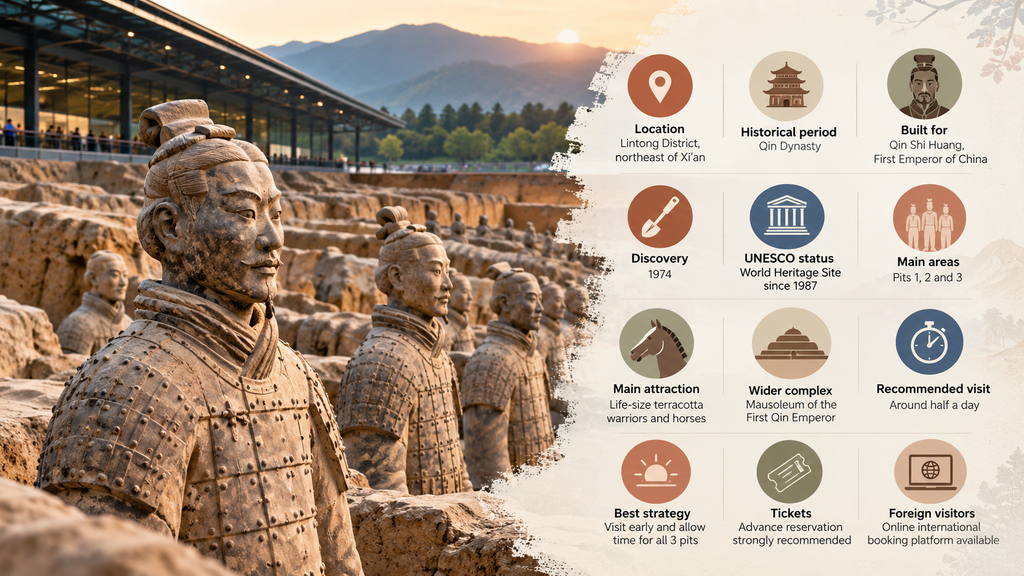
UNESCO places the mausoleum approximately 35 km northeast of Xi’an at the northern foot of Lishan Mountain.
| Detail | Information |
| Location | Lintong District, northeast of central Xi’an |
| Historical period | Qin Dynasty |
| Built for | Qin Shi Huang, First Emperor of China |
| Discovery | 1974 |
| UNESCO status | World Heritage Site since 1987 |
| Main areas | Pits 1, 2 and 3 |
| Main attraction | Life-size terracotta warriors and horses |
| Wider complex | Mausoleum of the First Qin Emperor |
| Recommended visit | Around half a day |
| Best strategy | Visit early and allow time for all 3 pits |
| Tickets | Advance reservation strongly recommended |
| Foreign visitors | Online international booking platform available |
What Is the Terracotta Army?
The Terracotta Army is a vast collection of life-size clay soldiers, horses, chariots, and military figures created to accompany China’s First Emperor, Qin Shi Huang, into the afterlife.
The figures stand in military formations inside large underground pits east of the emperor’s burial mound.
They include representations of:
- Infantry soldiers
- Archers
- Cavalry
- Officers
- Generals
- Charioteers
- Horses
Weapons found at the site have included swords, lances, axes, halberds, bows, and arrows. UNESCO notes that these discoveries provide unusually detailed evidence of military organization during the period.
But perhaps the most memorable details are the soldiers themselves.
Look closely and you will notice differences in:
- Facial features
- Hairstyles
- Headgear
- Armor
- Clothing
- Rank
- Posture
The army feels less like rows of identical statues and more like a military force assembled from individual figures.
Who Was Qin Shi Huang?
Qin Shi Huang was the ruler who unified rival states in 221 BCE and became the first emperor of a unified China.
His reign was short but transformative.
The Qin state introduced or expanded systems that helped centralize the empire, including standardized approaches to writing, currency, weights, and measures.
UNESCO describes the mausoleum as directly associated with the first unification of Chinese territory under a centralized state in 221 BCE.
Construction of Qin Shi Huang’s mausoleum began long before he became emperor.
UNESCO dates the beginning of the project to around 246 BCE, when Qin Shi Huang was still young and ruled the state of Qin.
The emperor died in 210 BCE.
His tomb lies within the much larger mausoleum landscape, while the famous warrior pits were positioned some distance away.
How Was the Terracotta Army Discovered?
The Terracotta Army was discovered by chance in 1974 when local farmers were digging a well near the emperor’s mausoleum.
What initially appeared to be fragments of ancient pottery eventually led archaeologists to one of the most significant archaeological discoveries of the 20th century.
Excavations revealed an enormous underground military formation.
The discovery did not mean archaeologists immediately uncovered everything.
Research and excavation have continued for decades, and UNESCO notes that thousands of statues may still remain underground.
This ongoing archaeology is one reason the museum is so compelling: visitors are looking at both an ancient burial complex and a continuing research site.
How Many Terracotta Warriors Are There?
The Terracotta Army is generally estimated to contain more than 8,000 warriors, along with horses and chariots, although not every figure has been completely excavated or reconstructed.
UNESCO documentation estimates that the army represented more than 8,000 warriors and horses across the pits.
Pit 1 alone is believed to have contained thousands of figures.
Numbers should therefore be understood as archaeological estimates rather than a simple count of intact statues currently standing on display.
Many figures were damaged over the centuries and have required painstaking reconstruction.
What Will You See at the Terracotta Army Museum?
The 3 principal pits offer different perspectives on the army.
Do not visit only Pit 1.
Its size makes it the obvious highlight, but Pits 2 and 3 help explain how the military formation was organized.
Pit 1: The Scale of the Army
Pit 1 is the largest and most visually impressive of the 3 main Terracotta Army pits.
This is the scene most travelers recognize from photographs: long rows of life-size warriors standing beneath an enormous covered archaeological hall.
The pit extends approximately 230 m in length, according to UNESCO’s documentation.
Rows of soldiers were arranged in military formation, with different units positioned according to their roles.
What Should You Look for in Pit 1?
Instead of viewing the army only from a distance, pay attention to:
- Different hairstyles
- Armor styles
- Facial features
- Infantry formations
- Horses
- Restoration areas
- Broken figures awaiting reconstruction
- Archaeological excavation zones
One particularly valuable part of the experience is seeing figures in different stages of restoration.
It demonstrates how much archaeological work lies behind the neat ranks of soldiers visitors see today.
Why Are So Many Warriors Broken?
The warriors were not discovered standing perfectly intact.
Many were found shattered.
Wooden structures originally covered parts of the pits, and damage, collapse, fire, soil pressure, and the passage of more than 2,000 years affected the figures.
Archaeologists have had to identify fragments and reconstruct individual warriors piece by piece.
The polished museum display therefore represents decades of conservation and archaeological work.
Pit 2: Understanding Qin Military Strategy
Pit 2 is particularly useful for understanding the variety and organization of the Qin army.
The formations represented here include different types of military units, such as:
- Archers
- Cavalry
- Chariots
- Infantry
Where Pit 1 impresses through sheer scale, Pit 2 helps visitors appreciate military specialization.
UNESCO documentation records approximately 1,500 warriors, chariots, and horses associated with Pit 2 in earlier archaeological assessments.
Look for differences in equipment and stance.
The position of a soldier’s hands, for example, can help indicate whether the figure once held a weapon.
Pit 3: The Command Center
Pit 3 is much smaller than Pits 1 and 2 and is generally interpreted as the command headquarters of the underground army.
Its smaller scale makes the contrast immediately noticeable.
UNESCO documentation records around 68 officers and dignitaries, along with a chariot and horses, in Pit 3.
This pit helps complete the military picture.
Rather than presenting another enormous infantry formation, it shows how command figures were positioned within the wider army.
Which Terracotta Army Pit Is the Best?
Pit 1 is the most spectacular for scale, but the strongest visit includes all 3 pits.
Think of them as different chapters:
- Pit 1: Size and visual impact
- Pit 2: Military variety and organization
- Pit 3: Command structure
Skipping Pits 2 and 3 means missing much of the archaeological story.
If your time is limited, prioritize Pit 1 but still try to walk through the other main exhibition areas.
Were the Terracotta Warriors Originally Colorful?
Yes. The Terracotta Warriors were originally painted rather than left in the earthy gray-brown appearance most visitors see today.
Pigments were used to create colored clothing, armor, and other details.
The problem is preservation.
Once excavated, surviving color can deteriorate rapidly when exposed to environmental changes.
That conservation challenge has influenced how archaeologists approach excavation.
So when looking across the muted figures today, remember that the original army would have appeared far more colorful.
Does Every Terracotta Warrior Have a Different Face?
The warriors display remarkable variation in facial features, hairstyles, expressions, clothing, and rank.
This has encouraged the popular claim that every warrior is completely unique.
A more careful interpretation is that ancient craftspeople used combinations of standardized production methods and individualized finishing to create considerable variation across the army.
What visitors can confidently observe is that the figures do not look like thousands of simple identical copies.
Take time to compare:
- Mustaches
- Beards
- Hairstyles
- Facial shapes
- Headgear
- Expressions
- Armor
The details are much easier to appreciate when you slow down.
Where Is Qin Shi Huang’s Actual Tomb?
Qin Shi Huang’s burial mound lies within the wider mausoleum complex, separate from the famous Terracotta Army pits.
The warriors were not placed directly inside the emperor’s tomb.
Instead, they formed part of an enormous funerary landscape designed around the emperor’s afterlife.
UNESCO states that the mausoleum complex was laid out to echo the urban plan of the Qin capital, Xianyang.
The surviving burial mound rises more than 50 m high according to UNESCO’s description of the site.
The central tomb chamber has not simply been opened to tourists.
That is an important distinction for visitors expecting to walk inside the emperor’s grave.
The museum experience centers on the archaeological pits and wider mausoleum landscape rather than entry into the main burial chamber.
Why Has Qin Shi Huang’s Main Tomb Not Been Excavated?
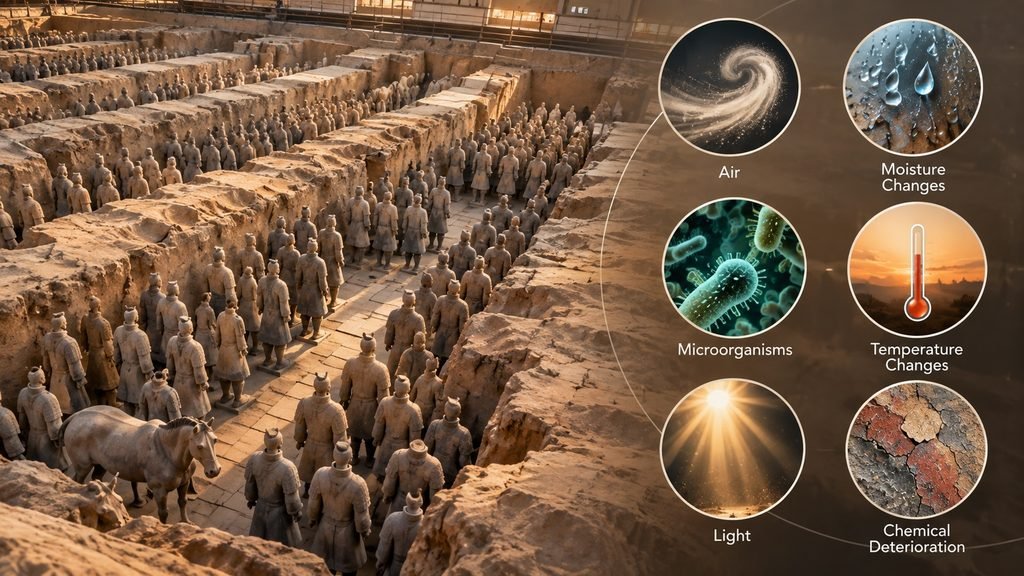
Archaeological excavation is not only about discovering objects.
It is also about preserving them.
Opening a complex burial environment can expose fragile materials to:
- Air
- Moisture changes
- Microorganisms
- Temperature changes
- Light
- Chemical deterioration
The loss of pigment from excavated Terracotta Warriors illustrates why conservation technology matters.
For that reason, archaeology can sometimes be better served by leaving a site undisturbed until researchers have suitable techniques to preserve what may be inside.
What Are the Bronze Chariots?
Among the extraordinary discoveries associated with Qin Shi Huang’s mausoleum are 2 bronze chariots.
UNESCO specifically highlights the bronze funerary carts alongside the terracotta warriors as works of exceptional technical and artistic quality.
These objects add another layer to the site.
The funerary complex was not designed around infantry alone. It attempted to recreate aspects of the emperor’s world through soldiers, horses, vehicles, officials, and other figures and objects.
How Long Do You Need at the Terracotta Army?
Allow around 3 to 4 hours at the museum itself, and approximately half a day once transport from Xi’an is included.
Travelers particularly interested in archaeology may want longer.
A practical visit might look like this:
| Activity | Suggested Time |
| Arrival and entry | 20-30 minutes |
| Pit 1 | 45-60 minutes |
| Pit 2 | 30-45 minutes |
| Pit 3 | 20-30 minutes |
| Exhibition areas | 30-45 minutes |
| Wider site/transfer time | 30-60+ minutes |
These are planning estimates rather than official time limits.
Crowds can substantially change how quickly you move through the museum.
What Is the Best Order for Seeing the Terracotta Warriors?
There is no compulsory viewing order for understanding the site, but a thoughtful route can improve the experience.
One option is:
Pit 2 → Pit 3 → Pit 1
Why save Pit 1?
Because beginning with the smaller archaeological areas helps you understand the army’s structure before seeing the immense main formation.
Another perfectly reasonable approach is to begin with Pit 1 while energy and attention are highest.
The better choice depends on crowd levels.
If Pit 1 is exceptionally busy when you arrive, visiting another section first can make sense.
When Is the Best Time to Visit the Terracotta Army?
Arriving early is generally the best strategy for travelers who want more time before the heaviest daytime crowds.
The museum is one of Xi’an’s most visited attractions.
China’s national holidays can be particularly busy.
The 2026 Mid-Autumn and National Day holiday arrangements demonstrate the site’s enormous visitor capacity: authorities increased the museum’s maximum daily capacity from the usual 65,000 to 75,000 visitors on September 25-30 and as many as 80,000 per day from October 1-7.
That makes advance planning especially important during:
- National Day holiday
- Other Chinese public holidays
- Summer travel periods
- Weekends
- Major school holidays
If you have flexibility, a regular weekday can be more comfortable.
Do You Need To Book Terracotta Army Tickets in Advance?
Advance booking is strongly recommended, particularly during busy periods.
Current museum arrangements use real-name ticketing, and special holiday announcements may change opening hours, daily visitor limits, and reservation procedures.
For the 2026 National Day period, Xi’an authorities specifically stated that tickets were being handled through the museum’s official website and official WeChat account, with real-name verification required.
Overseas visitors also have access to an international online ticket platform.
China’s State Council reported that the museum introduced an overseas booking service supporting 24 languages, visitors from 39 countries and regions, and payments in 29 currencies.
Because procedures can change, verify the museum’s current official booking instructions shortly before your trip.
What Documents Should Foreign Visitors Bring?
Foreign visitors should travel with the passport used to make the ticket reservation.
The museum uses identity-based ticketing, so the booking information should match the traveler’s identification document.
Do not rely only on a screenshot of somebody else’s reservation.
Keep:
- Passport
- Booking confirmation
- Relevant QR code or electronic ticket
- Payment confirmation if necessary
accessible when arriving.
How Do You Get to the Terracotta Army From Xi’an?
The Terracotta Army is in Lintong District, roughly 35 km northeast of central Xi’an, so travelers should account for transport time in addition to the museum visit.
Depending on current services and personal preference, visitors can use:
- Public transportation
- Tourist buses
- Taxi
- Ride-hailing services
- Private driver
- Guided tour
Travel time varies according to the starting point, traffic, and transport method.
A private driver or organized tour can be convenient for travelers combining the museum with other attractions outside central Xi’an.
Public transport can reduce costs but may require more navigation and transfer time.
Is a Guide Worth Having at the Terracotta Army?
A knowledgeable guide can significantly improve the visit because much of the Terracotta Army’s importance lies in details that are easy to miss.
Without context, visitors may see thousands of impressive clay soldiers.
With explanation, they can start identifying:
- Military rank
- Hairstyles
- Armor
- Weapon positions
- Battle formations
- Restoration methods
- Qin history
- Archaeological techniques
Audio guides and museum interpretation can also provide context for independent travelers.
If hiring a guide, choose an authorized or reputable service rather than accepting unsolicited offers around tourist areas.
Can You Take Photos of the Terracotta Warriors?
Photography rules can vary by museum area and may change, particularly for temporary exhibitions or sensitive artifacts.
Follow posted instructions and staff guidance.
Even where photography is allowed:
- Do not use prohibited flash.
- Do not cross barriers.
- Do not block walkways for extended photo sessions.
- Avoid holding phones above other visitors for long periods.
- Never touch artifacts.
The best views are often easier to appreciate after putting the camera down for a few minutes.
What Should You Look for Beyond the Famous Rows?
The Terracotta Army becomes much more interesting when you start looking for smaller details.
Watch for:
Different Ranks
Clothing and headgear help distinguish soldiers from higher-ranking figures.
Empty Hands
Many warriors originally carried real weapons, so their hand positions can indicate what they once held.
Horses
The terracotta horses help explain the role of cavalry and chariots within the army.
Restoration Areas
Broken warriors provide insight into archaeological reconstruction.
Uneven Preservation
Some figures are almost complete, while others survive only in fragments.
Excavated Earth
Remember that much of the attraction is an archaeological site rather than a conventional gallery.
Why Is the Terracotta Army a UNESCO World Heritage Site?
The Mausoleum of the First Qin Emperor was inscribed on UNESCO’s World Heritage List in 1987.
UNESCO recognizes it under criteria (i), (iii), (iv), and (vi).
Its significance comes from several factors:
- Exceptional artistic and technical quality
- Evidence of Qin military organization
- Monumental funerary planning
- Information about ancient craft and metallurgy
- Association with China’s first political unification
- Scale and preservation of the wider mausoleum complex
The warriors are therefore important not only because they are visually impressive but because they provide evidence about the society that created them.
What Else Should You See in Xi’an?
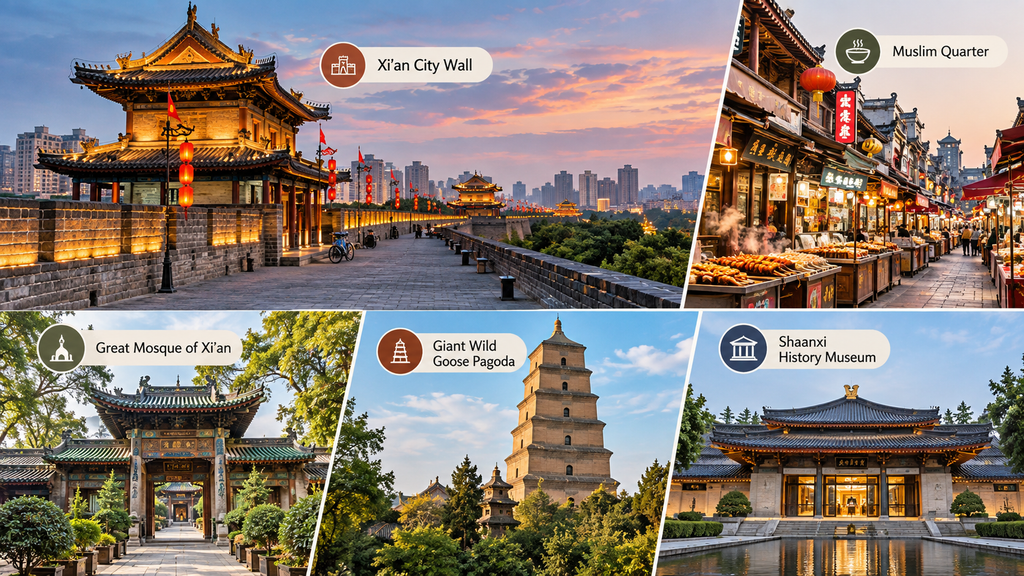
The Terracotta Army should be part of a broader Xi’an itinerary rather than the only reason to visit the city.
Xi’an was one of China’s great historical capitals and provides several complementary attractions.
Consider adding:
Xi’an City Wall
The surviving fortifications provide an excellent perspective on the historic urban core.
Muslim Quarter
Visit for busy streets, local snacks, restaurants, markets, and the city’s long-standing Muslim heritage.
Great Mosque of Xi’an
The mosque reflects the city’s multicultural history and combines Chinese architectural traditions with an Islamic religious setting.
Giant Wild Goose Pagoda
One of Xi’an’s major historic Buddhist landmarks.
Shaanxi History Museum
A particularly useful addition for travelers who want broader context about the civilizations that flourished around Xi’an.
Check current reservation procedures before visiting because popular museums can require advance booking.
How Many Days Should You Spend in Xi’an?
Two to 3 full days is a practical amount of time for a first visit to Xi’an.
A simple itinerary could be:
Day 1: Historic Xi’an
Visit the City Wall, Muslim Quarter, and central historic attractions.
Day 2: Terracotta Army
Dedicate the morning and early afternoon to the Terracotta Army and mausoleum area.
Return to Xi’an for dinner and an evening walk.
Day 3: Museums and Pagodas
Visit the Shaanxi History Museum, Giant Wild Goose Pagoda, or other sites that match your interests.
Travelers particularly interested in Chinese archaeology and history can easily justify a longer stay.
What Should You Wear to Visit the Terracotta Army?
There is no special dress code for ordinary visitors, but comfort matters.
Wear:
- Comfortable walking shoes
- Weather-appropriate clothing
- Layers during transitional seasons
- Sun protection when spending time outdoors
- Warm clothing in winter
The main pits are protected by large buildings, but moving between areas can involve outdoor walking.
Xi’an experiences hot summers and cold winters, so packing needs vary substantially by season.
Practical Tips for Visiting the Terracotta Army
A little planning makes the visit considerably easier.
- Reserve tickets ahead of time.
- Use the exact identification details shown on your passport.
- Arrive early when possible.
- Allow at least 3 hours inside the museum.
- Do not visit only Pit 1.
- Read about Qin Shi Huang before arriving.
- Consider a guide if you enjoy history.
- Wear comfortable shoes.
- Keep water available where permitted.
- Expect large crowds during Chinese public holidays.
- Ignore unofficial ticket sellers.
- Check official opening hours shortly before visiting.
- Leave time for security and entry procedures.
- Do not touch or lean across archaeological barriers.
Most importantly, do not rush from one famous viewpoint to another.
The small details tell much of the story.
Final Thoughts
The Terracotta Army deserves more than a hurried stop on a Xi’an itinerary. Pit 1 provides the unforgettable scale, but Pits 2 and 3, the restored figures, weapons, horses, and wider mausoleum landscape provide the context that makes the site meaningful.
Allow at least half a day, reserve your ticket in advance, and spend time looking at individual warriors rather than viewing the army only as a single enormous spectacle.
It also helps to remember how much remains unseen. Archaeologists have spent decades studying the mausoleum, yet substantial parts of the complex remain underground. What visitors see today is therefore both an extraordinary ancient monument and one chapter of an archaeological investigation that is still developing.
Frequently Asked Questions
The Terracotta Army is part of the Mausoleum of the First Qin Emperor in Lintong District, approximately 35 km northeast of central Xi’an in Shaanxi Province.
The warriors were discovered in 1974 after local farmers digging a well encountered archaeological remains.
The Terracotta Army dates to the Qin Dynasty and is more than 2,200 years old.
The entire army is generally estimated to include more than 8,000 warriors along with horses and chariots, although many figures and parts of the wider complex remain unexcavated.
Pit 1 is the largest and contains the vast military formation most commonly seen in photographs.
No. The figures show substantial variation in faces, hairstyles, clothing, armor, headgear, rank, and posture.
Yes. The figures originally carried colored pigments, although much of that coloration has deteriorated.
Visitors do not enter the main burial chamber of Qin Shi Huang. The Terracotta Army pits and other parts of the mausoleum complex form the principal visitor experience.
Around 3 to 4 hours is a useful amount of time for the museum itself. Including travel from Xi’an, allow roughly half a day.
Advance reservations are strongly recommended. An international online ticketing platform has been introduced for overseas visitors, and travelers should verify current procedures through official museum channels before visiting.
For travelers interested in Chinese history, archaeology, art, or ancient military organization, the site provides an unusually large and well-preserved archaeological record. Its significance extends well beyond the famous rows of clay soldiers.