
When Is the Best Time to Visit Egypt?
The best time to visit Egypt is generally from October through April, when temperatures are more comfortable for exploring Cairo, the Giza Pyramids, Luxor, Aswan, and other outdoor attractions. Egypt can be visited year-round, however, and the ideal month depends on whether your priority is sightseeing, a Nile cruise, desert adventures, or a Red Sea beach holiday.
Egypt’s climate is predominantly hot and dry, but conditions vary noticeably between the Mediterranean coast, Cairo, the Nile Valley, and southern Egypt. Winter brings comfortable days and cooler evenings, while summer can be extremely hot inland.
Best Time to Visit Egypt at a Glance
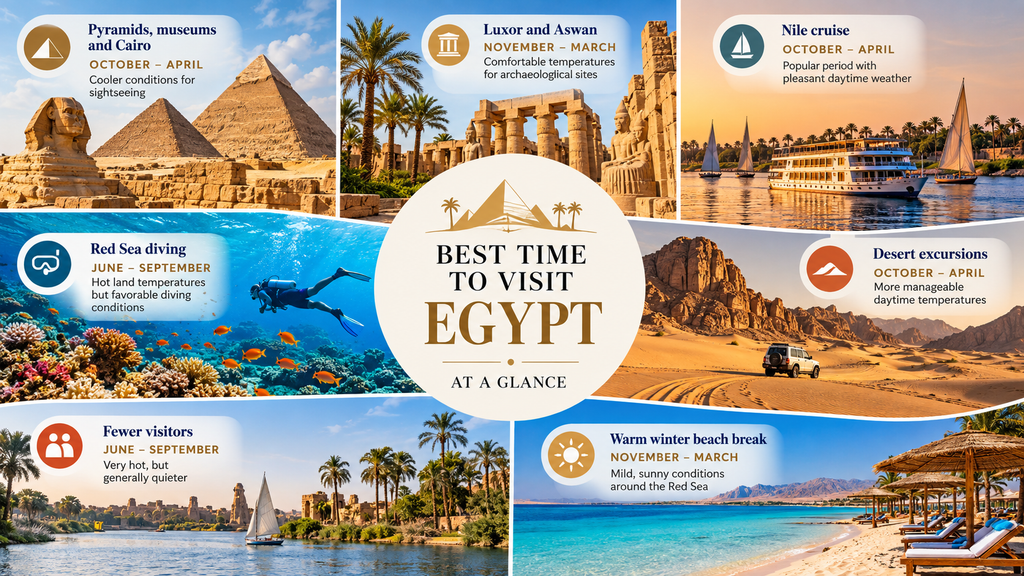
The most suitable travel period depends on what you want to do. November through February is particularly comfortable for major historical sights, while March, April, October, and early November can offer a useful balance between manageable weather and the busiest winter crowds.
| Travel goal | Months to consider | What to expect |
| Pyramids, museums and Cairo | October–April | Cooler conditions for sightseeing |
| Luxor and Aswan | November–March | Comfortable temperatures for archaeological sites |
| Nile cruise | October–April | Popular period with pleasant daytime weather |
| Red Sea diving | June–September | Hot land temperatures but favorable diving conditions |
| Desert excursions | October–April | More manageable daytime temperatures |
| Fewer visitors | June–September | Very hot, but generally quieter |
| Warm winter beach break | November–March | Mild, sunny conditions around the Red Sea |
There is no single “perfect” month for every itinerary. Southern Egypt, for example, can be considerably hotter than Cairo even during the same month.
Egypt Weather by Season
Egypt has relatively short seasonal transitions. The official tourism authority describes winter as moderate and summer as hot and dry, with the Mediterranean coast generally more humid and the Red Sea coast less humid.
Winter: November to February
Winter is the main sightseeing season because temperatures are much easier to handle than during the hottest months. Cairo can have cool mornings and evenings, while Luxor and Aswan remain comparatively warm during the day.
This period works particularly well for travelers planning a classic itinerary combining Cairo, Giza, Luxor, Aswan and a Nile cruise.
The trade-off is demand. Popular attractions, hotels and cruises can become busy, particularly around Christmas and New Year.
Best for:
- Pyramids and ancient monuments
- Nile cruises
- Walking tours
- First-time visits
- Desert excursions
What to pack: Light daytime clothing plus a sweater or light jacket for evenings, particularly in Cairo and desert areas.
Spring: March to May
Spring gradually becomes warmer, but March and much of April can still be excellent for sightseeing. In Luxor, average maximum temperatures rise from about 29°C in March to nearly 34°C in April and 38°C in May, according to long-term climate data.
One consideration is the khamsin, a hot, dry and sometimes dusty wind that can affect parts of Egypt during spring. Conditions vary from year to year, so travelers should keep some flexibility in outdoor plans.
May can already feel very hot in southern Egypt, although it may suit travelers who prefer fewer visitors and warmer weather.
Best for:
- Early-season Nile Valley sightseeing
- Photography
- Outdoor activities before peak summer heat
- Travelers looking for a shoulder-season trip
Summer: June to August
Summer is Egypt’s hottest period, particularly in the Nile Valley and southern cities. Long-term climate data puts average maximum temperatures in Luxor around 40°C or higher in June, July and August.
That makes extended midday sightseeing uncomfortable for many travelers. However, summer also has advantages. Visitor numbers can be lower, accommodation may be less expensive, and the Red Sea is attractive for diving and other water activities.
If you travel during summer, plan archaeological visits for early morning, use air-conditioned accommodation and allow time for breaks during the hottest part of the day.
Best for:
- Red Sea diving and snorkeling
- Resort holidays
- Travelers comfortable with intense heat
- Potentially quieter archaeological sites
Autumn: September to October
September remains hot, particularly in Luxor and Aswan, but conditions begin to ease as autumn progresses. October is considerably more comfortable for sightseeing and marks the beginning of the country’s cooler travel season.
For travelers who want a compromise between summer’s lower visitor numbers and winter’s more comfortable conditions, October is one of the most practical months to consider.
Best for:
- Cairo and Giza
- Nile cruises
- Ancient temples and tombs
- Red Sea resorts
- A transition-season itinerary
Best Time to Visit Egypt by Month
Rather than treating the entire year as one climate zone, consider what each period means for a typical traveler.
| Month | General conditions | Travel suitability |
| January | Mild days, cooler nights | Excellent for cultural sightseeing |
| February | Mild and sunny in much of the country | Excellent for Cairo and southern Egypt |
| March | Warmer but generally manageable | Very good for sightseeing |
| April | Warm, with possible khamsin winds | Very good, especially earlier in the month |
| May | Increasingly hot | Good for travelers who tolerate heat |
| June | Very hot inland | Better for Red Sea activities |
| July | Peak summer heat | Better suited to beaches and diving |
| August | Very hot inland | Good for Red Sea resorts; challenging for long tours |
| September | Still hot but easing | Good for Red Sea trips and heat-tolerant travelers |
| October | Warm to hot, increasingly comfortable | Excellent shoulder-season option |
| November | Pleasant and cooler | Excellent for sightseeing |
| December | Mild days, cooler nights | Excellent, but busy around holidays |
These are broad planning guidelines rather than guarantees. Weather varies by location, and conditions in Aswan can be very different from those in Alexandria during the same month.
When Is the Best Time to Visit Cairo and the Pyramids?
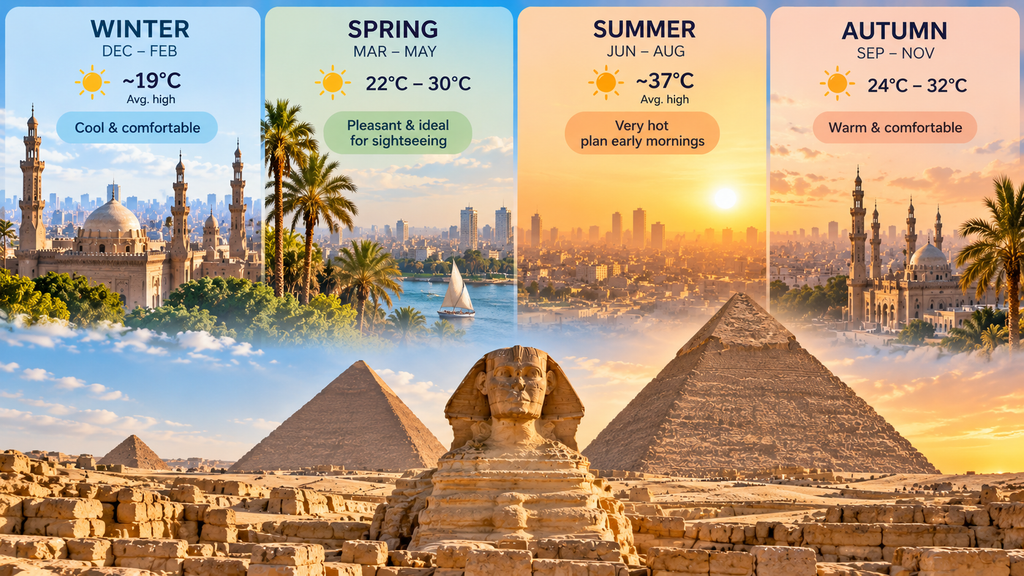
October through April is generally the most comfortable period for exploring Cairo and the Giza Plateau. Cairo’s long-term climate data shows average maximum temperatures of roughly 19°C in January, rising to around 37°C in July before declining again in autumn.
Winter is therefore useful if your itinerary involves several hours outdoors visiting the Pyramids, Saqqara, Islamic Cairo and other attractions.
Spring and autumn can also work well, especially if you prefer warmer weather without the full intensity of summer.
If visiting during a hot month, start outdoor sightseeing early. A morning at Giza followed by an indoor museum or a relaxed afternoon is generally more practical than spending the entire day in direct sun.
When Is the Best Time to Visit Luxor and Aswan?
For Luxor and Aswan, November through March is particularly comfortable for travelers who want to spend substantial time among temples, tombs and archaeological sites.
Southern Egypt stays warmer than Cairo throughout the year. In Luxor, long-term averages show maximum temperatures around 21°C in January, 29°C in March, 34°C in October and more than 40°C in July and August.
That difference matters because many of Luxor’s most important experiences involve walking outdoors, including visits to Karnak Temple, Luxor Temple and the West Bank.
For example, someone visiting Luxor in January may be able to comfortably spend several hours sightseeing during the day, while a July itinerary requires much more attention to timing, hydration and shade.
When Is the Best Time for a Nile Cruise?
The October-to-April period is the traditional high season for Nile cruising because cooler weather makes time on deck and visits to riverside monuments more comfortable.
The most popular period can also mean higher demand and busier attractions. Travelers willing to handle warmer conditions may consider May or June, particularly if their cruise schedule allows early-morning visits to major sites.
A Nile cruise can still be enjoyable in summer because the river provides a different experience from walking through exposed archaeological sites. However, the heat around Luxor and Aswan should not be underestimated.
When Is the Best Time to Visit Egypt for Diving?
For a Red Sea diving holiday, summer can be an attractive option even though it is one of the least comfortable periods for extensive inland sightseeing.
Destinations such as Sharm El-Sheikh, Hurghada and Marsa Alam offer diving and snorkeling opportunities throughout the year. Summer is particularly appealing to divers because warm water and good underwater conditions can outweigh the intense heat on land.
September can also be a useful transition month for Red Sea travel, with temperatures still high but the peak summer period beginning to pass.
If your trip is primarily about the Red Sea rather than pyramids and temples, there is less reason to restrict your plans to the winter sightseeing season.
When Is the Best Time for a Desert Trip?
Desert activities are generally more comfortable from October through April, when daytime temperatures are lower than during the peak summer months.
This includes experiences such as:
- Desert camping
- Camel rides
- 4×4 excursions
- Hiking in parts of Sinai
- Visits to desert oases
- Stargazing
Spring can be affected by dusty winds, while summer temperatures can become difficult for prolonged outdoor activities. The official Egyptian tourism authority also highlights Sinai hiking and desert activities as key outdoor experiences.
What Is the Cheapest Time to Visit Egypt?
There is no single low-price period that applies to every hotel, cruise or route, but summer generally sees less international tourist demand than the cooler high season.
Audley notes that June through August can have lower prices and fewer visitors, while October through December is a busier period with stronger demand.
That creates a straightforward trade-off:
- Summer: potentially fewer crowds and lower prices, but substantially hotter conditions.
- Winter: more comfortable weather, but greater demand and potentially higher accommodation and cruise prices.
Travelers can also consider the shoulder seasons, particularly spring and autumn, when conditions and demand fall between the two extremes.
How Crowded Is Egypt During Peak Season?
The busiest travel period generally falls during the cooler months because the weather is more comfortable for sightseeing. January through March, for example, can see busy hotels, cruises and archaeological sites, while Christmas and New Year are particularly popular.
If avoiding crowds is important, consider:
- Traveling outside the Christmas and New Year period
- Visiting major sites early in the morning
- Choosing shoulder-season dates
- Considering summer if you are comfortable with high temperatures
Crowd levels can also vary significantly by individual attraction and time of day, so “high season” does not mean every location is continuously crowded.
Traveling to Egypt During Ramadan
Ramadan follows the Islamic lunar calendar, so its dates change every year. Travelers visiting Egypt during Ramadan should expect some changes to normal operating patterns.
The Egyptian tourism authority notes that shop and business hours can change during Ramadan, while fasting takes place between dawn and sunset.
For visitors, this can mean later evening activity, different restaurant schedules and altered opening hours for some services. Tourist-oriented businesses continue operating, but it is sensible to check specific opening times before visiting attractions or planning meals.
Ramadan is not inherently a reason to avoid Egypt; it simply requires travelers to understand the rhythm of the month and be respectful of people who are fasting.
What to Pack for Egypt
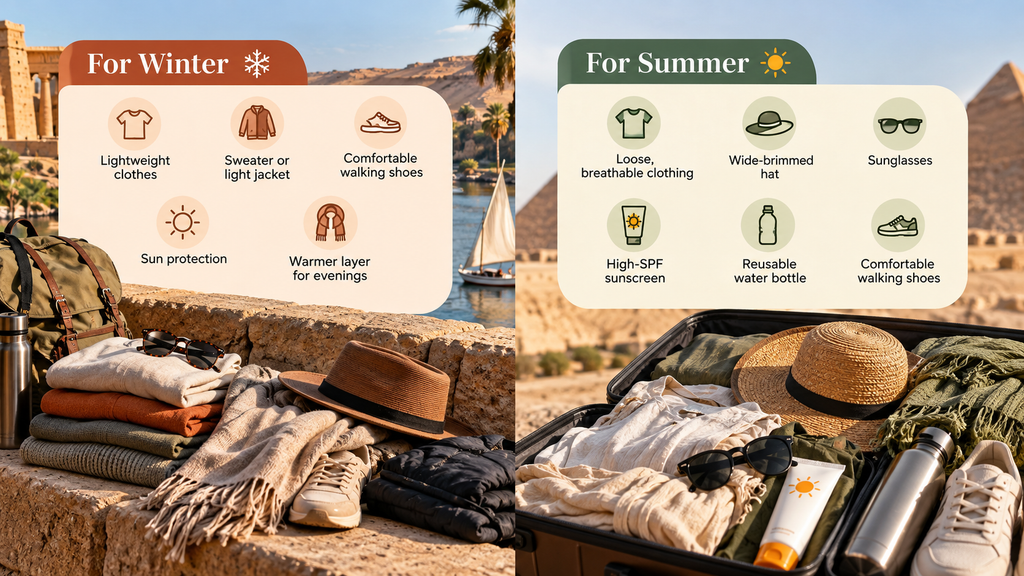
Your packing list should change with the season and itinerary.
For winter
Bring:
- Lightweight daytime clothes
- A sweater or light jacket
- Comfortable walking shoes
- Sun protection
- A warmer layer for evenings and desert areas
For summer
Prioritize:
- Loose, breathable clothing
- A wide-brimmed hat
- Sunglasses
- High-SPF sunscreen
- Reusable water bottle
- Comfortable walking shoes
The official Egyptian tourism authority recommends light, loose clothing and advises carrying a light-to-medium jacket or windbreaker during cooler seasons. It also recommends a scarf or light cardigan for visits to religious sites, where modest clothing is appropriate.
Tips for Choosing Your Egypt Travel Dates
Before booking flights or accommodation, match your dates to the type of trip you actually want.
- For a first-time Egypt itinerary:
Choose roughly October through April, with November through February particularly suitable for travelers prioritizing cooler sightseeing weather. - For a Cairo and Giza-focused trip:
Winter or the shoulder seasons provide more comfortable conditions for walking and outdoor exploration. - For Luxor, Aswan and Abu Simbel:
Favor the cooler months because the southern Nile Valley becomes extremely hot in summer. - For a Nile cruise:
October through April is the conventional comfort window, while warmer months can work for travelers who are comfortable with the heat. - For diving and beach resorts:
Summer and early autumn can work well, particularly around the Red Sea. - For lower crowds and potentially lower prices:
Consider summer or shoulder-season dates, but be aware that lower demand may come with much hotter weather.
Final Takeaway
For most travelers, October through April is the most practical time to visit Egypt, with November through February offering especially comfortable conditions for major archaeological and cultural attractions. Spring and autumn can provide a useful middle ground, while summer makes more sense for travelers prioritizing Red Sea activities, quieter attractions or lower-season travel.
Your route is the most important consideration. Cairo, Luxor, Aswan, the Western Desert and the Red Sea do not experience identical conditions, so check the weather for each destination on your itinerary before booking.
Frequently Asked Questions
For extensive sightseeing, winter is generally more comfortable because temperatures are lower. Summer can be preferable for Red Sea diving, resort stays, fewer visitors and potentially lower travel costs.
June, July and August are generally the hottest months, particularly in southern cities such as Luxor and Aswan. Long-term Luxor data records average maximum temperatures above 40°C during July and August.
Yes. October is a useful shoulder-season choice because temperatures are falling from the summer peak while the country enters its more comfortable sightseeing season.
Yes. December generally offers comfortable conditions for sightseeing and cruising, although it is part of the busier winter period and Christmas/New Year demand can push up prices and reduce availability.
Yes, but travelers should plan around the heat. Early-morning sightseeing, air-conditioned accommodation and a slower itinerary can make summer travel more manageable. The Red Sea is also particularly suitable for travelers focused on diving and beach activities during this period.
A first trip often benefits from around 7–10 days if you want to combine Cairo and Giza with Luxor, Aswan or a Nile cruise. A longer trip allows additional time for the Red Sea, Alexandria, desert destinations or a slower pace.