
Trivago Hotels: How to Search & Compare Hotel Prices
Looking for a hotel can mean checking the same property across several booking websites just to find out where the price is lowest. Trivago simplifies that comparison by bringing hotel offers from multiple booking sites into one search.
Trivago is far from a traditional hotel booking site. You enter your destination and dates, compare available accommodation and prices, and then select an offer. Trivago generally redirects you to the booking site or accommodation provider to complete the reservation and payment.
Here’s how Trivago hotels work, what you can compare, and what to check before booking.
What Is Trivago?
Trivago is an accommodation metasearch platform that compares hotel and other accommodation offers from multiple booking sites. Its search results can include offers from online travel agencies, hotel chains, and independent properties.
The key distinction is that Trivago is primarily the comparison layer rather than the party handling your hotel reservation. After you select an offer, you are typically redirected to the booking site providing that deal, where you complete the reservation and payment.
This also means that questions about an existing reservation—such as cancellation, changes, refunds, or missing booking details—are generally handled by the booking site through which you made the reservation.
How Does Trivago Work?
Using Trivago is relatively straightforward:
- Enter your destination, hotel, city, or point of interest.
- Add your check-in and check-out dates.
- Enter the number of travelers.
- Search available accommodations.
- Compare hotel offers and prices from different booking sites.
- Apply filters to narrow the results.
- Select the offer you want.
- Continue to the booking site to complete the reservation and payment.
The important part is the final step: Trivago helps you compare offers, but the terms of the reservation are determined by the booking provider you ultimately book through.
How to Search for Hotels on Trivago
Start by entering the destination you want to stay in. Depending on the search, you can look for accommodation by city, address, landmark, or a specific property. Add your travel dates and the number of guests, then run the search.
Trivago will display available accommodations that match your criteria. You can then compare different properties rather than opening numerous booking websites individually.
Use Filters to Narrow Your Results
If the initial results are too broad, filters can make the search much more useful.
Depending on the destination and available inventory, filters may include options related to:
- Price
- Guest ratings
- Hotel class
- Accommodation type
- Location
- Amenities
- Free cancellation
- Wi-Fi
- Pool
- Airport shuttle
- Spa
- Parking
- Other property features
Available filters can vary, so don’t assume that every option will appear for every destination or property.
How to Compare Trivago Hotel Prices
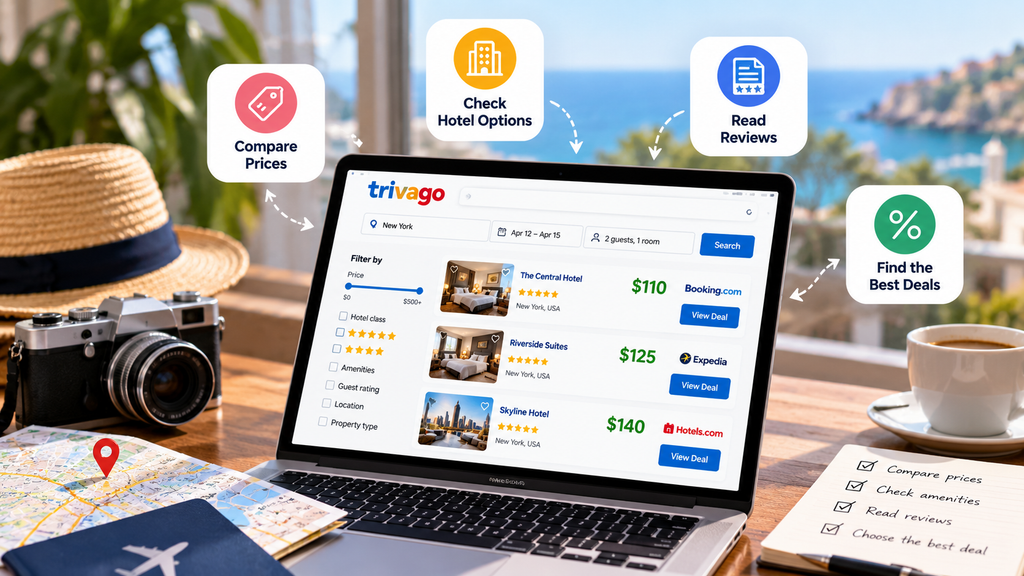
One of Trivago’s main functions is showing different offers for the same or similar accommodation.
A hotel listing may display several booking options, allowing you to compare prices and providers before selecting an offer. Trivago’s own documentation describes the platform as comparing offers supplied by numerous booking sites.
However, the lowest displayed number should not automatically be treated as the cheapest overall booking.
Before selecting an offer, check:
- Whether taxes and fees are included
- The room type
- Number of guests
- Cancellation conditions
- Breakfast or other inclusions
- Payment requirements
- Whether the rate is refundable
- The booking provider
- Any additional property charges
Two offers can appear similar while having different cancellation terms, inclusions, or final costs.
Does Trivago Actually Book the Hotel?
Usually, no. Trivago primarily compares accommodation offers and redirects you to the booking provider to complete the reservation. Trivago states that it is not generally a party to the booking agreement between the traveler and the booking site or accommodation provider.
That distinction matters after booking.
If you need to change or cancel a reservation, request a refund, or resolve an issue with a booking, you should generally contact the booking site shown on your reservation confirmation, rather than assuming Trivago is responsible for the reservation itself.
Can You Book Hotels Through Trivago?
Trivago’s platform can facilitate the transition from hotel search to booking, but the exact booking flow can vary. Its standard metasearch process sends users to selected booking sites or accommodation providers to complete the transaction.
Trivago also offers Book & Go for selected partners, where Trivago can facilitate parts of the booking process. Even in that model, Trivago explains that the accommodation booking remains between the traveler and the selected partner, and post-booking support is provided by that partner.
Is Trivago Free to Use?
Yes. You can use Trivago to search and compare accommodation offers without paying a separate search fee.
Trivago explains that it receives fees from booking partners when users interact with certain deals, while the accommodation reservation itself is completed with the relevant booking provider.
This means the price displayed in a Trivago search should still be evaluated based on the actual booking terms rather than assuming that the platform itself is adding a separate booking charge.
Does Trivago Have a Mobile App?
Yes. Trivago offers a mobile app that allows travelers to search for hotels, compare offers, use filters, and explore accommodation based on location. The app can also use a user’s current location to help find nearby hotels.
For travelers already on the road, location-based hotel searches can be particularly useful when the exact destination or property has not been selected in advance.
Does Trivago Have a Map?
Yes. Trivago provides map-based hotel searching, allowing travelers to examine accommodation in relation to a destination or specific location.
A map can be particularly useful when the hotel itself is not the only consideration. For example, you may want to compare properties based on their proximity to an airport, city center, attraction, business district, or other point of interest.
A slightly higher hotel rate can sometimes make more sense if it places you significantly closer to where you actually need to be.
Does Trivago Have Hotel Reviews?
Trivago displays hotel information and reviews gathered from booking and accommodation sources. Its app information also states that hotel reviews are collected from multiple booking sites.
Reviews should be considered alongside the property’s location, room type, amenities, cancellation terms, and the specific booking offer you are considering.
A strong overall rating does not necessarily mean a particular room or rate includes everything you expect.
Does Trivago Offer Price Alerts?
Trivago currently offers price alerts as a member feature in its app. Members can receive notifications when prices drop for selected hotels, according to Trivago’s current help documentation.
Availability of particular membership features can vary by platform or market, so check the options shown in your Trivago account.
Is Trivago Legit?
Yes. Trivago is an established accommodation metasearch platform. It compares accommodation offers from booking sites rather than operating as a conventional hotel reservation provider.
That said, being a legitimate metasearch platform does not mean every third-party booking experience will be identical. Before paying, review the booking provider, cancellation policy, payment conditions, and final price shown on the checkout page.
Who Should You Contact After Booking a Trivago Hotel?
If you have already completed a reservation, the first point of contact should generally be the booking site or accommodation provider named in your confirmation.
For example, if Trivago redirected you to a particular online travel agency and you completed the reservation there, that provider normally holds the booking details and handles changes, cancellations, refunds, and related requests. Trivago specifically advises travelers to contact the booking site directly regarding reservation status.
If the hotel cannot locate your reservation, check the confirmation for the actual booking provider and reservation number before contacting the property.
How to Get the Most From Trivago Hotel Searches
A good Trivago search is about more than finding the first low price.
Compare the Same Room Type
Make sure you’re comparing like-for-like rooms. A standard room and a suite may appear next to each other but obviously shouldn’t be compared as equivalent offers.
Check the Cancellation Policy
A cheaper non-refundable rate may not be the better fit if your travel plans could change. Look carefully at the cancellation deadline and any applicable charges.
Check the Final Price
Review taxes, fees, and other charges before completing your reservation. The price shown during the initial comparison should not be the only figure you consider.
Check Who You Are Booking With
Take note of the booking provider before clicking through. This becomes particularly important if you need help after the reservation.
Compare Location, Not Just Price
Use Trivago’s map and location information to determine whether the hotel is actually convenient for your trip.
Conclusion
Trivago is designed to make hotel comparison easier by bringing accommodation offers from multiple booking providers into one search. You can search by destination and dates, filter properties, compare prices, examine locations, and then select the offer that fits your requirements.
The most important distinction is what happens after the search: the booking relationship and its terms generally sit with the provider you book through. For that reason, compare the total price, room details, cancellation policy, and booking provider before confirming your stay.
Frequently Asked Questions
Trivago is primarily a hotel and accommodation metasearch engine. It compares offers from multiple booking sites and typically redirects travelers to the selected provider to complete the booking.
Trivago is focused on accommodation rather than flight search. Its platform compares hotel and other accommodation offers rather than functioning as a general flight booking engine.
Not necessarily. Trivago compares available offers from multiple providers, but the lowest price can vary depending on the property, dates, room type, booking provider, and rate conditions. Compare the final terms before booking.
Cancellation depends on the terms of the reservation and the provider you booked through. Check your confirmation and contact the booking site or accommodation provider responsible for the reservation.
Trivago’s standard metasearch service does not charge a separate fee simply for searching and comparing accommodation. The transaction takes place with the booking provider, whose pricing and applicable charges should be reviewed before payment.
Yes. You can search by location and use map-based results to identify accommodation near an airport or another point of interest.
Free cancellation can be available as a search filter or offer condition, depending on the property and market. Always check the specific cancellation terms attached to the rate before booking.