
How Can Travelers Find Delta Red-Eye Flights at Night?
Delta Air Lines offers red-eye flights on select domestic and international routes, letting passengers depart late in the evening and arrive the next morning. Travelers can find these overnight services by searching Delta’s flight schedules, filtering departures by time, and comparing available dates and airports.
Overnight flights provide an alternative to daytime travel, particularly for passengers who want to reach their destinations early without spending most of the day in transit. These flights are common on long-distance routes, including journeys between the West Coast and East Coast of the United States.
However, red-eye flights are not necessarily cheaper or more comfortable than daytime departures. Ticket prices, cabin amenities, flight duration, and opportunities to sleep vary considerably by route and aircraft.
Understanding how to find Delta Airlines red-eye flights, compare ticket prices, and prepare for overnight travel can help passengers select an itinerary that fits their schedule and budget.
What Is a Red-Eye Flight on Delta Air Lines?
A Delta red-eye flight is an overnight service that typically departs late in the evening and arrives at its destination the following morning.
The term red-eye refers to the tired appearance passengers may experience after traveling overnight with limited sleep.
Although red-eye flights are often associated with departures between approximately 9 p.m. and 1 a.m., there is no universal departure-time definition.
What Are the Main Features of Delta Red-Eye Flights?
| Feature | General characteristics |
| Departure time | Usually late evening or overnight |
| Arrival time | Often the following morning |
| Common routes | Long-distance domestic and international flights |
| Flight duration | Varies by route |
| Ticket prices | Depend on demand, fare class, and availability |
| Cabin options | Depend on aircraft and route |
| Meals and refreshments | Vary by cabin and service |
| Baggage allowance | Based on the purchased fare |
| Best suited for | Travelers comfortable with overnight journeys |
A red-eye flight does not represent a separate Delta fare category. It is simply a flight scheduled during overnight hours.
Does Delta Air Lines Offer Red-Eye Flights?
Yes. Delta operates overnight flights on selected routes within the United States and between the United States and international destinations.
Red-eye services are particularly practical on longer journeys where the flight duration allows passengers to spend several hours traveling overnight.
Which Domestic Routes May Have Delta Red-Eye Flights?
Delta red-eye flights are commonly associated with transcontinental and other long-distance routes.
| Departure airport | Destination airport | Overnight travel consideration |
| Los Angeles (LAX) | New York (JFK) | West-to-East overnight travel |
| San Francisco (SFO) | New York (JFK) | Transcontinental journey |
| Seattle (SEA) | Atlanta (ATL) | Overnight travel to a major Delta hub |
| Los Angeles (LAX) | Atlanta (ATL) | Late departures may provide morning arrivals |
| San Diego (SAN) | New York (JFK) | Long-distance overnight option |
| Honolulu (HNL) | Los Angeles (LAX) | Overnight Pacific journey |
| Las Vegas (LAS) | Detroit (DTW) | Possible late-night itinerary |
These are routes to investigate, not guaranteed daily red-eye schedules. Availability depends on the travel date, operating season, and airline timetable.
Does Delta Operate International Red-Eye Flights?
Yes. Delta operates overnight international flights, including selected transatlantic services to European destinations.
Flights departing from U.S. cities for destinations such as London, Paris, and Amsterdam frequently involve overnight travel.
However, international red-eye flights may arrive in the morning or afternoon depending on the departure time, flight duration, and time-zone difference.
Are Delta Red-Eye Flights Available Every Day?
Not necessarily. Overnight flight frequency varies by route, day of the week, and season.
Some routes offer multiple departure options, while others have limited overnight service.
Passengers should compare several dates rather than assuming a particular red-eye flight operates daily.
How Can Passengers Find Delta Red-Eye Flights Online?
Passengers can find Delta red-eye flights by searching their preferred route on Delta’s website or mobile app and identifying departures scheduled for late evening or overnight hours.
Flight search platforms can also help travelers compare schedules across different airlines.
How Can Travelers Search for Red-Eye Flights on Delta’s Website?
Travelers can use Delta’s flight search system to identify overnight departures.
- Open the official Delta Air Lines website.
- Enter the departure and destination airports.
- Select the preferred travel dates.
- Choose a one-way or round-trip itinerary.
- Search for available flights.
- Review departure and arrival times.
- Use available sorting or filtering options to identify late-night departures.
- Compare flight duration, connections, cabin options, and ticket prices.
- Select the preferred itinerary and complete the booking.
Passengers should check the arrival date carefully because overnight flights commonly arrive on the following calendar day.
Can Passengers Find Red-Eye Flights Through the Fly Delta App?
Yes. The Fly Delta app allows passengers to search for available flights and review their departure and arrival schedules.
Travelers can compare available itineraries and complete eligible bookings through the app.
After booking, the app can also provide flight notifications, boarding information, and reservation management services.
How Can Google Flights Help Find Delta Red-Eye Flights?
Google Flights can help travelers identify overnight Delta departures by allowing them to compare flight schedules and filter results.
The process generally involves entering the route, selecting the travel dates, filtering by Delta Air Lines, and narrowing departure times to the late-evening period.
Travelers can also compare nonstop flights with connecting itineraries and review nearby dates for potentially lower fares.
Can Alternative Airports Provide More Red-Eye Options?
Yes. Comparing nearby departure or arrival airports may reveal additional overnight flights.
For example, travelers departing from Southern California can compare Los Angeles International Airport with other regional airports where suitable Delta services operate.
However, an alternative airport is only useful when the flight schedule, ground transportation costs, and total journey time make sense.
Are Delta Red-Eye Flights Cheaper Than Daytime Flights?
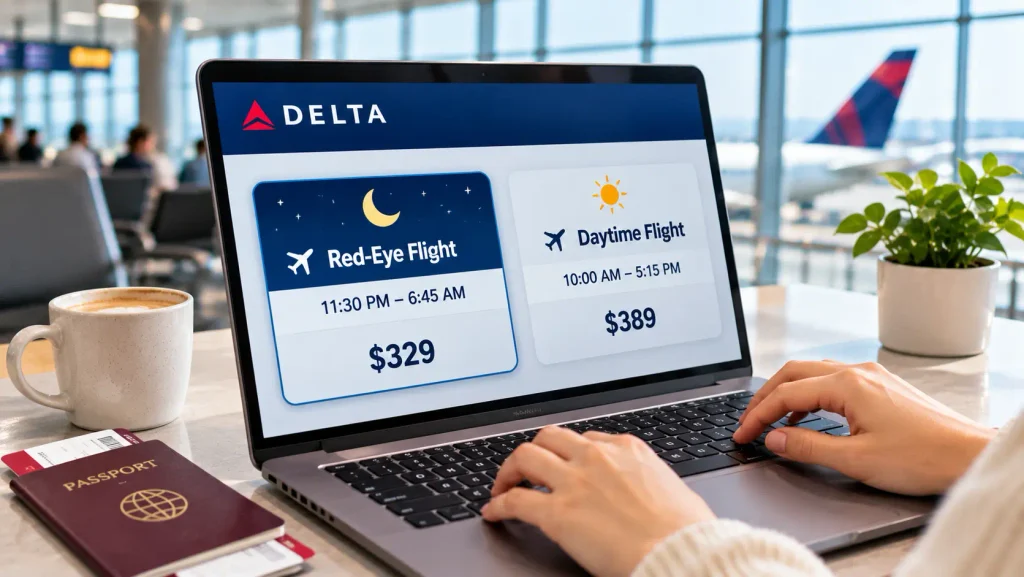
Delta red-eye flights can be cheaper than daytime services on certain routes, but overnight departures do not guarantee lower fares.
Airline pricing depends on demand, available seats, booking timing, travel dates, and fare restrictions.
Why Might Overnight Flights Cost Less?
Overnight flights may attract lower demand from travelers who prefer daytime departures or want to avoid sleeping on an aircraft.
When demand is lower, airlines may offer more competitive fares.
However, popular overnight routes can still command high prices, particularly during holidays, business travel periods, and busy vacation seasons.
How Can Travelers Compare Red-Eye and Daytime Fares?
Travelers should compare flights operating on the same route and date while accounting for baggage allowances, seating options, and other charges.
| Comparison factor | Red-eye flight | Daytime flight |
| Departure | Late evening or overnight | Morning, afternoon, or evening |
| Arrival | Often the following day | Usually the same day on domestic routes |
| Ticket price | May be lower or higher | May be lower or higher |
| Sleep opportunity | During the flight | Usually less important |
| Hotel planning | Early arrival may affect check-in | Depends on arrival time |
| Travel fatigue | Potentially greater | Depends on schedule |
| Airport transportation | May require late-night arrangements | Often more daytime options |
A lower ticket price does not necessarily represent the best overall value if the itinerary creates additional accommodation or transportation expenses.
Are Nonstop Red-Eye Flights Better Than Connecting Flights?
Nonstop red-eye flights are generally more convenient for passengers who want uninterrupted travel and a better opportunity to sleep.
Connecting itineraries may offer lower fares or additional route options, but they introduce another boarding process and potential connection delays.
Passengers should compare the total travel time rather than focusing exclusively on the advertised airfare.
When Is the Best Time to Book Delta Red-Eye Flights?
The best time to book a Delta red-eye flight depends on the route, season, and available fares rather than a fixed number of weeks before departure.
Travelers may find competitive prices by monitoring fares in advance and comparing several departure dates.
Should Passengers Book Red-Eye Flights Several Weeks Early?
Booking several weeks or months before departure can provide more flight choices, particularly on popular routes.
However, booking early does not guarantee the lowest fare. Prices may increase or decrease as demand and seat availability change.
Passengers should begin monitoring prices when their travel plans become reasonably certain.
Are Midweek Delta Red-Eye Flights Less Expensive?
Midweek red-eye flights may be cheaper on certain routes when passenger demand is lower.
Tuesday, Wednesday, and Thursday departures are worth comparing with weekend flights, but there is no universal rule that makes these dates consistently cheaper.
The departure date generally matters more than the day on which the ticket is purchased.
Can Flexible Travel Dates Help Travelers Find Lower Fares?
Yes. Flexible travel dates can help passengers identify less expensive overnight departures.
Travelers who can shift their journey by one or two days may discover different prices or more convenient schedules.
Comparing several dates is particularly useful for passengers without fixed business meetings, accommodation reservations, or connecting travel arrangements.
Should Travelers Set Price Alerts for Delta Red-Eye Flights?
Yes. Price alerts through supported flight comparison platforms can help passengers monitor changes in airfare.
Travelers can track a preferred route and receive notifications when the observed price changes.
However, a price alert does not guarantee that the fare will remain available when the passenger is ready to book.
What Are the Benefits of Flying Delta Red-Eye Flights?
Delta red-eye flights can help travelers preserve daytime hours, reach destinations earlier, and potentially find competitive fares on selected routes.
The benefits depend on the passenger’s schedule, sleep preferences, and destination.
Can Red-Eye Flights Save Travel Time?
Red-eye flights do not necessarily reduce the actual flight duration, but they can make better use of overnight hours.
For example, a passenger traveling from Los Angeles to New York may depart late in the evening and arrive the following morning.
This arrangement can leave more of the arrival day available for planned activities, provided the passenger is sufficiently rested.
Can Overnight Flights Reduce Accommodation Expenses?
Overnight flights may eliminate the need for an additional hotel night in certain circumstances.
However, early arrivals can create other expenses when hotel check-in is unavailable until the afternoon.
Passengers should compare accommodation costs and consider whether luggage storage or early check-in is available.
Are Airports Less Crowded During Red-Eye Departures?
Some airports experience lower passenger volumes late at night, but quieter terminals are not guaranteed.
Security checkpoint hours, terminal operations, and late-night flight schedules vary.
Travelers should not assume that shorter security queues eliminate the need to meet Delta’s recommended airport arrival times.
What Are the Disadvantages of Delta Red-Eye Flights?
The main disadvantages of Delta red-eye flights include limited sleep, travel fatigue, inconvenient departure times, and possible difficulty arranging transportation after arrival.
These challenges can be more noticeable on shorter overnight flights.
Can Red-Eye Flights Cause Sleep Disruption?
Yes. Sleeping on an aircraft can be difficult because of cabin noise, limited space, lighting, and interruptions.
Passengers may arrive feeling tired even after spending several hours on the aircraft.
The impact varies according to flight duration, seat comfort, personal sleep habits, and time-zone changes.
Are Short Red-Eye Flights Less Comfortable?
Shorter overnight flights may provide fewer opportunities for uninterrupted sleep.
Boarding, takeoff, cabin service, descent, and landing can occupy a significant portion of the journey.
Passengers should consider whether the available rest time justifies choosing an overnight departure.
Can Early Arrivals Create Transportation Problems?
Yes. Early-morning arrivals may occur before hotel check-in, public transportation services, or scheduled airport transfers become available.
Travelers should verify local transportation arrangements and accommodation policies before booking.
Which Delta Cabin Is Best for a Red-Eye Flight?
The most suitable Delta cabin for overnight travel depends on the passenger’s budget, desired comfort, and the aircraft operating the flight.
Some premium cabins provide additional space or lie-flat seating, while standard economy seating may be sufficient for shorter journeys.
Is Delta Main Cabin Suitable for Overnight Flights?
Delta Main Cabin, now marketed as Delta Main on eligible itineraries, provides standard economy seating and applicable onboard services.
Passengers can use travel pillows, eye masks, and other personal sleep accessories to improve comfort.
Seat pitch, recline, and available amenities vary by aircraft.
Is Delta Comfort Worth Considering for a Red-Eye Flight?
Delta Comfort may provide additional legroom and other eligible benefits compared with standard economy seating.
This can be useful for passengers who prefer more space during an overnight journey.
However, additional legroom does not guarantee better sleep, and the value depends on the upgrade cost and flight duration.
Does Delta One Offer Lie-Flat Seats on Red-Eye Flights?
Delta One offers lie-flat seating on eligible long-haul international and selected premium domestic routes.
These seats can provide a more comfortable sleeping environment during longer overnight flights.
However, Delta One is not available on every red-eye service, and aircraft configurations can differ.
Which Seat Is Better for Sleeping on a Red-Eye Flight?
Window seats are often preferred by passengers who want to rest without being interrupted by seatmates moving into the aisle.
Aisle seats provide easier access to the lavatory and more convenient movement.
Seats near galleys or lavatories may experience more passenger activity, although noise levels vary by aircraft.
What Food and Entertainment Does Delta Provide on Red-Eye Flights?
Delta provides onboard refreshments and entertainment according to the route, cabin, aircraft, and flight duration.
Passengers should not assume that every overnight flight includes a full meal or the same entertainment options.
Does Delta Serve Meals on Red-Eye Flights?
Meal availability varies by route and cabin class.
Some domestic overnight services may offer snacks and beverages rather than full meals, while eligible premium cabin and international flights can provide more substantial dining options.
Passengers should review the meal information associated with their itinerary.
Can Passengers Watch Movies During Overnight Flights?
Many Delta aircraft provide access to onboard entertainment, although the available system and content depend on the aircraft.
Travelers may find movies, television programs, music, or other entertainment options.
Passengers planning to sleep may prefer to use an eye mask and avoid extended screen time.
Does Delta Provide Pillows and Blankets on Red-Eye Flights?
Pillows and blankets may be provided on eligible long-haul and premium cabin services.
Availability is not uniform across all domestic overnight flights.
Passengers traveling in standard economy seating may prefer to carry a compact travel pillow and an additional clothing layer.
How Can Passengers Sleep Better on a Delta Red-Eye Flight?
Passengers can improve their chances of sleeping during a Delta red-eye flight by choosing a suitable seat, dressing comfortably, and preparing essential sleep accessories.
A comfortable overnight journey requires more than selecting a late departure.
What Should Travelers Pack for a Red-Eye Flight?
| Travel essential | Why it may help |
| Eye mask | Reduces exposure to cabin lighting |
| Earplugs | Limits background noise |
| Neck pillow | Supports the head while seated |
| Lightweight sweater | Helps with cabin temperature changes |
| Refillable water bottle | Supports hydration after security screening |
| Comfortable socks | Improves personal comfort |
| Headphones | Reduces unwanted distractions |
| Essential medications | Keeps necessary items accessible |
Passengers should keep important belongings in an accessible personal item rather than placing everything in the overhead bin.
Should Travelers Eat Before Boarding?
Eating before boarding may be useful when the overnight flight has limited meal service.
A light, familiar meal can help passengers avoid becoming hungry during the journey.
Travelers should also avoid relying on an onboard meal unless the service is confirmed for their itinerary.
Can Passengers Reduce Jet Lag on Overnight Flights?
Passengers may reduce some travel fatigue by following a consistent sleep schedule, adjusting to the destination’s local time, and allowing time to rest after arrival.
However, jet lag is primarily associated with crossing time zones, while an overnight domestic flight can cause tiredness even without a substantial time-zone change.
Should Passengers Schedule Important Activities Immediately After Arrival?
Passengers should allow recovery time when possible, particularly after a short overnight flight.
Although red-eye flights can preserve daytime hours, limited sleep may affect concentration and comfort.
Travelers attending important meetings or events should consider whether a daytime arrival or an earlier journey would provide better preparation.
How Can Travelers Book a Delta Red-Eye Flight?
Travelers can book Delta red-eye flights through the airline’s website, mobile app, or an eligible travel booking provider.
The reservation process is similar to booking a daytime flight, but passengers should pay particular attention to departure dates, arrival times, and fare conditions.
What Should Passengers Check Before Confirming a Red-Eye Booking?
Passengers should review the complete itinerary before purchasing an overnight ticket.
Important details include:
- Departure and arrival dates, including any next-day arrival.
- Total flight duration and connection times.
- Aircraft type and available seating.
- Cabin amenities and meal availability.
- Checked baggage and carry-on allowances.
- Ticket change and cancellation restrictions.
- Airport transportation availability.
- Hotel check-in arrangements after arrival.
Checking these details helps travelers avoid booking an overnight itinerary that creates unexpected scheduling complications.
Can Passengers Change or Cancel Delta Red-Eye Flights?
Yes. Delta red-eye flights can be changed or canceled according to the fare conditions and applicable airline policies.
Many eligible Delta Classic and Extra tickets originating in the United States and certain other markets do not carry standard change fees, although fare differences may apply.
Delta Basic tickets generally have more restrictive conditions and may involve applicable charges.
The overnight departure time does not create a separate cancellation policy.
Can Passengers Upgrade Their Delta Red-Eye Seats?
Yes. Eligible passengers may purchase available seat or cabin upgrades before departure.
Upgrade availability depends on the aircraft, route, fare conditions, and remaining seats.
Passengers should compare the upgrade price with the expected comfort benefits rather than assuming discounted upgrades will become available shortly before departure.
Conclusion
Delta red-eye flights provide a practical alternative for travelers who want to depart late, arrive the following day, and make efficient use of their travel schedules.
These overnight services can be particularly useful on long-distance domestic routes and international journeys. However, ticket prices, cabin comfort, and onboard amenities vary, so comparing itineraries is essential.
Passengers can find Delta red-eye flights by searching the airline’s website or mobile app, comparing departure times, and exploring alternative travel dates through flight search platforms.
While overnight travel can preserve valuable daytime hours, limited sleep and early arrival arrangements may create additional challenges. Choosing a suitable seat, preparing essential travel accessories, and allowing sufficient recovery time can make the journey more manageable.
Ultimately, the value of a Delta red-eye flight depends on how well its schedule, total cost, and available amenities match the passenger’s travel requirements.
Frequently Asked Questions
Delta red-eye flights generally depart late in the evening or overnight and arrive the following morning. Exact departure times vary by route and schedule.
Delta red-eye flights may be cheaper on certain routes, but lower prices are not guaranteed. Airfare depends on demand, travel dates, seat availability, and fare type.
Delta offers overnight travel options on selected Los Angeles–New York schedules. Passengers should check availability for their specific departure date.
Yes. Travelers can search Google Flights, select Delta Air Lines, and use departure-time filters to identify available overnight services.
Delta’s meal and snack services vary by route, cabin, and flight duration. Passengers should check their itinerary for applicable dining options.
Yes. Delta One provides lie-flat seats on eligible international and selected premium domestic routes. Not every overnight flight offers this cabin.
Yes. Delta operates overnight international flights, including selected services between the United States and European destinations.
Yes. Checked baggage is permitted according to the purchased fare and applicable baggage policy. Overnight departures do not create a separate baggage allowance.
The better option depends on the passenger’s schedule, budget, and ability to rest during overnight travel. Red-eye flights may preserve daytime hours, while morning departures may support a more regular sleep schedule.