
How To Get Between Terminals at Chicago O’Hare (ORD)
Chicago O’Hare International Airport (ORD) connects Terminals 1, 2, and 3 through pedestrian walkways, while travelers going to or from Terminal 5 can use the Airport Transit System (ATS) or, when eligible, the airside Terminal Transfer Bus. The best option depends on the departure terminal, whether the traveler has cleared security, the time of day, and whether the connection involves an international arrival.
O’Hare is a major connecting airport, and changing terminals is often straightforward once passengers know which transportation option to follow. However, the process differs for domestic connections, international arrivals, and travelers who need to leave the secure area to check in for another flight.
This guide explains how to move between all four terminals, where to find the ATS and transfer bus, how international connections work, and what to check before choosing a connecting flight.
Related: Admirals Club Chicago O’Hare: All 3 Lounges Reviewed.
O’Hare Terminal Transfers at a Glance
O’Hare has four numbered passenger terminals: 1, 2, 3, and 5. There is no Terminal 4 in the current passenger-terminal layout.
| Transfer situation | Recommended option | Important detail |
| Terminal 1 to Terminal 2 | Walk | Connected by indoor pedestrian walkways |
| Terminal 2 to Terminal 3 | Walk | Follow the terminal and gate signs |
| Terminal 1 to Terminal 3 | Walk | Allow extra time for the longer route |
| Terminal 1, 2, or 3 to Terminal 5 | ATS or Terminal Transfer Bus | Bus is restricted to eligible connecting passengers |
| Terminal 5 to Terminals 1, 2, or 3 | ATS or Terminal Transfer Bus | International arrivals must complete customs procedures first |
| Transfer outside the bus operating hours | ATS | Travelers using the landside route must pass security again |
| International arrival connecting to another flight | Follow customs and recheck instructions, then transfer | Most arriving international passengers must clear U.S. immigration and customs |
The ATS is a free, automated train system that connects the terminals and the airport’s Multi-Modal Facility. The Terminal Transfer Bus, by contrast, operates inside the secure area and is designed for eligible passengers making flight connections. These services are not interchangeable in every situation.
1. How To Get Between Terminals 1, 2, and 3
Passengers can walk between Terminals 1, 2, and 3 without taking a train or bus. These terminals have pedestrian connections, including secure-side walkways for travelers who are already past security.
For a connecting passenger whose arriving and departing flights are both within these terminals, walking is usually the simplest option. Follow the overhead signs for the destination terminal, concourse, or gate instead of heading to baggage claim or ground transportation.
Terminal 1 to Terminal 2
Terminal 1 and Terminal 2 are adjacent. Passengers can follow the pedestrian signage between them, including the airside walkway linking Terminal 1’s Concourse B area with Terminal 2’s gates.
Travelers should check the gate number before setting off. Reaching the correct terminal does not necessarily mean reaching the correct concourse or gate, and some gates require additional walking within the terminal.
Terminal 2 to Terminal 3
Pedestrian routes also connect Terminal 2 and Terminal 3. Travelers should follow the signs for Terminal 3 and the relevant concourse, then check the departure screens for the latest gate information.
For a connecting itinerary, walking between these terminals is generally more direct than exiting security to use the ATS. If the traveler has already passed security and remains in the secure area, the airside walkways can avoid an unnecessary trip through another checkpoint.
Terminal 1 to Terminal 3
Travelers can walk between Terminals 1 and 3 through the connected terminal complex. This is a longer walk than transferring between neighboring terminals, so passengers with a short connection should check their route and gate before leaving the aircraft area.
The airport’s physical layout, gate location, crowd levels, and walking pace all affect how long it takes. A connection from one end of Terminal 1 to a distant gate in Terminal 3 may take longer than a transfer between gates near the connecting walkway.
Can Passengers Walk Between Terminals Without Leaving Security?
Yes, passengers can walk between Terminals 1, 2, and 3 using the airside pedestrian connections, as long as they can remain in the secure area for their itinerary.
This is especially useful for domestic connections. However, passengers arriving on an international flight and needing to clear U.S. customs cannot simply follow the airside walkway to their next gate. They must first complete the required arrival formalities.
2. How To Get Between Terminals Using the Airport Transit System (ATS)
The Airport Transit System, commonly called the ATS, is O’Hare’s free automated train service. It connects passenger terminals to the airport’s Multi-Modal Facility, which includes the rental-car center and other ground-transportation connections.
The ATS is the main option for travelers who need to move between Terminal 5 and Terminals 1, 2, or 3 but cannot use the airside transfer bus. It also serves passengers traveling to or from the airport’s ground transportation facilities.
Where To Find the ATS at O’Hare
ATS station access varies by terminal, so follow the signs marked “ATS” and the train symbol.
- Terminals 1, 2, and 3: Follow the pedestrian bridge and station signs from the terminal complex.
- Terminal 5: Follow the ATS signs from the terminal’s public area.
- Multi-Modal Facility: Use the ATS for connections involving rental cars and other services located there.
Travelers arriving at Terminal 5 who need to transfer to another terminal should follow the train signs if they are using the landside route. Passengers should not assume that they can reach the ATS directly from an international arrival gate without first completing the required arrival procedures.
Is the ATS Free?
Yes. O’Hare’s ATS is a free airport transportation service. Passengers don’t need to buy a separate ticket to ride it between terminals.
However, the train ride itself is only one part of the transfer. Travelers using the ATS to reach a different departure terminal must allow time to find the station, ride the train, navigate the terminal, and clear security if required.
When Should Travelers Use the ATS?
The ATS is particularly useful when:
- Traveling between Terminal 5 and Terminals 1, 2, or 3.
- Transferring outside the Terminal Transfer Bus operating hours.
- Traveling between a passenger terminal and the Multi-Modal Facility.
- Arriving internationally and connecting to a flight that requires a new security screening.
- Traveling landside after collecting baggage or checking in for a separate ticket.
The ATS and terminal transfer bus serve different purposes. If a traveler is eligible to remain airside and the bus is running, the bus can avoid the need to exit security and be screened again. Outside the bus operating hours, the ATS is the alternative, but passengers should plan for security screening at the onward terminal.
3. How To Use the Terminal Transfer Bus
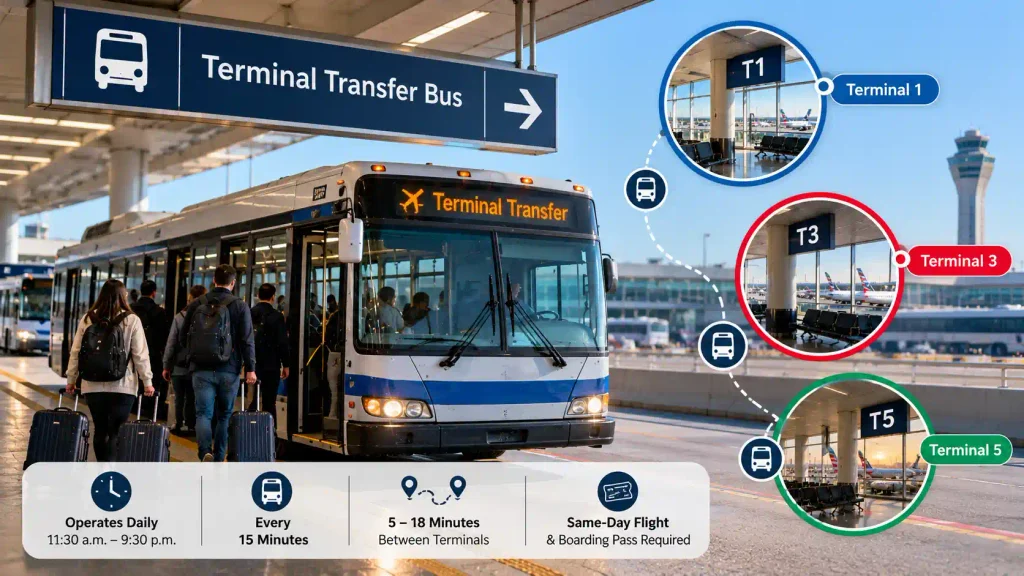
O’Hare operates a Terminal Transfer Bus (TTB) for eligible passengers connecting between Terminals 1, 3, and 5. Unlike the ATS, this bus operates inside the secure area, allowing eligible passengers to move between the terminals without exiting security and re-entering through a TSA checkpoint.
The bus is not a general-purpose shuttle for every airport visitor. Passengers must have a boarding pass and a same-day departing flight from the terminal to which they are transferring.
Current Bus Stops
According to the Chicago Department of Aviation, the Terminal Transfer Bus operates between Terminal 5 and Terminals 1 and 3. The Terminal 1 stop has been relocated because of construction.
| Terminal | Current pickup location |
| Terminal 1 | Gate C18B |
| Terminal 3 | Gates G17 and K20 |
| Terminal 5 | Gate M13 |
The Terminal 1 stop at Gate C18B is at the B/C tunnel level below Gate C18. The airport notes that the Gate K20 stop is not accessible. Travelers who require an accessible route should confirm the best boarding location and assistance options with airport staff.
Terminal Transfer Bus Operating Hours
The airport’s published schedule lists the bus as operating daily from 11:30 a.m. to 9:30 p.m., with departures approximately every 15 minutes. Travel times are estimates and may vary.
The airport’s published transfer-bus guide gives approximate travel times of:
| Route | Approximate travel time |
| Terminal 1 to Terminal 5 | 18 minutes |
| Terminal 5 to Terminal 1 | 13 minutes |
| Terminal 3 to Terminal 5 | 13 minutes |
| Terminal 5 to Terminal 3 | 5 minutes |
These are estimates for the bus journey, not guaranteed total transfer times. Passengers must also walk to the stop, wait for the bus, and reach the next gate after getting off. Allow additional time for boarding, delays, and walking through the terminal.
Who Can Use the Terminal Transfer Bus?
The service is intended for connecting passengers who have a same-day departing flight from the terminal they are transferring to. A boarding pass is required.
The bus can be especially useful for passengers arriving on domestic flights at Terminals 1, 2, or 3 and connecting to a departure from Terminal 5. It may also help eligible passengers traveling in the opposite direction.
However, the bus does not replace customs and immigration processing. Passengers arriving internationally at Terminal 5 generally must clear U.S. Customs and Border Protection and collect checked luggage before they can enter the public area. They should follow the airport’s instructions to recheck baggage and complete TSA screening before continuing their connection.
What If the Bus Is Not Running?
If the connection falls outside the published bus hours, passengers should use the ATS and allow time to clear security again at the departure terminal.
For example, someone arriving at Terminal 5 late at night for an early-morning departure from Terminal 1 should not build the connection around the transfer bus unless the operating schedule covers the planned transfer. The ATS route and the time needed for TSA screening should be part of the connection plan.
4. How To Transfer Between Terminals on an International Connection
International connections require additional planning because most international arrivals at O’Hare must complete U.S. immigration and customs procedures before continuing to another flight.
The exact process depends on the origin airport, whether the traveler has already completed U.S. preclearance, the ticket arrangement, and the baggage instructions.
International Arrival Connecting to a Domestic Flight
For most international arrivals, the general process is:
- Follow signs for U.S. Customs and Border Protection.
- Complete immigration and customs procedures.
- Collect checked luggage if instructed.
- Recheck luggage at the designated connection or airline counter, where available.
- Proceed to the departure terminal using the ATS or another permitted transfer option.
- Clear TSA security screening before reaching the domestic departure gate.
O’Hare states that passengers arriving internationally from locations without U.S. preclearance must clear customs and claim their checked luggage before entering the United States, including when they have a connecting flight. Connecting passengers may be able to recheck their luggage before re-entering security.
Some airports outside the United States offer U.S. preclearance. Passengers arriving from an eligible preclearance airport may follow a different arrival process, so they should follow the instructions given at the airport and on arrival at O’Hare.
International Arrival Connecting to Another International Flight
An international-to-international connection does not automatically mean that passengers can remain airside throughout the journey. At O’Hare, travelers arriving from most international destinations must complete the required U.S. entry procedures.
After customs, passengers should follow their airline’s instructions for checked baggage, check-in, terminal transfer, and security screening. Some travelers may need to move to another terminal and re-clear TSA security before boarding their onward flight.
Do Passengers Have To Collect Their Bags?
For most international arrivals that require U.S. entry processing, passengers must collect checked luggage during customs clearance. The airline or airport may then provide a designated bag-recheck point for connecting passengers.
For domestic connections, baggage handling depends on the ticket and airline arrangements. Travelers on separate tickets or different carriers should confirm whether they can check their bags through to the final destination or must collect them and check them in again.
Never assume that luggage will automatically transfer between airlines. Check the baggage tag and ask the airline if the final destination is unclear.
5. Which Airlines Use Each O’Hare Terminal?
O’Hare’s terminal assignments vary by airline and can change. Some airlines use more than one terminal, and an airline’s international and domestic flights may depart from different locations.
The following is a general orientation, not a substitute for checking the flight’s current terminal and gate.
| Terminal | General orientation |
| Terminal 2 | Used by a selection of domestic and regional airlines |
| Terminal 5 | Handles many international departures and arrivals, along with some domestic flights |
The airport’s airline directory and the traveler’s reservation are the best sources for current terminal information. Check the terminal and gate shown for the specific flight on the day of travel, especially when connecting between two airlines.
A codeshare flight can also complicate terminal planning: the airline selling the ticket may not be the airline operating the flight. Check the operating carrier’s instructions and the ticket information.
Read this blog: From G to L: A Practical Guide to All 3 Admirals Clubs at Chicago O’Hare.
6. How Much Time Should You Allow Between Terminals?
There is no single connection time that works for every O’Hare itinerary. The required time depends on the terminals, the distance between gates, whether the traveler needs to clear customs or security, baggage handling, and the transfer bus’s operating hours.
A short walk between nearby gates in Terminals 1 and 2 differs greatly from an international arrival at Terminal 5 followed by a domestic flight from Terminal 3.
Factors That Affect Transfer Time
- Terminal and gate distance: A terminal-to-terminal walk can be longer when the gates are at opposite ends of the concourses.
- Security screening: Travelers using the ATS to reach a departure terminal generally need to pass through TSA security.
- Immigration and customs: International arrivals may face queues and must complete the required entry procedures.
- Baggage: Collecting, rechecking, or checking in luggage adds time.
- Bus schedule: The Terminal Transfer Bus runs at set intervals and is not available around the clock.
- Flight delays: A delayed inbound flight can shorten the connection window.
- Airline arrangements: Separate tickets may provide less protection if the inbound flight arrives late.
When booking a connection, check the airline’s minimum connection time and allow extra time if the itinerary involves customs, baggage collection, a terminal change, or separate tickets. A technically permitted connection may still feel rushed during a busy travel period.
Final Takeaway
For most transfers between Terminals 1, 2, and 3 at O’Hare, walking is the simplest option. Terminal 5 requires the ATS or the airside Terminal Transfer Bus, depending on the traveler’s eligibility, connection, and time of day.
Before departure, verify the terminal and gate, confirm whether you must collect or recheck baggage, and check the current bus stop and operating hours on the official O’Hare connecting traveler page. For international connections, allow enough time for customs, baggage handling, and any required TSA screening, rather than planning only for the transfer journey.
Frequently Asked Questions
Yes. The free Airport Transit System connects all passenger terminals and the Multi-Modal Facility. Eligible connecting passengers can also use the Terminal Transfer Bus between Terminals 1, 3, and 5 during its operating hours.
Eligible passengers may use the airside Terminal Transfer Bus when it is operating, and they meet the boarding-pass requirements. Travelers using the ATS must exit the secure area and go through TSA screening at their departure terminal.
No. The airport’s published schedule lists daily service from 11:30 a.m. to 9:30 p.m., with buses approximately every 15 minutes. Outside those hours, passengers should use the ATS and allow time for security screening.
The current Terminal 1 pickup location is Gate C18B, at the B/C tunnel level below Gate C18. The stop was relocated because of construction. Check the airport’s latest signage before heading to the bus.
There is no airside pedestrian walkway connecting Terminal 3 directly to Terminal 5. Travelers should use the Terminal Transfer Bus if eligible and operating, or take the ATS.
It depends on the route. Travelers walking between Terminals 1, 2, and 3 while remaining airside generally do not need to clear security again. Passengers who exit the secure area and use the ATS to reach another departure terminal must pass through TSA screening there.
Most arriving international passengers must complete immigration and customs procedures and collect checked luggage before entering the United States. They should follow airline and airport instructions for baggage recheck, terminal transfer, and TSA screening before boarding the next flight.
No. O’Hare’s current passenger terminals are numbered 1, 2, 3, and 5. Travelers should use the terminal number shown on their flight information.