
Air France Boarding Groups and Process: Everything to Know
Air France uses five numbered boarding zones, plus preboarding for eligible passengers who need extra assistance or time, to organize boarding. Your assigned zone depends primarily on your travel cabin and Flying Blue or SkyTeam status, and it appears on your boarding pass. Knowing your zone, recognizing priority-boarding eligibility, and arriving at the gate on time can help make departure more predictable.
The boarding process moves passengers onto the aircraft in an organized sequence. La Première, Business, and eligible SkyPriority customers receive priority treatment, while passengers in other cabins board according to their assigned zones. Boarding times and some benefits vary by airport, fare, frequent-flyer status, and whether Air France or a partner airline operates the flight.
This guide explains Air France boarding groups, preboarding, priority eligibility, boarding deadlines, and practical ways to prepare for departure.
Air France Boarding Groups at a Glance
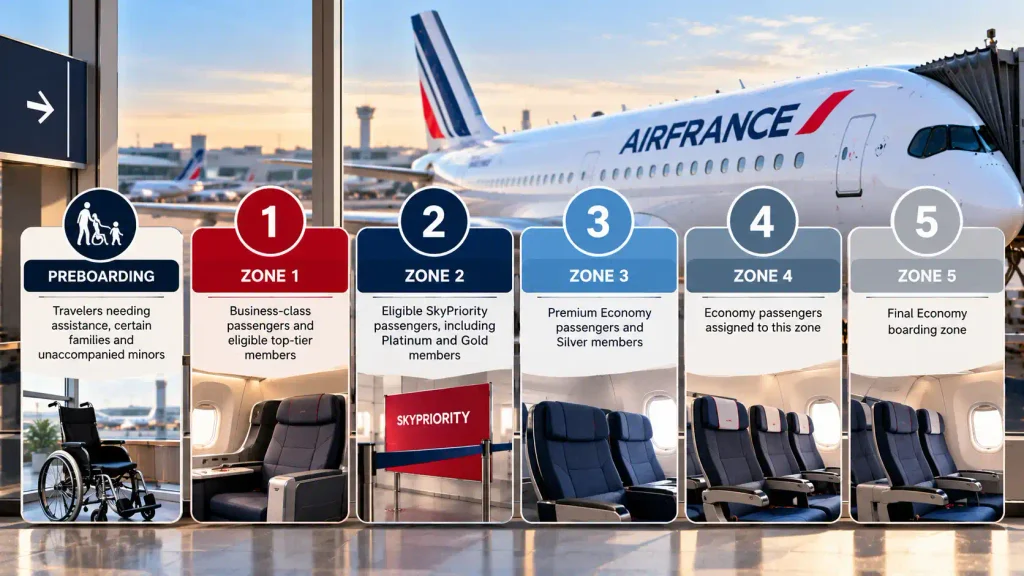
Air France assigns passengers to boarding zones numbered 1 through 5. Preboarding happens before the numbered zones are called, for eligible travelers who need extra time or assistance. The airline’s official guidance confirms that the assigned zone appears on the boarding pass and that boarding normally proceeds from Zone 1 to Zone 5.
| Boarding group | Who generally boards in this group |
| Preboarding | Eligible passengers needing assistance or extra time, including certain families and unaccompanied minors |
| Zone 1 | Business-class passengers, Flying Blue Ultimate members, and eligible invitation-only status members |
| Zone 2 | Eligible SkyPriority passengers, including Flying Blue Platinum and Gold members and SkyTeam Elite Plus members |
| Zone 3 | Premium Economy passengers, Flying Blue Silver members traveling in Economy, and eligible Air France KLM Visa Signature cardholders |
| Zone 4 | Economy passengers assigned to this zone |
| Zone 5 | Final Economy boarding zone, including passengers traveling on Economy Light fares when assigned here. |
Related: Air France Review: Seats, Services, Baggage, Fees, and More
1. Who Can Board Before the Numbered Zones?
Preboarding happens before the airline starts calling Zones 1 through 5. It is intended for passengers who need extra time or assistance getting onto the aircraft.
Depending on the flight and airport procedure, this can include passengers with reduced mobility, unaccompanied minors, and families traveling with young children. The reference guide identifies families with children aged six and under among those offered preboarding.
Preboarding is not the same as holding a numbered priority zone. It is a separate stage of the boarding process intended to accommodate particular needs before the main passenger flow begins.
Passengers Who Need Mobility Assistance
Passengers who have difficulty walking, navigating the airport, or boarding the aircraft should arrange assistance in advance whenever possible. This gives the airline and airport staff time to understand the passenger’s requirements and coordinate the appropriate service.
Passengers should not assume that every accessibility need automatically results in the same boarding arrangement at every airport. Assistance procedures can differ by airport, aircraft, and type of support required. Travelers should contact Air France before departure if they need help and follow the instructions provided for their flight.
Families Traveling With Young Children
Families with young children may be invited to board before the numbered zones. This gives them extra time to settle into their seats, organize essential items, and help children get comfortable before the main boarding flow begins.
The reference guide identifies families traveling with children aged six and under as eligible for preboarding. Because procedures may vary, families should listen for the gate announcement and ask airline staff if they are unsure whether they should board early.
For example, a family traveling with a five-year-old should pay attention to the preboarding announcement rather than automatically joining Zone 1 or Zone 2. Their assigned numbered zone may still appear on the boarding pass, but gate staff can explain when they should board.
Unaccompanied Minors
Unaccompanied minors may also receive boarding assistance before the main zones are called. Children traveling without a parent or guardian under the airline’s unaccompanied-minor arrangements should follow the instructions provided during booking and check-in.
The process may involve airline staff coordinating the child’s movement to the aircraft and confirming the appropriate handover arrangements. Parents or guardians should follow the airline’s current instructions rather than assume every child traveling alone follows the same procedure.
2. Air France Zone 1: Business Class and Top-Tier Members
Zone 1 is the first numbered boarding zone. It generally includes passengers traveling in Business class, Flying Blue Ultimate members, and certain invitation-only Flying Blue status members, including Club 2000 and Skipper.
Eligible companions traveling on the same itinerary as a member with qualifying Ultimate, Club 2000, or Skipper status may also be assigned to Zone 1 under the process described in the reference guide. Travelers should check their own boarding passes rather than assume that everyone in a group automatically receives the same zone.
Business-Class Passengers
Business-class passengers generally board in Zone 1 on Air France-operated flights covered by the airline’s standard zone system. Priority boarding lets them board before most Economy passengers and gives them more time to settle in before departure.
The benefit is part of the wider premium-cabin airport experience. Eligible passengers may also have access to SkyPriority services, depending on the ticket and itinerary. However, priority boarding should not be confused with a guarantee that every airport service or benefit is identical across all routes.
Flying Blue Ultimate, Club 2000, and Skipper Members
Flying Blue Ultimate is a top-tier status level in Air France-KLM’s loyalty program. The reference guide also lists invitation-only Club 2000 and Skipper status holders in Zone 1.
For these travelers, boarding priority depends on loyalty recognition rather than the booked cabin. Eligible companions may receive the same Zone 1 assignment when traveling on the same itinerary, subject to the applicable conditions.
A passenger with qualifying status should check the boarding pass to confirm the zone assigned for the specific flight. If the displayed zone appears inconsistent with the passenger’s eligibility, airline staff can clarify the assignment before boarding begins.
3. Air France Zone 2: SkyPriority and Elite Status
Zone 2 is another priority boarding group. The reference guide identifies Flying Blue Platinum and Gold members, as well as passengers with SkyTeam Elite Plus status from other airlines, among those assigned to this zone when they do not qualify for an earlier group.
Air France’s SkyPriority service offers eligible passengers priority treatment at designated airport touchpoints, including check-in, baggage drop-off, and boarding. The exact services available depend on the airport and itinerary.
Flying Blue Platinum and Gold Members
Flying Blue Platinum and Gold members generally qualify for Zone 2 when their cabin or other eligibility does not place them in Zone 1. For example, an eligible Gold member traveling in Economy may board in Zone 2 rather than waiting for the regular Economy zones.
When more than one rule applies, Air France generally assigns the passenger to the higher-priority zone. A qualifying Gold member traveling in Business class, for example, would normally be placed in Zone 1 with other Business-class passengers.
The zone printed on the boarding pass is still the practical reference for boarding. Travelers should not rely solely on a membership card or an assumption based on their usual benefits.
SkyTeam Elite Plus Members
SkyTeam Elite Plus members from partner airlines may also qualify for Zone 2 on eligible Air France flights. This is useful for travelers who earn status through another airline in the SkyTeam alliance but are flying with Air France.
The precise benefit can depend on the operating airline and the services offered on the itinerary. A flight carrying an Air France flight number but operated by a partner may not provide every standard Air France priority service. Travelers should check the operating-carrier details and the benefits confirmed for their booking.
What Is SkyPriority?
SkyPriority is a priority airport service available to eligible passengers. Air France identifies passengers in La Première, Business, and Premium cabins, SkyTeam Elite Plus members, and certain qualifying fare holders as eligible for SkyPriority on its flights. The airline’s published eligibility rules also include passengers traveling on qualifying Flex fares on routes between France and Europe or North Africa, and passengers with eligible Discount Passholder fares.
SkyPriority eligibility is generally indicated by the SkyPriority logo on the boarding pass. At the airport, passengers can follow the corresponding signs to find the appropriate services or boarding lane.
It is important to distinguish SkyPriority from a numbered boarding zone. SkyPriority customers generally board in Zone 1 or Zone 2, but the assigned zone depends on the applicable eligibility rules. Official boarding guidance also says SkyPriority customers may board at their convenience, so they should follow the instructions at their gate.
4. Air France Zone 3: Premium Economy and Other Eligible Travelers
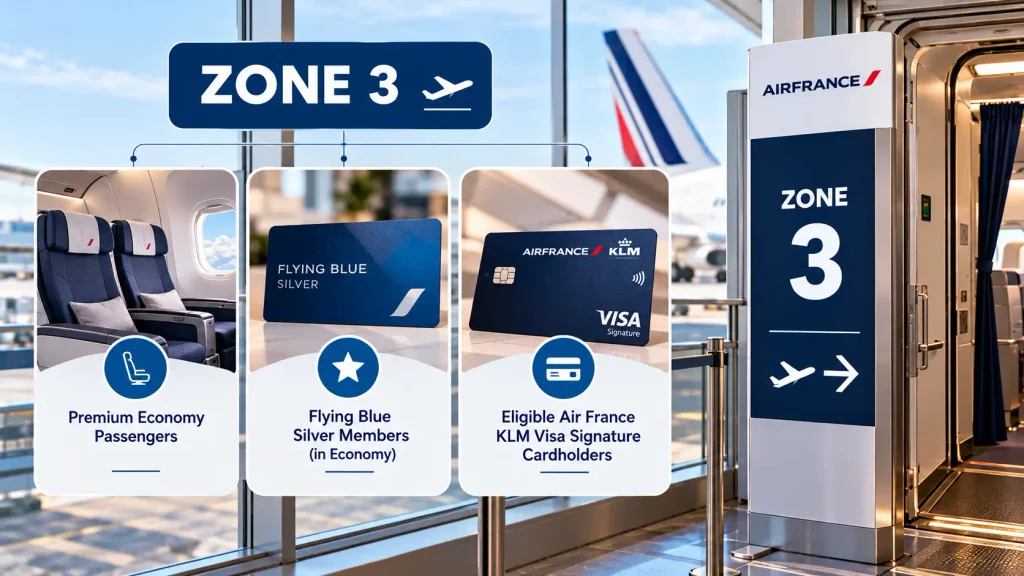
Zone 3 generally includes Premium Economy passengers, Flying Blue Silver members traveling in Economy, and certain eligible Air France KLM Visa Signature cardholders.
This zone sits between the higher-priority groups and the standard Economy boarding groups. It can therefore provide earlier access to the aircraft than Zone 4 or Zone 5, depending on the passenger’s eligibility and assigned zone.
Premium Economy Passengers
Passengers traveling in Premium Economy are generally assigned to Zone 3 under the process described in the reference guide. The cabin offers a separate travel class between Economy and Business, and its boarding position reflects that distinction.
Premium Economy boarding does not mean the passenger receives every benefit available to Business-class or SkyPriority customers. Travelers should distinguish between cabin-specific benefits and broader airport services tied to specific status levels or fares.
Flying Blue Silver Members
Flying Blue Silver members traveling in Economy are generally assigned to Zone 3. This gives eligible members an earlier boarding position than many other Economy passengers.
The zone can change if another benefit or cabin assignment takes precedence. For example, a passenger who qualifies for an earlier zone through a premium cabin or higher status should follow the earlier assignment shown on the boarding pass.
Eligible Air France KLM Visa Signature Cardholders
The reference guide identifies the Air France KLM Visa Signature credit card, issued by Bank of America, as offering a priority boarding benefit that can place eligible cardholders in Zone 3. This applies when the cardholder does not already qualify for an earlier zone through status or Business-class travel.
Because credit card benefits can be updated and may have eligibility conditions, cardholders should check the current terms issued by the card provider. They should also confirm the boarding zone shown on their Air France boarding pass rather than assuming the card automatically changes each flight’s assignment.
You May Also Like: KLM Royal Dutch Airlines Review
5. Air France Zone 4: Standard Economy Boarding
Zone 4 is the first numbered boarding zone for many Economy passengers. Travelers assigned to this group should wait until the gate staff announces Zone 4 before joining the boarding line.
Economy boarding position can depend on the ticket, Flying Blue status, and any other qualifying benefit. Passengers who do not qualify for a higher-priority zone may be assigned to Zone 4 or Zone 5.
The zone system is intended to reduce gate congestion and help passengers board in a more organized sequence. Waiting for the correct call also helps prevent crowding around the boarding scanner and allows staff to process each group efficiently.
How to Prepare for Zone 4
Before Zone 4 is announced, passengers can make the boarding process easier by keeping their boarding pass and travel documents accessible, checking the gate display, and organizing their hand baggage.
For instance, a traveler assigned to Zone 4 can wait near the designated boarding area without standing in the Zone 1 or Zone 2 line. When Zone 4 is called, the passenger can join the correct queue and present the boarding pass for scanning.
Passengers should avoid blocking the gate entrance while waiting. Boarding zones organize the line and don’t require every traveler to stand beside the scanner throughout the process.
6. Air France Zone 5: The Final Boarding Group
Zone 5 is the final numbered boarding zone for Economy passengers. The reference guide identifies passengers traveling on Economy Light fares among those who board in this group when assigned there.
Economy Light is Air France’s name for a basic Economy fare option. However, the fare name alone should not replace the zone printed on the boarding pass: the passenger’s assigned group is the one to follow for the specific flight.
Does Boarding Last Mean a Passenger Will Miss the Flight?
No. Being assigned to Zone 5 does not mean that a passenger is expected to miss the flight. It means the passenger should wait until Zone 5 is called and then board in the final numbered group.
The practical consideration is overhead-bin space. Passengers boarding later may find fewer convenient spaces available for cabin baggage, particularly on a busy flight. Travelers should comply with the baggage rules for their ticket and follow any instructions from the gate or cabin crew if a bag must be placed in the hold.
If overhead-bin space is limited, the airline may ask passengers to check certain compliant bags at the gate. Keep essential items such as medication, travel documents, and valuables accessible, following the airline’s instructions and applicable baggage rules.
Can a Zone 5 Passenger Board Earlier?
Passengers should not assume they can join an earlier zone simply because they arrive at the gate early. Air France’s boarding process depends on the assigned zone, cabin, and eligibility. Travelers who believe their zone is incorrect should ask airline staff to check their booking before boarding begins.
Official boarding guidance also says passengers who miss the moment their zone is called can still board as long as that zone has already been called. They should join the appropriate line and follow staff instructions. This is different from trying to board before their zone is eligible.
7. How to Find Your Air France Boarding Zone
Air France displays the boarding zone on the boarding pass. Passengers can access their pass through the airline’s website or mobile app, or get it at the airport during check-in.
To identify the zone:
- Open the boarding pass for the correct flight.
- Look for the boarding-zone or zone-number field.
- Check the gate and departure information.
- Follow the signage for the assigned zone.
- Wait until staff announces the zone before joining the boarding line, unless gate staff provides different instructions.
If a passenger’s boarding pass shows Zone 2, for example, the passenger should look for the Zone 2 boarding area and wait until it is called. If the pass shows Zone 5, the passenger should not enter the Zone 1 or Zone 2 queue simply because it is moving sooner.
If the zone is missing, unclear, or doesn’t match the passenger’s cabin or status, airport staff can verify the assignment. This is better than guessing, especially for passengers who believe they qualify for priority boarding.
8. Practical Tips for a Smoother Air France Boarding Experience
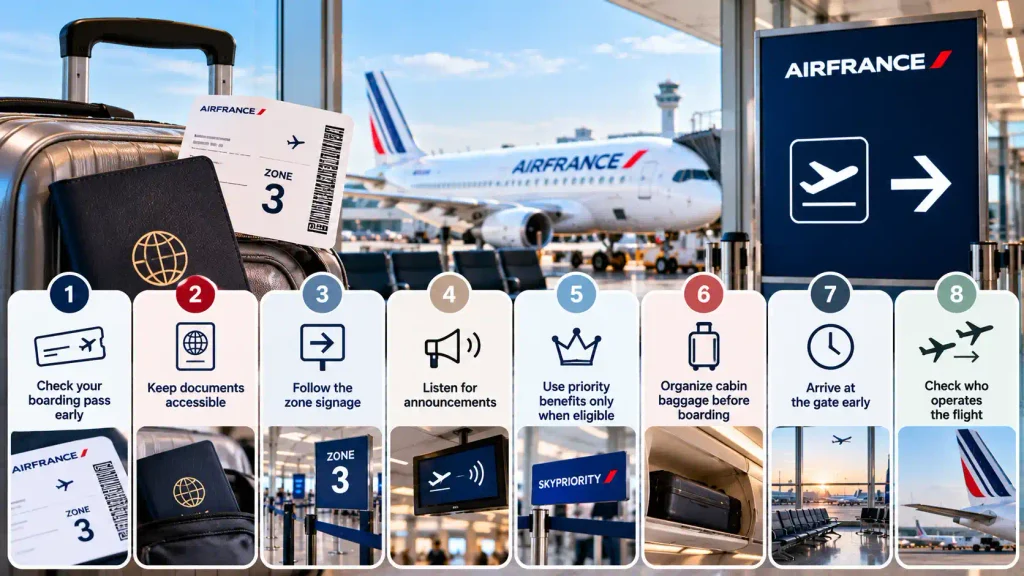
A little preparation can help passengers avoid confusion at the gate and reduce the chance of missing the boarding deadline.
Check the boarding pass early. Confirm the assigned zone as soon as the pass becomes available. This gives passengers time to resolve any questions about cabin, status, or eligibility before reaching the gate.
Keep documents accessible. Have your boarding pass and any required travel documents ready as you approach the scanner. This can help you and those waiting behind you avoid delays.
Follow the zone signage. Air France uses signs to identify the appropriate boarding areas. Join the line for the assigned zone rather than the shortest or fastest-moving queue.
Listen for announcements. Airport displays and the Air France app can help communicate changes, but gate announcements provide immediate instructions. Passengers should stay aware of updates, particularly when departure times change.
Use priority benefits only when eligible. A premium cabin, qualifying status, or other eligible benefit may provide an earlier zone or SkyPriority access. Passengers should rely on their boarding pass and current program terms rather than assumptions.
Organize cabin baggage before boarding. Keep essential items within reach and know which bag goes under the seat, where applicable. This reduces time spent rearranging luggage in the aisle and helps other passengers reach their seats.
Do not wait until the deadline. Boarding can close before the scheduled departure time. Arriving at the gate early is safer than assuming that the aircraft will still accept passengers at the last minute.
Check who operates the flight. On a codeshare or partner-operated service, some benefits and boarding arrangements may differ from those on an Air France-operated flight. Review the operating-carrier details and instructions for the actual flight.
Final Takeaway
Air France’s boarding process is easier to navigate when passengers understand their zone before reaching the gate. Preboarding accommodates eligible passengers who need extra time or assistance, while Zones 1 through 5 organize the rest of the boarding sequence by cabin, loyalty status, and other qualifying benefits.
Before departure, check your boarding pass, confirm the operating airline, monitor gate announcements, and note the boarding deadline. Those steps are more reliable than assuming a zone based solely on ticket type or frequent-flyer status. For the most accurate instructions, use the information displayed for the specific flight and follow the gate team’s directions.
Frequently Asked Questions
Air France generally boards eligible passengers who need extra time or assistance first, then Zones 1 through 5. Zone 1 includes Business-class passengers and certain top-tier Flying Blue members, while Zone 5 is the final numbered Economy group.
Zone 3 generally includes Premium Economy passengers, Flying Blue Silver members traveling in Economy, and eligible Air France KLM Visa Signature cardholders who do not qualify for an earlier zone. Passengers should follow the assignment on the boarding pass.
Business-class passengers generally board in Zone 1 on Air France-operated flights covered by the standard boarding-zone process. For partner-operated flights, procedures and benefits may differ, so passengers should check the instructions for their specific itinerary.
Yes. Air France’s official boarding guidance says passengers who couldn’t board when their zone was called can still board as long as that zone has already been called. They should go to the appropriate line and follow gate staff instructions.
The reference guide gives a deadline of 20 minutes before departure for most flights and 15 minutes before departure for domestic flights from Paris-Orly. Travelers should verify the deadline for their specific flight and arrive at the gate well before it.
Flying Blue Silver members traveling in Economy are generally assigned to Zone 3 under the process described in the reference guide. The exact zone depends on the cabin and any other qualifying benefit shown for the flight.
No. SkyPriority services depend on eligibility, the airport, and the itinerary. Eligible passengers should look for the SkyPriority logo on their boarding pass and follow airport signage to the services available for their journey.
The reference guide identifies Economy Light passengers among those assigned to Zone 5, but passengers should follow the zone printed on their own boarding pass. A different qualifying status or benefit may affect the assigned zone.