
ANA or JAL? A Guide to Domestic First Class in Japan!
Japan Airlines currently offers the more traditional domestic First Class experience in Japan, while ANA’s First Class (formerly Premium Class) is particularly compelling for travelers who prioritize generous legroom, lounge access, dining, and Star Alliance benefits. The difference is less about one airline being universally better and more about what a traveler values: JAL has a more exclusive cabin and stronger premium ground-and-catering package, while ANA offers an excellent wide-seat product with substantial legroom and a broader Premium Class foodifferwo largest full-service airlines, All Nippon Airways (ANA) and Japan Airlines (JAL), compete extensively on major domestic routes. Both offer premium cabins on selected flights, but their products are not identical.
One important terminology change also matters in 2026: for flights departing from May 19, 2026, ANA changed the reservation-search display from “Premium Class” to “First Class (Premium Class).” ANA says the naming change did not alter the underlying service.
JAL, meanwhile, continues to market its highest domestic cabin simply as First Class.
This comparison examines the areas that matter most before booking: aircraft and seats, airport treatment, lounges, food and drinks, service, baggage, routes, upgrades, mileage, and overall value.
ANA vs. JAL Domestic First Class at a Glance
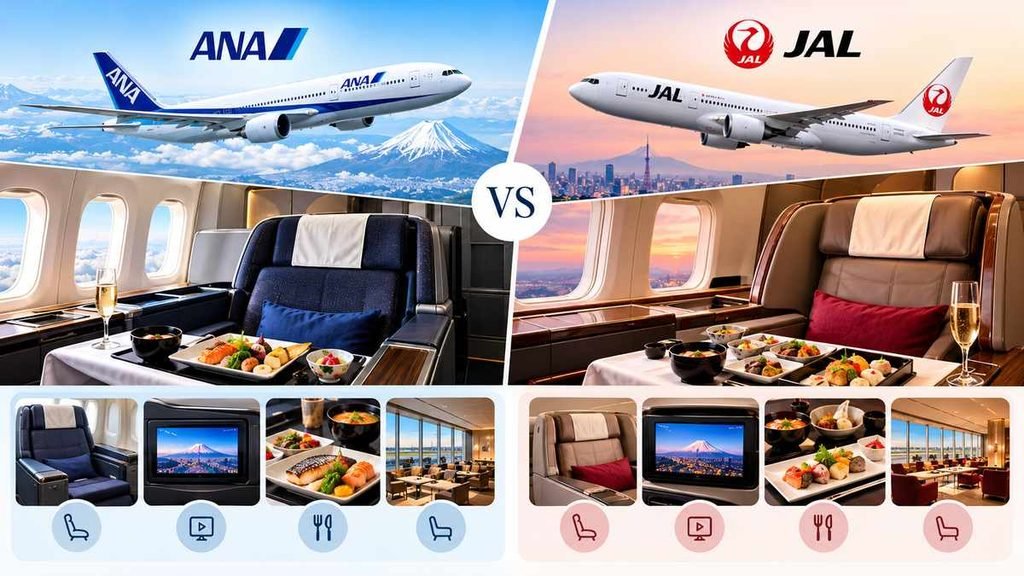
| Feature | ANA First Class (Premium Class) | JAL Domestic First Class |
| Official cabin name | First Class (Premium Class) in current booking displays | First Class |
| Main premium aircraft | Boeing 777-200, 787-9, 787-10 and other configurations | Airbus A350-900, Boeing 787-8, Boeing 767 |
| Seat experience | Wide electric recliners; selected aircraft have 127 cm pitch | Large-shell premium seats; A350 pitch about 134 cm |
| Personal screen | 15.6-inch on selected 777-200/787-9/787-10 configurations | 15.6-inch on A350/787 First Class |
| Meal | Premium Class seasonal meals | Breakfast, lunch/dinner menus based on departure time |
| Alcohol | Premium beverage selection | Champagne, sake, wine, beer, shochu and other drinks |
| Lounge | ANA Lounge at eligible airports | Diamond Premier/JAL First Class Lounge or Sakura Lounge depending on airport |
| Checked baggage | Up to 32 kg per bag; allowance varies by fare | Up to 45 kg total, max 32 kg per item |
| Priority boarding | Premium Class ground services | First Class priority boarding |
| Same-day upgrade | Available under ANA’s applicable rules | Available from 3 hours before departure if seats remain |
| Award availability | ANA domestic awards do not directly book Premium Class; miles can be used for eligible upgrades | JAL domestic awards can include First Class |
| Best suited to | Star Alliance travelers, spacious seating, ANA network | Dedicated First Class experience, food, privacy and premium ground service |
The aircraft assigned to an individual flight matters considerably. ANA and JAL both operate multiple aircraft types domestically, so the seat shown in a review is not necessarily the seat a traveler will receive.
1. ANA and JAL Use Different Definitions of “First Class”
The biggest source of confusion is that ANA and JAL do not position their domestic premium cabins in exactly the same way.
ANA historically called its service change cabin Premium Class. From May 19, 2026, ANA’s booking system began displaying it as Premium Class. Still, the airline explicitly states that the terminology change does not represent a change in service as the name of its highest domestic cabin.
That distinction matters because comparing ANA Premium Class directly with JAL First Class can create the impression that the two products are designed to be identical. They are not.
ANA’s offering combines a premium reclining seat, lounge access, priority services, meals, drinks, and other amenities. JAL’s First Class adds a particularly private seat design on its A350 and 787 aircraft, premium airport treatment, a generous baggage allowance and a more elaborate food-and-beverage program.
For a traveler booking simply because the reservation screen says “First Class,” checking the aircraft and actual cabin configuration is therefore essential.
2. JAL Has the More Distinctive Premium Seat
If the seat itself is the deciding factor, JAL has a particularly strong proposition on its newer domestic First Class aircraft.
JAL’s A350-900 and 787-8 First Class seats use large shells and center dividers to create a more private environment. In terms of space, the seat offers a roomy 134 cm of pitch and 51 cm of width, while JAL lists a 15.6-inch personal screen, power outlets, USB, storage, motorized controls, and a massage function.
The A350 First Class cabin has a more enclosed feel than a conventional domestic premium recliner. The divider can also be moved when two passengers are traveling together.
JAL’s 767 First Class product is different, with leather seating and a separate configuration. JAL specifically warns that seat specifications can vary by aircraft and route.
What does ANA offer?
All Nippon Airways premium seats on the Boeing 777-200, 787-9 and 787-10 feature electric reclining, personal monitors, power, USB connectivity, larger dividers, a footrest and additional storage. The published seat pitch for these configurations is approximately 127 cm.
That is a substantial amount of legroom for a domestic flight.
For example, a traveler flying Tokyo Haneda to another major Japanese city may spend only one or two hours in the air, but the additional leg support can make the premium cabin noticeably more comfortable than standard economy.
Seat comparison
JAL: stronger emphasis on privacy and a first-class-style personal space.
ANA: exceptionally generous legroom and a comfortable reclining seat, particularly on its newer wide-body configurations.
The aircraft assignment can change the equation, so travelers should check the seat map before paying a substantial premium.
3. JAL Has a More Comprehensive First Class Food-and-Drink Program
Food is another major distinction.
ANA’s Premium Class serves seasonal meals created by its culinary team, with menus determined partly by the departure time. ANA also provides an extensive beverage selection.
ANA describes its Premium Class dining as a seasonal restaurant-style experience, with Japanese and Western dishes depending on the menu.
JAL’s domestic First Class has an equally structured meal program. Breakfast is served on flights departing before 10:29 a.m.; lunch is associated with departures from 10:30 a.m. through 4:59 p.m.; and dinner is offered on flights departing from 5 p.m. onward. The airline says dinner menus can involve collaborations with restaurants and high-end establishments around Japan.
JAL’s beverage list includes:
- Champagne
- Japanese sake
- Shochu
- Red and white wine
- Beer
- Coffee and tea
- Japanese green tea
- Soft drinks
- Mineral water
- Consommé soup
The exact products can change, so travelers should treat the current onboard menu rather than an older review as the definitive reference.
Which matters more?
For travelers who view premium flying as a culinary experience, JAL’s structured First Class dining and beverage offering is a significant attraction.
ANA’s food is also a central part of its Premium Class product, so the distinction is not between “meal” and “no meal.” It is more about presentation, beverage program and the overall premium atmosphere.
4. JAL Has the Stronger Dedicated First Class Ground Experience
Before boarding, JAL gives its First Class passengers several priority services.
JAL provides dedicated First Class check-in counters at many airports. At Hiroshima and Kagoshima, dedicated First Class counters are not available, but First Class passengers receive priority treatment. Ishigaki also provides priority handling rather than a dedicated First Class counter.
First Class passengers receive:
- Priority check-in
- Up to 45 kg of free checked baggage
- Priority boarding
- Highest-priority baggage delivery
- Access to eligible JAL lounges
The baggage allowance is especially notable: JAL permits up to 45 kg total, although no individual checked bag can exceed 32 kg.
ANA also provides dedicated Premium Class counters at applicable airports and priority baggage handling.
For ANA’s current domestic First Class fares, the free checked baggage allowance can reach 32 kg per bag, with the number of bags depending on the fare. For example, ANA’s current Flex and Standard First Class fares list 32 kg and up to three bags, while some lower-priced First Class fares allow two bags.
This makes JAL’s 45 kg total particularly attractive for travelers carrying substantial luggage.
5. Lounge Access Is Excellent on Both, but the Experience Depends on the Airport
Lounge access is included with both premium products at qualifying airports.
ANA Premium Class passengers can use ANA Lounges at airports including Haneda, New Chitose, Sendai, Komatsu, Itami, Okayama, Hiroshima, Matsuyama, Fukuoka, Kagoshima and Naha, among others, with shared lounges available at some airports.
ANA also permits one accompanying passenger into the ANA Lounge when the relevant eligibility requirements are met.
JAL First Class passengers can use the Diamond Premier Lounge where available or the Sakura Lounge at other qualifying airports. JAL describes Diamond Premier as its highest domestic lounge tier.
JAL is also changing the branding of selected lounges. In autumn 2026, the Haneda domestic North Wing Diamond Premier Lounge is scheduled to reopen under the JAL First Class Lounge name, with the Diamond Premier Lounges at other airports also being renamed subsequently.
Therefore, lounge comparison should be made according to the departure airport, not just the airline.
6. ANA Has a Particularly Interesting Advantage for Star Alliance Travelers
Frequent flyers should consider loyalty-program implications before deciding between the two airlines.
ANA is part of Star Alliance, while JAL belongs to oneworld. This can affect mileage earning, elite benefits and how a traveler builds status across an international itinerary.
ANA states that Japan domestic Premium Class receives a 50% bonus-mile component for the applicable Premium Points calculation, while its current domestic mileage rules vary according to fare type.
There is also a major distinction in award booking.
ANA’s current domestic award rules state that domestic flight awards themselves are not available directly in Premium Class. However, eligible economy tickets can be upgraded using ANA miles under the domestic upgrade-award program, subject to fare and availability rules.
ANA also allows paid upgrades from eligible economy fares from 24 hours before departure until 20 minutes before departure, provided Premium Class seats remain available. The fee varies by flight segment.
JAL’s program works differently. JAL domestic award tickets can be redeemed for First Class, Class J or Economy Class, although premium cabins are not offered on every route, flight or aircraft.
JAL also permits same-day paid upgrades to First Class when seats are available. Its current First Class information says same-day upgrades begin three hours before departure.
For points-and-miles travelers, this can make JAL’s First Class particularly interesting because the premium cabin can be booked directly as an award.
7. Route and Aircraft Availability Can Matter More Than the Airline
The best premium cabin is irrelevant if it is not operating on the route and date a traveler needs.
JAL currently lists First Class on selected flights across 10 domestic routes, including:
- Tokyo Haneda–Osaka Itami
- Tokyo Haneda–Sapporo New Chitose
- Tokyo Haneda–Hiroshima
- Tokyo Haneda–Fukuoka
- Tokyo Haneda–Kagoshima
- Tokyo Haneda–Okinawa Naha
- Tokyo Haneda–Ishigaki
- Tokyo Haneda–Miyako
- Osaka Itami–Sapporo New Chitose
- Osaka Itami–Okinawa Naha
JAL notes that some routes, particularly Haneda–Ishigaki and Haneda–Miyako, are subject to limited-period availability.
For fiscal 2026, JAL also introduced First Class on selected Itami–New Chitose flights operated with First Class-equipped aircraft.
ANA has a broader domestic premium-cabin footprint, but the aircraft and exact premium-seat configuration vary. ANA’s current seat information includes premium configurations on Boeing 777-200, 787-9, and 787-10 aircraft, as well as other aircraft configurations.
The practical rule
Do not search only for “ANA First Class” or “JAL First Class.”
Instead, search for:
Route → date → flight number → aircraft → seat map → premium cabin.
For example, two flights between the same cities can potentially use different aircraft, resulting in different seats and cabin layouts.
ANA vs. JAL: Which Has Better Service?
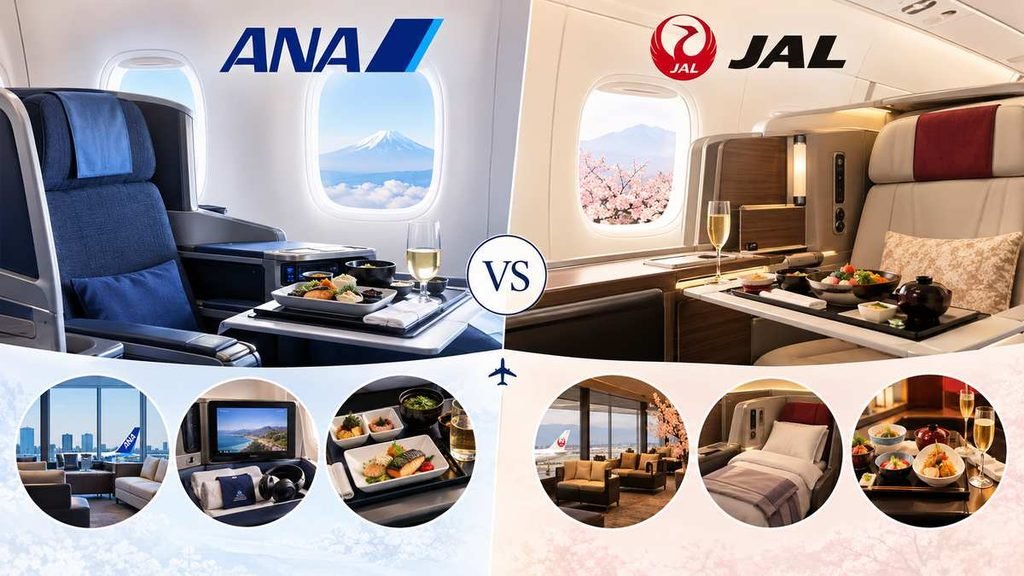
Both airlines have strong reputations for attentive Japanese hospitality, but the onboard experience can feel different.
JAL’s First Class product is designed around a more exclusive cabin environment, with privacy features, premium dining, and a dedicated First Class service structure. Its ground experience also includes priority boarding and baggage delivery.
ANA’s Premium Class offers a similarly polished experience, with dedicated airport services, lounge access, a generous seat, seasonal meals, drinks, and amenities such as blankets, slippers, and headphones.
Service quality can vary by crew and flight length, so don’t treat individual reviews as proof that every flight will be identical.
Is ANA or JAL Better for a Long Domestic Flight?
For a longer Japanese domestic sector, both premium cabins become more useful because there is enough flight time to take advantage of the meal, reclining seat, and lounge.
JAL’s advantage: the larger-shell seat on A350/787 aircraft, premium meal and beverage service, and strong airport treatment.
ANA’s advantages: generous legroom, comfortable electric reclining seats, personal entertainment on selected aircraft, lounge access, and strong Star Alliance integration.
For a traveler flying several hours between Tokyo and Okinawa, Ishigaki or another distant destination, the aircraft type deserves particular attention.
What About Short Domestic Flights?
On a short flight, the difference becomes more about airport benefits and the seat than dining.
A traveler flying a short Tokyo–Osaka sector may spend relatively little time in the air. In that situation, lounge access, priority baggage, boarding, and seat comfort can be more valuable than the meal itself.
This is also where paying a large cash premium can be harder to justify. Travelers should compare the premium fare against the standard economy fare rather than assuming the most expensive cabin automatically provides proportional value.
Which Airline Is Better for Families?
Both can work well for families, but JAL has an especially useful advantage for travelers carrying significant checked luggage because First Class provides up to 45 kg of free checked baggage in total, subject to the 32 kg per-item limit.
ANA First Class can also provide generous baggage allowances, but the exact number of bags depends on the fare type.
Families should also check the aircraft’s seating arrangement before booking. A seat map can reveal whether a particular First Class cabin has a configuration suitable for traveling together.
Can Travelers Upgrade to ANA or JAL First Class?
Yes, but the mechanisms differ.
ANA
ANA Airways offers both paid and mileage-based upgrade options for eligible domestic tickets.
The paid upgrade window begins 24 hours before departure and closes 20 minutes before departure, subject to eligibility, availability, and a segment-specific fee.
ANA also introduced a domestic upgrade-award program for eligible flights departing from May 19, 2026, allowing Mileage Club members to use miles for upgrades.
JAL
JAL offers same-day First Class upgrades when seats are available, with applications beginning three hours before departure. Additional fees apply.
JAL also allows First Class awards through its domestic award program, although availability varies.
Travelers should therefore check the upgrade rules for the exact ticket rather than assuming every economy fare can be upgraded.
ANA vs. JAL: Which One Should Travelers Choose?
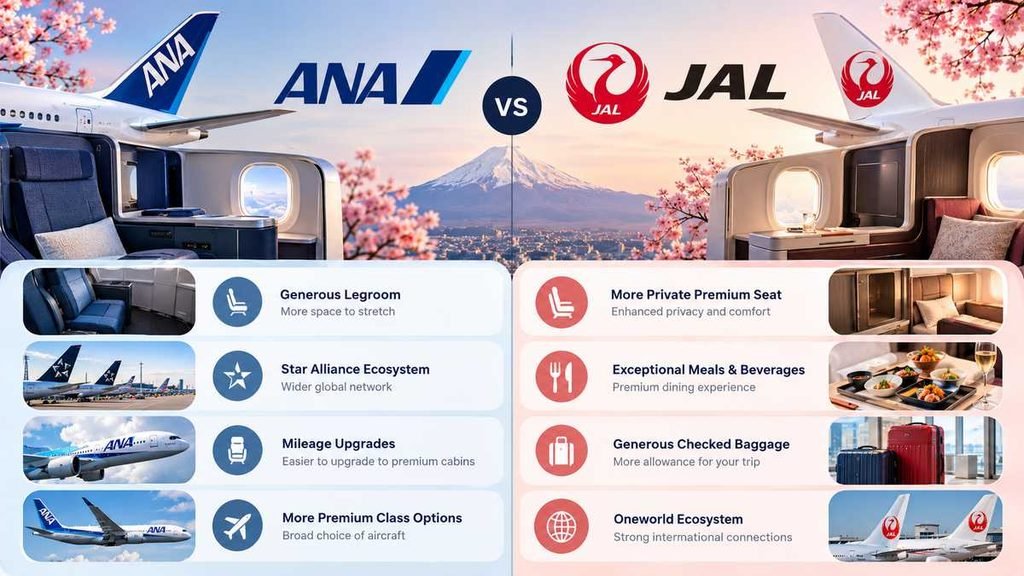
The comparison is easiest when broken down by priority rather than assigning a single universal winner.
| Traveler priority | More relevant option |
| More private premium seat | JAL |
| Large-shell A350 First Class | JAL |
| Generous legroom | ANA |
| Premium meal and beverage experience | JAL |
| Heavy checked luggage | JAL |
| Star Alliance ecosystem | ANA |
| Oneworld ecosystem | JAL |
| Domestic award First Class | JAL |
| Mileage upgrade to ANA premium cabin | ANA |
| Broad choice of ANA Premium Class aircraft | ANA |
| Premium ground treatment | JAL |
| Short flight where lounge/boarding matter | Either, depending on airport |
| Long domestic flight | Either; check aircraft first |
The table should be read as a feature comparison, not a universal ranking. Aircraft, route, fare, availability and loyalty-program circumstances can change the practical choice.
How Much Should Travelers Pay for Domestic First Class?
There is no single useful nationwide price because Japanese domestic fares fluctuate according to route, travel date, fare type, seat availability and booking timing.
The important calculation is the incremental cost.
For example, if an economy ticket costs ¥15,000 and First Class costs ¥30,000, the traveler is effectively paying ¥15,000 more for the premium package. That extra amount buys more than the seat: lounge access, premium meals and drinks, priority services and additional baggage benefits can all be part of the equation.
For a short flight, that difference may be difficult to justify for some travelers. On a longer flight where the passenger can use the lounge, eat a full meal and spend several hours in the premium seat, the additional cost can provide more practical value.
What Should Travelers Check Before Booking?
Before choosing ANA or JAL domestic First Class, travelers should verify five things:
- Aircraft type – the premium seat varies substantially between aircraft.
- Flight number – premium service may be available only on selected flights.
- Current fare difference – compare the premium fare with economy rather than judging value in isolation.
- Lounge at the departure airport – access and lounge type vary by airport.
- Mileage or upgrade options – award availability and upgrade eligibility depend on the ticket and program.
These checks are particularly important because Japanese domestic schedules and aircraft assignments can change.
Final Verdict: ANA vs. JAL Domestic First Class
Japan Airlines is the more traditional domestic First Class proposition, particularly for travelers who prioritize a private premium seat, premium dining, generous checked baggage and a strong airport experience. ANA is an excellent alternative for passengers who value legroom, ANA Lounge access, seasonal Premium Class dining and the Star Alliance ecosystem.
The most important lesson is that the airline name alone should not determine the booking. A traveler comparing Tokyo–Fukuoka flights, For example, should check the actual aircraft, seat map, fare difference, lounge, upgrade availability and mileage options before paying for First Class.
Frequently Asked Questions
ANA offers a domestic premium cabin that is displayed as First Class (Premium Class) in its current reservation system. ANA previously called the cabin Premium Class and says the 2026 naming change did not change the service itself.
No. Both are premium domestic cabins, but their seats, baggage policies, lounges, food programs and award rules differ. JAL’s A350 First Class, for example, uses a large-shell seat with approximately 134 cm of pitch, while ANA’s selected wide-body Premium Class seats list approximately 127 cm of pitch.
Yes. JAL serves meals based on the scheduled departure time, with separate breakfast, lunch and dinner offerings. Menus can include seasonal Japanese and Western dishes and restaurant collaborations.
Yes, eligible ANA domestic Premium Class passengers receive access to ANA Lounges at qualifying airports, with shared-lounge arrangements at some locations.
JAL currently provides up to 45 kg of free checked baggage in First Class, with a maximum of 32 kg for an individual item. ANA’s current First Class fares provide 32 kg per bag, with the number of bags depending on the fare.
Yes. JAL’s domestic award program permits redemptions for First Class on eligible flights, although First Class is not available on every domestic route, flight or aircraft.
ANA’s current domestic award rules state that domestic flight awards are not available directly in Premium Class. Eligible economy tickets can instead be upgraded using ANA miles under the applicable domestic upgrade-award rules.
No. JAL First Class is offered only on selected flights and routes. Its current list covers 10 domestic routes, and some availability is seasonal or limited to aircraft equipped with First Class seats.