
12 Best Places to Visit in Greece for Your Next Trip
Greece’s 12 best places to visit include Athens, Thessaloniki, Meteora, Nafplio, Corfu, Crete, Mykonos, Santorini, Milos, Naxos, Paros, and Delphi, covering ancient landmarks, archaeological sites, dramatic mountains, beaches, island villages, food, and distinct regional cultures. The country is much more varied than its postcard-famous islands: mainland Greece combines major historical centers with mountain landscapes and archaeological treasures. In contrast, the Aegean and Ionian islands offer very different scenery and experiences.
Your choice depends heavily on the type of trip. Athens works well for history and city life, Santorini for volcanic scenery and caldera views, Naxos for beaches and rural landscapes, and Meteora and Delphi for travelers interested in history, religion, and dramatic inland scenery. The following guide examines each destination independently and explains what makes it worth including in a Greek itinerary.
How to Choose Where to Go in Greece
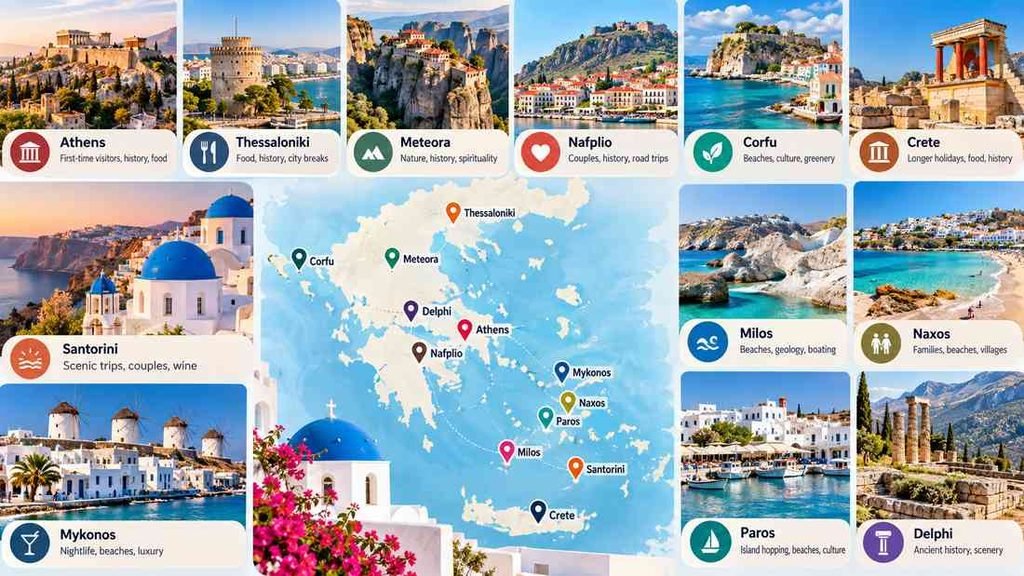
Greece is not one uniform beach destination. Its geography stretches from the mountains of mainland Greece to the Cyclades in the Aegean and the Ionian Islands in the west. That means two destinations only a few hours apart can offer completely different experiences.
| Destination | Best suited to | Key experience |
| Athens | First-time visitors, history, food | Acropolis and city neighborhoods |
| Thessaloniki | Food, history, city breaks | Byzantine and multicultural heritage |
| Meteora | Nature, history, spirituality | Monasteries on rock pillars |
| Nafplio | Couples, history, road trips | Old Town and Peloponnese excursions |
| Corfu | Beaches, culture, greenery | UNESCO-listed Old Town |
| Crete | Longer holidays, food, history | Knossos, beaches and mountains |
| Mykonos | Nightlife, beaches, luxury | Little Venice and windmills |
| Santorini | Scenic trips, couples, wine | Caldera and volcanic landscape |
| Milos | Beaches, geology, boating | Sarakiniko and Kleftiko |
| Naxos | Families, beaches, villages | Long beaches and mountain villages |
| Paros | Island hopping, beaches, culture | Naoussa and Cycladic villages |
| Delphi | Ancient history, scenery | Sanctuary of Apollo |
The choice also depends on the season. July and August are generally the busiest summer months for popular islands, while spring and early autumn can provide a more comfortable combination of sightseeing weather and outdoor activities. For travelers planning an itinerary around archaeological sites, inland destinations such as Delphi and Meteora are worth considering outside the hottest part of summer.
1. Athens
Athens is the natural starting point for many Greece trips because it combines the country’s most recognizable ancient monument with a large, contemporary city. The Acropolis, Parthenon, Acropolis Museum, Ancient Agora and surrounding historic districts provide an unusually concentrated introduction to classical Greek history. At the same time, neighborhoods such as Plaka, Psyrri and Exarchia give the city a more modern character through restaurants, cafés, galleries and street art. Greece’s official tourism authority describes Athens as a city where ancient monuments, neoclassical architecture and contemporary neighborhoods coexist.
What to do: Visit the Acropolis early in the day, explore the historic center on foot, spend time at the Acropolis Museum and sample Greek food in local markets and tavernas.
Best for: First-time visitors, history, museums, food and short city breaks.
Practical tip: Athens is also an important transportation hub. Athens International Airport is Greece’s principal international gateway, with domestic services connecting the capital to mainland destinations and islands.
2. Thessaloniki
Northern Greece’s largest city offers a different urban experience from Athens. Thessaloniki developed through Greek, Roman, Byzantine, Ottoman, and Jewish influences, leaving archaeological remains, churches, monuments, and neighborhoods that reveal different periods of its history. The waterfront, White Tower, and Upper Town are among its most recognizable areas. At the same time, the city’s food culture makes it particularly appealing for travelers who want to combine sightseeing with regional cuisine.
Thessaloniki can also serve as a base for excursions into northern Greece. Historical sites associated with ancient Macedonia, including Pella and Vergina, are accessible from the wider region, while Mount Olympus provides opportunities for hiking and nature-focused trips.
What to do: Walk the waterfront, see the White Tower, explore Ano Poli, visit Byzantine monuments, and try local specialties such as bougatsa.
Best for: Food lovers, history enthusiasts, urban travelers, and visitors wanting to see northern Greece.
Why add it: Thessaloniki offers a useful contrast to Greece’s island-focused image and fits naturally into a broader mainland itinerary.
3. Meteora
Meteora is one of Greece’s most distinctive inland destinations, where Orthodox monasteries sit dramatically above enormous sandstone rock formations. The landscape is both geological and cultural: centuries of erosion produced the towering formations, while monks established communities in the cliffs and caves from the medieval period onward. The Meteora complex is recognized as a UNESCO World Heritage Site for its combined natural and cultural importance.
Six historic monasteries remain operational today, and visitors can combine monastery visits with hiking, photography, and viewpoints around Kalabaka and Kastraki. Some trails provide a closer look at the rock formations without requiring a strenuous climb.
What to do: Visit the monasteries, hike around the rock pillars, photograph the landscape at sunrise or sunset, and explore nearby Kalabaka.
Best for: Nature, photography, hiking, history and religious heritage.
Practical tip: Dress respectfully when visiting monasteries, and check individual opening schedules before setting out because access arrangements can vary.
4. Nafplio
Nafplio is a historic seaside city in the Peloponnese and a practical stop for travelers exploring the region by road. Its architecture reflects centuries of Venetian, Ottoman and Greek influence, while Palamidi Fortress overlooks the city and the Argolic Gulf. The old town is compact enough to explore on foot, with neoclassical buildings, narrow streets, waterfront restaurants and small squares.
Its location is arguably as important as the town itself. Nafplio works as a base for visiting major archaeological sites in the Peloponnese, including Mycenae and Epidaurus. Travelers interested in Greek wine can also explore the Nemea wine region.
What to do: Climb to Palamidi Fortress, walk the old town, visit Bourtzi and plan day trips to Mycenae and Epidaurus.
Best for: Couples, history-focused road trips, architecture and travelers exploring the Peloponnese.
Practical tip: Nafplio makes more sense as part of a mainland itinerary than as a standalone destination reached solely for its beaches.
5. Corfu
Corfu stands apart from the Cycladic islands through its lush landscape and strong Venetian, French, and British influences. The island’s UNESCO-listed Old Town features arcaded streets, historic buildings, churches, and fortifications, while outside the capital lie olive groves, mountain villages, coves, and beaches.
The island is also known for its food and cultural traditions. Visitors can spend one day walking through Corfu Town and another exploring the countryside or coastline. Boat trips can extend the experience to nearby Paxos and Antipaxos.
What to do: Explore Corfu Old Town, visit the Old Fortress, see Saint Spyridon Church, discover mountain villages and spend time along the coastline.
Best for: Beach holidays, culture, greenery, food and travelers who prefer the Ionian Islands.
Practical tip: Corfu’s greener landscape and architectural character make it noticeably different from the dry, whitewashed appearance associated with many Cycladic islands.
6. Crete
Crete is Greece’s largest island and a destination that can justify a longer stay. Its attractions range from Minoan archaeological sites and Venetian old towns to beaches, mountains, gorges, vineyards and villages. The island has more than 1,000 kilometers of coastline, according to Greece’s official tourism authority.
Knossos near Heraklion is the island’s most famous archaeological attraction, while Chania offers a historic Venetian harbor and access to destinations such as Balos, Elafonisi and Samaria Gorge. Rethymno adds another well-preserved historic center, and eastern Crete offers places such as Elounda and Spinalonga.
Crete’s cultural significance also received a major update in 2025, when UNESCO added its Minoan Palatial Centers—including Knossos, Phaistos, Malia, Zakros, Zominthos and Kydonia—to the World Heritage List.
What to do: Visit Knossos, explore Chania, hike a gorge, sample Cretan cuisine and spend time at the beaches.
Best for: Families, food lovers, history enthusiasts, and travelers planning a week or longer.
Practical tip: Because Crete is large, travelers should avoid trying to cover the entire island in only a few days.
7. Mykonos
Mykonos is widely associated with nightlife and luxury travel, but its appeal extends beyond clubs and beach parties. Mykonos Town has narrow pedestrian streets, whitewashed buildings, small churches, and the famous Little Venice waterfront. The island’s traditional windmills remain among its defining landmarks.
A major advantage is the combination of daytime sightseeing and evening entertainment. Travelers can spend the morning exploring historic areas, the afternoon at a beach, and the evening dining or visiting bars.
Mykonos is also a convenient base for a visit to Delos, an important archaeological site in the Cyclades. Delos has extensive remains from the Archaic, Classical and Hellenistic periods and is traditionally associated with Apollo and Artemis.
What to do: Walk Mykonos Town, see the windmills, visit Little Venice, enjoy the beaches and take a trip to Delos.
Best for: Nightlife, upscale holidays, beach clubs, shopping and island hopping.
Practical tip: Mykonos can be significantly busier during peak summer, so travelers seeking a quieter experience should consider shoulder-season dates.
8. Santorini
Santorini is famous for its volcanic caldera, cliffside settlements and views across the Aegean. Major volcanic activity shaped the island, creating the distinctive caldera landscape seen from Fira, Oia, and other villages along the rim. Official tourism information highlights its volcanic beaches, caldera views and historic settlements.
The island is more than a sunset destination. Travelers can visit the archaeological site at Akrotiri, explore vineyards, take boat trips around the caldera and see beaches with black, red or otherwise volcanic terrain. Santorini’s distinctive grape-growing traditions also make wine an important part of its tourism identity.
What to do: Walk between Fira and Oia, visit Akrotiri, take a caldera cruise, sample local wines and explore volcanic beaches. Best for couples, scenery, photography, wine and short island stays.
Practical tip: The cliffside paths can involve considerable walking and stairs. Comfortable footwear helps, especially for travelers staying in elevated villages.
9. Milos
Milos offers a different visual identity from the classic white-and-blue Cycladic image. Its volcanic geology has produced unusual coastlines, colorful rock formations, sea caves, and beaches. Sarakiniko, with its bright white rock formations, is one of the island’s most recognizable landscapes, while Kleftiko is known for sea caves and dramatic rock formations accessible by boat. Greece’s tourism authority describes Milos as having more than 70 beaches.
Milos is particularly appealing to travelers who want to combine beach time with geology and boating. A boat excursion can reach sections of the coast that are difficult to access overland.
What to do: Visit Sarakiniko, take a boat trip to Kleftiko, explore fishing villages and discover beaches along the volcanic coastline.
Best for: Beaches, photography, boating, geology and travelers wanting a less conventional Cycladic landscape.
Practical tip: Boat trips are particularly useful because some of Milos’ most impressive coastal formations are best viewed from the water.
10. Naxos
Naxos is the largest and one of the most agriculturally productive islands in the Cyclades. It combines long sandy beaches with mountain villages, fertile valleys, traditional food and historical sites. The island’s landscape makes it particularly versatile: visitors can swim in the morning and drive into the mountains or explore villages later in the day.
Naxos Town, or Chora, features a Venetian castle and narrow streets, while the Portara—the monumental marble gateway associated with an unfinished temple of Apollo—is one of the island’s best-known sights. Inland villages such as Apeiranthos provide a different perspective on island life.
What to do: Visit Portara, swim at Agios Prokopios or Plaka, explore mountain villages and sample local cheeses, potatoes and citron-based products.
Best for: Families, beaches, food, hiking and travelers who want more variety than a traditional resort island.
Practical tip: Naxos is a strong option for travelers who want a Cycladic island experience without limiting the trip to beaches and nightlife.
11. Paros
Paros combines beaches, traditional villages, water sports, history, and a lively social scene. In the Cyclades, the island is known for its distinctive white architecture and its historic connection to Parian marble, widely used in ancient Greek sculpture and architecture.
Naoussa is one of the island’s most recognizable settlements, with a picturesque harbor and Venetian remains. Lefkes provides a quieter inland alternative, while beaches and watersports make the coastline attractive for active travelers.
Paros also works particularly well on an island-hopping itinerary because it pairs well with nearby Antiparos and other Cycladic destinations.
What to do: Explore Naoussa, visit Panagia Ekatontapiliani, walk through Lefkes, spend time at the beaches and try sailing or windsurfing.
Best for: Island hopping, beaches, couples, food and travelers wanting a balance between activity and relaxation.
Practical tip: Approach Paros as a destination with several distinct areas rather than a single beach resort.
12. Delphi
Delphi is one of Greece’s most important ancient sites and a top choice for travelers who want to understand the religious and political significance of ancient Greece. The sanctuary was associated with Apollo and the Oracle of Delphi, and the archaeological complex occupies a dramatic mountainside overlooking the surrounding landscape.
The archaeological site includes remains connected with the Sanctuary of Apollo, theater, stadium, and other monuments, while the nearby archaeological museum displays important artifacts discovered in the area. Delphi’s mountain setting also means the visit is as much about scenery as archaeology.
Travelers can combine Delphi with nearby Arachova, a mountain town known for traditional architecture and its position on the slopes of Mount Parnassus.
What to do: Walk the archaeological site, visit the museum, see the Temple of Apollo, and explore Arachova.
Best for: Ancient history, archaeology, mountain scenery and cultural travel.
Practical tip: Delphi works particularly well as a mainland excursion from Athens or as part of a wider central Greece road trip.
How Long Should a Greece Trip Be?
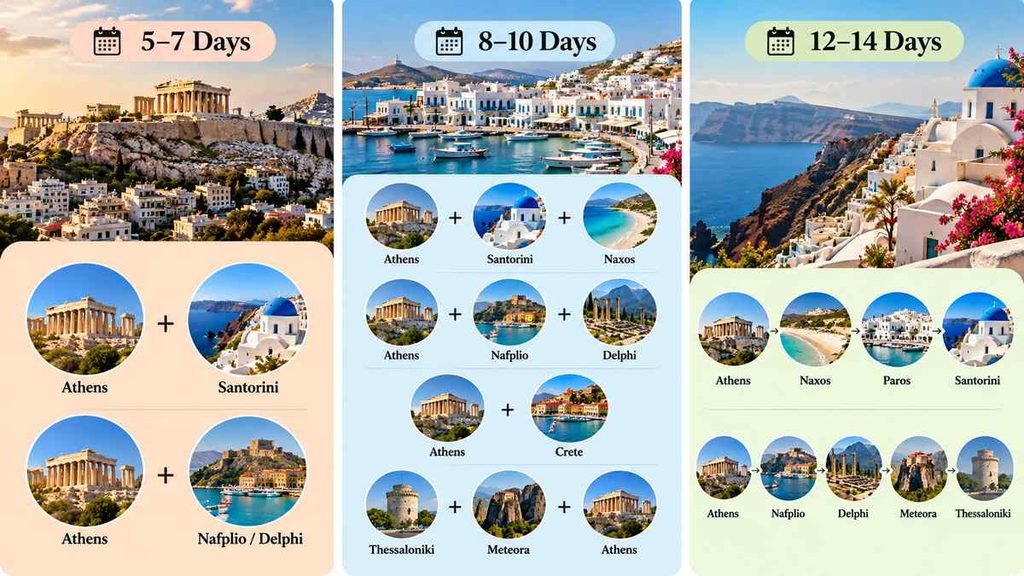
The ideal length depends on how many regions a traveler wants to combine.
For 5–7 days
A shorter trip should focus on Athens plus one additional destination. Athens and Santorini are a straightforward combination for first-time visitors who want ancient history and an iconic island landscape.
Another option is Athens with Nafplio or Delphi for a predominantly mainland itinerary.
For 8–10 days
Travelers can comfortably combine Athens with two or three additional destinations. For example:
- Athens + Santorini + Naxos
- Athens + Nafplio + Delphi
- Athens + Crete
- Thessaloniki + Meteora + Athens
The key is to avoid spending too much vacation time changing hotels and catching ferries.
For 12–14 days
A two-week trip allows greater regional variety. A traveler might combine Athens, a mainland historical destination, and two or three islands.
For example, Athens → Naxos → Paros → Santorini provides a classic Cycladic itinerary, while Athens → Nafplio → Delphi → Meteora → Thessaloniki focuses more heavily on history and mainland scenery.
When Is the Best Time to Visit These Greek Destinations?
For many travelers, May, June, September, and early October offer a useful balance of warm weather, outdoor sightseeing, and fewer peak-season pressures than July and August. However, the ideal period depends on the destination and activities.
| Travel period | What it can suit |
| April–May | Archaeological sites, hiking, city sightseeing |
| June | Beaches, island trips, outdoor activities |
| July–August | Swimming, nightlife and peak summer atmosphere |
| September | Beaches, sightseeing and island hopping |
| October | Mainland touring, food, culture and milder conditions |
| November–March | City breaks and cultural travel, with more limited island services |
The Greek islands also have different seasonal patterns. Popular destinations such as Mykonos and Santorini are busiest in summer, while mainland attractions such as Athens, Delphi, and Meteora are easier to incorporate in spring or autumn.
Travelers should also check ferry and flight schedules for the exact dates. Seasonal transportation can change, particularly on smaller islands.
Greece Travel Tips for First-Time Visitors
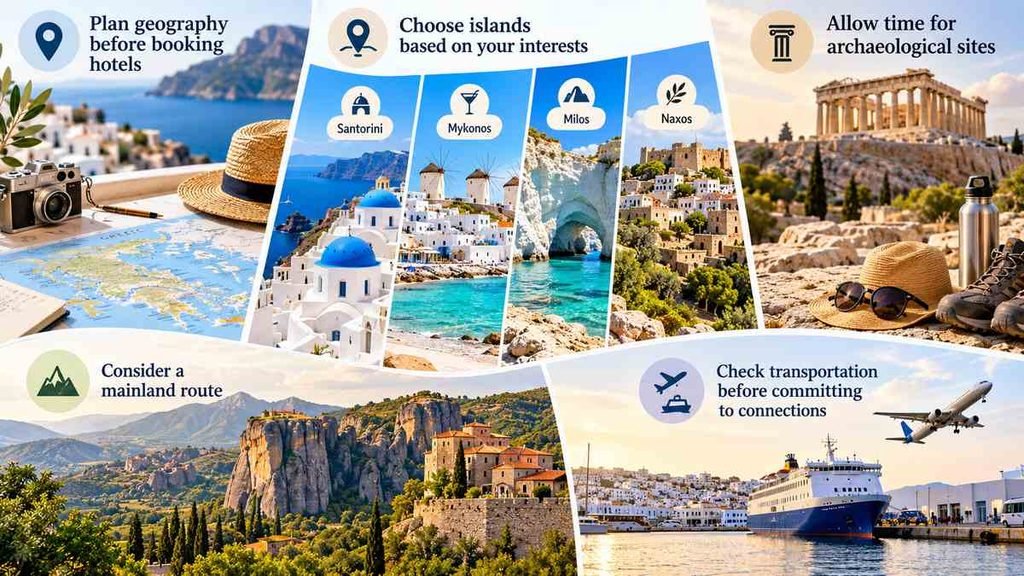
Plan geography before booking hotels
Greece looks compact on a map, but traveling between mainland locations and islands can take much longer than expected. Weather or seasonal schedules may also affect ferry departures.
Do not treat every island as interchangeable.
Santorini is volcanic and caldera-focused, Mykonos is strongly associated with nightlife and cosmopolitan tourism, Milos is notable for unusual geology, while Naxos combines beaches with agriculture and mountain villages. Choosing based on interests produces a more useful itinerary than simply selecting the most famous names.
Allow time for archaeological sites.
Athens, Delphi and Meteora can involve substantial walking, stairs and outdoor exposure. Comfortable shoes, water and sun protection are particularly useful during warmer months.
Consider a mainland route.
Travelers often concentrate entirely on the islands, but destinations such as Nafplio, Delphi, Meteora and Thessaloniki reveal a different side of Greece. Ancient sites, mountains, monasteries and regional food can make a mainland itinerary as varied as island hopping.
Check transportation before committing to connections
Athens is Greece’s primary international gateway, while islands such as Santorini, Naxos, Paros and Corfu have their own airports and ferry connections. Official destination information lists air connections from Athens to several major islands, but schedules can vary seasonally.
Which Greek Destination Is Right for Different Travelers?
Instead of treating the 12 destinations as interchangeable, travelers can narrow the list according to the experience they want:
- For ancient history: Athens, Delphi, Meteora and Nafplio
- For beaches: Crete, Naxos, Milos, Paros and Corfu
- For nightlife: Mykonos and, to a lesser extent, Paros
- For food: Crete, Thessaloniki, Naxos and Athens
- For couples: Santorini, Nafplio, Paros and Corfu
- For families: Crete and Naxos offer particularly broad combinations of beaches, activities and sightseeing
- For hiking and nature: Meteora, Crete, Naxos and Corfu
- For photography: Santorini, Meteora, Milos and Mykonos
- For a first Greece trip: Athens combined with Santorini, Naxos or another island can provide a useful introduction
- For a history-heavy trip: Athens, Delphi, Meteora and Nafplio create a strong mainland route
These categories are not exclusive. For example, Crete offers history and beaches, while Naxos combines beaches, food, villages, and hiking.
Final Takeaway
The best places to visit in Greece depend on what the traveler wants from the trip: Athens and Delphi emphasize ancient history, Meteora adds dramatic mountain scenery and monastic heritage, Crete offers an exceptionally broad mix of beaches and culture, and the Cycladic islands provide distinct combinations of scenery, nightlife, beaches and village life. A well-planned itinerary does not need to include every famous destination; choosing two or three places that complement each other can produce a more rewarding trip than rushing through a long list.
Before booking, travelers should check seasonal flight and ferry schedules, accommodation availability, local transportation, and opening information for major archaeological attractions. Greece rewards slower itineraries, particularly when travelers allow enough time to experience the differences between its mainland regions and islands.
Frequently Asked Questions
Athens is the most practical starting point for many first-time visitors because it combines major ancient sites, museums, food, and modern city life with Greece’s main international airport gateway.
They offer different experiences rather than serving the same purpose. Santorini is best known for its caldera, volcanic landscape, and cliffside settlements, while Mykonos combines beaches, nightlife, Cycladic architecture, and access to Delos.
Yes, but Crete is large enough that a short trip should focus on one region. Travelers staying only a few days can focus on Chania, Heraklion, or another specific area instead of trying to cover the whole island.
For a one-week trip, one or two islands are usually more practical than trying to visit several. Within two weeks, travelers can add multiple islands, provided they plan ferry and flight connections carefully.
Meteora is particularly worthwhile for travelers interested in dramatic landscapes, Orthodox heritage, hiking, and photography. Its monasteries and rock formations create an experience that differs substantially from Greece’s coastal destinations.
Naxos is a strong combination because it has long sandy beaches, traditional mountain villages, agricultural landscapes, and a historic main town.
Delphi can be incorporated into a day trip from Athens, although travelers who want more time at the archaeological site and surrounding mountain area may prefer an overnight stay.
No. Spring and autumn can be particularly useful for sightseeing, archaeological sites, hiking,g and city travel. Summer remains important for beach holidays and the full seasonal atmosphere of many islands, but it also coincides with the busiest travel period.