
Visiting Chichen Itza for the First Time: What You Should Know
Chichén Itzá is one of Mexico’s most significant Maya archaeological sites and a must-see destination for travelers exploring the Yucatán Peninsula. The ancient city combines monumental pyramids, temples, a vast ball court, sacred cenotes, and structures that reveal the Maya’s sophisticated understanding of architecture and astronomy.
UNESCO describes Chichén Itzá as one of the greatest Maya centers on the Yucatán Peninsula, where Maya traditions blended with influences from central Mexico over its long history. The archaeological site was added to the UNESCO World Heritage List in 1988.
For first-time visitors, however, appreciating Chichén Itzá requires more than simply arriving and photographing El Castillo. Knowing when to arrive, what structures to see, what to bring, and how much time to allow can make the experience far more rewarding.
Chichén Itzá at a Glance
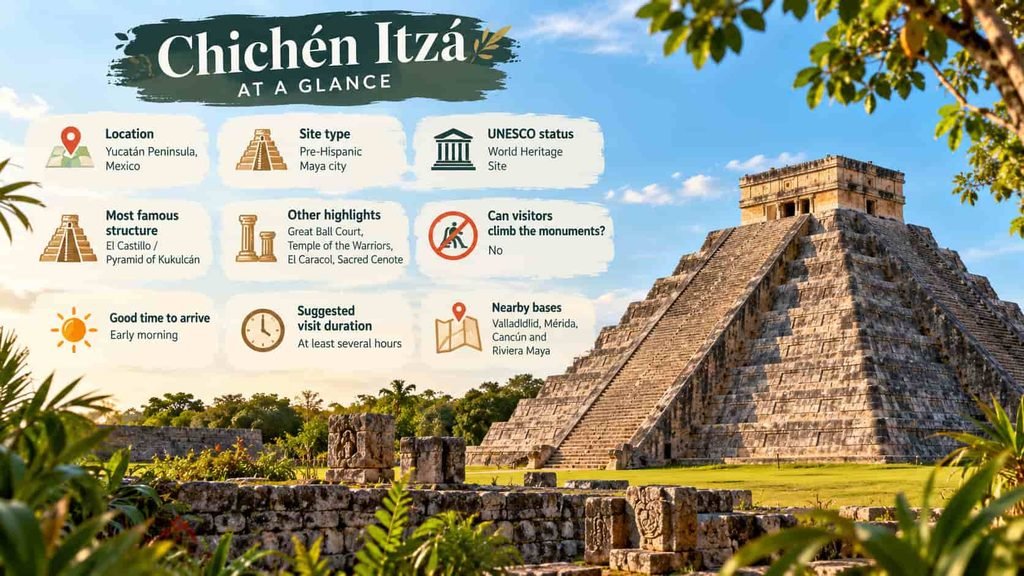
| Detail | Information |
| Location | Yucatán Peninsula, Mexico |
| Site type | Pre-Hispanic Maya city |
| UNESCO status | World Heritage Site |
| Most famous structure | El Castillo/Pyramid of Kukulcán |
| Other highlights | Great Ball Court, Temple of the Warriors, El Caracol, Sacred Cenote |
| Can visitors climb the monuments? | No |
| Good time to arrive | Early morning |
| Suggested visit duration | At least several hours |
| Nearby bases | Valladolid, Mérida, Cancún and Riviera Maya |
Audley recommends arriving early to avoid the large groups of day-trippers that travel to the ruins from Cancún and other resort areas.
Why Is Chichén Itzá So Famous?
Chichén Itzá was a major political, religious, and economic center of the ancient Maya world.
UNESCO notes that different peoples contributed to the city during its nearly 1,000-year history. Its surviving monuments display a combination of Maya construction traditions and influences from central Mexico, making the city particularly important for understanding Maya-Toltec civilization in Yucatán.
Its most recognizable monument is El Castillo, also called the Temple or Pyramid of Kukulcán.
However, Chichén Itzá is much more than one pyramid. Visitors can see temples, columns, ceremonial platforms, a large ball court, an astronomical observatory, and a sacred cenote.
That variety is why first-time visitors should allow enough time to explore beyond El Castillo.
What Should You See at Chichén Itzá?
A first visit should focus on several major structures rather than rushing from one photo opportunity to another.
1. El Castillo – The Pyramid of Kukulcán
El Castillo dominates the central archaeological area and has become the defining image of Chichén Itzá.
The stepped pyramid is associated with Kukulcán, the feathered-serpent deity. Audley notes that the pyramid rises to roughly 100 feet and contains a total of 365 steps when its four stairways and upper platform are counted together.
The structure is also famous for the visual phenomenon associated with the equinoxes.
As sunlight and shadow fall across the pyramid’s staircase, a pattern resembling a serpent appears to descend toward a carved serpent head near the base. The event attracts particularly large numbers of visitors.
Visitors should know that climbing El Castillo is not permitted.
2. The Great Ball Court
The Great Ball Court is another essential stop.
Audley describes the Chichén Itzá ball court as more than 160 m (525 ft) long and 70 m (229 ft) wide, making its scale one of the most striking features of the archaeological complex.
The court was used for a Mesoamerican ball game with important ceremonial and political meanings.
Rather than treating it simply as an ancient sports field, take time to inspect its stone walls, hoops, carvings, and surrounding structures. They provide clues to the ritual importance of the games within Maya society.
3. Temple of the Warriors
The Temple of the Warriors is recognizable for its stepped structure and rows of carved columns.
UNESCO identifies the Warriors’ Temple as one of the important surviving monuments that demonstrates the cultural and architectural significance of Chichén Itzá.
The extensive columns around the temple make this section visually different from El Castillo and help demonstrate the architectural diversity found throughout the city.
4. El Caracol
Chichén Itzá also contains an unusual circular structure known as El Caracol.
UNESCO identifies it as the site’s circular observatory.
Its form stands apart from many of the rectangular temples and platforms elsewhere at Chichén Itzá. It is commonly associated with the Maya’s sophisticated astronomical observations, making it an important stop for visitors interested in how architecture, calendars, and observations of the sky were interconnected.
5. Sacred Cenote
Natural sinkholes, or cenotes, played an important role in the development of communities across the Yucatán Peninsula.
UNESCO explains that Chichén Itzá was established close to two natural cavities that provided access to underground water. The site’s name is connected with these wells.
The Cenote Sagrado, or Sacred Cenote, had ceremonial significance. Archaeological discoveries from the cenote include valuable objects deposited there in ancient times.
Unlike recreational cenotes elsewhere in Yucatán, the Sacred Cenote is a historical and archaeological feature rather than a place to go swimming.
Can You Climb the Pyramid at Chichén Itzá?
No, visitors cannot climb El Castillo or the other protected archaeological structures at Chichén Itzá.
The restriction helps protect the monuments from damage caused by heavy visitor traffic. Audley’s current visitor guide also confirms that travelers can no longer climb the site’s temples and structures.
Visitors can instead walk around designated areas and view the structures from ground level.
Even without climbing El Castillo, its scale, symmetry, stonework, and surrounding ceremonial area make it impressive from below.
When Is the Best Time to Visit Chichén Itzá?
November through April is generally a popular period for visiting Chichén Itzá because conditions are typically drier than during the wetter part of the year. Audley specifically recommends this period in its first-time visitor guide.
However, the best time also depends on what you want from the experience.
Visit Early in the Morning
Regardless of the month, arriving early is one of the most useful strategies.
Audley recommends getting to the archaeological site as early as possible, before large groups of day-trippers arrive.
Early visits can also make walking more comfortable before temperatures rise around midday.
Think Carefully About the Equinoxes
The spring and autumn equinox periods attract visitors interested in seeing the famous shadow-and-light effect on El Castillo.
However, these dates can also produce exceptionally large crowds.
If your priority is seeing Chichén Itzá with fewer people, an equinox visit may therefore not be your best choice.
How Much Time Do You Need at Chichén Itzá?
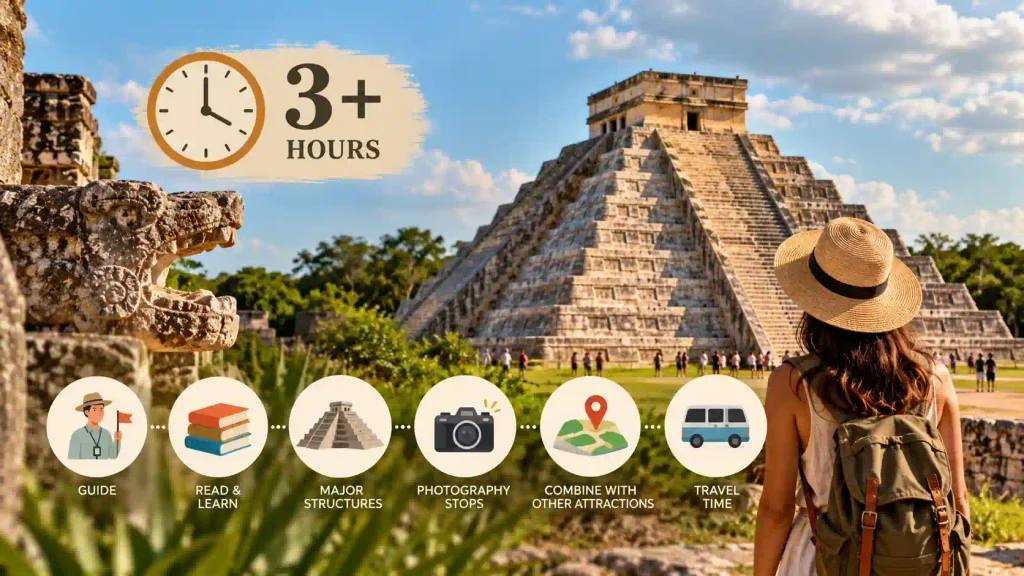
Plan at least several hours to explore Chichén Itzá properly.
Visitors interested in archaeology and Maya history can easily spend much longer walking between the major monuments and listening to explanations from a guide.
Audley’s specialists recommend dedicating a full day to the experience rather than rushing through it.
Your required time will depend on whether you:
- Hire a guide
- Read interpretive information in detail
- Visit all major structures
- Stop frequently for photography
- Combine the ruins with another Yucatán attraction
- Travel from a distant resort area
A two- or three-hour visit can cover major highlights, but a slower schedule provides more time to understand what you are actually seeing.
Should You Hire a Guide at Chichén Itzá?
A guide is not essential for physically seeing the archaeological site, but having one can add valuable historical context.
Without explanations, it is easy to walk around Chichén Itzá, seeing impressive stone buildings without understanding their original functions or significance.
A knowledgeable guide can explain topics such as:
- Maya history
- Kukulcán
- Religious ceremonies
- Architectural symbolism
- The ball game
- Astronomy
- Cenotes
- Carvings and iconography
- Different periods of construction
Audley also recommends exploring with a guide to better understand the history behind the individual parts of the archaeological site.
How Do You Get to Chichén Itzá?
Chichén Itzá is inland on the Yucatán Peninsula, so most international travelers reach it after arriving elsewhere in Mexico.
Common starting points include:
- Cancún
- Mérida
- Valladolid
- Playa del Carmen and the Riviera Maya
- Tulum
Audley places Chichén Itzá about 75 miles (120 km) east of Mérida and notes that reaching it from Mérida or Cancún by road can take roughly two to three hours, depending on the route and conditions.
Travelers can generally visit through an organized excursion, private transfer, rental vehicle, or available intercity transportation.
From Cancún
Chichén Itzá is a popular day trip from Cancún.
Because of the distance, however, expect a substantial amount of the day to involve road travel. Organized excursions can simplify transportation but may also arrive alongside other tour groups.
From Mérida
Mérida is another convenient base for travelers combining Chichén Itzá with a broader exploration of Yucatán’s Maya heritage.
The city is approximately 120 km west of Chichén Itzá, according to Audley.
From Valladolid
Valladolid is considerably closer to Chichén Itzá than the major coastal resort areas, making it useful for travelers who want to reach the ruins early.
Staying nearby can help you avoid spending several hours traveling before you even begin sightseeing.
Should You Stay Near Chichén Itzá?
Staying close to the archaeological site can be worthwhile if Chichén Itzá is a major priority on your itinerary.
The biggest advantage is an early start.
Travelers arriving from Cancún and other resort areas have a lengthy journey, while someone staying nearby can reach the ruins before many day-tour groups.
Audley specifically recommends staying close to Chichén Itzá to visit while conditions are cooler and before day-trippers arrive.
Alternatively, Valladolid can work well as part of a broader Yucatán itinerary.
What Should You Wear to Chichén Itzá?
Dress for heat, sun, and extensive walking rather than for photographs alone.
Useful items include:
- Lightweight, breathable clothing
- Comfortable walking shoes
- Hat or other sun protection
- Sunscreen
- Sunglasses
- Refillable water bottle
- Small day bag
- Rain protection during wetter periods
Audley’s guide particularly emphasizes light clothing, sun protection, comfortable footwear, and staying hydrated because midday temperatures in the Yucatán can become very hot.
There is limited shade across some exposed sections of the archaeological site, making sun protection especially important.
Can You Visit Chichén Itzá With Children?
Yes, families can visit Chichén Itzá, but the heat and amount of walking deserve consideration.
For children, an early visit can be particularly helpful because temperatures are generally more comfortable than around midday.
Parents should carry sufficient water, use sun protection, and allow breaks rather than trying to cover every structure rapidly.
Older children interested in history may find stories surrounding Maya astronomy, temples, ball games, and cenotes especially engaging.
What Else Can You See Near Chichén Itzá?
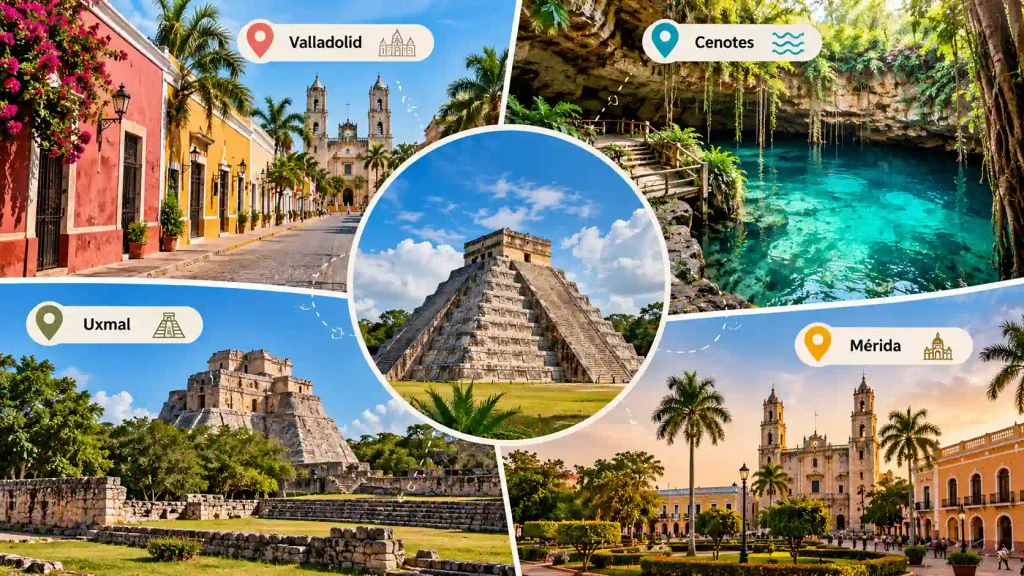
Chichén Itzá can easily become part of a larger exploration of the Yucatán Peninsula.
Valladolid
Valladolid provides colorful colonial architecture, local food, and access to nearby cenotes. Its location also makes it convenient for travelers planning an early Chichén Itzá visit.
Cenotes
The limestone geology of the Yucatán has created thousands of natural sinkholes.
Unlike the Sacred Cenote inside Chichén Itzá, some cenotes elsewhere in the region permit swimming. A cenote stop can therefore be a refreshing addition after several hours walking around the ruins.
Uxmal
Travelers interested in Maya archaeology can also consider Uxmal, another major ancient city in Yucatán. Audley recommends it as a nearby archaeological destination for visitors who want to see more than Chichén Itzá.
Mérida
Mérida combines historic architecture, museums, markets, restaurants, and cultural attractions, making it a useful base for a longer Yucatán itinerary.
Practical Tips for First-Time Visitors
A few simple decisions can make your first visit much easier.
Arrive early. You’ll have a better chance of experiencing the ruins before the busiest day-tour period.
Bring water. The heat and amount of walking make hydration important.
Wear proper footwear. You’ll spend much of the visit walking outdoors.
Use sun protection. Shade can be limited in exposed areas.
Don’t plan on climbing El Castillo. Climbing the archaeological structures is prohibited.
Consider a guide. Historical context can transform what might otherwise look like a collection of stone structures into a much richer experience.
Allow enough time. El Castillo may be the star attraction, but the Great Ball Court, Temple of the Warriors, El Caracol, and Sacred Cenote deserve attention too.
Avoid an overly packed itinerary. Combining Chichén Itzá with several distant attractions on the same day can turn the visit into a race against the clock.
Is Chichén Itzá Worth Visiting?
Yes, particularly for travelers interested in Maya history, archaeology, architecture, and the cultural heritage of Mexico.
Its significance extends far beyond the famous image of El Castillo. The city preserves evidence of a complex civilization, including ceremonial spaces, monumental architecture, astronomical knowledge, water management, and cultural interactions that developed over centuries.
UNESCO considers Chichén Itzá one of the most important examples of Maya-Toltec civilization in Yucatán.
Giving yourself time to understand those elements makes the experience considerably more meaningful than simply stopping for a photograph of the pyramid.
Final Thoughts
A first trip to Chichén Itzá is most rewarding when you look beyond El Castillo and give yourself time to understand the ancient city surrounding it. The Great Ball Court, Temple of the Warriors, El Caracol, Sacred Cenote, carvings, and ceremonial spaces collectively reveal why the site occupies such an important place in Maya history.
Arrive early, prepare for the Yucatán heat, wear comfortable shoes, and consider exploring with a knowledgeable guide. Most importantly, avoid rushing through the archaeological zone simply to check it off your itinerary. Chichén Itzá’s value lies not only in its monumental architecture but also in the history and culture those structures preserve.
Frequently Asked Questions
Chichén Itzá is located in Mexico’s Yucatán Peninsula, roughly 120 km east of Mérida.
El Castillo, also known as the Pyramid of Kukulcán, is the site’s best-known monument.
Yes. UNESCO recognizes the Pre-Hispanic City of Chichén Itzá as a World Heritage Site and describes it as one of the greatest Maya centers of the Yucatán Peninsula.
No. Visitors are no longer permitted to climb El Castillo or the other protected structures at Chichén Itzá.
Major attractions include El Castillo, the Great Ball Court, Temple of the Warriors, El Caracol, and Sacred Cenote.
El Caracol is a circular structure traditionally identified as an astronomical observatory. UNESCO lists the circular observatory among Chichén Itzá’s significant surviving buildings.
Yes. Arriving early can help you avoid some of the larger day-trip crowds and the stronger midday heat. Audley specifically recommends visiting as early as possible.
Yes. Chichén Itzá is commonly visited as a day trip from Cancún, although travelers should expect several hours of total road travel.
The Sacred Cenote at Chichén Itzá is an archaeological and ceremonial feature, not a recreational swimming location. Travelers interested in swimming can visit designated cenotes elsewhere in Yucatán.
Comfortable shoes, breathable clothing, water, sunscreen, sunglasses, and a hat are useful. Audley particularly recommends preparing for the strong midday heat.
A guide is not mandatory for seeing the site, but one can provide valuable explanations about the history, architecture, religion, astronomy, and symbolism behind the monuments.
Uxmal and Cobá are among the other archaeological sites travelers can consider as part of a broader trip through the region.