
Hawaiian Airlines Baggage Fees and Ways to Reduce Your Travel Costs
Hawaiian Airlines checked baggage fees currently range from $30 to $200 per bag on domestic routes, depending on whether you are flying within Hawaii or between Hawaii and the mainland, while many international itineraries include one or more checked bags at no additional charge. The applicable price depends on your ticket purchase date, cabin, loyalty status, eligible credit card, and whether your bag is overweight or oversized.
Hawaiian Airlines updated its North America checked-bag pricing for tickets booked on or after April 10, 2026, increasing the first bag to $45, the second to $55, and the third or additional bags to $200 each. Neighbor Island flights wholly within Hawaii continue to use a separate, lower fee schedule.
Understanding those rules before packing can make a noticeable difference to your total trip cost. A bag that is simply a few pounds too heavy can attract a surcharge on top of the normal checked-bag fee, while some travelers can avoid the charge entirely through First Class, Atmos Rewards status, an eligible Hawaiian Airlines credit card, military benefits, or Huakaʻi membership.
Hawaiian Airlines Baggage Fees at a Glance
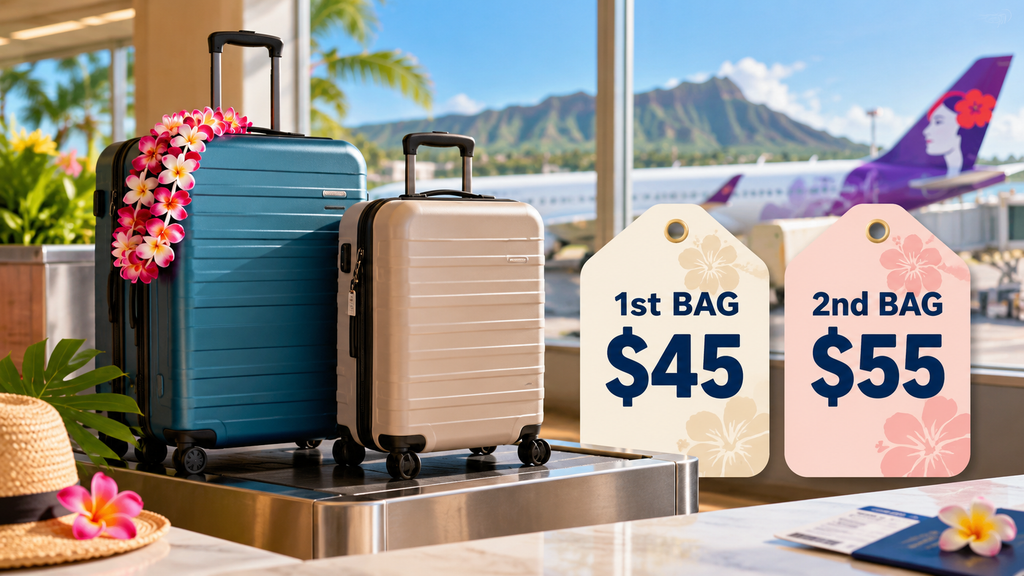
For tickets booked on or after April 10, 2026, Hawaiian Airlines uses different checked-bag prices for North American and wholly intra-Hawaii travel. The fees below are generally charged per bag, each way.
| Route / Traveler Type | 1st Checked Bag | 2nd Checked Bag | 3rd+ Checked Bag |
| North America | $45 | $55 | $200 each |
| Neighbor Island — wholly within Hawaii | $30 | $40 | $50 each |
| First Class on eligible routes | Free | Free | $200 each where applicable |
| Huakaʻi member — Neighbor Island | Free | Free | Subject to applicable excess-bag fees |
Important: The 45/55/$200 North America schedule applies to tickets booked on or after April 10, 2026. Hawaiian and Alaska announced that the increase did not apply to wholly intra-Hawaii flights, which remain at $30 for the first bag and $40 for the second.
Travelers with older tickets should check the date of purchase because tickets issued before the April 10 change may be governed by the earlier baggage schedule.
What Is Hawaiian Airlines Carry-On Baggage Allowance?
Hawaiian Airlines allows passengers to bring one carry-on bag and one personal item without a checked-bag charge. The published carry-on maximum is 22 × 14 × 9 inches (56 × 36 × 23 cm), including the bag’s external dimensions. The personal item must fit safely under the seat in front of you.
This allowance also applies to Saver fares. Hawaiian’s current Saver guidance states that Saver passengers receive the same carry-on and checked-baggage allowance as Main Cabin passengers, subject to the applicable baggage rules and fees.
That makes careful packing one of the simplest ways to reduce baggage costs. Instead of checking a small suitcase containing items you could fit into your cabin baggage, use the free carry-on and personal-item allowance first.
What counts as a personal item?
Common examples include a purse, laptop bag, briefcase, or small backpack. The important requirement is that the item fits under the seat in front of you.
Hawaiian Airlines Checked Baggage Size and Weight Limits
For a standard checked bag, the general limit is 50 pounds (23 kg) and 62 linear inches (157 cm). Linear inches are calculated by adding the bag’s length, width, and height.
For example, a suitcase measuring:
28 × 20 × 14 inches = 62 linear inches
would meet the standard dimensional limit.
A bag measuring 30 × 20 × 14 inches, however, would total 64 linear inches and therefore exceed the standard 62-inch limit.
It is worth measuring your luggage after it is fully packed and with wheels and handles included where applicable. A suitcase marketed as meeting an airline’s size limit can still exceed the allowance once its external components are counted.
Hawaiian Airlines Overweight and Oversized Baggage Fees
Overweight and oversized charges are additional to the normal checked-bag fee. That means paying $45 to check a North America bag does not cover the cost of a bag that weighs more than 50 pounds.
North America overweight and oversized charges
For current North America travel, Hawaiian’s fee schedule lists:
| Bag Issue | Additional Charge |
| 51–70 lb | $100 |
| 71–100 lb | $200 |
| Oversized | $200 |
The airline’s April 2026 fee update also confirms that when a North America bag is both oversized and overweight, the surcharges can combine: an oversized bag weighing up to 70 pounds produces a $300 surcharge, while an oversized bag weighing 71–100 pounds can incur a $400 surcharge.
So a standard first checked bag that is both oversized and weighs 60 pounds could cost substantially more than the base $45 fee.
Neighbor Island overweight and oversized charges
Wholly intra-Hawaii flights have lower excess-bag charges:
| Bag Issue | Additional Charge |
| 51–70 lb | $35 |
| 71–100 lb | $70 |
| Oversized | $35 |
These charges are added to the applicable Neighbor Island checked-bag fee.
Bags above the airline’s accepted maximums may not be carried as ordinary checked baggage, so it is better to resolve an oversized or overweight problem before reaching the airport.
Hawaiian Airlines International Baggage Fees
International baggage rules are different from domestic pricing, and the fee can depend on the country where the journey begins as well as the cabin. Hawaiian’s published international schedule generally provides more free checked baggage than its North American domestic fares.
Some current examples include:
| International Region | Typical Main Cabin Allowance |
| Europe | 1st bag free; 2nd $100; 3rd+ $200 |
| Asia | 1st and 2nd free; 3rd+ $200 |
| Australia/New Zealand | 1st free; 2nd $100; 3rd+ $200 |
| Africa & Middle East | 1st and 2nd free; 3rd+ $250 |
| South America | 1st free; 2nd $100; 3rd+ $200 |
Higher cabins can receive additional free baggage, and certain routes have destination-specific rules. Hawaiian’s international contract also states that international baggage rules can apply to the entire itinerary, including U.S. domestic segments, when the ticket includes an applicable international point.
Because international rules are more complicated than the domestic fee schedule, travelers should check the baggage allowance attached to their exact reservation rather than relying on a generic international table.
Who Can Get Free Checked Bags on Hawaiian Airlines?
Several Hawaiian and Alaska-related benefits can remove or reduce checked baggage charges.
First Class passengers
First Class passengers on applicable itineraries receive free checked baggage, with the current North America schedule providing the first and second bags free at the higher 70-pound allowance.
Atmos Rewards status members
HawaiianMiles has been incorporated into the combined Atmos Rewards program. The current baggage schedule provides free checked-bag benefits based on elite status, including:
| Atmos Rewards Status | Free Checked Bags |
| Silver / oneworld Ruby | 1 |
| Gold / oneworld Sapphire | 2 |
| Platinum / Titanium / oneworld Emerald | 3 |
The standard free-bag allowance for these benefits is generally up to 50 pounds per bag, subject to the published terms.
This is especially useful for travelers who already hold status. Check that your Atmos Rewards number is attached to the reservation before checking your bags.
Hawaiian Airlines World Elite Mastercard
The Hawaiian Airlines World Elite Mastercard continues to provide eligible primary cardmembers with two complimentary checked bags on qualifying Hawaiian Airlines-operated flights. International flights are excluded from this particular benefit.
The benefit can make a significant difference on a round trip, but travelers should still check the card’s current terms and the specific flight eligibility before relying on it.
Atmos Rewards Visa cards
Eligible Atmos Rewards Visa cardholders can receive a complimentary first checked bag on qualifying Hawaiian Airlines flights when the ticket is purchased with the eligible card, with the published benefit extending to the cardholder and up to six travel companions on the same reservation.
Active-duty U.S. military members
Hawaiian Airlines provides special baggage exemptions for active-duty U.S. military personnel and eligible accompanying dependents.
For qualifying leisure travel, each eligible traveler can check up to two standard bags free, generally up to 50 pounds each. With qualifying official travel orders, the allowance increases to five bags, with the airline’s published military limits applying to weight and dimensions.
Huakaʻi by Hawaiian members
A particularly recent change affects residents traveling between the Hawaiian Islands. On September 2, 2026, Hawaiian announced that Huakaʻi by Hawaiian members would receive two free checked bags on Neighbor Island flights. The program is designed for Hawaiʻi residents and also includes other travel benefits.
This is worth checking for eligible residents because Neighbor Island baggage costs can otherwise be $30 for the first bag and $40 for the second.
How Can You Save Money on Hawaiian Airlines Baggage Fees?
The easiest way to lower baggage costs is to avoid creating a chargeable bag in the first place, but several other strategies can help when checked luggage is necessary.
1. Use the free carry-on allowance strategically
A free 22 × 14 × 9-inch carry-on plus a personal item can hold a surprising amount when packed efficiently. Put clothing, electronics, toiletries within applicable security limits, and other lightweight essentials in the cabin rather than checking them.
Keep important items such as medication, identification, valuables, and travel documents in your cabin baggage rather than placing them in checked luggage.
2. Weigh your suitcase before leaving home
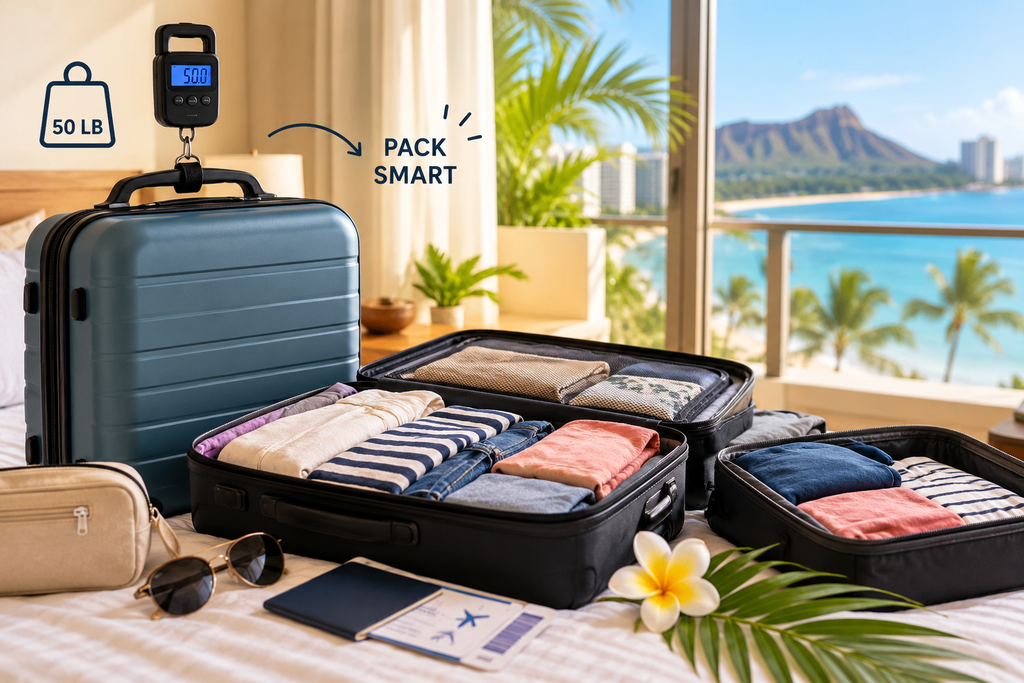
A portable luggage scale can prevent an expensive surprise at check-in.
This matters because an overweight charge is added to the ordinary checked-bag fee. For a North America itinerary, a 60-pound first checked bag could cost the standard $45 fee plus a $100 overweight surcharge.
Taking a few minutes to redistribute heavy items at home can therefore save much more than the cost of a luggage scale.
3. Split a very heavy suitcase into two standard bags
This is one of the most useful calculations for North America travel.
Suppose your luggage weighs about 100 pounds in total. Checking one 100-pound bag could trigger the $200 overweight surcharge in addition to the base bag fee. Splitting the same belongings between two bags of roughly 50 pounds each would instead put you into the first- and second-bag charges.
At current North America rates:
One standard + overweight bag: $45 + $200 = $245, before any other applicable charge.
Two standard bags: $45 + $55 = $100.
The difference is substantial, assuming you are permitted to check both pieces and neither is oversized.
4. Measure the bag, not just the suitcase shell
Oversize fees are based on the bag’s outside linear dimensions. A suitcase that looks compact can cross the 62-inch threshold once wheels, handles, or other external components are included.
Measure the packed bag at home and calculate:
Length + Width + Height = Linear Inches
Do this before deciding that a larger suitcase is worth taking.
5. Check your benefits before paying
Before you purchase baggage, look at your reservation for any applicable:
- Atmos Rewards elite status
- Hawaiian Airlines World Elite Mastercard benefit
- Eligible Atmos Rewards Visa benefit
- First Class allowance
- Military exemption
- Huakaʻi by Hawaiian membership
Several of these benefits can eliminate the first one or more checked-bag charges altogether.
6. Do not assume that paying online means a discount
Hawaiian and Alaska specifically removed the previous $5 online/mobile prepay discount for the North America fee schedule introduced on April 10, 2026. The new structure keeps the ability to manage baggage digitally but no longer includes that previous discount.
The unified Alaska Hawaiian app and website can be used to manage trips and add baggage-related services before the airport.
7. Compare the cost of an upgrade with the cost of bags
Some travelers consider upgrading to First Class simply to obtain free checked bags. That calculation should be done carefully.
For example, if two people would otherwise pay $55 each way for a second checked bag, the avoided baggage charge alone may not justify a significantly more expensive cabin upgrade. Compare the actual upgrade price with the baggage charges you would otherwise pay, along with the other First Class benefits you would receive.
Baggage savings should be treated as one part of the calculation rather than the sole reason to upgrade.
What Happens on a Hawaiian Airlines Itinerary With Another Airline?
Do not assume that Hawaiian Airlines’ baggage fee automatically governs every segment of a multi-airline trip.
The applicable baggage rules can depend on the ticket, itinerary, operating carriers, and whether the baggage must be transferred or rechecked. Hawaiian’s international contract specifically notes that baggage connecting to another airline may also be subject to that carrier’s applicable excess charges.
A separate issue can arise with a stopover. Hawaiian’s domestic contract states that if a stopover requires passengers to reclaim and recheck their bags, the applicable baggage fee can be charged again for the subsequent flight.
For complex itineraries, check the baggage allowance shown on the booking rather than calculating fees solely from the airline’s general table.
Common Mistakes That Lead to Higher Hawaiian Airlines Baggage Costs
The most avoidable baggage charges usually come from a few simple mistakes:
- Confusing domestic and Neighbor Island pricing: A flight entirely within Hawaii uses the 30/40/$50 schedule, not the 45/55/$200 North America schedule.
- Packing one extremely heavy suitcase: The overweight surcharge can be much higher than the cost of checking a second standard bag.
- Ignoring bag dimensions: Staying below 50 pounds does not protect you from an oversize fee if the bag exceeds the applicable dimensional limit.
- Forgetting a baggage benefit: Status, eligible credit cards, First Class, military exemptions, and Huakaʻi membership can change the amount you actually owe.
- Using outdated fee information: Hawaiian’s North America pricing changed on April 10, 2026, so older articles may show lower charges and an online prepay discount that no longer applies to newer tickets.
Final Takeaway
Hawaiian Airlines baggage costs are easiest to control when you know which fee schedule applies before you pack. For current North America tickets, budget $45 for the first checked bag, $55 for the second, and $200 for the third or additional bag; Neighbor Island flights within Hawaii use the lower 30/40/$50 schedule.
Before heading to the airport, check the baggage allowance on your reservation, confirm any Atmos Rewards or credit-card benefits, and weigh and measure every checked bag. In many cases, simply redistributing luggage between two standard bags or using the free carry-on allowance can prevent a much larger overweight or oversize charge.
Frequently Asked Questions (FAQs)
Not generally for Main Cabin or Saver fares on North America routes. For tickets purchased on or after April 10, 2026, the first checked bag costs $45 on those routes unless a benefit or exemption applies. Neighbor Island flights within Hawaii charge $30 for the first bag.
No. Hawaiian Airlines allows one carry-on bag and one personal item without a checked-bag charge, subject to the airline’s baggage requirements. The published carry-on size limit is 22 × 14 × 9 inches.
For tickets purchased on or after April 10, 2026, the second checked bag costs $55 on North America routes and $40 on Neighbor Island flights wholly within Hawaii.
An overweight charge is added to the normal checked-bag fee. On North America routes, the additional charge is $100 for a bag weighing 51–70 pounds and $200 for a bag weighing 71–100 pounds.
A standard checked bag is limited to 62 linear inches, calculated by adding length, width, and height. Standard weight is generally 50 pounds.
Yes. Depending on eligibility, baggage fees can be waived through First Class, Atmos Rewards status, qualifying Hawaiian or Atmos credit-card benefits, military exemptions, and Huakaʻi by Hawaiian benefits for eligible Neighbor Island travel.
The previous $5 online/mobile prepay discount was removed for the North America fee schedule introduced on April 10, 2026. Travelers can still manage baggage through the airline’s digital systems, but the former discount should not be assumed.
No. International baggage allowances and charges vary by destination, point of origin, cabin, and number of bags. Some international fares include one or two checked bags at no additional charge.